On This Page
Description of the Pest
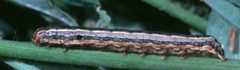
Western yellowstriped armywormlarvae are dark-colored, usually nearly black (but occasionally gray) with a broad yellow stripe on each side. They have a black spot on the side of the first abdominal segment.
Damage
If infestations occur early in the season, young cotton plants may be defoliated, but this is rare. Later-season infestations occur primarily on field edges and can cause defoliation and damage to fruit.
Management
This pest occurs infrequently in the San Joaquin Valley. It is afoliage feeder that may become abundant during the late season as a result of migration from nearby alfalfa. You can stop migrating larvae by plowing a trench with the steep side toward cotton and applying an insecticidal spray to kill trapped larvae. Treat only the infested area; it is rarely necessary to treat a whole cotton field.
Organically Acceptable Methods
Sprays ofBacillus thuringiensis (Bt) are acceptable for use on organically grown cotton.
Monitoring and Treatment Decisions
The degree of foliage damage is the best indicator for determining treatment thresholds. Early in the season, plants can sustain up to 50% loss of leaf surface without affecting yield. During the fruiting period, only 20 to 25% of the leaf surface can be lost without yield loss. After this period, up to 50% loss of leaf surface can again be tolerated.
| Common name | Amount per acre** | REI‡ | PHI‡ | |
|---|---|---|---|---|
| (Example trade name) | (hours) | (days) | ||
| Not all registered pesticides are listed. The following are ranked with the pesticides having the greatest IPM value listed first—the most effective and least harmful tonatural enemies,honey bees, and theenvironment are at the top of the table. When choosing a pesticide, consider information relating to air and water quality,resistance management, and thepesticide's properties and application timing. Always read the label of the product being used. | ||||
| A. | BACILLUS THURINGIENSIS ssp. KURSTAKI# | |||
| (various products) | Label rates | 4 | 0 | |
| SELECTIVITY: High | ||||
| PERSISTENCE: Pest: Short NE:2 Short | ||||
| MODE-OF-ACTION GROUP NUMBER1: 11 | ||||
| COMMENTS: Does not disrupt natural enemies. | ||||
| B. | CHLORANTRANILIPROLE | |||
| (Coragen) | 3.5–7.0 fl oz | 4 | 21 | |
| SELECTIVITY: High | ||||
| PERSISTENCE: Pest: Unknown NE:2 Short | ||||
| MODE-OF-ACTION GROUP NUMBER1: 28 | ||||
| C. | METHOXYFENOZIDE | |||
| (Intrepid 2F) | Label rates | 4 | 14 | |
| SELECTIVITY: High | ||||
| PERSISTENCE: Pest: Moderate NE:2 Moderate | ||||
| MODE-OF-ACTION GROUP NUMBER1: 18 | ||||
| COMMENTS: An insect growth regulator. | ||||
| D. | INDOXACARB | |||
| (Steward) | Label rates | 12 | 14 | |
| SELECTIVITY: Moderate | ||||
| PERSISTENCE: Pest: Moderate NE:2 Moderate | ||||
| MODE-OF-ACTION GROUP NUMBER1: 22A | ||||
| E. | ACEPHATE | |||
| (Orthene 97) | 1 lb | 24 | 21 | |
| SELECTIVITY: Low | ||||
| PERSISTENCE: Pest: Moderate NE:2 Moderate | ||||
| MODE-OF-ACTION GROUP NUMBER1: 1B | ||||
| COMMENTS: May cause severe spider mite infestations. | ||||
| F. | METHOMYL* | |||
| (Lannate SP) | 0.5 lb | 72 | 15 | |
| SELECTIVITY: Low | ||||
| PERSISTENCE: Pest: Short NE:2 Short | ||||
| MODE-OF-ACTION GROUP NUMBER1: 1A | ||||
| COMMENTS: Kills eggs and larvae. Use may redden cotton. According to the label, do not make more than 8 applications per season. Do not graze or feed cotton trash to livestock. | ||||
| * | Permit required from county agricultural commissioner for purchase or use. |
| ** | Mix with sufficient water to provide complete coverage. |
| ‡ | Restricted entry interval (REI) is the number of hours (unless otherwise noted) from treatment until the treated area can be safely entered without protective clothing. Preharvest interval (PHI) is the number of days from treatment to harvest. In some cases, the REI exceeds the PHI. The longer of the two intervals is the minimum time that must elapse before harvest. |
| # | Acceptable for use on organically grown produce. |
| 1 | Group numbers for insecticides and miticides are assigned by theInsecticide Resistance Action Committee (IRAC). Rotate pesticides with a different mode-of-action group number, and do not use products with the same mode-of-action group number more than twice per season to help prevent the development of resistance. For example, the organophosphates have a group number of 1B; insecticides with a 1B group number should be alternated with insecticides that have a group number other than 1B. |
| 2 | NE = natural enemies |

UC IPM Pest Management Guidelines: Cotton
UC ANR Publication 3444
V.M. Barlow, UC Cooperative Extension Riverside County
L.D. Godfrey, Entomology, UC Davis
P.B. Goodell (emeritus), UC IPM and Kearney Agricultural Research and Extension Center, Parlier
D.R. Haviland, UC IPM and UC Cooperative Extension Kern County
E.T. Natwick (emeritus), UC Cooperative Extension Imperial County
Acknowledgement for Contributions to Insects, Mites, and Other Invertebrates
E.E. Grafton-Cardwell (emeritus), Lindcove Research and Extension Center, Exeter and Entomology, UC Riverside
N.C. Toscano, Entomology, UC Riverside
Text Updated: 05/13
Treatment Table Updated: 05/13