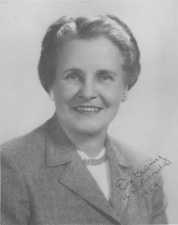
In 1954 Eva Kelly Bowring arrived in the Senate withthe vocabulary of a witty cattle wrangler and impressivecredentials as a state political figure and prosperousbusinesswoman. Appointed to fill the vacancy resultingfrom the death of Senator Dwight Griswold of Nebraska,Bowring had become one of Nebraska’s wealthiest womenthrough her ranching enterprises and was a leading GOPfigure in the state. Her transition from riding the range onher sprawling ranch to the U.S. Senate Chamber was abruptand somewhat unexpected. “I’m going to have to ride thefence a while until I find where the gates are,” Bowring tolda reporter shortly after arriving at the Capitol.1
Eva Kelly was born on January 9, 1892, in Nevada,Missouri. She attended school in Kansas City, Missouri.In 1911, at age 19, she married Theodore Forester, a grainand feed salesman, and the Foresters settled in Kansas City.When Theodore Forester died in 1924, Eva was left to raisethe couple’s three young sons: Frank, Harold, and Donald.2To support her family, Eva moved to Lincoln, Nebraska, andtook up Theodore’s work selling livestock feed; she drove asmany as 40,000 miles a year around rural Nebraska roadsin an unreliable old car. Once, near Merriman, Nebraska,the car broke down. A homesteader named Art Bowringhappened to be driving by and stopped to help. In 1928Eva and Bowring, who had served as county commissionerand went on to win election as a representative and senatorin the state legislature, married. The family settled on ArtBowring’s ranch, the Barr-99, near Merriman in the SandHill Country of Cherry County. The couple expanded theirlandholdings and eventually managed a prosperous 13,000-acre operation. After Arthur’s death in 1944, Eva Bowringoperated the Barr-99, becoming the first woman to chairthe Nebraska Stockgrowers Association Brand Committee.In her capacity as a rancher, Bowring became involved withNebraska Republican politics, eventually serving as thestate’s first woman county GOP chair. From 1946 to 1954,Bowring served as vice chair of the Nebraska Republicancentral committee and as its director of women’s activities.
Bowring’s transition to public office was sudden.Governor Robert B. Crosby appointed Bowring on April16, 1954, to fill the vacancy caused by the death of SenatorDwight Palmer Griswold. Bowring, who described herself asa “forward looking Republican,” refused the offer initially.She was reluctant to leave her 1,200 head of cattle andthe calving and branding work that she still enjoyed andactively participated in at age 62. “This is one cross I don’tthink I have to bear, Bob,” Bowring told the governor. ButCrosby was persuasive. After a private meeting with thegovernor, Bowring emerged from the office to tell reportersshe accepted the appointment. She explained that after yearsof exhorting GOP women into politics, she could not nowreverse course herself, noting that, “when a job is offeredto you, take it. Men can refuse but women are increasinglyimportant in political life.”3 Bowring was sworn in as thefirst Nebraska woman to serve in Congress on April 26,1954, for the term that would end, according to state law,at the next general election. In November 1954 a candidatewould be selected to finish out the final two months ofGriswold’s term, as well as a successor to the full six-yearterm starting in the 84th Congress (1955–1957). At thetime of her appointment, Bowring joined the Senate’s onlyother woman Member, Margaret Chase Smith of Maine.Smith wrote that Bowring’s appointment “did the women ofAmerica as well as the women of Nebraska a great honor.”4
For her part, Bowring expressed hope that her Senatecolleagues would “remember I’m just a girl from cowcountry.”5 Her guiding philosophy was succinct: “I’ve notbeen one who thought the Lord should make life easy; I’vejust asked Him to make me strong.”6 According to custom,the state’s senior Senator, Hugh Alfred Butler, accompaniedher to the front of the chamber for the swearing in. VicePresident Richard M. Nixon, presiding over the ceremony,relayed a message from Butler to viewers in the gallery:“The senior Senator from Nebraska has asked the chair toannounce that no implication should be drawn from thefact that the senior Senator from Nebraska is a widower andthe junior Senator from Nebraska is a widow.”7
Bowring was appointed to three committees: Interstateand Foreign Commerce; Labor and Public Welfare; andPost Office and the Civil Service. The needs of Nebraska’sagricultural constituents were familiar to Bowring and werethe focus of her only two major floor speeches. Bowringdeclared her backing for a program of flexible agriculturalprice supports proposed by the Dwight D. Eisenhoweradministration to reduce production fluctuations that oftenresulted in surplus food staples. She argued that the measurewould “cushion farmers against wide breaks in the marketon basic commodities,” economize land use, and produce amore stable market. “In the long run, rigid price supportstake from the farmer more than he receives,” Bowringconcluded. “They encourage him to deplete his soil. Theysaddle the markets with surpluses which give him noopportunity to realize full parity. They destroy the normalrelationship of feed and livestock prices … They place thefarmers in such a position that they lose much of theirfreedom to make management decisions.” A number ofher colleagues who attended the speech, including PrescottSheldon Bush of Connecticut and Albert Arnold Gore ofTennessee, praised her “incisiveness” and “intimate grasp”of the workings of the agriculture market.8 In addition tothe commodities pricing bill, Bowring and Senator Butlerintroduced a measure for the construction of the RedWillow Dam and Reservoir as part of the Missouri RiverBasin Project. Bowring also sponsored legislation providingfor flood control works in the Gering Valley of Nebraska.On August 18, 1954, Bowring had the distinction ofjoining a select handful of women who presided over theSenate when she was named acting president pro temporefor the day’s debates.9
In June 1954, Bowring announced that she would notseek election to the full six-year term or the short termto follow the November general election. After HughButler’s death on July 1, 1954, she became Nebraska’ssenior Senator. On November 8, she was succeeded byanother woman, Republican Hazel Hempel Abel, whomshe presented before the Senate. After leaving office,Bowring returned to her Barr-99 ranch and later servedon the national advisory council of the National Institutesof Health from 1954 to 1958 and from 1960 to 1961.President Dwight Eisenhower also appointed Bowring tothe Board of Parole at the Department of Justice, where sheserved from 1956 to 1964. Eva Bowring died on January 8,1985, in Gordon, Nebraska.
Footnotes
1Evelyn Simpson, “Senator in a Hustle: She’ll Probably Put Her Brand on Congress,” 25 April 1954,Washington Post: S1; Josephine Ripley, “Senator’s in New Saddle: Nebraskan Doubles Distaff Strength,” 3 May 1954,Christian Science Monitor: 12.
2Ripley, “Senator’s in New Saddle: Nebraskan Doubles Distaff Strength.”
3“Nebraska Woman Named to Griswold Senate Seat,” 17 April 1954,New York Times: 1; Simpson, “Senator in a Hustle: She’ll Probably Put Her Brand on Congress.”
4Hope Chamberlin,A Minority of Members: Women in the U.S. Congress (New York: Praeger, 1973): 240.
5“Woman Joins Senate Today,” 26 April 1954,New York Times: 27; “Nebraska’s Senator Is Sworn In,” 27 April 1954,New York Times: 27.
6“Nebraska Woman Named to Griswold Senate Seat.”
7“Random Notes from Washington,” 2 May 1954,New York Times: 16.
8Congressional Record, Senate, 83rd Cong., 2nd sess. (24 June 1954): 8836–8838; Aubrey Graves, “Ike to Press Farm Fight on Floors of Congress,” 25 June 1954,Washington Post: 1; see also,Congressional Record, Senate, 83rd Cong., 2nd sess. (6 August 1954): 13554–13555.
9Congressional Record, Senate, 83rd Cong., 2nd sess. (18 August 1954): 14921.