Introduction
In this example, we illustrate how to use Bayesian dynamic borrowing(BDB) with the inclusion of inverse probability weighting to balancebaseline covariate distributions between external and internal datasets(Psioda et al.,2025). Thisparticular example considers a hypothetical trial with a time-to-eventoutcome which we assume to follow a Weibull distribution; i.e.,where Definewhereis the intercept (i.e., log-inverse-scale) parameter of a Weibullproportional hazards regression model andis the shape parameter.
Our objective is to use BDB with IPWs to construct a posteriordistribution for the probability of surviving past timein the control arm,(hereafter denoted asfor notational convenience). For each treatment arm, we will define ourprior distributions with respect tobefore eventually obtaining MCMC samples from the posteriordistributions ofand(i.e., the survival probability at timefor the active treatment arm). In this example, suppose we areinterested in survival probabilities atmonths.
Data Description
We will use simulated internal and external datasets from the packagewhere each dataset has a time-to-event response variable (the observedtime at which a participant either had an event or was censored), anevent indicator (1: event; 0: censored), the enrollment time in thestudy, the total time since the start of the study, and four baselinecovariates which we will balance.
The external control dataset has a sample size of 150 participants,and the distributions of the four covariates are as follows:
Covariate 1: normal with a mean and standard deviation ofapproximately 65 and 10, respectively
Covariate 2: binary (0 vs. 1) with approximately 30% ofparticipants with level 1
Covariate 3: binary (0 vs. 1) with approximately 40% ofparticipants with level 1
Covariate 4: binary (0 vs. 1) with approximately 50% ofparticipants with level 1
The internal dataset has 160 participants with 80 participants ineach of the control arm and the active treatment arms. The covariatedistributions of each arm are as follows:
Covariate 1: normal with a mean and standard deviation ofapproximately 62 and 8, respectively
Covariate 2: binary (0 vs. 1) with approximately 40% ofparticipants with level 1
Covariate 3: binary (0 vs. 1) with approximately 40% ofparticipants with level 1
Covariate 4: binary (0 vs. 1) with approximately 60% ofparticipants with level 1
library(tibble)library(distributional)library(dplyr)#>#> Attaching package: 'dplyr'#> The following objects are masked from 'package:stats':#>#> filter, lag#> The following objects are masked from 'package:base':#>#> intersect, setdiff, setequal, unionlibrary(ggplot2)library(rstan)#> Loading required package: StanHeaders#>#> rstan version 2.32.7 (Stan version 2.32.2)#> For execution on a local, multicore CPU with excess RAM we recommend calling#> options(mc.cores = parallel::detectCores()).#> To avoid recompilation of unchanged Stan programs, we recommend calling#> rstan_options(auto_write = TRUE)#> For within-chain threading using `reduce_sum()` or `map_rect()` Stan functions,#> change `threads_per_chain` option:#> rstan_options(threads_per_chain = 1)set.seed(1234)summary(int_tte_df)#> subjid y enr_time total_time#> Min. : 1.00 Min. : 0.7026 Min. :0.01367 Min. : 1.309#> 1st Qu.: 40.75 1st Qu.: 6.4188 1st Qu.:0.83781 1st Qu.: 7.268#> Median : 80.50 Median :12.1179 Median :1.27502 Median :14.245#> Mean : 80.50 Mean : 9.6651 Mean :1.19144 Mean :15.427#> 3rd Qu.:120.25 3rd Qu.:12.7287 3rd Qu.:1.58949 3rd Qu.:20.699#> Max. :160.00 Max. :13.9913 Max. :1.98912 Max. :58.644#> event trt cov1 cov2 cov3#> Min. :0.00 Min. :0.0 Min. :46.00 Min. :0.0000 Min. :0.0000#> 1st Qu.:0.00 1st Qu.:0.0 1st Qu.:57.00 1st Qu.:0.0000 1st Qu.:0.0000#> Median :0.00 Median :0.5 Median :62.00 Median :0.0000 Median :0.0000#> Mean :0.45 Mean :0.5 Mean :61.83 Mean :0.3688 Mean :0.3625#> 3rd Qu.:1.00 3rd Qu.:1.0 3rd Qu.:67.00 3rd Qu.:1.0000 3rd Qu.:1.0000#> Max. :1.00 Max. :1.0 Max. :85.00 Max. :1.0000 Max. :1.0000#> cov4#> Min. :0.0000#> 1st Qu.:0.0000#> Median :1.0000#> Mean :0.5563#> 3rd Qu.:1.0000#> Max. :1.0000summary(ex_tte_df)#> subjid y enr_time total_time#> Min. : 1.00 Min. : 0.05804 Min. :0.005329 Min. : 1.191#> 1st Qu.: 38.25 1st Qu.: 4.45983 1st Qu.:0.857692 1st Qu.: 5.782#> Median : 75.50 Median : 9.42003 Median :1.308708 Median :10.576#> Mean : 75.50 Mean : 8.58877 Mean :1.232657 Mean :12.533#> 3rd Qu.:112.75 3rd Qu.:12.71370 3rd Qu.:1.673582 3rd Qu.:16.549#> Max. :150.00 Max. :14.00703 Max. :1.975702 Max. :64.793#> event cov1 cov2 cov3#> Min. :0.0000 Min. :37.00 Min. :0.0000 Min. :0.0000#> 1st Qu.:0.0000 1st Qu.:58.00 1st Qu.:0.0000 1st Qu.:0.0000#> Median :1.0000 Median :64.00 Median :0.0000 Median :0.0000#> Mean :0.6267 Mean :64.28 Mean :0.3533 Mean :0.4533#> 3rd Qu.:1.0000 3rd Qu.:70.00 3rd Qu.:1.0000 3rd Qu.:1.0000#> Max. :1.0000 Max. :90.00 Max. :1.0000 Max. :1.0000#> cov4#> Min. :0.0000#> 1st Qu.:0.0000#> Median :0.0000#> Mean :0.4733#> 3rd Qu.:1.0000#> Max. :1.0000Propensity Scores and Inverse Probability Weights
With the covariate data from both the external and internal datasets,we can calculate the propensity scores and ATT inverse probabilityweights (IPWs) for the internal and external control participants usingthecalc_prop_scr function. This creates a propensity scoreobject which we can use for calculating an approximate inverseprobability weighted power prior in the next step.
Note: when reading external and internal datasets intocalc_prop_scr, be sure to include only the arms in whichyou want to balance the covariate distributions (typically the internaland external control arms). In this example, we want to balancethe covariate distributions of the external control arm to be similar tothose of the internal control arm, so we will exclude the internalactive treatment arm data from this function.
ps_obj<-calc_prop_scr(internal_df=filter(int_tte_df,trt==0), external_df=ex_tte_df, id_col=subjid, model=~cov1+cov2+cov3+cov4)ps_obj#>#>──Model───────────────────────────────────────────────────────────────────────#>• cov1 + cov2 + cov3 + cov4#>#>──Propensity Scores and Weights───────────────────────────────────────────────#>• Effective sample size of the external arm: 81#># A tibble: 150 × 4#> subjid Internal `Propensity Score` `Inverse Probability Weight`#><int><lgl><dbl><dbl>#> 1 1 FALSE 0.333 0.500#> 2 2 FALSE 0.288 0.405#> 3 3 FALSE 0.539 1.17#> 4 4 FALSE 0.546 1.20#> 5 5 FALSE 0.344 0.524#> 6 6 FALSE 0.393 0.646#> 7 7 FALSE 0.390 0.639#> 8 8 FALSE 0.340 0.515#> 9 9 FALSE 0.227 0.294#>10 10 FALSE 0.280 0.389#># ℹ 140 more rows#>#>──Absolute Standardized Mean Difference───────────────────────────────────────#># A tibble: 4 × 3#> covariate diff_unadj diff_adj#><chr><dbl><dbl>#>1 cov1 0.339 0.0461#>2 cov2 0.0450 0.0204#>3 cov3 0.160 0.000791#>4 cov4 0.308 0.00857In order to check the suitability of the external data, we can createa variety of diagnostic plots. The first plot we might want is ahistogram of the overlapping propensity score distributions from bothdatasets. To get this, we use theprop_scr_hist function.This function takes in the propensity score object made in the previousstep, and we can optionally supply the variable we want to look at(either the propensity score or the IPW). By default, it will plot thepropensity scores. Additionally, we can look at the densities ratherthan histograms by using theprop_scr_dens function. Whenlooking at the IPWs with either the histogram or the density functions,it is important to note that only the IPWs for external controlparticipants will be shown because the ATT IPWs for all internal controlparticipants are equal to 1.
prop_scr_hist(ps_obj)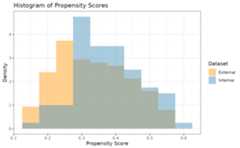
prop_scr_dens(ps_obj, variable="ipw")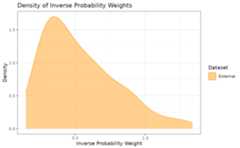
The final plot we might want to look at is a love plot to visualizethe absolute standardized mean differences (both unadjusted and adjustedby the IPWs) of the covariates between the internal and external data.To do this, we use theprop_scr_love function. Like theprevious function, the only required parameter for this function is thepropensity score object, but we can also provide a location along thex-axis for a vertical reference line.
prop_scr_love(ps_obj, reference_line=0.1)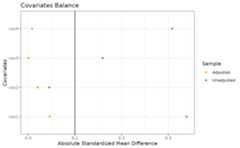
Approximate Inverse Probability Weighted Power Prior
Now that we have created and assessed our propensity score object, wecan read it into thecalc_power_prior_weibull function tocalculate an approximate inverse probability weighted power prior forunder the control arm, which we denote as.Specifically, we approximate the power prior with a bivariate normaldistribution using one of two approximation methods: (1) Laplaceapproximation or (2) estimation of the mean vector and covariance matrixusing MCMC samples from the unnormalized power prior (see the detailssection of thecalc_power_prior_weibull documentation formore information). In this example, we use the Laplace approximationwhich is considerably faster than the MCMC approach.
To approximate the power prior, we need to supply the followinginformation:
weighted object (the propensity score object we createdabove)
response variable name (in this case)
event indicator variable name (in this case)
initial prior for the intercept parameter, in the form of anormal distributional object (e.g.,)
scale hyperparameter for the half-normal initial prior for theshape parameter
approximation method (either “Laplace” or “MCMC”)
pwr_prior<-calc_power_prior_weibull(ps_obj, response=y, event=event, intercept=dist_normal(0,10), shape=50, approximation="Laplace")plot_dist(pwr_prior)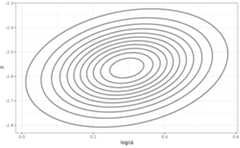
Inverse Probability Weighted Robust Mixture Prior
We can robustify the approximate multivariate normal (MVN) powerprior forby adding a vague component to create a robust mixture prior (RMP). Wedefine the vague component to be a MVN distribution with the same meanvector as the approximate power prior and a covariance matrix that isequal to the covariance matrix of the approximate power prior multipliedby,wheredenotes the number of observed events in the external control arm. Toconstruct this RMP, we can use either therobustify_norm orrobustify_mvnorm functions, and we place 0.5 weight on eachcomponent. The two components of the resulting RMP are labeled as“informative” and “vague”.
We can print the mean vectors and covariance matrices of each MVNcomponent using the functionsmix_means andmix_sigmas, respectively.
r_external<-sum(ex_tte_df$event)# number of observed eventsmix_prior<-robustify_mvnorm(pwr_prior,r_external, weights=c(0.5,0.5))# RMPmix_means(mix_prior)# mean vectors#> $informative#> [1] 0.2940907 -2.5655689#>#> $vague#> [1] 0.2940907 -2.5655689mix_sigmas(mix_prior)# mean covariance matrices#> $informative#> [,1] [,2]#> [1,] 0.016251652 0.003325476#> [2,] 0.003325476 0.011868788#>#> $vague#> [,1] [,2]#> [1,] 1.5276553 0.3125948#> [2,] 0.3125948 1.1156660#plot_dist(mix_prior)Posterior Distributions
To create a posterior distribution for,we can pass the resulting RMP and the internal control data to thecalc_post_weibull function which returns a stanfit objectfrom which we can extract the MCMC samples for the control parameters.In addition to returning posterior samples forand,the function returns posterior samples for the marginal survivalprobabilitywhere the time(s)can be specified as either a scalar or vector of numbers using theanalysis_time argument.
Note: when reading internal data directly intocalc_post_weibull, be sure to include only the arm ofinterest (e.g., the internal control arm if creating a posteriordistribution for).
post_control<-calc_post_weibull(filter(int_tte_df,trt==0), response=y, event=event, prior=mix_prior, analysis_time=12)summary(post_control)$summary#> mean se_mean sd 2.5% 25%#> beta0 -2.6887252 0.0007416549 0.08973077 -2.8896461 -2.7388799#> log_alpha 0.3621925 0.0007810625 0.10469515 0.1575300 0.2930159#> alpha 1.4444037 0.0011479498 0.15277470 1.1706159 1.3404641#> survProb[1] 0.4730793 0.0003307721 0.04382526 0.3949843 0.4439155#> lp__ -148.4751404 0.0118123153 1.15276979 -151.6658488 -148.8919240#> 50% 75% 97.5% n_eff Rhat#> beta0 -2.682493 -2.6292044 -2.5358069 14637.910 1.0000966#> log_alpha 0.361368 0.4291120 0.5731935 17967.248 0.9999709#> alpha 1.435292 1.5358930 1.7739230 17711.572 0.9999736#> survProb[1] 0.470524 0.4987585 0.5702913 17554.608 1.0001324#> lp__ -148.108591 -147.6609827 -147.3811442 9523.906 0.9999708#plot_dist(post_control)We can extract and plot the posterior samples of.Here, we plot the samples using a histogram, however, additionalposterior plots (e.g., density curves, trace plots) can easily beobtained using thebayesplot package.
surv_prob_control<-as.data.frame(extract(post_control, pars=c("survProb")))[,1]ggplot(data.frame(samp=surv_prob_control),aes(x=samp))+labs(y="Density", x=expression(paste(S[C],"(t=12)")))+ggtitle(expression(paste("Posterior Samples of ",S[C],"(t=12)")))+geom_histogram(aes(y=after_stat(density)), color="#5398BE", fill="#5398BE", position="identity", binwidth=.01, alpha=0.5)+geom_density(color="black")+coord_cartesian(xlim=c(-0.2,0.8))+theme_bw()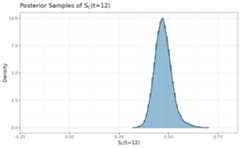
Next, we create a posterior distribution for the survival probabilityfor the active treatment arm at timeby reading the internal data for the corresponding arm into thecalc_post_weibull function. In this case, we use the vaguecomponent of the RMP as our MVN prior.
As noted earlier, be sure to read in only the data for theinternal active treatment arm while excluding the internal controldata.
vague_prior<-dist_multivariate_normal(mu=list(mix_means(mix_prior)[[2]]), sigma=list(mix_sigmas(mix_prior)[[2]]))post_treated<-calc_post_weibull(filter(int_tte_df,trt==1), response=y, event=event, prior=vague_prior, analysis_time=12)summary(post_treated)$summary#> mean se_mean sd 2.5% 25%#> beta0 -2.9467394 0.0014810376 0.14726947 -3.26991147 -3.0353030#> log_alpha 0.3526892 0.0015533881 0.15956920 0.02989851 0.2470030#> alpha 1.4409985 0.0022038801 0.22910480 1.03034996 1.2801829#> survProb[1] 0.5903455 0.0003800737 0.05223538 0.48591817 0.5548152#> lp__ -141.7011034 0.0098800342 1.02027824 -144.47671402 -142.0942676#> 50% 75% 97.5% n_eff Rhat#> beta0 -2.9322638 -2.8440318 -2.6968268 9887.653 0.9999780#> log_alpha 0.3568371 0.4618120 0.6563501 10552.082 0.9999734#> alpha 1.4288031 1.5869469 1.9277434 10806.684 0.9999703#> survProb[1] 0.5911443 0.6259527 0.6894547 18888.340 1.0000317#> lp__ -141.3906390 -140.9749554 -140.7038264 10664.005 0.9999849#plot_dist(post_treated)As was previously done, we can extract and plot the posterior samplesof.
surv_prob_treated<-as.data.frame(extract(post_treated, pars=c("survProb")))[,1]ggplot(data.frame(samp=surv_prob_treated),aes(x=samp))+labs(y="Density", x=expression(paste(S[T],"(t=12)")))+ggtitle(expression(paste("Posterior Samples of ",S[T],"(t=12)")))+geom_histogram(aes(y=after_stat(density)), color="#FFA21F", fill="#FFA21F", position="identity", binwidth=.01, alpha=0.5)+geom_density(color="black")+coord_cartesian(xlim=c(-0.2,0.8))+theme_bw()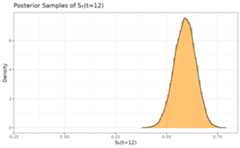
We define our marginal treatment effect to be the difference insurvival probabilities at 12 months between the active treatment andcontrol arms (i.e.,).We can obtain a sample from the posterior distribution forby subtracting the posterior sample offrom the posterior sample of.
samp_trt_diff<-surv_prob_treated-surv_prob_controlggplot(data.frame(samp=samp_trt_diff),aes(x=samp))+labs(y="Density", x=expression(paste(S[T],"(t=12) - ",S[C],"(t=12)")))+ggtitle(expression(paste("Posterior Samples of ",S[T],"(t=12) - ",S[C],"(t=12)")))+geom_histogram(aes(y=after_stat(density)), color="#FF0000", fill="#FF0000", position="identity", binwidth=.01, alpha=0.5)+geom_density(color="black")+coord_cartesian(xlim=c(-0.2,0.8))+theme_bw()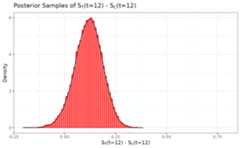
Posterior Summary Statistics
Suppose we want to test the hypothesesversus.We can use our posterior sample forto calculate the posterior probability(i.e., the probability in favor of),and we conclude that we have sufficient evidence in favor of thealternative hypothesis if.
mean(samp_trt_diff>0)#> [1] 0.9534667We see that this posterior probability is less than 0.975, and hencewe do not have sufficient evidence in support of the alternativehypothesis.
With MCMC samples from our posterior distributions, we can calculateposterior summary statistics such as the mean, median, and standarddeviation. As an example, we calculate these statistics using theposterior distribution for.
c(mean=mean(samp_trt_diff), median=median(samp_trt_diff), SD=sd(samp_trt_diff))#> mean median SD#> 0.11726619 0.11920218 0.06795424We can also calculate credible intervals using thequantile function.
Lastly, we calculate the effective sample size of the posteriordistribution forusing the method by Pennello and Thompson (2008). To do so, we firstmust construct the posterior distribution ofwithout borrowing from the external control data (e.g., using avague prior).
post_ctrl_no_brrw<-calc_post_weibull(filter(int_tte_df,trt==0), response=y, event=event, prior=vague_prior, analysis_time=12)surv_prob_ctrl_nb<-as.data.frame(extract(post_ctrl_no_brrw, pars=c("survProb")))[,1]n_int_ctrl<-nrow(filter(int_tte_df,trt==0))# sample size of internal control armvar_no_brrw<-var(surv_prob_ctrl_nb)# post variance of S_C(t) without borrowingvar_brrw<-var(surv_prob_control)# post variance of S_C(t) with borrowingess<-n_int_ctrl*var_no_brrw/var_brrw# effective sample sizeess#> [1] 123.4881References
Psioda, M. A., Bean, N. W., Wright, B. A., Lu, Y., Mantero, A., andMajumdar, A. (2025). Inverse probability weighted Bayesian dynamicborrowing for estimation of marginal treatment effects with applicationto hybrid control arm oncology studies.Journal of BiopharmaceuticalStatistics, 1–23. DOI:10.1080/10543406.2025.2489285.