
Stressed Aquifers Around the Globe
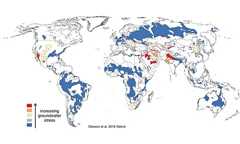 Glesson et al. 2012 NatureGroundwater depletion is particularly severe in places including California’s Central Valley, the Upper Ganges in India and Pakistan, Iran and Saudi Arabia, researchers report.
As the worst drought in decades continues to afflict the Midwest and the Great Plains, it is straining a precious commodity far beneath the earth’s surface: groundwater.
Take, for instance, theOgallala aquifer, which underlies eight states from Nebraska to Texas. The aquifer helps irrigate fields of corn, soybeans and wheat, notes Mark Svoboda, a climatologist atthe University of Nebraska at Lincoln who maintainsthe U.S. Drought Monitor.
In a summer like this, even farmers who draw from the Ogallala instead of relying on rain to water their crops are hit hard, Dr. Svoboda said. They generally have to pump up more water from below, especially because the extreme heat above evaporates moisture quickly. “When you’re not getting any help from what’s coming out of the sky, you are drawing down more than you would like to,” he said.
But the Ogallala — and other aquifers in major agricultural regions around the world — is overextended already, according to a study published inthe latest issue of Nature. Such aquifers are being depleted at an unsustainable rate in the long term, not as a result of a single summer’s weather, said Tom Gleeson, a hydrogeologist atMcGill University in Canada and the lead author ofthe study.
The paper tracks groundwater depletion across the globe. For their analysis, Dr. Gleeson and his colleagues at Utrecht University in the Netherlands used data fromthe International Groundwater Resources Assessment Center on groundwater drawn from more than 700 aquifers. To calculate the level of stress on the aquifers, they combined the data with estimates of how much rainfall would help replenish each one and how much groundwater would flow into lakes, rivers or other bodies of water in the vicinity.
The study underlinesa problem that scientists have already pinpointed: that the demand for groundwater in several major agricultural regions of the world is unsustainable.
The analysis showed that groundwater supplies in the Upper Ganges of India and Pakistan, the Central Valley of California and the North China plain are heavily overexploited, something that was already well known before. But the new study also revealed that aquifers in Iran, western Mexico and Saudi Arabia are also being quickly depleted, Dr. Gleeson said.
He said hoped that the study and its way of quantifying the stress on an aquifer would help groundwater managers re-evaluate their policies, In a region with an overexploited aquifer, the water managers could limit how much groundwater is drawn or encourage farmers to use groundwater more efficiently when irrigating their crops, he said.
Altogether, 1.7 billion people live in areas with overextended groundwater supplies. But in an interconnected world where food travels thousands of miles, the impact stretches further, Dr. Gleeson said.
“If our agricultural systems are stressed, where the people are eating that food matters,” he said.
What's Next
- Previous PostClimate Insight From a Magical Mountain Range
- Next PostHeat Shuts Down a Coastal Reactor
About
Archive
Recent Posts
Follow Our Environmental Coverage
Where to find continuing coverage of the environment at The Times.Read more…
An Addendum
Some longtime contributors to the Green blog will now be posting to the Caucus and Bits blogs instead, and they can be followed on Twitter.Read more…
A Blog’s Adieu
The New York Times is discontinuing the Green blog but plans to press on with aggressive energy and environment coverage.Read more…

Q and A: The Angry Economist
Because of its natural gas boom, the United States is ahead of Europe in fixing climate change, the Oxford economist Dieter Helm argues.Read more…

A Snapshot of Drilling on a Park’s Margins
A photographer seeks to drive home the proximity of fracking to Glacier National Park.Read more…