- Notifications
You must be signed in to change notification settings - Fork125
what is webpack
__webpack is amodule bundler.
For documentation to webpack 2.x, please visit ournew documentation page!!
webpack takes modules with dependencies and generates static assets representing those modules.
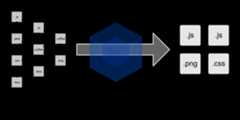
Existing module bundlers are not well suited for big projects (big single page applications). The most pressing reason for developing another module bundler wasCode Splitting and that static assets should fit seamlessly together through modularization.
I tried to extend existing module bundlers, but it wasn't possible to achieve all goals.
- Split the dependency tree into chunks loaded on demand
- Keep initial loading time low
- Every static asset should be able to be a module
- Ability to integrate 3rd-party libraries as modules
- Ability to customize nearly every part of the module bundler
- Suited for big projects
webpack has two types of dependencies in its dependency tree: sync and async. Async dependencies act as split points and form a new chunk. After the chunk tree is optimized, a file is emitted for each chunk.
Read more aboutCode Splitting.
webpack can only process JavaScript natively, but loaders are used to transform other resources into JavaScript. By doing so, every resource forms a module.
Read more aboutUsing loaders andLoaders.
webpack has a clever parser that can process nearly every 3rd party library.It even allows expressions in dependencies such as:require("./templates/" + name + ".jade").It handles the most common module styles:CommonJs andAMD.
Read more aboutexpressions in dependencies,CommonJs andAMD.
webpack features a rich plugin system. Most internal features are based on this plugin system. This allows you to customize webpack for your needs and distribute common plugins as open source.
Read more aboutPlugins.
webpack 👍