- Notifications
You must be signed in to change notification settings - Fork1
A Python library for simulating optical systems, similar to Zemax
NotificationsYou must be signed in to change notification settings
sun-data/optika
Folders and files
| Name | Name | Last commit message | Last commit date | |
|---|---|---|---|---|
Repository files navigation


A Python library for simulating optical systems, similar to Zemax.
Optika can be installed using pip:
pip install optika
- Sequential raytrace modeling
- Spherical, conical and toroidal surface sag profiles
- Ruled surfaces, constant, variable, and holographic line spacing
- Circular, rectangular, and polygonal apertures
- multilayer reflectivity and transmissivity
- n-dimensional configurations of the optical system usingnamed-arrays
- uncertainity propagation usingnamed-arrays
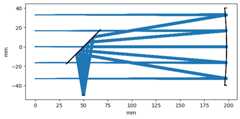
Anexampleof how to raytrace a Newtonian telescope using Optika:
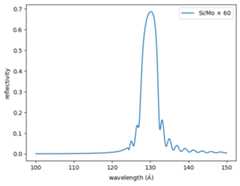
Compute thereflectivity of a multilayer mirrorby specifying the materials and thicknesses of the layers.
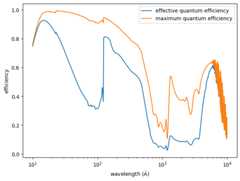
Model thequantum efficiency of a backilluminated CCD
About
A Python library for simulating optical systems, similar to Zemax
Topics
Resources
Uh oh!
There was an error while loading.Please reload this page.
Stars
Watchers
Forks
Uh oh!
There was an error while loading.Please reload this page.
Contributors2
Uh oh!
There was an error while loading.Please reload this page.