- Notifications
You must be signed in to change notification settings - Fork3
An R package to interface with bikeshare data!
simonpcouch/gbfs
Folders and files
| Name | Name | Last commit message | Last commit date | |
|---|---|---|---|---|
Repository files navigation


Thegbfs package supplies a set of functions to interface with GeneralBikeshare Feed Specification .json feeds in R, allowing users to saveand accumulate tidy .rds datasets for specified cities/bikeshareprograms. The North American Bikeshare Association’sgbfs is a standardized data releaseformat for live information on the status of bikeshare programs, as wellas metadata, including counts of bikes at stations, ridership costs, andgeographic locations of stations and parked bikes.
Features
- Get bikeshare data by specifying city name or supplying url of feed
- All feeds for a city can be saved with a single function
- New information from dynamic feeds can be appended to existingdatasets
We’re on CRAN! Install the latest release with:
install.packages("gbfs")library(gbfs)
You can install the developmental version ofgbfs from GitHub with:
# install.packages("devtools")devtools::install_github("simonpcouch/gbfs")
Thegbfs is a standardized data feed describing the current status ofa bikeshare program.
Although all of the data is live, only a few of the datasets changeoften:
station_status: Supplies the number of available bikes and docksat each station as well as station availabilityfree_bike_status: Gives the coordinates and metadata on availablebikes that are parked, but not at a station.
In this package, these two datasets are considered “dynamic”, and can bespecified as desired datasets by settingfeeds = "dynamic" in the mainwrapper function in the package,get_gbfs.
Much of the data supplied in this specification can be consideredstatic. If you want to grab all of these for a given city, setfeeds = "static" when callingget_gbfs. Static feeds include:
system_information: Basic metadata about the bikeshare programstation_information: Information on the capacity and coordinatesof stations- Several optional feeds:
system_hours,system_calendar,system_regions,system_pricing_plans, andsystem_alerts
Each of the above feeds can be queried with theget_suffix function,wheresuffix is replaced with the name of the relevant feed.
For more details on the officialgbfs spec, seethisdocument.
In this example, we’ll grab data from Portland, Oregon’s Biketownbikeshare program and visualize some of the different datasets.
# load necessary packageslibrary(tidyverse)
First, we’ll grab some information on the stations.
# grab portland station information and return it as a dataframepdx_station_info<- get_station_information("https://gbfs.lyft.com/gbfs/1.1/pdx/gbfs.json")#> Message: Returning the output data as an object, rather than saving it, since the `directory` argument was not specified. Setting `output = "return"` will silence this message.# check it out!glimpse(pdx_station_info)#> Rows: 165#> Columns: 19#> $ region_code <chr> "biketown_pdx", "biketown_pdx", "biketown_pdx", "biketown_pdx", "PDX…#> $ legacy_id <chr> "1440914125193298376", "14409138…#> $ station_type <chr> "lightweight", "lightweight", "l…#> $ eightd_station_services <list> [[], [], [], [], [], [], [], []…#> $ external_id <chr> "motivate_PDX_144091412519329837…#> $ lon <dbl> -122.6813, -122.6687, -122.6604,…#> $ has_kiosk <lgl> FALSE, FALSE, FALSE, FALSE, FALS…#> $ name <chr> "SW Yamhill at Director Park", "…#> $ station_id <chr> "1440914125193298376", "14409138…#> $ dockless_bikes_parking_zone_capacity <int> 20, 12, 18, 18, 6, 10, 6, 12, 18…#> $ capacity <int> 20, 12, 18, 18, 6, 10, 6, 12, 18…#> $ lat <dbl> 45.51898, 45.53480, 45.55645, 45…#> $ rack_model <chr> "CITY_PILOT_RACK", "CITY_PUBLIC_…#> $ address <chr> "Park Avenue West, Southwest Yam…#> $ eightd_has_key_dispenser <lgl> FALSE, FALSE, FALSE, FALSE, FALS…#> $ electric_bike_surcharge_waiver <lgl> FALSE, FALSE, FALSE, FALSE, FALS…#> $ client_station_id <chr> "motivate_PDX_144091412519329837…#> $ rental_uris.ios <chr> "https://pdx.lft.to/lastmile_qr_…#> $ rental_uris.android <chr> "https://pdx.lft.to/lastmile_qr_…
…as well as the number of bikes at each station.
# grab current capacity at each station and return it as a dataframepdx_station_status<- get_station_status("https://gbfs.lyft.com/gbfs/1.1/pdx/gbfs.json")#> Message: Returning the output data as an object, rather than saving it, since the `directory` argument was not specified. Setting `output = "return"` will silence this message.# check it out!glimpse(pdx_station_status)#> Rows: 165#> Columns: 19#> $ is_renting <int> 1, 1, 1, 1, 1, 1, 1, 1, 1, 1, 1, 1, 1, 1, 1…#> $ station_id <chr> "1440914030704017724", "1440914074618217706…#> $ is_installed <int> 1, 1, 1, 1, 1, 1, 1, 1, 1, 1, 1, 1, 1, 1, 1…#> $ num_docks_available <int> 9, 5, 4, 8, 18, 8, 2, 4, 17, 12, 11, 5, 17,…#> $ num_docks_disabled <int> 0, 0, 0, 0, 0, 0, 0, 0, 0, 0, 0, 0, 0, 0, 0…#> $ is_returning <int> 1, 1, 1, 1, 1, 1, 1, 1, 1, 1, 1, 1, 1, 1, 1…#> $ last_reported <dbl> 1.599610e+12, 1.599610e+12, 1.599610e+12, 1…#> $ num_ebikes_available <int> 9, 6, 7, 7, 0, 6, 5, 1, 1, 5, 7, 7, 1, 2, 3…#> $ num_bikes_available <int> 0, 0, 0, 0, 0, 0, 0, 0, 0, 0, 0, 0, 0, 0, 0…#> $ eightd_has_available_keys <lgl> FALSE, FALSE, FALSE, FALSE, FALSE, FALSE, F…#> $ station_status <chr> "active", "active", "active", "active", "ac…#> $ legacy_id <chr> "1440914030704017724", "1440914074618217706…#> $ num_bikes_disabled <int> 0, 0, 0, 0, 0, 0, 0, 0, 0, 0, 0, 0, 0, 0, 0…#> $ last_updated <dttm> 2020-10-04 12:44:55, 2020-10-04 12:44:55, …#> $ year <dbl> 2020, 2020, 2020, 2020, 2020, 2020, 2020, 2…#> $ month <dbl> 10, 10, 10, 10, 10, 10, 10, 10, 10, 10, 10,…#> $ day <int> 4, 4, 4, 4, 4, 4, 4, 4, 4, 4, 4, 4, 4, 4, 4…#> $ hour <int> 12, 12, 12, 12, 12, 12, 12, 12, 12, 12, 12,…#> $ minute <int> 44, 44, 44, 44, 44, 44, 44, 44, 44, 44, 44,…
Just like that, we have two tidy datasets containing information aboutPortland’s bikeshare program.
Joining these datasets, we can get the capacity at each station, alongwith each station’s metadata.
# full join these two datasets on station_id and select a few columnspdx_stations<- full_join(pdx_station_info,pdx_station_status,by="station_id") %>%# just select columns we're interested in visualizing select(id=station_id,lon,lat,num_bikes_available,num_docks_available) %>% mutate(type="docked")
Finally, before we plot, lets grab the locations of the bikes parked inPortland that are not docked at a station,
# grab data on free bike status and save it as a dataframepdx_free_bikes<- get_free_bike_status("https://gbfs.lyft.com/gbfs/1.1/pdx/gbfs.json",output="return") %>%# just select columns we're interested in visualizing select(id=bike_id,lon,lat) %>%# make columns analogous to station_status for row binding mutate(num_bikes_available=1,num_docks_available=NA,type="free")
…and bind these dataframes together!
# row bind stationed and free bike infopdx_full<- bind_rows(pdx_stations,pdx_free_bikes)
Now, plotting,
# filter out stations with 0 available bikespdx_plot<-pdx_full %>% filter(num_bikes_available>0) %>%# plot the geospatial distribution of bike counts ggplot()+ aes(x=lon,y=lat,size=num_bikes_available,col=type)+ geom_point()+# make aesthetics slightly more cozy theme_minimal()+ scale_color_brewer(type="qual")
pdx_plot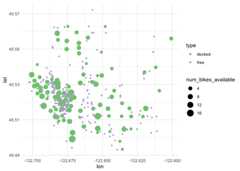
Folks who have spent a significant amount of time in Portland might beable to pick out the Willamette River running Northwest/Southeastthrough the city. With a few lines ofgbfs,dplyr, andggplot2, wecan put together a meaningful visualization to help us better understandhow bikeshare bikes are distributed throughout Portland.
Some other features worth playing around with ingbfs that weren’ttouched on in this example:
- The main wrapper function in the package,
get_gbfs, will grabevery dataset for a given city. (We call the functions to grabindividual datasets above for clarity.) - In the above lines, we output the datasets as returned dataframes.If you’d rather save the output to your local files, check out the
directoryandreturnarguments. - When the
outputargument is left as default inget_free_bike_statusandget_station_status(the functions forthedynamicdataframes,) and a dataframe already exists at thegiven path,gbfswill row bind the dataframes, allowing for thecapability to accumulate large datasets over time. - If you’re not sure if your city supplies
gbfsfeeds, you mightfind theget_gbfs_citiesandget_which_gbfs_feedsfunctionsuseful.
Please note that thegbfs R package is released with aContributorCode of Conduct. By contributing to this project, youagree to abide by its terms.
About
An R package to interface with bikeshare data!
Resources
Contributing
Uh oh!
There was an error while loading.Please reload this page.
Stars
Watchers
Forks
Uh oh!
There was an error while loading.Please reload this page.
Contributors2
Uh oh!
There was an error while loading.Please reload this page.