- Notifications
You must be signed in to change notification settings - Fork0
Object-oriented design and implementation of a Design Pattern Code Generator
License
samujjwaal/Design-Pattern-Code-Generator
Folders and files
| Name | Name | Last commit message | Last commit date | |
|---|---|---|---|---|
Repository files navigation
This project is to generate the implementation code of the 23 Gang of Four(GoF) design patterns, as presented in the book “Design Patterns: Elements of Reusable Object-Oriented Software”.
AnIntellij Plugin to generate design pattern code based on this implementation.
- About Design Patterns
- About JavaPoet
- Application Design
- Test Cases
- Instructions to Execute
- Results of Execution
Design patterns are the best practices that a programmer can employ to solve trivial problems while designing an application. Design patterns help in speeding up the development process as they provide a set of time tested, proven development paradigms. They provide an industry standard approach to solve a recurring problem. Using design patterns promotes reusability that leads to more robust and highly maintainable code.
The 23 Design Patterns are classified into 3 main categories:
Creational Design Patterns
- Singleton
- Abstract Factory
- Builder
- Factory Method
Structural Design Patterns
- Adapter
- Bridge
- Composite
- Decorator
- Facade
- Flyweight
- Proxy
Behavioral Design Patterns
- Chain of Responsibility
- Command
- Interpreter
- Iterator
- Mediator
- Memento
- Observer
- State
- Strategy
- Template
- Visitor
JavaPoet, a successor toJavaWriter, is a Java API for generating .java source files. It can generate primitive types, reference types (like classes, interfaces, enumerated types, anonymous inner classes), fields, methods, parameters, annotations, and Javadocs.
JavaPoet manages the import of the dependent classes automatically. It uses theBuilder design pattern to specify the logic to generate Java code.
A HelloWorld program like the one here:
packagecom.example.helloworld;publicfinalclassHelloWorld {publicstaticvoidmain(String[]args) {System.out.println("Hello, JavaPoet!"); }}
can be generated using JavaPoet as follows:
MethodSpecmain =MethodSpec.methodBuilder("main") .addModifiers(Modifier.PUBLIC,Modifier.STATIC) .returns(void.class) .addParameter(String[].class,"args") .addStatement("$T.out.println($S)",System.class,"Hello, JavaPoet!") .build();TypeSpechelloWorld =TypeSpec.classBuilder("HelloWorld") .addModifiers(Modifier.PUBLIC,Modifier.FINAL) .addMethod(main) .build();JavaFilejavaFile =JavaFile.builder("com.example.helloworld",helloWorld) .build();javaFile.writeTo(System.out);
MethodSpec "main" is configured with modifiers, return type, parameters and code statements to declare the main method. The main method is added to aHelloWorld class and then the class is added to aHelloWorld.java file.
JavaPoet offers models for classes & interfaces (TypeSpec), fields (FieldSpec), methods & constructors (MethodSpec), parameters (ParameterSpec) and annotations (AnnotationSpec). It also generates the package folder structure for the output java source files.
The most recent version of JavaPoet available as of now is 1.12.1.
To implement Design Pattern Code Generator(DePaCoG), I have employed theFactory Method,Template Method andSingleton design patterns.
TheFactory Method, a creational design pattern, creates two basic abstractions: the Product and Creator classes. Both these classes are abstract and clients need to extend them to realize their specific implementations. This pattern is used when there is a super class with multiple sub-classes and based on user input a particular sub-class needs to be instantiated. The responsibility of instantiation of a class is taken from the user to the factory class.
In the case of DePaCoG, theDesignPattern andDesignPatternGenerator are the two abstractions I have chosen.
DesignPatternis aninterfacewhich declares methods for accepting and displaying the class names & package names from the user, generating java source code of the design patterns using JavaPoet and writing the java code into java files as output.
publicinterfaceDesignPattern {voiddisplayClassNames(String[]classes);String[]setClassNames(String[]oldClasses);StringsetPackageName(StringdefaultPckgName);voidcreateDesignPattern(String[]oldClasses,StringoldPackageName);JavaFile[]generateCode(String[]classes,StringpackageName);voidwriteJavaFiles(JavaFile[]files);}
There are 23 separate concrete classes(java files) to generate the java source code for each design pattern. Each concrete classimplements DesignPattern. InterfaceDesignPattern provides thedefault method definition of all methods except the methodgenerateCode() as the implementation of all other methods do not change according to the design patterns. Each concrete class ofDesignPattern overridesgenerateCode().
DesignPatternGeneratoris anabstract classwhich declares methods to display a menu of all available design patterns and invoking appropriate classes to generate a user selected design pattern.
abstractclassDesignPatternGenerator {protectedString[]designPatterns;abstractvoiddisplayDesignPatterns();abstractvoidgenerateDesignPattern();abstractvoiddesignPatternFactory();}
The fielddesignPatterns declares all the design patterns available for creation. All the methods are abstract and are provided with the implementation in the concrete classHw1DesignPatternGenerator whichextends DesignPatternGenerator. The classHw1DesignPatternGenerator also defines an additional methodchooseDesignPattern(int choice) which takes in user’s choice of design pattern as input and instantiates an anonymous object of the appropriate design pattern class.
- Advantages of using Factory Method pattern:
- It provides an approach to “program to an interface, not an implementation”.
- Through inheritance it provides an abstraction between implementation and client classes. It removes the instantiation of objects of implementation classes from the user/client code
- It makes the code more robust, easy to extend and less coupled
- New types of concrete products can be introduced without any modifications to the existing client code
- Disadvantages of using Factory Method pattern:
- For just creating a single instance of a particular concrete object the user might have to sub-class the creator, which complicates the hierarchy of creator classes
- Makes the code difficult to interpret as all code is behind an abstraction that may also be hiding another set of abstractions
TheTemplate Method, a behavioral design pattern, is used to create method stub and defer the steps of implementation to the subclasses.
The algorithm for generating design patterns has the following steps: display list of all design patterns, ask user which design pattern code is to be generated, ask for and set custom (or default) class names & package name, generate source file using JavaPoet and finally write into output files. The order of execution of these steps cannot be altered as the sequence is critical for the execution of the program. So here different methods are used to achieve the goal of generating the design pattern code. Steps like asking class names& package name and writing generated code into file are common for any design pattern whether it is a creational or structural design pattern.
This is where Template Method design pattern is useful. It helps define the basic steps to execute an algorithm and can provide default implementation of the methods that might be common for all or a majority of the sub-classes implementing the design pattern. The method is which defines an exclusive property of a design pattern can be overridden by the sub-class.
Template Method is implemented in theinterface DesignPattern and its sub-classes. InterfaceDesignPattern provides thedefault method definition of all methods except the methodgenerateCode() as the implementation of all other methods do not change according to the design patterns. Each concrete class ofDesignPattern overridesgenerateCode().
Inside theinterface DesignPattern:
JavaFile[]generateCode(String[]classes,StringpackageName);
Insideclass Singleton which implementsDesignPattern:
publicJavaFile[]generateCode(String[]classes,StringpackageName){inti =0;ClassNameSingleton =ClassName.get("",classes[i]);MethodSpecconstructor =MethodSpec.constructorBuilder() .addModifiers(Modifier.PRIVATE) .build();FieldSpecinstance =FieldSpec.builder(Singleton,"INSTANCE") .addModifiers(Modifier.PRIVATE,Modifier.STATIC) .build();MethodSpecgetInstance =MethodSpec.methodBuilder("getInstance") .addModifiers(Modifier.PUBLIC,Modifier.STATIC) .returns(Singleton) .beginControlFlow("if ($N == null)",instance.name) .addStatement("$N = new $T()",instance.name,Singleton) .endControlFlow() .addStatement("return $N",instance.name) .build();TypeSpecsingleton =TypeSpec.classBuilder(Singleton) .addModifiers(Modifier.PUBLIC) .addField(instance) .addMethod(constructor) .addMethod(getInstance) .build();generatedCode[i] =JavaFile.builder(packageName,singleton) .skipJavaLangImports(true) .build();returngeneratedCode; }
- Advantages of using Template Method pattern:
- All the duplicate code/methods of sub-classes can be put together in the super-class
- Client can override only certain methods of a large algorithm, so that the other components of the algorithm are not affected
- Disadvantages of using Template Method pattern:
- Sometimes client might have to change certain fundamental aspects of the algorithm and changing only certain fixed components of the algorithm might not suffice
- If the number of components in the algorithm being modelled is large, it is harder to maintain the code
TheSingleton, a creational design pattern, that helps in ensuring that a class has only one instance in a program while also providing a global access point to the instance. I have used Singleton to instantiate only one instance of the classHw1DesignPatternGenerator so that in the client classDePaCoG the design pattern generating method is only called once at a time. Theinstance field inHw1DesignPatternGenerator is lazy initialized.
Inside classHw1DesignPatternGenerator:
privatestaticHw1DesignPatternGeneratorinstance;privateHw1DesignPatternGenerator(){logger.info("Executing constructor Hw1DesignPatternGenerator()");generateDesignPattern();}publicstaticHw1DesignPatternGeneratorgetInstance(){if (instance ==null) {instance =newHw1DesignPatternGenerator(); }returninstance; }
Creating instance insideDePaCoG class:
publicclassDePaCoG {publicstaticvoidmain(String[]args){Hw1DesignPatternGenerator.getInstance(); }}
- Advantages of using Singleton pattern:
- It makes sure that a single instance is instantiated for a class
- Helps to get a global access point to the instance
- The object is only initialized when initially requested
- Disadvantages of using Singleton pattern:
- Sometimes singleton pattern can hide bad code design
- It requires modifications to be used in a multi threaded environment to make sure multiple instances are not created by multiple threads
The image below shows a class diagram for the complete application. For simplicity I have selected only 3 design pattern classes (each representing its category of design patterns) out of the 23.

The classDePaCoG has the main() method in it. It creates an instance of classHw1DesignPatternGenerator (concrete implementation ofDesignPatternGenerator ). Methods here are for displaying menu of design patterns and getting choice of design pattern from user. Depending on user’s choice the corresponding design pattern generating class (implementation ofDesignPattern) is instantiated to generate the design pattern source code.
There are 2 test classesDesignPatternTest andHw1DesignPatternGeneratorTest, with a total of 5 test cases.
- Test Case to verify only 1 instance of
Hw1DesignPatternGeneratoris created each time. - Test Case to verify correct design pattern file is executed when user inputs the choice of design pattern.
- Test Case to check null is returned on selecting incorrect design pattern choice.
- Test Case to verify
generateCode()returnsJavaFile[]object - Test Case to verify the generated java files are written successfully in the output folder.
First clone the repository from GitHub.
Execution can be in two modes, using default config file or using interactive environment/menu to get custom inputs from user.
Thedefault.conf configuration file is present atsrc/main/resources.
For command line execution, locatehw1-assembly-0.1.jar attarget\scala-2.13.
On Windows, the command to run the jar file:java -jar hw1-assembly-0.1.jar mode
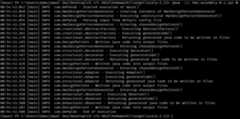
Executing using default config file, then
mode = 0:- run
java -jar hw1-assembly-0.1.jar 0
- run
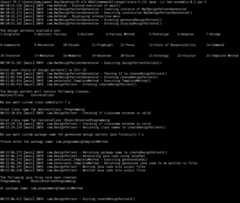
Executing using custom inputs from user, then
mode = 1:- run
java -jar hw1-assembly-0.1.jar 1
- run


For execution in IntelliJ, userun 0 orrun 1 for the preferred way of execution (argument passed has similar purpose like in the command line method)
The output java files are saved under the package name provided in the config file (or as custom input) in a folder namedoutputs. Theoutputs folder is created in the current working directory during execution.
While executing the Design Pattern Code Generator, the main() method in classDePaCoG is executed along with a command line argument (0 or1). The command line argument is to select whether inputs will be entered via a configuration file or via inputs through the interactive environment.
Here is an example of config values to create Abstract Factory design pattern.
{ designPatternChoice = "2" classes = ["Processor", "Intel", "AMD", "OperatingSystem", "OS", "ChromeOS", "Ubuntu", "LaptopFactory", "ChromeBookFactory","LinuxLaptopFactory"] packageName = "com.laptopAbstractFacty"}For above config input, the output files will be saved atoutputs/com/laptopAbstractFactory.
The classes created are :Processor.java, Intel.java, AMD.java, OperatingSystem.java, OS.java, ChromeOS.java, Ubuntu.java, LaptopFactory.java, ChromeBookFactory.java,LinuxLaptopFactory.java
The image below shows the class diagram of the classes generated after executing the config input values.

In addition to Abstract Factory, thedefault.conf configuration file also contains inputs for Decorator, Adapter and Observer design patterns.
Theoutputs folder is created in the current working directory during execution.

About
Object-oriented design and implementation of a Design Pattern Code Generator
Topics
Resources
License
Uh oh!
There was an error while loading.Please reload this page.