- Notifications
You must be signed in to change notification settings - Fork7.1k
3.0.0
lodash v3.0.0
After a little over a year & more than2,000commits we’re excited to releaselodash v3.0.0. lodash followssemantic versioning so with this major release we’ve taken the opportunity to clean house & makesome back-compat breaking changes. We’ll get into that in a bit, but first lets talk about all the cool things this release has to offer.
String methods
By popular demand we surveyed the utility landscape for a cross-section of string APIs to add to lodash. We settled on 17 string methods:
_.camelCase,_.capitalize,_.deburr,_.endsWith,_.escapeRegExp,
_.kebabCase,_.pad,_.padLeft,_.padRight,_.repeat,_.snakeCase,
_.startsWith,_.trim,_.trimLeft,_.trimRight,_.trunc, &_.words
There’s familiar methods from ES5, like_.trim, & ES6, like_.endsWith,_.repeat, &_.startsWith, as well as some lesser known methods like_.deburr &_.kebabCase.
// trims whitespace like `String#trim` but// also allows specifying characters to trim_.trim(' abc ');// → 'abc'_.trim('-_-abc-_-','_-');// → 'abc'// works great with `_.map` too_.map([' foo ',' bar '],_.trim);// → ['foo', 'bar']// deburr diacritical marks (http://en.wikipedia.org/wiki/Diacritic)_.deburr('déjà vu');// → 'deja vu'// similar to a `dasherize` or `slugify` method_.kebabCase('foo bar');// → 'foo-bar'
Following casing rules with methods like_.camelCase,_.kebabCase, &_.snakeCase allows for strings to be transformed from say camel case, to kebab case, to snake case, & back again.
_.camelCase(_.snakeCase(_.kebabCase('fooBar')));// → 'fooBar'
ES is our jam
Previous versions of lodash added_.assign,_.find,_.findIndex, & ES template delimiter support. In this release we’re taking our ES adoption up a notch by aligning_.includes,_.isFinite, &_.keys, supporting typed arrays in_.clone &_.isEqual, usingSet &WeakMap forperformance-gains, allowingMap &WeakMap to be used as_.memoize.Cache, & supportingES modularized builds withlodash-cli.
Functional goodies
There’s lots of functional goodies in v3 like_.ary,_.curryRight,_.flow,_.rearg, & support for customizable argument placeholders in_.bind,_.bindKey,_.curry,_.curryRight,_.partial, &_.partialRight.
// infomercial fail_.map(['6','8','10'],parseInt);// → [6, NaN, 2]// using a placeholder to pass over the// `string` parameter & specify a `radix` of `0`_.map(['6','8','10'],_.partial(parseInt,_,0));// → [6, 8, 10]// is equivalent to_.map(['6','8','10'],function(value){returnparseInt(value,0);});// customize `_.partial.placeholder`_.partial.placeholder='_';_.map(['6','8','10'],_.partial(parseInt,'_',0));// → [6, 8, 10]
Also several methods nowwork out-of-the-box as iteratees for methods like_.map &_.reduce
_.map(['6','8','10'],_.parseInt);// → [6, 8, 10]_.map(['a','a'],['b','b'],_.uniq);// → [['a'], ['b']]_.reduce([{'b':2},{'c':3}],_.assign,{'a':1});// → { 'a': 1, 'b': 2, 'c': 3}
We’ve heard from some functional programming fans that lodash wasn’tfunctional enough, often citing our method signatures as an issue. To ease composition & currying they’d prefer methods like_.filter bepredicate first &collection second instead ofcollection first &predicate second.

It’d be a shame for those fans to lose out on lodash over something as little as method signatures so with v3 we’ve added_.ary &_.rearg. The_.ary method sets the argument cap of a function &_.rearg rearranges the arguments provided to a function.
// cap the number arguments provided to `parseInt` at one_.map(['6','8','10'],_.ary(parseInt,1));// → [6, 8, 10]// create a `filter` that’s predicate-firstvarfilter=_.rearg(_.filter,1,0);filter('a',[{'a':0},{'a':1}]);// → [{ 'a': 1 }]// create an `includes` that’s auto-curried & needle-firstvarincludes=_(_.includes).ary(2).rearg(1,0).curry(2).value();includes(2)([1,2,3]);// → true
You can also use individual packages likelodash.ary,lodash.curry, &lodash.rearg to convert functions.
varary=require('lodash.ary'),curry=require('lodash.curry'),rearg=require('lodash.rearg');vargetobject=require('getobject'),get=curry(rearg(ary(getobject,2),[1,0]),2);get('a.b.c')({'a':{'b':{'c':'foo'}}});// → 'foo'
Combined with_.runInContext you could easily create a version of lodash with auto-curried iteratee-first methods. In fact, that’s whatwe’ve done! Introducinglodash-fp.
varitems=[{'value':_.constant(['a','b'])},{'value':_.constant(['b','c'])}];vargetValues=_.flow(_.map(_.result('value')),_.flatten,_.uniq);getValues(items);// => ['a', 'b', 'c']_.map(parseInt)(['6','08','10']);// → [6, 8, 10]
lodash reduces the cost of method wrapping produced by_.ary,_.curry, &_.rearg by using aWeakMap to store function metadata. In this way a function is only wrapped once even though it may have_.ary,_.curry, &_.rearg applied.
Modules, modules, modules
In lodash v2 we introducednpm packages per-method as well as bundles of modules for AMD & Node.js. With v3 we’ve improvedlodash-cli’s ability to inline dependencies allowing us to easily customize inlining per method, enabling a better balance between deep dependency graphs & code duplication.
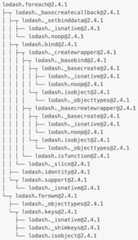 | 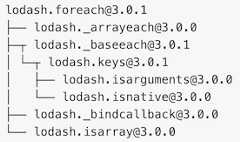 |
In addition all modularized dependencies now use the^ version range, instead of the~, so they’ll update as needed without you having to worry about it. Moving forward all per-method packages will be independently updated, instead of in bulk, becauselodash-cli will soon be able to detect changes in packages & automatically bump patch/minor version numbers.
Thelodash &lodash-compat npm packages now come with modules baked in too.
Perfect forbrowserify andwebpack!
// load the modern buildvar_=require('lodash');// or a method categoryvararray=require('lodash/array');// or a methodvarchunk=require('lodash/array/chunk');
The method modules are organized by category so they’reeasy to find.
lodash is available in a variety of other builds & module formats.
- npm packages formodern,compatibility, &per method builds
- AMD modules formodern &compatibility builds
- ES modules for themodern build
Performance
We’ve improved performance 20-40% overall in v3 by better utilizing the JIT in JavaScript engines, using internal helper functions that avoid optimization disqualifications & increase the likelihood of function inlining.

In v3 we’ve also introducedlazily evaluated chaining formassive performance wins in certain scenarios.
As mentioned above we’re usingSet &WeakMap forperformance-gains which all modern browsers, Node.js, & io.js can benefit from.
Breaking changes
lodash v3 is a major bump & we’ve introduced several back-compat breaking changes. One such change is that while we stilltest against Underscore/Backbone unit tests we’re no longer supporting an Underscore/Backbone build. Over the last year we’ve seen Underscore align more & more with lodash’s API so the need for a separate Underscore build has diminished. If you still need compatibility around some of the edges we recommend leveraging modules in lodash v3 to supplement your Underscore use.
Be sure to check out thechangelog for a full rundown of changes & givelodash-migrate a spin to help migrate older lodash code to the latest release.
New Core Member
In closing I want to welcomeBenjamin Tan (bnjmnt4n) as an official core member.
Without the efforts ofcontributors, like Benjamin, lodash v3 would not have happened.
If you dig lodash v3 don't forget to star the repo ornpm star lodash!
Assets2
Uh oh!
There was an error while loading.Please reload this page.