- Notifications
You must be signed in to change notification settings - Fork28
Apache Airflow (Incubating)
License
github/incubator-airflow
Folders and files
| Name | Name | Last commit message | Last commit date | |
|---|---|---|---|---|
Repository files navigation


Apache Airflow (or simply Airflow) is a platform to programmatically author, schedule, and monitor workflows.
When workflows are defined as code, they become more maintainable, versionable, testable, and collaborative.
Use Airflow to author workflows as directed acyclic graphs (DAGs) of tasks. The Airflow scheduler executes your tasks on an array of workers while following the specified dependencies. Rich command line utilities make performing complex surgeries on DAGs a snap. The rich user interface makes it easy to visualize pipelines running in production, monitor progress, and troubleshoot issues when needed.
Table of contents
- Project Focus
- Principles
- Requirements
- Support for Python versions
- Getting started
- Installing from PyPI
- Official source code
- Convenience packages
- User Interface
- Contributing
- Who uses Apache Airflow?
- Who Maintains Apache Airflow?
- Can I use the Apache Airflow logo in my presentation?
- Airflow merchandise
- Links
Airflow works best with workflows that are mostly static and slowly changing. When DAG structure is similar from one run to the next, it allows for clarity around unit of work and continuity. Other similar projects includeLuigi,Oozie andAzkaban.
Airflow is commonly used to process data, but has the opinion that tasks should ideally be idempotent (i.e. results of the task will be the same, and will not create duplicated data in a destination system), and should not pass large quantities of data from one task to the next (though tasks can pass metadata using Airflow'sXcom feature). For high-volume, data-intensive tasks, a best practice is to delegate to external services that specialize on that type of work.
Airflow is not a streaming solution, but it is often used to process real-time data, pulling data off streams in batches.
- Dynamic: Airflow pipelines are configuration as code (Python), allowing for dynamic pipeline generation. This allows for writing code that instantiates pipelines dynamically.
- Extensible: Easily define your own operators, executors and extend the library so that it fits the level of abstraction that suits your environment.
- Elegant: Airflow pipelines are lean and explicit. Parameterizing your scripts is built into the core of Airflow using the powerfulJinja templating engine.
- Scalable: Airflow has a modular architecture and uses a message queue to orchestrate an arbitrary number of workers.
Apache Airflow is tested with:
| Master version (dev) | Stable version (2.0.1) | Previous version (1.10.14) | |
|---|---|---|---|
| Python | 3.6, 3.7, 3.8 | 3.6, 3.7, 3.8 | 2.7, 3.5, 3.6, 3.7, 3.8 |
| PostgreSQL | 9.6, 10, 11, 12, 13 | 9.6, 10, 11, 12, 13 | 9.6, 10, 11, 12, 13 |
| MySQL | 5.7, 8 | 5.7, 8 | 5.6, 5.7 |
| SQLite | 3.15.0+ | 3.15.0+ | 3.15.0+ |
| Kubernetes | 1.20, 1.19, 1.18 | 1.20, 1.19, 1.18 | 1.18, 1.17, 1.16 |
Note: MySQL 5.x versions are unable to or have limitations withrunning multiple schedulers -- please see the "Scheduler" docs. MariaDB is not tested/recommended.
Note: SQLite is used in Airflow tests. Do not use it in production. We recommendusing the latest stable version of SQLite for local development.
As of Airflow 2.0 we agreed to certain rules we follow for Python support. They are based on the officialrelease schedule of Python, nicely summarized in thePython Developer's Guide
We finish support for python versions when they reach EOL (For python 3.6 it means that we will remove itfrom being supported on 23.12.2021).
The "oldest" supported version of Python is the default one. "Default" is only meaningful in terms of"smoke tests" in CI PRs which are run using this default version.
We support a new version of Python after it is officially released, as soon as we manage to makeit works in our CI pipeline (which might not be immediate) and release a new version of Airflow(non-Patch version) based on this CI set-up.
- Previous versionrequires at least Python 3.5.3when using Python 3
Visit the official Airflow website documentation (lateststable release) for help withinstalling Airflow,getting started, or walking through a more completetutorial.
Note: If you're looking for documentation for master branch (latest development branch): you can find it ons.apache.org/airflow-docs.
For more information on Airflow's Roadmap or Airflow Improvement Proposals (AIPs), visit theAirflow Wiki.
Official Docker (container) images for Apache Airflow are described inIMAGES.rst.
We publish Apache Airflow asapache-airflow package in PyPI. Installing it however might be sometimes trickybecause Airflow is a bit of both a library and application. Libraries usually keep their dependencies open andapplications usually pin them, but we should do neither and both at the same time. We decided to keepour dependencies as open as possible (insetup.py) so users can install different versions of librariesif needed. This means that from time to time plainpip install apache-airflow will not work or willproduce unusable Airflow installation.
In order to have repeatable installation, however, introduced inAirflow 1.10.10 and updated inAirflow 1.10.12 we also keep a set of "known-to-be-working" constraint files in theorphanconstraints-master,constraints-2-0 andconstraints-1-10 branches. We keep those "known-to-be-working"constraints files separately per major/minor python version.You can use them as constraint files when installing Airflow from PyPI. Note that you have to specifycorrect Airflow tag/version/branch and python versions in the URL.
- Installing just Airflow:
NOTE!!!
On November 2020, new version of PIP (20.3) has been released with a new, 2020 resolver. This resolvermight work with Apache Airflow as of 20.3.3, but it might lead to errors in installation. It mightdepend on your choice of extras. In order to install Airflow reliably, you might need to either downgradepip to version 20.2.4pip install --upgrade pip==20.2.4 or, in case you use Pip 20.3,you might need to add option]--use-deprecated legacy-resolver to your pip install command.Whilepip 20.3.3 solved most of theteething problems of 20.3, this note will remain here until wesetpip 20.3 as official version in our CI pipeline where we are testing the installation as well.Due to those constraints, onlypip installation is currently officially supported.
While they are some successes with using other tools likepoetry orpip-tools, they do not share the same workflow aspip - especially when it comes to constraint vs. requirements management.Installing viaPoetry orpip-tools is not currently supported.
If you wish to install airflow using those tools you should use the constraint files and convertthem to appropriate format and workflow that your tool requires.
pip install apache-airflow==2.0.1 \ --constraint"https://raw.githubusercontent.com/apache/airflow/constraints-2.0.1/constraints-3.7.txt"- Installing with extras (for example postgres,google)
pip install apache-airflow[postgres,google]==2.0.1 \ --constraint"https://raw.githubusercontent.com/apache/airflow/constraints-2.0.1/constraints-3.7.txt"For information on installing provider packages checkproviders.
Apache Airflow is anApache Software Foundation (ASF) project,and our official source code releases:
- Follow theASF Release Policy
- Can be downloaded fromthe ASF Distribution Directory
- Are cryptographically signed by the release manager
- Are officially voted on by the PMC members during theRelease Approval Process
Following the ASF rules, the source packages released must be sufficient for a user to build and test therelease provided they have access to the appropriate platform and tools.
There are other ways of installing and using Airflow. Those are "convenience" methods - they arenot "official releases" as stated by theASF Release Policy, but they can be used by the userswho do not want to build the software themselves.
Those are - in the order of most common ways people install Airflow:
- PyPI releases to install Airflow using standard
piptool - Docker Images to install airflow via
dockertool, use them in Kubernetes, Helm Charts,docker-compose,docker swarmetc. You canread more about using, customising, and extending the images in theLatest docs, andlearn details on the internals in theIMAGES.rst document. - Tags in GitHub to retrieve the git project sources thatwere used to generate official source packages via git
All those artifacts are not official releases, but they are prepared using officially released sources.Some of those artifacts are "development" or "pre-release" ones, and they are clearly marked as suchfollowing the ASF Policy.
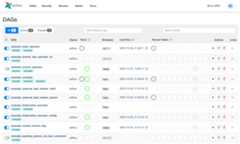
DAGs: Overview of all DAGs in your environment.
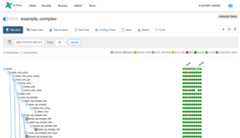
Tree View: Tree representation of a DAG that spans across time.
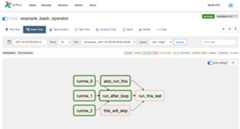
Graph View: Visualization of a DAG's dependencies and their current status for a specific run.
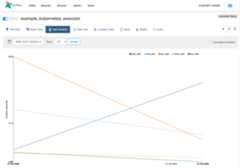
Task Duration: Total time spent on different tasks over time.
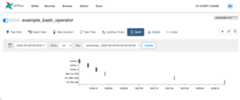
Gantt View: Duration and overlap of a DAG.
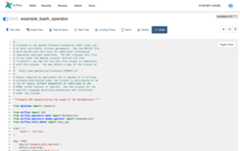
Code View: Quick way to view source code of a DAG.


Want to help build Apache Airflow? Check out ourcontributing documentation.
More than 350 organizations are using Apache Airflowin the wild.
Airflow is the work of thecommunity,but thecore committers/maintainersare responsible for reviewing and merging PRs as well as steering conversation around new feature requests.If you would like to become a maintainer, please review the Apache Airflowcommitter requirements.
Yes! Be sure to abide by the Apache Foundationtrademark policies and the Apache AirflowBrandbook. The most up to date logos are found inthis repo and on the Apache Software Foundationwebsite.
If you would love to have Apache Airflow stickers, t-shirt etc. then check outRedbubble Shop.
About
Apache Airflow (Incubating)
Resources
License
Code of conduct
Contributing
Security policy
Uh oh!
There was an error while loading.Please reload this page.
Stars
Watchers
Forks
Packages0
Uh oh!
There was an error while loading.Please reload this page.
Languages
- Python93.8%
- Shell4.3%
- HTML1.2%
- Dockerfile0.2%
- JavaScript0.2%
- Jinja0.2%
- Other0.1%