- Notifications
You must be signed in to change notification settings - Fork210
Mastering Atari with Discrete World Models
License
danijar/dreamerv2
Folders and files
| Name | Name | Last commit message | Last commit date | |
|---|---|---|---|---|
Repository files navigation
Status: Stable release

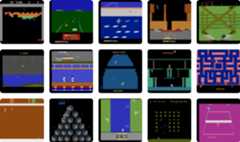
Implementation of theDreamerV2 agent in TensorFlow 2. Trainingcurves for all 55 games are included.
If you find this code useful, please reference in your paper:
@article{hafner2020dreamerv2, title={Mastering Atari with Discrete World Models}, author={Hafner, Danijar and Lillicrap, Timothy and Norouzi, Mohammad and Ba, Jimmy}, journal={arXiv preprint arXiv:2010.02193}, year={2020}}DreamerV2 is the first world model agent that achieves human-level performanceon the Atari benchmark. DreamerV2 also outperforms the final performance of thetop model-free agents Rainbow and IQN using the same amount of experience andcomputation. The implementation in this repository alternates between trainingthe world model, training the policy, and collecting experience and runs on asingle GPU.
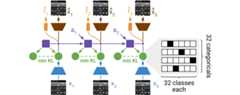
DreamerV2 learns a model of the environment directly from high-dimensionalinput images. For this, it predicts ahead using compact learned states. Thestates consist of a deterministic part and several categorical variables thatare sampled. The prior for these categoricals is learned through a KL loss. Theworld model is learned end-to-end via straight-through gradients, meaning thatthe gradient of the density is set to the gradient of the sample.
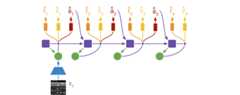
DreamerV2 learns actor and critic networks from imagined trajectories of latentstates. The trajectories start at encoded states of previously encounteredsequences. The world model then predicts ahead using the selected actions andits learned state prior. The critic is trained using temporal differencelearning and the actor is trained to maximize the value function via reinforceand straight-through gradients.
For more information:
The easiest way to run DreamerV2 on new environments is to install the packageviapip3 install dreamerv2. The code automatically detects whether theenvironment uses discrete or continuous actions. Here is a usage example thattrains DreamerV2 on the MiniGrid environment:
importgymimportgym_minigridimportdreamerv2.apiasdv2config=dv2.defaults.update({'logdir':'~/logdir/minigrid','log_every':1e3,'train_every':10,'prefill':1e5,'actor_ent':3e-3,'loss_scales.kl':1.0,'discount':0.99,}).parse_flags()env=gym.make('MiniGrid-DoorKey-6x6-v0')env=gym_minigrid.wrappers.RGBImgPartialObsWrapper(env)dv2.train(env,config)
To modify the DreamerV2 agent, clone the repository and follow the instructionsbelow. There is also a Dockerfile available, in case you do not want to installthe dependencies on your system.
Get dependencies:
pip3 install tensorflow==2.6.0 tensorflow_probability ruamel.yaml'gym[atari]' dm_controlTrain on Atari:
python3 dreamerv2/train.py --logdir~/logdir/atari_pong/dreamerv2/1 \ --configs atari --task atari_pongTrain on DM Control:
python3 dreamerv2/train.py --logdir~/logdir/dmc_walker_walk/dreamerv2/1 \ --configs dmc_vision --task dmc_walker_walkMonitor results:
tensorboard --logdir~/logdirGenerate plots:
python3 common/plot.py --indir~/logdir --outdir~/plots \ --xaxis step --yaxis eval_return --bins 1e6
TheDockerfilelets you run DreamerV2 without installing its dependencies in your system. Thisrequires you to have Docker with GPU access set up.
Check your setup:
docker run -it --rm --gpus all tensorflow/tensorflow:2.4.2-gpu nvidia-smi
Train on Atari:
docker build -t dreamerv2.docker run -it --rm --gpus all -v~/logdir:/logdir dreamerv2 \ python3 dreamerv2/train.py --logdir /logdir/atari_pong/dreamerv2/1 \ --configs atari --task atari_pong
Train on DM Control:
docker build -t dreamerv2. --build-arg MUJOCO_KEY="$(cat~/.mujoco/mjkey.txt)"docker run -it --rm --gpus all -v~/logdir:/logdir dreamerv2 \ python3 dreamerv2/train.py --logdir /logdir/dmc_walker_walk/dreamerv2/1 \ --configs dmc_vision --task dmc_walker_walk
Efficient debugging. You can use the
debugconfig as in--configs atari debug. This reduces the batch size, increases the evaluationfrequency, and disablestf.functiongraph compilation for easy line-by-linedebugging.Infinite gradient norms. This is normal and described under loss scaling inthemixed precision guide. You can disable mixed precision by passing
--precision 32to the training script. Mixed precision is faster but can inprinciple cause numerical instabilities.Accessing logged metrics. The metrics are stored in both TensorBoard andJSON lines format. You can directly load them using
pandas.read_json(). Theplotting script also stores the binned and aggregated metrics of multiple runsinto a single JSON file for easy manual plotting.
About
Mastering Atari with Discrete World Models
Topics
Resources
License
Uh oh!
There was an error while loading.Please reload this page.
Stars
Watchers
Forks
Uh oh!
There was an error while loading.Please reload this page.