- Notifications
You must be signed in to change notification settings - Fork7.6k
Backpressure
In RxJava it is not difficult to get into a situation in which an Observable is emitting items more rapidly than an operator or subscriber can consume them. This presents the problem of what to do with such a growing backlog of unconsumed items.
For example, imagine using thezip operator to zip together two infinite Observables, one of which emits items twice as frequently as the other. A naive implementation of thezip operator would have to maintain an ever-expanding buffer of items emitted by the faster Observable to eventually combine with items emitted by the slower one. This could cause RxJava to seize an unwieldy amount of system resources.
There are a variety of strategies with which you can exercise flow control and backpressure in RxJava in order to alleviate the problems caused when a quickly-producing Observable meets a slow-consuming observer. This page explains some of these strategies, and also shows you how you can design your own Observables and Observable operators to respect requests for flow control.
Acold Observable emits a particular sequence of items, but can begin emitting this sequence when its Observer finds it to be convenient, and at whatever rate the Observer desires, without disrupting the integrity of the sequence. For example if you convert a static Iterable into an Observable, that Observable will emit the same sequence of items no matter when it is later subscribed to or how frequently those items are observed. Examples of items emitted by a cold Observable might include the results of a database query, file retrieval, or web request.
Ahot Observable begins generating items to emit immediately when it is created. Subscribers typically begin observing the sequence of items emitted by a hot Observable from somewhere in the middle of the sequence, beginning with the first item emitted by the Observable subsequent to the establishment of the subscription. Such an Observable emits items at its own pace, and it is up to its observers to keep up. Examples of items emitted by a hot Observable might include mouse & keyboard events, system events, or stock prices.
When a cold Observable ismulticast (when it is converted into aConnectableObservable and itsconnect() method is called), it effectively becomeshot and for the purposes of backpressure and flow-control it should be treated as a hot Observable.
Cold Observables are ideal for the reactive pull model of backpressure described below. Hot Observables typically do not cope well with a reactive pull model, and are better candidates for some of the other flow control strategies discussed on this page, such as the use oftheonBackpressureBuffer oronBackpressureDrop operators, throttling, buffers, or windows.
Your first line of defense against the problems of over-producing Observables is to use some of the ordinary set of Observable operators to reduce the number of emitted items to a more manageable number. The examples in this section will show how you might use such operators to handle a bursty Observable like the one illustrated in the following marble diagram:

By fine-tuning the parameters to these operators you can ensure that a slow-consuming observer is not overwhelmed by a fast-producing Observable.
Operators likesample( ) orthrottleLast( ),throttleFirst( ), andthrottleWithTimeout( ) ordebounce( ) allow you to regulate the rate at which an Observable emits items.
The following diagrams show how you could use each of these operators on the bursty Observable shown above.
Thesample operator periodically "dips" into the sequence and emits only the most recently emitted item during each dip:
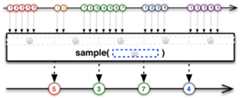
Observable<Integer>burstySampled =bursty.sample(500,TimeUnit.MILLISECONDS);
ThethrottleFirst operator is similar, but emits not the most recently emitted item, but the first item that was emitted after the previous "dip":
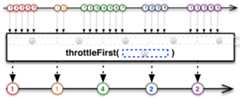
Observable<Integer>burstyThrottled =bursty.throttleFirst(500,TimeUnit.MILLISECONDS);
Thedebounce operator emits only those items from the source Observable that are not followed by another item within a specified duration:
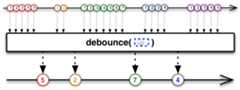
Observable<Integer>burstyDebounced =bursty.debounce(10,TimeUnit.MILLISECONDS);
You can also use an operator likebuffer( ) orwindow( ) to collect items from the over-producing Observable and then emit them, less-frequently, as collections (or Observables) of items. The slow consumer can then decide whether to process only one particular item from each collection, to process some combination of those items, or to schedule work to be done on each item in the collection, as appropriate.
The following diagrams show how you could use each of these operators on the bursty Observable shown above.
You could, for example, close and emit a buffer of items from the bursty Observable periodically, at a regular interval of time:
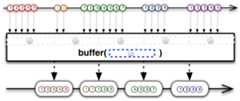
Observable<List<Integer>>burstyBuffered =bursty.buffer(500,TimeUnit.MILLISECONDS);
Or you could get fancy, and collect items in buffers during the bursty periods and emit them at the end of each burst, by using thedebounce operator to emit a buffer closing indicator to thebuffer operator:
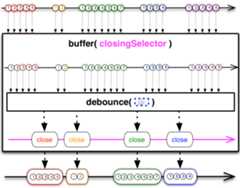
// we have to multicast the original bursty Observable so we can use it// both as our source and as the source for our buffer closing selector:Observable<Integer>burstyMulticast =bursty.publish().refCount();// burstyDebounced will be our buffer closing selector:Observable<Integer>burstyDebounced =burstMulticast.debounce(10,TimeUnit.MILLISECONDS);// and this, finally, is the Observable of buffers we're interested in:Observable<List<Integer>>burstyBuffered =burstyMulticast.buffer(burstyDebounced);
window is similar tobuffer. One variant ofwindow allows you to periodically emit Observable windows of items at a regular interval of time:
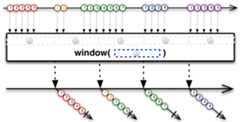
Observable<Observable<Integer>>burstyWindowed =bursty.window(500,TimeUnit.MILLISECONDS);
You could also choose to emit a new window each time you have collected a particular number of items from the source Observable:
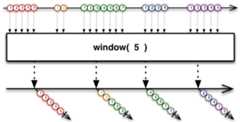
Observable<Observable<Integer>>burstyWindowed =bursty.window(5);
Another way of handling an overproductive Observable is to block the callstack (parking the thread that governs the overproductive Observable). This has the disadvantage of going against the “reactive” and non-blocking model of Rx. However this can be a viable option if the problematic Observable is on a thread that can be blocked safely. Currently RxJava does not expose any operators to facilitate this.
If the Observable, all of the operators that operate on it, and the observer that is subscribed to it, are all operating in the same thread, this effectively establishes a form of backpressure by means of callstack blocking. But be aware that many Observable operators do operate in distinct threads by default (the javadocs for those operators will indicate this).
When you subscribe to anObservable with aSubscriber, you can request reactive pull backpressure by callingSubscriber.request(n) in theSubscriber’sonStart() method (wheren is the maximum number of items you want theObservable to emit before the nextrequest() call).
Then, after handling this item (or these items) inonNext(), you can callrequest() again to instruct theObservable to emit another item (or items). Here is an example of aSubscriber that requests one item at a time fromsomeObservable:
someObservable.subscribe(newSubscriber<T>() {@OverridepublicvoidonStart() {request(1); }@OverridepublicvoidonCompleted() {// gracefully handle sequence-complete }@OverridepublicvoidonError(Throwablee) {// gracefully handle error }@OverridepublicvoidonNext(Tn) {// do something with the emitted item "n"// request another item:request(1); }});
You can pass a magic number torequest,request(Long.MAX_VALUE), to disable reactive pull backpressure and to ask the Observable to emit items at its own pace.request(0) is a legal call, but has no effect. Passing values less than zero torequest will cause an exception to be thrown.
Backpressure doesn’t make the problem of an overproducing Observable or an underconsuming Subscriber go away. It just moves the problem up the chain of operators to a point where it can be handled better.
Let’s take a closer look at the problem of the unevenzip.
You have two Observables,A andB, whereB is inclined to emit items more frequently thanA. When you try tozip these two Observables together, thezip operator combines itemn fromA and itemn fromB, but meanwhileB has also emitted itemsn+1 ton+m. Thezip operator has to hold on to these items so it can combine them with itemsn+1 ton+m fromA as they are emitted, but meanwhilem keeps growing and so the size of the buffer needed to hold on to these items keeps increasing.
You could attach a throttling operator toB, but this would mean ignoring some of the itemsB emits, which might not be appropriate. What you’d really like to do is to signal toB that it needs to slow down and then letB decide how to do this in a way that maintains the integrity of its emissions.
The reactive pull backpressure model lets you do this. It creates a sort of active pull from the Subscriber in contrast to the normal passive push Observable behavior.
Thezip operator as implemented in RxJava uses this technique. It maintains a small buffer of items for each source Observable, and it requests no more items from each source Observable than would fill its buffer. Each timezip emits an item, it removes the corresponding items from its buffers and requests exactly one more item from each of its source Observables.
(Many RxJava operators exercise reactive pull backpressure. Some operators do not need to use this variety of backpressure, as they operate in the same thread as the Observable they operate on, and so they exert a form of blocking backpressure simply by not giving the Observable the opportunity to emit another item until they have finished processing the previous one. For other operators, backpressure is inappropriate as they have been explicitly designed to deal with flow control in other ways. The RxJava javadocs for those operators that are methods of the Observable class indicate which ones do not use reactive pull backpressure and why.)
For this to work, though, ObservablesA andB must respond correctly to therequest(). If an Observable has not been written to support reactive pull backpressure (such support is not a requirement for Observables), you can apply one of the following operators to it, each of which forces a simple form of backpressure behavior:
- onBackpressureBuffer
- maintains a buffer of all emissions from the source Observable and emits them to downstream Subscribers according to therequests they generate
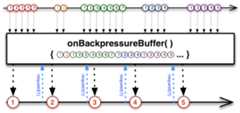
an experimental version of this operator (not available in RxJava 1.0) allows you to set the capacity of the buffer; applying this operator will cause the resulting Observable to terminate with an error if this buffer is overrun - onBackpressureDrop
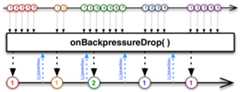
- drops emissions from the source Observable unless there is a pendingrequest from a downstream Subscriber, in which case it will emit enough items to fulfill the request
- onBackpressureBlock(experimental, not in RxJava 1.0)
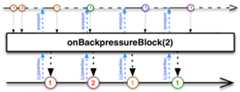
- blocks the thread on which the source Observable is operating until such time as a Subscriber issues arequest for items, and then unblocks the thread only so long as there are pending requests
If you do not apply any of these operators to an Observable that does not support backpressure,and if either you as the Subscriber or some operator between you and the Observable attempts to apply reactive pull backpressure, you will encounter aMissingBackpressureException which you will be notified of via youronError() callback.
If the standard operators aren't providing the expected behavior,one can write custom operators in RxJava.
Copyright (c) 2016-present, RxJava Contributors.
Twitter @RxJava |Gitter @RxJava