ggplot() initializes a ggplot object. It can be used todeclare the input data frame for a graphic and to specify theset of aesthetic mappings for the plot, intended to be common throughout allsubsequent layers unless specifically overridden.
Usage
ggplot(data=NULL, mapping=aes(),..., environment=parent.frame())Arguments
- data
Default dataset to use for plot. If not already a data.frame,will be converted to one by
fortify(). If not specified,must be supplied in each layer added to the plot.- mapping
Default list of aesthetic mappings to use for plot.If not specified, must be supplied in each layer added to the plot.
- ...
Other arguments passed on to methods. Not currently used.
- environment
![[Deprecated]](/image.pl?url=https%3a%2f%2fggplot2.tidyverse.org%2freference%2f..%2freference%2f..%2freference%2ffigures%2flifecycle-deprecated.svg&f=jpg&w=240) Used prior to tidyevaluation.
Used prior to tidyevaluation.
Details
ggplot() is used to construct the initial plot object,and is almost always followed by a plus sign (+) to addcomponents to the plot.
There are three common patterns used to invokeggplot():
ggplot(data = df, mapping = aes(x, y, other aesthetics))ggplot(data = df)ggplot()
The first pattern is recommended if all layers use the samedata and the same set of aesthetics, although this methodcan also be used when adding a layer using data from anotherdata frame.
The second pattern specifies the default data frame to usefor the plot, but no aesthetics are defined up front. Thisis useful when one data frame is used predominantly for theplot, but the aesthetics vary from one layer to another.
The third pattern initializes a skeletonggplot object, whichis fleshed out as layers are added. This is useful whenmultiple data frames are used to produce different layers, asis often the case in complex graphics.
Thedata = andmapping = specifications in the arguments are optional(and are often omitted in practice), so long as the data and the mappingvalues are passed into the function in the right order. In the examplesbelow, however, they are left in place for clarity.
See also
Thefirst steps chapter of the online ggplot2 book.
Examples
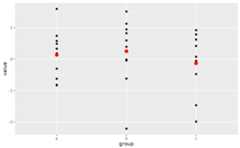
# Create a data frame with some sample data, then create a data frame# containing the mean value for each group in the sample data.set.seed(1)sample_df<-data.frame( group=factor(rep(letters[1:3], each=10)), value=rnorm(30))group_means_df<-setNames(aggregate(value~group,sample_df,mean),c("group","group_mean"))# The following three code blocks create the same graphic, each using one# of the three patterns specified above. In each graphic, the sample data# are plotted in the first layer and the group means data frame is used to# plot larger red points on top of the sample data in the second layer.# Pattern 1# Both the `data` and `mapping` arguments are passed into the `ggplot()`# call. Those arguments are omitted in the first `geom_point()` layer# because they get passed along from the `ggplot()` call. Note that the# second `geom_point()` layer re-uses the `x = group` aesthetic through# that mechanism but overrides the y-position aesthetic.ggplot(data=sample_df, mapping=aes(x=group, y=value))+geom_point()+geom_point( mapping=aes(y=group_mean), data=group_means_df, colour='red', size=3)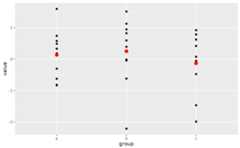 # Pattern 2# Same plot as above, passing only the `data` argument into the `ggplot()`# call. The `mapping` arguments are now required in each `geom_point()`# layer because there is no `mapping` argument passed along from the# `ggplot()` call.ggplot(data=sample_df)+geom_point(mapping=aes(x=group, y=value))+geom_point( mapping=aes(x=group, y=group_mean), data=group_means_df, colour='red', size=3)
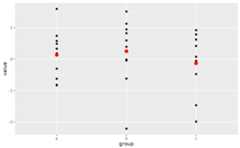 # Pattern 3# Same plot as above, passing neither the `data` or `mapping` arguments# into the `ggplot()` call. Both those arguments are now required in# each `geom_point()` layer. This pattern can be particularly useful when# creating more complex graphics with many layers using data from multiple# data frames.ggplot()+geom_point(mapping=aes(x=group, y=value), data=sample_df)+geom_point( mapping=aes(x=group, y=group_mean), data=group_means_df, colour='red', size=3)