RGL e-Book Cover©
Roy Glashan's Library
Non sibi sed omnibus
Go to Home Page
This work is out of copyright in countries with a copyright
period of 70 years or less, after the year of the author's death.
If it is under copyright in your country of residence,
do not download or redistribute this file.
Original content added by RGL (e.g., introductions, notes,
RGL covers) is proprietary and protected by copyright.
RGL e-Book Cover©

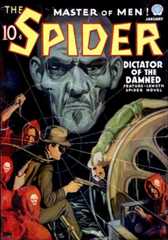
The Spider, January 1937, with "Dictator of the Damned"
With appalling suddenness, a new hoodedmonster of crime unleashed swift murder and soul-chilling madnessupon Manhattan. His army of assassins struck with wanton savageryto lash terrified millions into a paralysis of fear. The Dictatorheld sway!—and Richard Wentworth, the avenging Spider,driven to the ambuscades of the underworld, faced the vortex ofsudden peril alone.
YOUNG Frank Dunning was visibly nervous as hetooled the long limousine expertly in to the curb before hisemployer's residence on Madison Avenue. He threw a quickglance over his shoulder, as if fearing the quick, deadly burstof a submachine-gun from somewhere in the obscurity of theshadows across the street.
He slid swiftly out from behind the wheel, and held the dooropen for the Honorable Howard Appleton to alight. At the sametime he carefully scanned the pedestrians who were passing. TheHonorable Howard Appleton dismissed him and hurried up the stepsof the old brownstone residence.
Frank Dunning, eyeing his broad back, thought with admirationthat his employer was a very brave man. For Howard Appleton waswalking in the shadow of death. Only that evening he had acceptedthe post of police commissioner of the City of New York—apost which, to Frank Dunning's mind, carried with it thethreat of death. Appleton was the third incumbent of thatposition in the last ten days.
Young Dunning's mind flew back to the first of thosetwo. Patrick Sargent had been found dead of poison two days afterbeing appointed; and there was little reason to suspect thatSargent had taken his own life. Then, Harlan Foote, the secondappointee, had suddenly been afflicted with a mental ailment thatrequired his removal to an insane asylum. Now, Howard Appleton, aformer fighting District Attorney of New York County, hadaccepted the job.
Dunning's eyes were troubled. But momentarily he forgothis caution as he saw his employer safely on the top step,thumbing the buzzer. He breathed a sigh of relief, got into thelimousine, and started away.
Neither he nor Appleton saw the two slowly moving sedans thatcrawled up Madison Avenue. The first warning they had was thewicked, spatting sound of a silenced revolver.
A black hole appeared as if by magic between Appleton'sshoulder blades. He uttered a tortured gasp and clutched at histhroat. Blood suddenly flecked his lips. He tried to shout, butno sound came from his throat except a muted gurgle. Hestaggered, his knees buckled under him, and he collapsed beforehis own door. He twitched convulsively, stiffened—and laystill.
The Honorable Howard Appleton, formerly District Attorney, andnewly appointed Commissioner of Police, was dead.
SEVERAL people passing in the street began to shout.Frank Dunning braked the limousine to a stop and leaped to thepavement. He sprang across the sidewalk and up the three shortstairs to kneel beside the body of his employer. The two slowlymoving cars which had just passed also pulled up short. Four menemerged from them, two from each.
A large crowd gathered almost at once, miraculously, as iffrom nowhere. The two men from the first of the two cars pushedconfidently through the crowd, making directly for the stoop. Thesecond pair, lost in the crowd for a moment, soon joined theircompanions beside the body of Appleton.
The door of the brownstone was open now, and Appleton'smanservant, Brock, appeared. Brock was tall, saturnine. Noexpression of any sort flickered across his face as he saw thedead body of his master. He glanced up, and his eyes flitted fromone to the other of the four men who had come from the twosedans. Then his gaze rested on Dunning. He said savagely:"Damn you, Dunning, I didn't think you'd doit!"
The young chauffeur flushed, stepped around the body ofAppleton and stood toe to toe with the servant, glaring athim.
His big, capable fists were knotted, and he said hotly:"You say anything like that again, Brock, and I'llshove your teeth down your lying throat!"
Brock smiled thinly and shrugged. "I'll talk atthe proper time."
Police were coming from both directions on Madison Avenue now,and a radio car pulled in at the curb. A few minutes later a carfrom the precinct station house also arrived
Young Dunning exclaimed: "Damn you, if youthink—"
The two men who had descended from the first of the passingsedans moved inconspicuously up on either side of Dunning."That's all right, buddy. You just stick aroundhere." Their hands gripped the chauffeur's elbowstightly.
"W-who are you?" Frank demanded. His face had gonesuddenly white.
The two men flipped open their coats, exhibiting shields."We're Sorenson and Masters of the Five-StarDetective Agency. Appleton hired us to act as bodyguards when hewas appointed Commissioner. We got here just a minute toolate—but in plenty of time to see enough to fry you, Mr.Chauffeur!"
"You couldn't have seen anything!" FrankDunning exclaimed with growing consternation. "I swear Ididn't kill him—"
He was interrupted by one of the two men who had alighted fromthe second sedan. This man was dressed in impeccable eveningclothes, and he carried himself with an air of great authority.He was in his middle fifties. His name was Hugh Varner, and hewas known throughout the city as the attorney for the bankingsyndicate which floated municipal loans. Varner's companionwas Stephen Pelton, the City Comptroller.
Varner glanced sidewise at Pelton as if for confirmation ofwhat he was going to say, then addressed the two detectives,Sorenson and Masters. "I think if you gentlemen will lookin poor Mr. Appleton's limousine, you will find evidenceagainst this young man," he said. "We were coming tovisit poor Howard, to congratulate him on his appointment, andthe first thing we knew that anything was happening was whenHoward fell forward with that hole in his back. Pelton and Iglanced toward the limousine, and we saw Dunning here, bendingover as if he were doing something at the bottom of his car. Isuggest you look there—"
He stopped as Sergeant Thayer, of Homicide, pushed through thecrowd. Thayer was a grizzled veteran of twenty years'service in the Department, and he had little respect for wealthor position. It was due to his extreme brusqueness, and to hisdislike for toadying to those in authority, that he had notadvanced beyond the position of sergeant. Now he demandedgruffly: "What happened here? Who shot Appleton?"
The two detectives, Sorenson and Masters, retaining their gripon Frank Dunning's elbows, quickly gave the sergeant aresume of what had occurred. Then Hugh Varner repeated his storyof having seen Dunning place something in the bottom of thecar.
Without a word, Thayer turned brusquely around and pushedthrough the crowd to where Dunning had left the limousine. Heopened the door, peered in under the wheel, and whistled. Thefloorboard was loose, and the rubber mat that covered it wasbuckled in several places as if it had been replaced in a hurry.Thayer pulled back the mat, unscrewed the single nut that heldthe floorboard and lifted it up.
There, resting on the battery, was a long-barreled high-caliber revolver, to the muzzle of which was attached a latemodel silencer.
Very carefully, Thayer lifted the gun out of the receptacle,his handkerchief wrapped around the barrel. He carried it throughthe gaping throng, up the steps of the dead man's house,and thrust it under the nose of Frank Dunning.
He growled: "Looks like you rushed yourself a little,Dunning. You might have gotten away with it if you had smoothedout the mat a little better. I guess this will cookyou."
Dunning shouted feverishly, desperately: "I didn'tput it there, Sergeant. I swear to God I didn't!"
Thayer said softly: "Dunning, I arrest you for themurder of Howard Appleton. I warn you that anything you say maybe used against you!"
TEN minutes had elapsed since young Frank Dunning had drivenHoward Appleton up to the curb in the limousine. Life and deathhad marched on inexorably in those ten minutes.
And across at the other end of town, the man who was known astheSpider did not as yet know that at that moment therewas being woven a weird pattern of murder and madness and fear,which would once more drag him into the vortex of sudden peril,upon which he was about to turn his back.
IN the beautifully appointed penthouse apartmentabove the small nine-story building which he owned, RichardWentworth,alias theSpider, was entertainingfriends at a late supper. They were seated about the snowy-whitetables, sipping a priceless liqueur which Wentworth himself hadbrought back from Tibet years before.
Directly opposite him, at the foot of the table, sat StanleyKirkpatrick, onetime Commissioner of Police. At Wentworth'sright hand sat the woman Wentworth loved—Nita Van Sloan,whose fine-textured, copper-bronze hair reflected a hundredfacets of light from the brilliant fixtures high up in theceiling.
At Wentworth's left sat a little girl, golden-haired,demure. She was no more than ten, but she bore herself with allthe grace of a great lady. Purposely, she was modeling herselfupon the gestures and mannerisms of her heroine, Nita Van Sloan.This little girl was Elaine Robillard. Not so long ago, adreadful blight had descended upon the city in the shape of onewho called himself the Living Pharaoh. Wentworth and Nita hadfought this Living Pharaoh through three months of cruel,merciless warfare. In the end they had conquered; but one of thecasualties was little Elaine Robillard, who had been left anorphan. Now, Nita Van Sloan had adopted the child. It was agesture indicative of Nita's steadfast love of Wentworth.For, since he had dedicated his life to a constant battle againstcrime, there could be no marital happiness for either of them.Nita found her natural urge for motherhood partially satisfied bythe adoption of Elaine.
There were three other men in the room. They wereWentworth's personal servants. One, a huge, bearded Sikh,was garbed in the traditional costume of the high-caste Hindu,with a ceremonial turban wound about his head. His long beard wascarefully trimmed, and a jewel-hilted dagger rested in a sheathat his belt. The other two were Jenkyns, his butler, and Jackson,his chauffeur.
All three of these men were as devoted to Richard Wentworth asit is possible for one human being to be to another. Jenkyns hadserved Wentworth's father before him. Jackson had beenunder Major Wentworth's command in France, and the tiesthat lay between them were far greater than those of master andservant. As for Ram Singh, the Sikh came from a long line ofwarriors, and his fierce pride was a thing he would defend withhis life. Yet he found it not inconsistent to be in the serviceof Richard Wentworth, whom he respected as a warrior greater thanhimself.
Jenkyns had just finished pouring the liqueur, and was restingwith the decanter. Ram Singh and Jackson had entered the room amoment before, and were standing at the door.
Ex-Commissioner Kirkpatrick was about to raise his glass, whenWentworth stopped him. "Just a moment, Kirk. I have anannouncement to make. But first—" He arose, pushinghis chair back, and faced his three servants. His voice assumedthe curt ring of command. "Jenkyns! Jackson! RamSingh!"
THE three loyal servants drew themselves up to attention.Wentworth went on: "Jenkyns, you will pour three moreliqueurs, and set three more chairs at the table. Then, you threewill seat yourselves."
The old butler looked slightly dismayed. Jackson was shocked.And Ram Singh spread his hands, palms upward, in a gesture ofnegation. "Nay,sahib, we are but servants,"he protested. "A servant does not sit at the same boardwith his master!"
Wentworth's eyes were glowing, and his voice throbbedwith emotion. "You three are far more than servants. Wehave all gone through so much together that there can be noquestion of master and servant between us. Seatyourselves."
"But, sir," Jenkyns exclaimed, "it'sagainst all precedent—"
"We can listen to you standing up, Major," Jacksonsaid.
"And it will be more seemly," Ram Singh added,"in deference to your distinguished company." Hebowed slightly toward Commissioner Stanley Kirkpatrick.
Richard Wentworth's eyes regarded the threeaffectionately. A smile hovered at his lips, but he quicklysuppressed it. Sternly he rapped: "An end to thisdiscussion. You will seat yourselves. It is an order!"
Ram Singh glanced at the other two servants, then shrugged hisshoulders helplessly. "If it is an order,sahib,that is different. An order is an order."
Reluctantly, Jenkyns set three more places, and poured some ofthe golden brown liqueur into three additional glasses Then, asif celebrating a special rite, the three took their places at thetable—Ram Singh and Jackson on the side at which Nita sat,and Jenkyns next to little golden-haired Elaine Robillard. Theysat stiffly, ill at ease.
Elaine clapped her hands gleefully. "Fine! Now we areall like a great big family. Jenkyns is nice, and so is Jackson.But I like Ram Singh best. He lets me pull his beard!"
They all smiled, and then Richard Wentworth got to his feet.He looked around the table slowly.
Elaine Robillard knew him only as Richard Wentworth, a wealthygentleman who had been incredibly good to her. Nita Van Sloan,Jackson, Jenkyns and Ram Singh knew that he was also theSpider. They had fought with him, risked their lives, withand for him, a hundred times. They were completely in hisconfidence, and they knew that on the occasions when RichardWentworth disappeared unaccountably from his usual haunts,somewhere theSpider was working alone against crime.
Stanley Kirkpatrick was the only one who did not knowdefinitely that he was theSpider. As Commissioner ofPolice, Kirkpatrick had waged a relentless war against thatscourge of the underworld. He more than suspected his trueidentity, and when he was Commissioner he had as much as toldWentworth that if he ever got the goods on theSpider hewould prosecute him without mercy; for theSpider'sunorthodox method of dealing with criminals had placed himoutside the pale of the law. But on many an occasion the twoblazing guns of that mysterious and dreaded character had cutshort the cruel and vicious lives of underworld nabobs whom thered tape of the law had been unable to reach.
Now Richard Wentworth saw that the faces of all these peoplewere fixed upon him questioningly. They were wondering whatimportant announcement he was about to make, and for which he hadset the stage so carefully. He spoke to them in a low voice whichbarely carried beyond the bounds of the table.
"My friends," he said, "we have all of uslived through some very perilous and some very exciting times. Inour association we have learned to love and respect one another.You, Kirk, were a brave and efficient police commissioner. No onecan blame you if you resigned at last, because you are richlyentitled to the rest that you are going to enjoy. In the war withthe man who called himself the Living Pharaoh, we were all closeto death. By a miracle we triumphed, and now the city is rid ofthe menace of that super-criminal.
"I, too, want a rest. I feel that the time has come whenI can retire from the work that I have been doing. The underworldis quiet, except for a few occasional crimes. Ram Singh, Jackson,Jenkyns, I am releasing you three from service. I haveestablished a trust fund for all of you, which will give you anincome amply sufficient to live in comfort for the rest of yourlives."
There was a stunned silence around the table. It was broken atlast by Jackson.
"But, sir, you can't let us go," he burstout. "It's not the money we want. You know we'dnever be happy if we weren't working foryou—"
Wentworth raised a hand to silence him. He glanced down atNita Van Sloan, and she nodded, lowering her eyes. Wentworthsmiled and addressed the gathering once more. "The reason Iam releasing you three from service will become apparent when Imake the next announcement. Nita and I are going to be married.We are going to take Elaine with us on a cruise around theworld!"
Slowly, Wentworth sat down and placed a hand over Nita'sslim one. Little Elaine cried out joyously: "Hurrah!Hurrah! We'll see all those beautiful countries that theytell about in the geography book!"
JENKYNS furtively brushed the back of his hand across hiseyes. Jackson was grinning broadly. And Ram Singh said in hisdeep booming voice: "Inshallah! It is a good thing.There are no two in the world who would make a better match. Wethree servants will resign ourselves to live alone."
Stanley Kirkpatrick arose from his seat. His voice was a bitunsteady. "You two have richly deserved this. I trust thatyou will lead a full and happy life." He raised his liqueurglass, and his eyes rested on Nita. "I drink to a mostbrave and beautiful lady!"
They all raised their glasses and drank the toast. ThenWentworth leaned over and kissed Nita lightly on the lips.
Ram Singh said with a sly look in his eyes: "And theSpider, Master? What of theSpider? Does he, too,retire?"
They all tensed, watching Wentworth. His face suddenly becamehard. He said harshly: "TheSpider, my friends, isdead! Let him remain the myth and the legend that he always hasbeen. Let us forget that there ever was such a person as theSpider."
Kirkpatrick sighed. "Let's drink one moretoast," he said. "Let's drink to the hope thattheSpider will never walk again!"
Just then, the buzzer in the foyer rang, announcing a caller.They looked at each other questioningly. Nita Van Sloan grewpale. She put an impulsive hand on Wentworth's sleeve.
"Dick! Don't answer it! I have a strange feeling.Something tells me it's—"
Abruptly, her voice dropped. "Dick, I knew it was toogood to be true." The words came from her lips as if shewere uttering a dire prophecy. "I'm afraid—theSpider—will—walk again!"
THE buzzer sounded once more, and Jenkyns half rose from hisseat, glancing at Wentworth for instructions. Dick nodded, andthe old servant made his way around the table, left the room inthe direction of the foyer. The others sat silent. They were allimpressed by the sudden feeling of foreboding which had assailedNita. They knew very well from past experience that thosepremonitions of hers usually bore fruit.
In a moment, Jenkyns returned and announced: "MayorLarrabie calling to see Mr. Wentworth—"
He was interrupted by the abrupt entrance of a short, stocky,florid-faced man. This was Mayor Phillips Larrabie, who had beenelected only recently on a reform ticket following the sweepingrevulsion of the city at the long list of crimes which theprevious administration had countenanced. Larrabie had sworn,upon taking office, to rid the city of crime and to drive everymember of the underworld out of the Metropolitan District. But sofar he had been unable to find a commissioner to take the job ofdirecting the Police Department in its work.
Now Larrabie advanced quickly into the room, walking withshort, jerky steps. He glanced around the room, nodded insatisfaction when he saw Kirkpatrick, then hurried over toWentworth and grasped his hand. He spoke in the quick, sharpaccent of a busy man who always knew what he wanted and wentafter it as directly as he could.
"You must excuse me for breaking in on you this way,Wentworth. I assure you that only a grave emergency would haveinduced me to do so."
Wentworth smiled tolerantly, and pressed the Mayor'shand. "You're always welcome here, Larrabie. I wantyou to meet Miss Van Sloan, my fiancée, little Elaine Robillard,Ram Singh, Jackson, and Jenkyns. You know Stanley Kirkpatrick, ofcourse. These are all old friends of mine, and I'm surethey will all join me in asking you to have a drink with us,especially as Miss Van Sloan and I are soon to be married, andmake a trip around the world."
"No, no," Larrabie said quickly. "Nothingwould please me more than to drink with you, but you must excuseme. I've come here on an extremely serious matter."His gaze met squarely that of the ex-commissioner across thelength of the table. "Stanley Kirkpatrick, I would like totalk to you privately. No doubt, these good people will excuseus—"
Kirkpatrick stretched a hand across toward him. "Sitdown, Larrabie. I have no secrets from anyone in this room. Youmust feel free to talk before them."
Larrabie bit his lip in vexation, then shrugged and took theseat which Jenkyns had provided for him.
"All right!" he snapped. "I called yourhome, and they told me you were here so I came directly, withouttelephoning. I'll tell you what I want in anutshell." He leaned over the table, and there was a queergleam in his eye. "Stanley Kirkpatrick, I want to appointyou Police Commissioner of New York City. And I want you toaccept!"
Kirkpatrick's face set sternly. "No, Larrabie. Iwon't do it. I've been through enough, and I'mgoing to take a rest. There are plenty of men in New York whowill be glad to take the job. You don't need me."
"But Ido need you, Kirkpatrick. I need youbadly. I'm going to give you an idea of how badly I needyou." Larrabie kicked back his chair and arose. He placedboth hands on the table and leaned over to emphasize his words."Six days ago I appointed Patrick Sargent policecommissioner. He died of poison. Four days ago I appointed HarlanFoote to the post of Commissioner. Foote becameinsane."
Kirkpatrick nodded. "We all know that. They wereunfortunate occurences—"
Larrabie smiled twistedly. "You think they wereaccidents? Let me tell you this. Today I appointed HowardAppleton to the commissionership.At eleven forty-twoo'clock tonight, Howard Appleton was shot to death on thesteps of his own home!"
Larrabie waited while the full force of that announcementstruck home to those around the table. Silently, RichardWentworth and Nita Van Sloan exchanged understanding glances.This was the thing that Nita had feared when the doorbellsounded. When catastrophe struck three times like this in quicksuccession, it could be no accident. There was something deeplysinister underlying the sudden madness of one, and the death oftwo newly appointed police commissioners.
Larrabie nodded, reading their thoughts. "You get theidea. There is something more than appears on the surface here.There've been a few isolated holdups in the city during thelast week, crimes that might be attributed to occasionalgangsters. But I think that they are directed from a singlesource—the same source that is eliminating each newcommissioner as fast as I appoint him.
"There've been rumors in the underworld about ahooded master—a dictator of the underworld, a man whointends to force me or trick me into eventually appointing apolice commissioner whom he can handle. I'm going to foolthis dictator. I'm going to appoint Stanley Kirkpatrick ascommissioner."
Nita Van Sloan exclaimed: "You want to put Kirk indanger? If three men have already been killed, what is there toprevent Mr. Kirkpatrick from meeting the same fate?"
Larrabie sighed. "Yes, I'm putting Kirk on thespot. But I think I'm outsmarting this dictator by doing itthis way. Do you know why?"
Kirkpatrick looked uneasily across the table at Wentworth andNita, but said nothing.
Larrabie went on impetuously: "You see, I know thatwhile Kirkpatrick was in charge of the Police Department, acertain very notorious character was very active in aiding himagainst the underworld."
He spoke slowly now, as if wishing to impress every word hesaid upon his hearers. And as he spoke, he allowed his gaze totravel around the table and to rest significantly uponWentworth.
"That notorious character was theSpider. I feelthat if Kirkpatrick becomes commissioner, theSpider willtake an interest in the situation. And, my friends, I think thesituation is serious enough to warrant such intervention. As anofficer of the law, as the chief executive of this city, I cannotopenly enlist the services of theSpider. But Icanappoint theSpider's best friend asCommissioner!"
Kirkpatrick wiped perspiration from his forehead. "Whatmakes you think that theSpider is my friend? Doyou—er—know who theSpider is?"
Larrabie smiled twistedly. "I have a goodidea—" once more his gaze returned toWentworth—"but I wouldn't want to make astatement unsupported by fact. I will say, however, that if theSpider is looking for excitement, he will find it in thiscity,without taking any trip around the world."
Wentworth stiffened. Larrabie, like some few others, guessedthat he was theSpider. Wentworth was not worried by thatso much as by the sudden challenge that had been laid at his doorby Larrabie.
And in the eyes of Nita Van Sloan there was a sudden dawningfear. When Richard Wentworth looked like that, he wasn'tthinking of love, or of trips around the world, or of peacefuland complacent happiness; he was thinking of battle, of swiftadventure and of sudden death. And Nita's heart throbbed infierce revolt beneath her breast. Now, on the threshold ofhappiness, she was to be denied it. Why,why did thisthing have to come up just at this moment? Couldn'tLarrabie have waited until tomorrow? By that time they would havebeen on the high seas.
KIRKPATRICK was talking now, low-voiced, moody. "Soyou want me on the job, Larrabie, in order to enlist the supportof theSpider? You hope that theSpider will exerthimself to protect me, and in event that I'm killed, youthink that theSpider will avenge me by going after thisdictator of yours?"
Larrabie struck the table with his fist. "By God,Kirkpatrick, I'll protect you plenty. I'm not goingto have the same thing happen to you that happened to the otherthree. If you accept, you're coming downtown with me, andI'll give you a bodyguard of the best men the Departmenthas. Not only that, but I'll give you a free hand.Regardless of whether theSpider comes into this or not,you are the only man who can cope with the present situation.
"Kirkpatrick, it's your duty to accept the job.The city needs you.What do you say?"
Stanley Kirkpatrick hesitated. It was very evident that astruggle was going on within him. He had been through a good dealin the days of the hectic fight against the Living Pharaoh.Unjustly accused of murder, he had been deprived of his positionand incarcerated in jail. Only by Wentworth's cleverstrategy was he finally cleared of that charge. Disillusioned andweary, he had been glad to find rest in retirement. Now he wasbeing virtually forced back into public life.
He drummed nervously with his fingertips on the table.Larrabie saw his hesitation and urged: "I've givenyou all the facts, Kirkpatrick. You know what you are going toface. They will try to get you, the way they got Sargent andFoote and Appleton. If I thought you were a coward, I would neverhave asked you in the first place, and I wouldn't have putthe cards on the table the way I did."
Suddenly Kirkpatrick raised his eyes. He spoke in a low,decisive voice. "I'll take the job,Larrabie!"
The Mayor sighed in relief. "Good! I knew youwouldn't fail me. Come on. We'll go down toheadquarters right now, and I will install you. And I'llsee that you're damn well guarded!"
Slowly Kirkpatrick arose and walked around the table. Nita andRichard Wentworth also arose, and he shook hands with Nita, thenwith Wentworth. Kirkpatrick said significantly: "Idon't want this to stop you, Dick, from taking that cruisearound the world. I don't think it's as serious asLarrabie makes out."
Wentworth said nothing. But Nita and Kirkpatrick both knewthat Wentworth would not leave for any world cruise while hisfriend was entering upon a period of danger.
Larrabie and Kirkpatrick drank one toast with the others tothe success of the new Commissioner, and then the two of themleft. When the door closed Nita said, with a catch in her voice:"Dick, does it mean—"
He looked at her somberly. "I'm afraid so,darling. Would you want me to leave now?"
She sighed. "I suppose not. I suppose I couldn'tlove you the way I do if you were the kind of man to leave yourfriend when he needs you. But it all seems so unfair!"
Dick Wentworth said nothing. He looked preoccupied. He pressedNita's arm, said abstractedly: "This set-updoesn't look right to me. Excuse me, Nita."
He left her side swiftly, and hurried toward a corner of theroom where a queer-looking mirror stood on a low table. Thismirror was part of a complicated periscope arrangement by whichWentworth could see everything that went on down in the streetbelow, as well as around both corners of the building. Theperiscope mirrors were arranged in a false drain pipe in such away that it was almost impossible for the tenants of the buildingto notice them. From the penthouse windows there was a clear viewof the Hudson River and of the Jersey shore on the otherside.
But Wentworth paid no attention to that now. He gazed into theperiscope, and his face tautened. He said reflectively:"That's funny. I've never seen a hearse withportholes before."
Suddenly he jerked away from the periscope, his eyes blazingwith excitement.
"Ram Singh! Jackson!" he exclaimed. "Yourhigh-powered rifles, quick! There's a hearse slowly movingtoward the doorway of this building from the corner. Stop it ifyou can!"
HIMSELF he raced across the room, while Nita and ElaineRobillard watched him, wide-eyed. In the foyer he slipped open adrawer of the telephone table and snatched out two blued-steelColt automatics, then launched himself out through the front doorinto the hall. Fortunately, there were two self-service elevatorsserving the penthouse. Wentworth had been careful to see that hehad the additional elevator in case of emergency. The indicatorof one of the two elevators showed that it was just passing thesecond floor on its way to the lobby. The second elevator was atthe penthouse floor, and Wentworth swung into it, jabbed hard atthe ground-floor button.
As the door swung shut, he caught a last glimpse of Ram Singhand Jackson, through the open door of the apartment. They wereracing toward the terrace of the penthouse, carrying their longrifles, with which they were crack shots. Then the cage began toslide downward.
Wentworth's body was taut as he reached the groundfloor. He had slipped off the safety catches on both automatics,and now he swung open the door, leaped out into the lobby, bothguns thrust out straight ahead of him. At the doorway he sawKirkpatrick and Larrabie in the act of stepping out onto thesidewalk. And just at that instant the dark bulk of theundertaker's hearse which he had glimpsed from up abovecame pulling slowly in front of the entrance.
Wentworth opened his mouth to shout a warning, but his cry wasdrowned by the sudden sharp staccato barking of machine-guns.
The elevators were at a slight angle from the doorway, andWentworth himself escaped that blast of lead. Ahead of him, hesaw Larrabie suddenly stiffen, then quickly heave againstKirkpatrick, and send the Commissioner sprawling on the floor toone side of the doorway. Larrabie himself was left in theentrance, and his body caught the full blast of that machine-gunbarrage.
Like a tortured thing the body of the Mayor seemed to dance inlive agony as wave after wave of hot lead slammed into him.Wentworth uttered a hoarse cry and raised his automatics, senttwin streaks of blue flame searing in the direction of thehearse. His slugs rebounded harmlessly from shatterproof glass.He saw four open portholes from which four machine-guns dealtlead. He also saw a man in the driver's seat crouching overthe wheel, and beside him another man whose face and head werecovered by a black hood.
Wentworth swerved his guns from the useless fusillade againstthe bulletproof glass, and aimed for the driver. He had only oneshot left in each automatic, and he fired each in quicksuccession. The driver's head seemed to disintegrate underthe two powerfully-propelled slugs. The hearse swerved, careened,and the machine-gun fire suddenly ceased.
Larrabie was on the tiled floor now, writhing feebly, a sparkof life still in his eyes.
Kirkpatrick was picking himself up from the floor whereLarrabie had thrust him. The Commissioner was crawling toward theentrance on all fours. Being in evening dress, he had comeunarmed, and had no gun.
Wentworth's guns were useless, for he had fired the lastshot. But he leaped over the body of the still-quiveringLarrabie, and raced out into the open in time to see the truck,out of control, swerve and smash head-on into the lamppost thirtyfeet beyond the doorway.
From the driver's seat the figure of a man suddenlyerupted. It was the man who wore the hood. He leaped to theground and ran, zigzag, diagonally across the street into thesafety of the shadows of Riverside Park, on the opposite side. Ina moment he had disappeared down the steep slope of thecliff.
The four men who had operated the machine-guns within thehearse leaped out of it and dashed after the hooded man. They hadleft their machine-guns in order the better to escape. But nowthey were pulling revolvers out of their shoulder holsters.
Wentworth disregarded the danger of those revolvers, and racedafter the four fleeing men. One of them turned, snarling, andleveled a gun at him. But the man never had an opportunity tofire. For at that moment a rain of lead spattered onto thesidewalk on all sides of him as well as around the other threegunmen. Ram Singh and Jackson were firing swiftly, with deadlyprecision, from the penthouse overhead.
The two thugs nearest to Wentworth fell, riddled with bullets.The other two ran a few more paces, reached the edge of the cliffabove the railroad tracks, and then toppled over into space asmore slugs from the rifles of the two men on the roof poundedinto them.
Wentworth smiled tightly, but there was a bit ofdisappointment in that smile. Ram Singh and Jackson had surelysaved his life, but the hooded man who must have been the leaderof the gang had escaped. He shrugged, left the bodies of the deadgunmen in the middle of the street, and hurried around to thefront of the hearse.
THE radiator was entirely smashed in, and clouds of hotsteam were pouring from it. The dead man behind the wheel wasunrecognizable, for both of Wentworth's bullets had gonethrough his head, tearing away most of his face. RichardWentworth reached in grimly and turned off the ignition, in orderto prevent the hearse from catching fire. Then he turned andstrode back into the building. His eyes were bleak and hard as heknelt beside the dying Mayor Larrabie. On the other side of himknelt Kirkpatrick. The Commissioner's hands were trembling,and there was sweat on his forehead.
"My God!" Kirkpatrick exclaimed. "He gave uphis life to save me. If he hadn't pushed me out of the way,I'd have got it too!"
Wentworth nodded. "Yes, I saw it. It was a brave thingto do. Larrabie—was a man!"
Abruptly he knelt lower, as he saw the Mayor's eyesflickering, and his lips moving feebly. A mumble was coming fromLarrabie's mouth now, mingled with the gurgling of blood inhis larynx. The tiled floor was being stained a deep crimson byhis life's blood. But there was an uncanny perseverance, astubborn courage that kept the man alive until he had spoken whathe wanted to say. Now his lips were forming a message that he wastrying desperately to get across. Wentworth caught thesewords:
"I—saved Kirk'slife—because—he's needed—more than I, andI—promised him protection..." A wry smile pinched atLarrabie's pallid lips. "I—made—good. Nowhe must fight for me—must fight the Dictator... Iwish—to God—theSpider—would help himtoo..."
A police whistle was sounding outside, and Wentworth motionedto Kirkpatrick, who arose and went to the doorway to meet theuniformed men who had come running. The elevator indicator showedthat one of the cages was at the fifth floor on its way down. Fora moment or two Wentworth would be alone with the dying Mayor. Hebent low, and said clearly, strongly. "Larrabie! Can youhear me?"
The spunky Mayor's eyelids flickered."If theSpider would only help!"
Wentworth suddenly said through clenched teeth:"Larrabie, theSpider will help. You have my wordfor it. TheSpider will avenge you!"
A sudden access of energy seemed to surge through theMayor's body. "You—promise it? How do Iknow—"
The exertion was too much for him. He dropped back to thefloor from which he had pulled himself up, and lay panting.
Wentworth said softly: "This is how you can know it,Larrabie." From his pocket he extracted a platinumcigarette lighter. Swiftly he unscrewed the back of it, exposinga small seal. He pressed this seal upon a drop of the blood thatspattered the floor, and said:"Look!"
There, perfectly etched in the smear of blood, was a miniaturereplica of a spider—the seal of the man who was known andfeared throughout the underworld.
Larrabie's eyes widened. He had seen that seal upon theforeheads of many dead men during the past years. He knew thatwhenever theSpider "executed" a dangerousunderworld character he left that seal of his handiwork upon theman's forehead. And he knew now that Richard Wentworth wastheSpider.
A slow, happy smile spread upon his pain-wracked features. Fora moment it seemed as if he suffered no agony whatsoever. Hiseyes brightened, and he spoke clearly. "Now I can die. NowI know I have not died in vain. Remember,Spider,you—have promised—to avenge me."
Larrabie's eyes closed as if he were weary, and atremendous spasm racked his body. A gurgle sounded in his throat,and he stiffened, his eyes opening wide, staring upward emptily.He was dead.
POLICE were pushing in from the street pastKirkpatrick; Ram Singh and Jackson were coming out of the door ofthe self-service elevator. Wentworth arose swiftly, and scrapedhis foot over the spot of blood where he had imprinted the sealof theSpider
His eye alighted on the corner of a paper of some sort thatwas protruding from the inner pocket of Larrabie's dresssuit. He bent and drew it out.
A hand grasped his shoulder.
A plainclothes detective, who had just come in, seized him bythe arm and whirled him around. "Say, you, what do youthink you're doing?"
The sight of the dead body of the Mayor had caused the policeto see red; and now they were gruffly herding everyone into acorner of the lobby. The plainclothes detective raised a clenchedfist to strike Wentworth. "You give me thatpaper—"
Kirkpatrick interrupted. "It's all right,Dennison," he said mildly. "Mr. Wentworthis—"
Dennison swung on him, snarling. "Never you mind, Mr.Kirkpatrick. We ain't taking orders from you. You'renot the commissioner anymore. This is a case of murder, andI'm going to act—"
He was interrupted by the soft voice of Richard Wentworth, whohad unfolded the document taken from Larrabie's coat."You will excuse me, Detective Dennison, but you aremistaken in your facts. Youare taking orders fromCommissioner Kirkpatrick whether you like it or not. Here is acertified document, signed and attested at the City Hall, whichMayor Larrabie must have executed before coming here. It is anorder appointing Stanley Kirkpatrick Commissioner of Police. Thatmeans, my friend, that you will take orders from CommissionerKirkpatrick until Mayor Larrabie's successor appointsanother commissioner!"
Dennison turned back to Wentworth, his mouth agape. Dick heldup the paper so that the detective could read it.
Kirkpatrick said in an awed voice: "Larrabie knewI'd never be able to refuse him. He had the appointment alldrawn up!"
Dennison saluted awkwardly. "Sorry, Commissioner. I hopeyou will overlook what I said before. I neverknew—"
"That's all right, Dennison. Now suppose you getaround and organize this thing, and leave Mr. Wentworthalone."
Kirkpatrick, now that he was commissioner, swung with smoothease and efficiency into the discharge of his duties. He gavecrisp orders, and in a moment it seemed that he had never beenout of the Police Department.
While he was directing the handling of the body and thesetting up of police lines outside to keep the crowds of curiousaway, Wentworth drew Ram Singh and Jackson out of the building tothe sidewalk. He frowned at them. "What happened to youtwo?" he asked. "You had the rifles—"
Ram Singh lowered his eyes. "Master, only one escapedus—the one with the hood. Of the others, two lie dead herein the street, and the other two have fallen over the side of thecliff. But the man in the hood escaped, because we shot at thoseothers first. We wished to protect you."
Before Wentworth could speak, Nita Van Sloan came hurrying outof the building. She had thrown a cloak over her shoulders, andWentworth's heart skipped a beat as the full force of herbeauty struck him, flushed as she was with excitement and thescent of danger. Her eyes were wide, and she came up toWentworth, put both hands on his chest. "Dick! You'reall right?"
He nodded grimly. "I'm all right, darling. ButLarrabie got it. It was only by a miracle that Kirk is stillalive. Larrabie sacrificed his own life to save Kirk."
Nita said: "What now, Dick? Ourplans—they're all wrecked?"
Soberly, he inclined his head. "I'm afraid so,darling. This looks like war. It seems that everything Larrabiesaid is true. And I've sworn to avenge him."
Nita faced him bravely. "All right, then. We'llwork together—"
She stopped, and her face grew pale. He was shaking his head,smiling grimly.
"No, Nita, we won't work together.I—I've been a fool, letting you risk your life allthose other times. Darling, you're too precious to me. Ifanything happened to you, I—I don't think I could goon. And I've no right to let Ram Singh and Jackson takesuch terrible risks. From now on—" his voice becamehard, with a decisive finality—"from now on, theSpider walks alone."
Nita bowed her head. She recognized that tone. There would beno use arguing the matter with Wentworth now. But Ram Singh andJackson both broke into voluble protestations at once.
Wentworth frowned, and ejaculated sharply: "Ram Singh!Jackson! I have made up my mind. There is no use arguing. I willnot expose my friends to any further risks. I'm leavingnow. You won't hear from me until this is over."
He grasped Ram Singh's hand, pressed it warmly, thenshook Jackson's hand. "I will expect you both to takegood care of Nita. I want nothing to happen to her."
He turned from them, and drew Nita Van Sloan into his arms.Bravely, she smiled up at him as he held her warm, throbbing bodyclose against him. For a moment the whole world dissolved awayfrom these two as they stood there. Wentworth's lips metNita's in a long kiss, and she clung to him, her smallhands gripping hard at his shoulders as if to keep him fromleaving her. At last he tore his lips away from hers.
"Dick! Dick, dear! Must you do it this way? Can'tyou let me fight by your side—"
"No, darling. I want to know that you'll be safeand alive when I come back. Goodbye, darling. Tell Kirkpatrick togo ahead full blast with every facility of the Department againstthis Dictator. Tell him that theSpider will be workingtoo!"
And Wentworth twisted out of Nita's arms, raised a handto Ram Singh and Jackson, and hurried quickly up the street.
The three of them gazed after his broad back for a long momentAnd then Nita Van Sloan suddenly came out of the daze in whichhis abrupt departure had left her. Her voice throbbed withurgency. "Ram Singh! Jackson! Go after him. Follow himeverywhere. I am afraid for him. I know—he goes into greatdanger."
Ram Singh's eyes gleamed with eagerness, and Jacksonsmiled broadly. "You want us to stay on his trail all thetime?"
"Yes, yes. I shall be in no danger. But I have afeeling—that this Dictator is stronger than Dick imagines.Stay with him, you two. Never leave him out of your sight. Butdon't let him know you're following him."
Ram Singh and Jackson needed no second urging. Jackson salutedstiffly, Ram Singh salaamed, and then they both slipped away intothe night after the fast-disappearing figure of RichardWentworth.
For a long time after they had gone Nita Van Sloan stood therein the street, regardless of the bustling police and thenewspaper reporters, of the crowds of curious who had gatheredaround the building. Her little hands were clenched hard at herside, and she blinked her eyes to keep back the suspicion oftears that welled within them. Then, abruptly, raising her chin,she turned back and reentered the building...
IN a room in the basement of police headquarters onCenter Street in New York City, curly-headed young Frank Dunningsat in a chair under a powerful light that nearly blinded him.The room was bare of furniture except for a single table andchair at which sat a police stenographer. Grouped aboutDunning's chair were three plainclothes detectives,together with Sergeant Thayer and Inspector Strong, the head ofthe Homicide Squad.
"You've got to talk!" Thayer was saying."By God, you'll stay here all night and all daytomorrow if you don't talk. I tell you, Dunning,you'll wish you'd never been born if you don'tcome across with the dope!"
Dunning raised haggard eyes to the sergeant. His hair wasruffled, and there was a bloody crack across his lips. He had thelook of a desperate, cornered animal.
"I swear to God, Sergeant, I didn't kill Mr.Appleton. I tell you, I don't know a thing about that gun.I don't know how it got in the car—"
Thayer's rasping laughter cut across Dunning'sfrantic protestations of innocence. "You can't getaway with that stuff, Dunning. Brock, the butler, says you askedAppleton for a raise last week, and you were sore as hell whenyou didn't get it. He says you told him you'd like toknock Appleton's block off. Did you say that, ordidn't you?"
"It wasn't anything like that," the youngchauffeur wailed. "I just said it was a shame hewouldn't give a fellow a raise. I'd been with him sixmonths, and he was only paying me twenty-twodollars—"
"You didn't feel like that when you got thejob," Thayer interrupted. "Your uncle, ArgyleDunning, the President of the Board of Aldermen, got you that jobwith Appleton, didn't he?"
"That's true. My uncle got me the job and I wasgrateful. I never said I'd knock Mr. Appleton's blockoff. Brock is lying." He looked up beseechingly."Won't one of you please get in touch with my uncle?He'll help me—"
"Nix. Argyle Dunning isn't going to know anythingabout where you're being held, until you're arraignedin court tomorrow. We're not letting him send any high-priced lawyers in here to drag you out."
Inspector Strong, who had been watching from a few feet away,now stepped forward. He spoke in the soothing voice of a father-confessor.
"Why don't you confess, my boy? I'm sure itwill go easier with you if you do. You won't have a leg tostand on when you go on trial for murder, if you don't comeclean with us. Those two detectives, Sorenson and Masters, claimthey saw you fire the gun. The bullet in Appleton's bodywas checked by the Ballistics Bureau, and there's no doubtat all that it was fired from that gun you had in the car. Notonly that, but Hugh Varner and Comptroller Pelton both testifythey saw you hiding the gun in the battery compartment.It's an airtight case, Dunning. You'd do well to comeclean."
Frank's voice rose in a hysterical shriek. "Iwon't confess! I tell you, I won't confess. Iwon't admit doing something I never had a hand in. Sorensonand Masters are lying. Varner and Pelton were mistaken. I nevershot Appleton, and I never put that gun in the car."
Strong exchanged significant glances with Sergeant Thayer.Then the Inspector said flatly: "All right, Thayer. Ifthat's the way he feels about it, go to work onhim!"
Sergeant Thayer grinned smugly. "Okay, Inspector.We'll give him the works—from soup to nuts. Before weare through with him, he'll be begging to talk!"
"I needn't tell you," Strong cautioned,"to be careful. Don't leave any marks that will showin court tomorrow."
Thayer nodded. "The boys know their business, Inspector.Leave everything to us."
Dunning plunged up from his seat. "Damn you, leave mealone! I'm innocent—"
Thayer's fist crashed full into his face, sending himsmashing back into the seat, sobbing in frantic helplessness.Thayer nodded to the three plainclothesmen. "Go to work,boys."
Inspector Strong started for the door, but stopped when heheard a discreet tap, and a uniformed attendant entered with aslip of paper. The man's holster at his side was empty ofits revolver, and his face bore a flushed, excited, half-terrified expression.
Inspector Strong rapped out, frowning: "What's thematter, Griggs?"
The man exclaimed: "Gawd, Inspector! TheSpiderwas just here!"
"TheSpider! He was here—and he gotaway?"
"Y-yes, sir. He suddenly appeared out of nowhere in theCharge Room, and he pulled a gun on us and made us all line upagainst the wall. Then he stuck a piece of paper in thetypewriter and typed a message. It's for you. He backed outof the room and got away before we could do a thing. He took allour guns with him."
Inspector Strong grated: "You're a fine bunch ofguys. Letting one man get away with a thing like that! So theSpider is back, is he? Let's see thatnote!"
He snatched the slip of paper from Griggs. At the top appearedthe imprint of theSpider's seal. Below it werewritten the following terse lines:
You are wasting your time with Dunning. Mastersand Sorenson are lying. Varner and Pelton are either lying ormistaken. Dunning is innocent. I know that you are putting himthrough the third degree without the knowledge of CommissionerKirkpatrick. You are doing this either through stupidity ormalice. If it is stupidity, take warning and cease now. If it isthrough malice, you will have to answer to theSpider.Here is a tip for you: concentrate on Sorenson and Masters ratherthan on Dunning!
There was no signature on the note, but it needed none. Theimprint of theSpider's seal at the top wassufficient to identify it.
Strong swore softly under his breath and read the grim messagealoud to Sergeant Thayer. The two of them glanced around to makesure they were not overheard, then moved over to a corner andwhispered between themselves.
Finally Thayer shrugged and said: "Kirkpatrick phonedthat he wouldn't be back at headquarters for another hour.We have an hour to work on this kid. To hell with theSpider! If we can break Dunning down and make him confess,it will practically close the case."
Inspector Strong nodded. "Go ahead. If Kirkpatrick comesand finds out about it, you can refer him to me. I'll takethe blame. I know how to handle that baby!"
Thayer nodded and turned back toward Dunning, grinning evilly.Inspector Strong went out and issued swift orders to theBroadcast Room to notify all radio cars to be on the lookout fortheSpider.
"He's gone too far, invading police headquarterslike this. Give out a statement," he ordered Griggs,"for publication in the newspapers. Say that theSpider raided headquarters and wounded one of our men.We'll get the public turned against that guy. Therewon't be anybody in the city will have any sympathy for himwhen we catch him and shoot him down!"
Inspector Strong hurried into his office, closed and lockedthe door, then picked up his own private telephone, which was notconnected through the headquarters switchboard. He dialed anumber; then, when his connection was made, he said cautiously:"Hello, this is Number Twenty-seven talking. I have areport to make..."
IN A richly furnished room in a tall building overlookingthe Public Library of New York City, a telephone bell tinkledmusically. The walls of this room were covered with rich hangingswhich screened even the doorway. The furniture was expensive andrichly upholstered, and the rug was thick and luxurious.
At one wall, directly opposite the window which looked outacross the library, was a broad desk of carved mahogany, intowhich had been worked the figures of tawny-maned lions. On thehanging behind the desk, which was a drape of purest cloth ofgold, was emblazoned a heraldic design. It consisted of thefigure of a lion seated upon a golden crown. The lion'sforepaws were outstretched, and in one paw it held a sword whilein the other it held a miter.
The chair behind the desk was suggestive of a throne. It wasmassive, with a high back upon which the emblem of the lion wasrepeated.
A man sat in this chair. He was impeccably garbed, dressed inevening clothes, but his hands were gloved, and his head wascovered by a hood. The soft, indirect lighting of the room leftthe eyes behind the slit in the hood in deep shadow.
Opposite him sat a woman, beautiful in a dark, exotic way.Black hair was coiled in a deep mass at the back of her head andover her ears, from which hung long emerald earrings. The whiteskin of her throat and bosom was daringly revealed by anextremely low-cut, brilliant red gown. Long, dark-lashed eyesgazed steadily at the hooded man. Small red lips formed a flashof crimson in an otherwise white face.
She did not move as the telephone rang, but the man behind thedesk broke off in the act of speaking to her, made a gesture ofimpatience, and picked up the phone. His voice was harsh, abrupt,as he spoke into the instrument: "Yes?"
Over the wire came the voice of Inspector Strong: "Thisis Number Twenty-seven talking. I have a report tomake."
"You may speak, Twenty-seven," said the hoodedman.
Inspector Strong's voice came over the phone once more.It no longer had the ring of authority with which the Inspectorspoke when at headquarters. "We have Dunning downstairs,but we haven't been able to make him talk yet. TheSpider just visited headquarters—"
"What?" The hooded man's gloved handtightened on the instrument. "Repeat that!"
"I said, sir, theSpider just visited us atheadquarters. He left me a note."
"Read it to me!"
Quickly, Strong obeyed.
The hooded man spoke harshly into the phone: "You are afool, Number Twenty-seven. You have allowed yourself to behoodwinked. Did I not instruct you that you were to haveDunning's signed confession in court tomorrowat allcosts?"
"But, sir, I did my best. I threatened, and I cajoled.He's stubborn. But Thayer and the boys will break himdown—"
"You fool! They won't break him down anymore. Didyou read that note from theSpider aloud inDunning's presence?"
"I did."
"Don't you see, you idiot, that theSpiderwanted you to do just that? He knew you were down there withDunning. He did it that way to make it spectacular, so you wouldbe taken by surprise and read the note right there. It containsnothing that he couldn't have told you by calling you onthe telephone. His purpose was to give Dunning enough courage toresist, to withstand the third degree. And he succeeded. NowDunning knows theSpider is behind him. Dunning also knowsthat as soon as Kirkpatrick learns he is being held there, hewill be released from the third degree. That is all theSpider wanted to accomplish!"
Inspector Strong's voice came over the phone now, muchweaker, much less sure of himself. "I—I'msorry, sir. I didn't think of that. It took me bysurprise—"
"Of course it did. I am displeased with you, NumberTwenty-seven. Do you know what it means when I am displeased withone of my numbers?"
"No, no, sir! I beg you, be merciful. I'll dobetter next time. I'll do anything you say. Give me anotherchance—"
"I seldom give another chance. In this case I will belenient. Let Thayer and the others do what they can. And in themeantime use every means at your disposal to capture theSpider. Hold yourself in readiness for furtherorders."
The hooded man carefully replaced the phone in its cradle. Fora long time there was utter silence in the dimly lit room, whilehe seemed to be meditating. The dark-haired, white-skinned womanopposite him said nothing, but watched through veiled eyes. Therewas a slight hint of a smile upon her carmine lips as minutesticked into minutes while the hooded man was lost inmeditation.
AT last he spoke. "My dear Olga, I have made aserious mistake."
She raised her eyebrows in mock surprise. "What! Is itpossible that the clever, unscrupulous, infallible Count Calypsahas actually made a mistake—"
She stopped, choking back the rest of her words. The hoodedman was leaning forward in his seat, with hands clenched inanger.
"Stop!" he thundered. "I have forbidden youever to mention that name." His voice dropped suddenly,became sulky, threatening. "I think, my dear Olga, that youpresume too much upon our past acquaintance. One of these daysyou will go too far—and there will be no turning back foryou."
Olga smiled tauntingly at him across the desk. "I know,dear Count. One of these days I will die, just as so many otherswho have displeased you have already died. But for the present Ithink I am safe—because you still need me. When myusefulness to the Dictator is over, I shall prepare fordeath."
The hooded man's hands slowly unclenched on the desk. Helost his tenseness. "Let us hope for your sake, dearestOlga, that you will remain useful to me for a longtime."
"Believe me," she said earnestly, "I shalltry very hard to do so. But what about this mistake you speak of.It is in connection with theSpider!"
"Yes. My mistake was in underestimating him as anadversary. I knew that in this operation I would doubtless havetheSpider to contend with. But I thought I had plannedwell and carefully, so as to eliminate that danger. Now I find Imust destroy theSpider before going on with my otherplans. You, Olga, are going to be the principal means of trappinghim for me."
She moved her chair a little closer to the desk. "Thatwill be interesting," she murmured. "Tell memore."
The voice of the hooded man came in muffled tones through hisgruesome-appearing headgear. "We know, but the police donot know, that young Frank Dunning, the chauffeur, is secretlyengaged to Evelyn Appleton, the daughter of the man he is accusedof murdering. We are going to make use of that secret connectionto bring theSpider into our little net.
"Leave me now, Olga, and return in an hour. I will havefull instructions for you. You can spend that hour in imaginingthe things that would be done to you, if you should be soindiscreet as to mention anywhere else the name which you spoke afew minutes ago in this room."
Looking at that expressionless black mask which covered theface of the man behind the desk, the woman Olga shuddered."I—I'll never repeat that name again—evento myself."
The man whom she had addressed as Count Calypsa watched herwithout speaking as she arose and crossed the room to the wall atthe left. She pulled aside the hanging, revealing a dark paneledwall. She stood there waiting, and the hooded man pressed abutton on his desk. Soundlessly a section of the wall slid away,revealing a passageway.
She spoke again, nervously: "Thank you. I will be backin an hour." She stepped through the opening, and the panelslid back once more, leaving the hooded man alone in theroom.
He did not remove his mask. Instead he pressed another buttonon his desk, and the call-o-phone box at his side becameilluminated. A voice from the box said: "At your service,sir."
The Dictator's unemotional orders flowed from the slitin his hood with cold efficiency.
"My plans have not been going through as smoothly asthey should. At Riverside Drive, where I directed operationspersonally, I was almost shot. The machine-gunners in the hearsewere bunglers. They fired a full minute too soon. Number Ninety-two, who furnished those men, must be punished. You will assignNumbers Thirty-six, Thirty-seven and Thirty-eight, to thattask."
"Your order is noted, sir," the voice came throughthe call-o-phone box.
The hooded man went on: "Commissioner Kirkpatrick isstill alive. He must be eliminated at once. You will assignNumbers Fifty, Fifty-one, Fifty-two and Eighty-three to thattask."
The voice from the call-o-phone repeated: "Order noted,sir."
"Further, there is now no doubt in my mind that RichardWentworth is theSpider. He, too, must be eliminated. Hehas disappeared from his Riverside Drive residence. He hasprobably assumed the disguise, and I am now at a disadvantage asI cannot put my finger on him. I want him located with the leastpossible waste of time. You will assign as many men as may benecessary to the task of locating theSpider—even upto a hundred."
"Order noted, sir. TheSpider to be located atall costs."
"Operation Number Thirteen, which is planned fortomorrow evening at eight-thirty, must be carried out onschedule."
"But sir, that is the Grand Central Station operation.According to your plans, it will be necessary to control themovements of the police for the successful completion of thatoperation. If Kirkpatrick remains as commissioner, that will beimpossible—"
"That will be taken care of, Number One, before tomorrownight. If your men succeed in eliminating Kirkpatrick, I amthoroughly certain that my own man in the Police Department willbe appointed commissioner. But see that you do not fail, or itshall be necessary for me to find another Number Oneman."
"I will do my best, sir. Do you wish Kirkpatrick killedor—"
"No, I think that since the failure of the RiversideDrive attempt, we will change our method here. The same treatmentthat we used for Harlan Foote should be employed now."
"Very good, sir. Any further orders?"
"The girl, Evelyn Appleton, the daughter of HowardAppleton, is to be found and put under surveillance at all times.I shall want to arrange a meeting between her and Olga Laminoffsometime during the night."
"Noted, sir."
"Also, the woman, Nita Van Sloan, and the girl, ElaineRobillard, must be placed in custody. If our plans for trappingtheSpider should fail tonight, we will exert pressureupon him through those two. That is all for the present. Signoff."
There was a click, and the light in the call-o-phone boxbecame extinguished. For a long time the hooded man sat in thetall, throne-like chair under the emblem of the lion, and he didnot move. Then, arising from his chair, he went to a door in theopposite wall from that through which Olga Laminoff had passed.He pressed his thumbs against two different spots in the wallunder the hangings, and another sliding door opened soundlessly.He passed through this, and suddenly the light in the room wentout, leaving it in utter darkness.
A POORLY-DRESSED man shuffled along Broadway,apparently without any definite destination. He wore no overcoat,though the weather was quite cold. His trousers were baggy, andhis jacket collar was turned up as a meager protection againstthe inclement weather.
To the casual observer he might have been a working man comeover to Broadway from some squalid residential district to seethe bright lights; or he might have been a habitual hanger-on ofthe Great White Way who was down on his luck. In any case, therewas not enough about him to attract a second glance fromanyone.
However, a really careful observer might have been impressedby the breadth of this man's shoulders, by the narrowwaistline, and by the gleam of keen alertness in his eyes, whichwas veiled by his general appearance of casualness.
In addition, a close observer might have noticed the twoalmost imperceptible bulges under this man's armpits.
This shabby man stopped for a moment before one of the manyrun-down office buildings which offered space to the numerousquestionable enterprises that seek to do business along Broadway.His eye rested on one of the brass plates in the directory ofoccupants. That plate read:
FIVE-STAR DETECTIVE AGENCY
ConfidentialInvestigations Everywhere
Room 511
The shabby man paused before the building for only a moment,then entered. He took the elevator up to the fifth floor, andwalked down the corridor until he came to Room 511. At this hourof the evening most of the occupants of the building had gonehome. But a number of theatrical agencies were still open, andone or two lights showed on the floor in addition to that in theoffice of the Five-Star Detective Agency.
The shabby man pushed open the door, and blinked at the floodof light in the main office of the detective agency. Half a dozengirls were busy at desks, transcribing reports. A switchboardoperator was busily answering the phone. Behind the generaloffice there was a corridor from which opened the doors of fourinner offices. Apparently the Five-Star Detective Agency was aprosperous, busy concern—so busy that it kept going intoall hours of the night.
The shabby man blinked as he approached the switchboardoperator, and he asked her: "Can I see the boss,please?"
The girl looked at him quizzically. "Have you anappointment?"
"No. I'm looking for a job."
She hesitated, looked him over carefully, then shrugged andplugged the wire into her switchboard, rang one of the inneroffices. She conveyed the message, listened a moment, then withan upward glance said to the visitor: "What's yourname?"
"Smith."
The girl raised her eyebrows and repeated the name into thetelephone. She listened a moment, then said: "The bosswants to know who sent you."
"Nobody sent me. But I heard around the street that youwere hiring extra help."
"I'm sorry, mister, but there are no jobs open.You came to the wrong place."
Mr. Smith suddenly showed a little aggressiveness. He leanedover the switchboard: "Look here, miss, you better let metalk to your boss. I want a job, see, and I'm going to stayhere till I talk to him."
The girl said: "Oh, yeah?" Surreptitiously herfinger touched a buzzer at the side of the switchboard. Almost atonce a tall, burly man came out from an office at the side, notin the corridor with the private offices.
The visitor had a glimpse for a moment of the room from whichthe burly man had come. It was filled with smoke, and he couldsee that there were at least a dozen men seated in the room.
THE burly man came up to the switchboard, glared at thevisitor, and said to the switchboard operator:"Whatsamatter, Mamie?"
The girl jerked her thumb at Mr. Smith. "It's thisguy, Mr. Sorenson. He wants a job, and he won't take no foran answer. Says he will stay here whether we like it ornot."
At the name of Sorenson, the shabby man's face seemed totighten just a trifle. Keen eyes studied the big fellowcarefully. Sorenson came up close to the visitor, growled:"Tough guy, huh? You gonna get out of here peaceable, orwill you get thrown out?"
Mr. Smith suddenly shed his slouching attitude. Hestraightened, and amazingly it appeared that he was as tall, ifnot taller, than Sorenson. The slouch had disappeared from hisback, and his voice assumed a hardness that had not been therebefore. "Listen, you," he rapped, "I came herefor a job, and I'm going to talk to the big boss. It willtake more than you to throw me out."
Sorenson grinned wickedly. "Just askin' for it,ain't you?" One big hand went into his hip pocket andcame out with a leather-thonged blackjack. His other hand reachedout to grip the shabby man's coat lapels.
But Mr. Smith suddenly revealed a deadly speed. His left handcaught Sorenson's wrist, and twisted it savagely. Sorensongasped and dropped the blackjack. In the same instant Mr.Smith's right fist pistoned in a short jab that caughtSorenson squarely in the abdomen and doubled him up, sending himcrashing back into the wall.
Sorenson's face purpled with rage as he gasped, tryingto catch his breath. Mr. Smith straightened his coat and smiledslightly. "Sorry, Mr. Sorenson, but you asked forit."
The girls in the office had suddenly stopped the clattering oftheir typewriters, and gasps of surprise went up from all ofthem. The switchboard operator was frantically pushing the buzzeralongside her switchboard. The door of the room from whichSorenson had come now opened once more, and men began piling outin answer to the switchboard operator's summons.
Sorenson picked himself up from the floor, cursing, and hishand went for the gun in his shoulder holster. He shouted to theother men who had come rushing into the room: "Holdeverything, guys. I'll take this monkey!"
Several of the other men were already drawing guns. But Mr.Smith was in no way overawed by this display of belligerency.Instead, his two hands moved with such lightning speed that itwas almost impossible for the eye to follow him. They crossedover his chest, then swung back in almost one continuous motion.In each fist there was a snub-nosed, blue-barreled automatic.Sorenson and the other men froze under the threat of those twodeadly guns.
Mr. Smith said mildly: "You'll have to excuse me,gentlemen. I don't like this business of gunplay. But I gotto talk to your boss."
Sorenson's hand slowly came away empty from his shoulderholster. His eyes were wide with unbelief. "Gawd!" hemuttered. "I never seen a draw like that. Say, youain't no ordinary punk!"
Mr. Smith smiled. "That's what I've beentrying to tell you, Mr. Sorenson. It's—"
He stopped as one of the doors from an inner office opened anda tall man stepped into the outer office. This man, in his latefifties, carried himself with an air of authority. He was MartinKreamer, the head of the Five-Star Detective Agency.
Kreamer frowned, demanded shortly: "What's goingon here?"
Sorenson had already picked himself up from the floor, and hemotioned for the other men to retire into the back room. Theybacked out, throwing respectful glances toward Kreamer.
Sorenson said: "This man says his name is Smith, Mr.Kreamer. He came here looking for a job, and when he got tough Itried to throw him out. But he's got the goods. I never sawa draw as fast as his. Maybe you could use him."
Mr. Smith smiled, and deftly replaced the two automatics inhis shoulder holster. "I heard you were hiring men, Mr.Kreamer, so I came up. All I want is a chance to makegood."
Martin Kreamer studied him carefully for a moment, then noddedto Sorenson. "All right. I'll talk to him. Comeinside."
Mr. Smith eagerly followed Martin Kreamer across the outeroffice into the inner room. Sorenson did not accompany them.
ONCE in the private office, Kreamer motioned to a chair,and seated himself behind his desk. He lit a cigar withoutoffering one to his visitor, then puffed it slowly, letting hisshrewd eyes study every characteristic of his visitor'sface and attitude.
Mr. Smith's face was not an extraordinary one. The nosewas a little wide, the teeth slightly stained and discolored. Theforehead was low, topped by very black hair parted in the center.The eyebrows were very thick, and there were lines around Mr.Smith's mouth. He was apparently somewhere in his lateforties.
Of course, Martin Kreamer could not know as he inspected hisvisitor that the wide nose was caused by two very cleverlyconstructed platinum plates which had been inserted in thenostrils; that the discolored teeth were really artistic capscarefully mounted upon the man's natural teeth; that thehair had been painstakingly dyed black from the roots out, andthat the thick, bushy eyebrows had been artificially superimposedupon Mr. Smith's natural eyebrows.
Stripped of all those disguising touches, the face of Mr.Smith would have become the face of Richard Wentworth, alias theSpider.
But if Martin Kreamer noticed anything unnatural about hisvisitor's appearance, he gave no sign of it. Instead, aftera suitable interval of inspection, he said: "So you want ajob?"
Mr. Smith nodded eagerly. "Give me a chance, Mr.Kreamer. I'm a fast man with my fists, and I guessI'm even faster with a gun. I need dough badly, andI'll do anything."
Kreamer said noncommittally: "We're not in thehabit of hiring strangers who walk in on us like this. Wegenerally investigate our men carefully. We like to know whom wehave working for us. You'll have to tell me more aboutyourself."
"All right. The name is Jake Smith. I come fromCleveland. I might as well come clean with you. The cops arelooking for me."
"What for?"
Smith grinned. "There was a jewelry store that got heldup there ten days ago. Maybe you read about it in the papers. Theproprietor thought he was a wise guy, and reached for a gun. Hegot a slug between the eyes."
Martin Kreamer frowned. "You have the nerve to walk inhere and tell me that you're wanted for murder? How do youknow I won't turn you in to the police?"
Jake Smith did not appear too much disturbed. "Ididn't say I had committed murder. I only said there was ajewelry store held up. And besides, I've been hearing thatyou're taking on a lot of the boys that's on the lamfrom other cities."
"Where did you hear that?" Kreamer askedcrisply.
Smith shrugged. "Oh, here and there. I've been intown a couple of days, and I get around. How about thejob?"
Kreamer was looking at him speculatively. "Let'ssee that draw of yours again—"
"Sure," said Smith. And before the word was out ofhis mouth his hands had crossed over his chest, and the twoautomatics were pointing unwaveringly at the detective agencyproprietor's chest. Smith smiled tightly.
Kreamer jerked back, startled at the suddenness with whichthose guns had appeared. The long ash fell from the end of hiscigar. "God! Sorenson was right."
Satisfied, Jake Smith holstered his guns once more."Glad you like it, Mr. Kreamer. Can you use me?"
"I might," Kreamer said reflectively, "beable to use you, at that. I think you're the one man whocould meet a certain person that interests us. In a gun fight.You know who I mean?"
Smith shook his head.
"I mean—theSpider."
Smith's eyes narrowed. "You tangling with theSpider?"
Kreamer's eyes were fixed steadily on his visitor."Would you take a job that would mean your coming upagainst theSpider in a gun fight?"
"Why not? I never yet met a guy who was faster with agun than me. ThisSpider might not be what he'scracked up to be."
Kreamer nodded. "All right. But you'll have to bepassed on by somebody besides me. That somebody will check up onyou every which way. He'll find out all about your past. Ifyou shape up okay, the job is yours. You'll be paid ahundred dollars a week."
Smith's eyes were gleaming. "Why, that'swhat I call gold! And only a few minutes ago I almost got chuckedout of the office!"
Kreamer leaned forward in his chair. "But there'ssomething else for you to bear in mind. When this party that Ispeak of checks up on you, if it turns out that you're aphony,you'll wish to God you had never walked into thisoffice!"
"I'll take my chances," Smith saidflatly.
Kreamer nodded. "Wait a minute while I get the okay onyou."
HE picked up the phone and dialed a number. While he wasdoing this, Smith leaned back in his chair and closed his eyes asif he were relaxing. In reality, his mind was sharply alert, andhis ears were listening carefully. Each time that Kreamerreleased the dial indicator, Smith was counting the number ofclicks which it took to return to the normal position. To theaverage ear those dial clicks seemed to merge into one another inone long scraping sound. But to the keen senses of the man whosat in that chair, there were a distinct number of clicks.Mentally, he tabulated them one after the other:two, four,three, nine, two, ten, ten.
Wentworth's alert mind stored that series of figures inhis memory.Two, four, three, nine, two, ten, ten. Hewould be able to call those numbers up in his mind when he neededthem again. By referring to a telephone dial, he would be able totell exactly what number Kreamer had just dialed.
Now, he opened his eyes again, seemed to watch lazily, withoutany special interest as Kreamer talked with his mouth close tothe hush-a-phone attachment on the telephone. It was impossiblefor him to hear what Kreamer was saying. But his blood was racingwith excitement. He had spent a whole day ambling aroundBroadway, going from one underworld retreat to another, having adrink here, another there, mingling in conversations whereverpossible. And he had picked up a very meager amount ofinformation.
But among that information was the hint that Martin Kreamer,the head of the Five-Star Detective Agency, was the Number Oneman for the mysterious Dictator. And here he was, by anincredible stroke of good fortune combined with the skillfulplaying of the cards as they had fallen, sitting inKreamer's office while the latter was actually arranging togive him a job in the Dictator's organization.
He knew very well that he was by no means to consider himselfan accepted member of that organization. He knew very well thatthere would be some sort of test as well as a very carefulexamination of the story he had told. But he had laid the groundcarefully. Unless this mysterious Dictator were a man of a muchgreater degree of intelligence than Wentworth credited him with,he should stand a good chance of getting away with his imposture.He wished that he could listen in on that conversation. The hush-a-phone rendered that impossible, but it would have been veryenlightening to him had he been able to hear.
For Kreamer was saying: "This is Number One, sir.I've got a man here who gives the name of Smith. His storysounds a little queer, but he's the fastest man with a pairof guns I've ever seen. I thought maybe we could use him ina pinch if it came to a question of burning down theSpider. I don't think even theSpider couldbe faster than he is."
From the other end of the phone came the voice of the hoodedDictator: "You must be careful, Number One. Do not forgetthe possibility that this man may even be theSpiderhimself, in disguise. Have you thought of that?"
Kreamer restrained a visible start. "I haven'tthought of it, sir. But now that you mention it—he'suncannily swift with those guns of his. I imagine that'sthe way theSpider would be—"
The Dictator chuckled evilly. "Wouldn't it befunny if theSpider walked in on us that way? But Idon't think even he would have the gall to try it. Have yougot his fingerprints?"
"Yes, sir. I let him open the door of my office when wecame in. His prints are on the knob outside, and my men haveprobably taken them off already. I'll have a report in ashort time."
"Good. We'll give this man a chance. If he provesto be bona fide, we can make good use of him. As a firstassignment, send him over to the Casey Grogan Dance Hall.There's a bouncer's job vacant there, and I want oneof our own men stationed in that place, to make reports ofeverything that happens. In the meantime, you will check hisfingerprints, and I will conduct other investigations about him.Tell him not to take no for an answer, but to make Grogan givehim the job by whatever means he can."
Kreamer laughed shortly. "With this guy's guts,I'm sure he'll get the job. Any further orders,sir?"
"No. Report to me as soon as you have found EvelynAppleton. Sign off now."
KREAMER hung up, and smiled at Smith. "Well,you're hired. Now this first assignment is going to be asort of test. You know where Casey Grogan's Dance Hall islocated on Fifty-fourth Street?"
"I think I know that place. You want it shotup?"
"No, no. There's a job as bouncer open over there.You're to go and get that job. Sell yourself to CaseyGrogan. Get him to give you the job, and then keep your eyes andears open. You'll report back here to me whatever happensthat might be of interest."
"Such as what?"
Kreamer shrugged. "Oh, you can keep your eye out for anystrange characters, or anything like that. After you'vebeen there a day or so I'll give you definite instructionsas to what to watch for."
Smith nodded. "I get it. This is just a test. Ifmy—er—references turn out to be okay, then I get abetter assignment. Is that it?"
Kreamer smiled twistedly. "That's the idea. Nowget going."
Mr. Smith got up, and as Kreamer did not offer to shake hands,the visitor quietly left the office. In the outside room,Sorenson was waiting for him. Mr. Smith said: "I'msorry about that jab in the stomach I gave you, Mr.Sorenson."
"Never mind that," the big man growled."I've been socked harder than that in my life. Didyou get the job?"
Smith nodded. "I'm on trial."
"Well," Sorenson told him, "lemme give you atip. Don't you ever try to pull nothing on Mr. Kreamer oron anyone else in this outfit. It's dangerous."
"Thanks," Mr. Smith said dryly. "I'llremember that."
With narrowed eyes, Sorenson watched him leave the office. Thebig man shook his head. "I don't like thatguy," he said to the switchboard operator."He's too damn smooth!"
Martin Kreamer came out from the inner office."Sorenson!" he called. "Did you check on hisfingerprints?"
"I took off the knob with his print, and stuck anotherone on the door. Masters is in the next room now, developing theprint."
Just then the door of the operatives room opened, and Masterscame in. This was the man who had been Sorenson's partnerat the time of the young Dunning's arrest.
Masters' face wore a puzzled frown. He was holding thedoorknob which Sorenson had removed from Kreamer's door. Itwas an old trick, which the Five-Star Agency had often used inthe past. All of their doors were equipped with highlysensitized, quickly removable doorknobs, for the purpose ofrecording the fingerprints of any visitors. In this way manycallers who never suspected it had their fingerprints on file inthe offices of the Five-Star Detective Agency.
Now, however, something seemed to have gone wrong. Masters wasfingering the knob in a puzzled way, and he looked at Sorenson,then asked: "Did this guy wear gloves?"
Sorenson shook his head. "No. I'm sure hedidn't. Why?"
Masters still looked puzzled. "Well, he couldn'thave touched this doorknob, because there ain't a singlefingerprint on it!"
"Impossible!" Martin Kreamer exclaimed. "Iwas very careful not to touch that knob when I went out, and whenwe came back in the office I stood aside and let Smith open thedoor.I distinctly saw him touch that doorknob, and he did notwear gloves!"
"Then," Masters exclaimed, "there'ssomething phony here. This doorknob is as clean as awhistle!"
Kreamer barked: "Let me have that knob!" He tookit from Masters, examined it carefully, then sniffed at it. Hiseyes narrowed. His lips pursed into a noiseless whistle."Smell that!" He thrust the knob intoSorenson's hand.
Sorenson sniffed at it, too, said: "It's got afunny smell—like ether—"
Kreamer swore softly. "Ether is right, Sorenson. Thatman Smith is deeper than he looks. You know what you smelled onthat? That's collodion. He had his fingertips coated withcollodion, and they left no print!" Kreamer's voicedropped, and he said very low to Sorenson and Masters: "Ithink this man Smith is more than he appears to be. You two boyshad better get out after him and keep tabs on what he does.Understand?"
"We understand, boss," Sorenson said softly.
"He's going over to Casey Grogan's,"Kreamer went on. "Pick him up from there."
"Right," Sorenson said.
The two detectives turned and swiftly went out after themysterious Mr. Smith.
Kreamer stood in the center of the office, frowning, lost inthought for a moment. Then he hurried back into his privateoffice and dialed a number. As soon as he had his connection, hesaid: "This is Number One again, sir. This man Smith,sir—I'm afraid there's something phony in thatset-up..."
WHEN Richard Wentworth, alias theSpider,alias Jake Smith, reached the street from the offices of theFive-Star Detective Agency, Broadway was growing more crowded bythe minute. A steady stream of New Yorkers was jostling into thesubway kiosk at the corner. Other hundreds were already moving inclosely packed throngs up and down Broadway, on their way to dineand dance. Times Square seemed to be a seething mass of hurryinghumanity. Barkers for picture shows and burlesque theatersshouted their raucous messages in an endeavor to tempt thepassersby to patronize their respective houses.
Wentworth's thoughts were bitter as he scanned all thesethousands of people, hurrying home, or to leisurely dinners,heedless of the sinister undercurrents of crime which werethreatening to drag men down to their death.
What if these people were suddenly to be informed that asinister dictator of the underworld was welding all the criminalelements of the city into a vast organization that would soonstrike at their own homes, at their own lives, at their own wivesand children? Somewhere in the city this dictator was sitting atthis very moment, possibly reviewing his accomplishments of thelast few days—the murder of Patrick Sargent, the madness ofHarlan Foote, the slaying of Howard Appleton and PhillipsLarrabie. Perhaps he was chuckling at the thought of young FrankDunning in the clutches of the law, accused of the murder of hisemployer. Perhaps this dictator was planning the next great stepin his campaign for power. What would that step be?
Wentworth tried to put himself in the place of this mysteriousmaster of the underworld. Where would he logically strike next?Larrabie had guessed that Wentworth was theSpider; wouldit not therefore be logical that this dictator should also haveguessed the same thing? Would he attempt to strike at Wentworththrough those whom Wentworth loved—Nita, or ElaineRobillard? Or would he attempt to follow up his efforts toeliminate Kirkpatrick?
Wentworth moved north on Broadway toward Casey Grogan'sDance Hall. He tried to isolate in his mind a name that mightidentify the dictator. For this dictator must be someone wellknown in the city—someone with many connections, enablinghim to operate in this fashion. He must be someone who wasruthless, clever, cruel, and powerful enough to command theobedience of an unscrupulous man like Martin Kreamer.
Hugh Varner, the banking attorney, and Stephen Pelton, theCity Comptroller, had both given false testimony which tended toincriminate young Frank Dunning. That false testimony might bethe result of honest mistakes in observation on their part: yet,on the other hand, it might have been deliberately done. In thelatter case, both Varner and Pelton must come under suspicion.Both wielded great influence, both were clever men, and they wereboth ambitious. It would not be difficult to imagine eitherVarner or Pelton as aspiring to attain the power which a dictatorof the underworld could command.
Inspector Strong, Wentworth was certain, was not of a caliberto be the guiding force behind this movement. Wentworth knew thatStrong had been appointed Inspector of Homicide from the outside,over the heads of dozens of other deserving officers. Kirkpatrickwould never keep him. And if Strong was a tool of the Dictator,then it would become imperative for the Dictator to removeKirkpatrick. Wentworth felt that his friend, the commissioner,was in imminent danger. But Kirkpatrick was warned, and would seeto it that he was well guarded.
TheSpider stopped at Fifty-fourth Street and bought anevening newspaper, scanned the headlines. The main story of theday, spread across the whole front page, gave him food forthought:
ARGYLE DUNNING BECOMES MAYOR
At a special ceremony this afternoon, ArgyleDunning, President of the Board of Aldermen, was sworn in beforeChief Justice Murray as Mayor of this city to succeed PhillipsLarrabie, who was assassinated last night. Mayor Dunningannounced he would appoint a new police commissioner, but thereis some question as to whether his authority permits him torevoke Mayor Larrabie's appointment of CommissionerKirkpatrick.
Argyle Dunning's nephew, FrankDunning, is still being held in the Tombs pending trial on thecharge of murdering his employer, Howard Appleton. Mayor Dunningannounced that young Frank Dunning, his nephew, would receive nospecial consideration as the nephew of the Mayor. The chauffeurwill have to stand trial as if he were an averagecitizen...
Wentworth folded the paper and stuffed it in his pocket, thencontinued east on Fifty-fourth Street toward the tall neon signin the middle of the block which read:
CASEY GROGAN'S DANCE HALL
He walked slowly, because his mind was struggling with aproblem—the problem of just where Argyle Dunning stood inthe situation. As President of the Board of Aldermen, ArgyleDunning was the person to benefit most directly by the death ofPhillips Larrabie, for he automatically became mayor.
On the other hand, it was unreasonable to suppose that a manwould deliberately frame his own nephew for murder. And since itwas logical to assume that the same hand was behind the murdersof both Larrabie and Appleton, one would have to believe that ifArgyle Dunning was responsible for Larrabie's death, he wasalso responsible for having placed his nephew in jail as theaccused murderer of Howard Appleton.
Whoever this Dictator was, he had been clever enough to soconfuse the situation, to so befuddle the issues, that it wouldbe almost impossible to point the finger of suspicion at any oneman as the result of a logical course of reasoning. For that,Wentworth's respect for this unknown Dictator increasedtremendously.
TheSpider still remembered that series of numbers hehad memorized in Kreamer's office. He repeated them now ashe walked:two, four, three, nine, two, ten, ten. He didnot delude himself into the belief that by merely checking thesenumbers back on the dial phone he could trace the mysteriousDictator whom Kreamer served. That would be expecting too muchstupidity from a man who had shown himself so clever thus far.There would be some blind connection there along theline—some break in the back trail to the Dictator; for theunknown ruler of the underworld would not make it that easy forhis Number One man to search him out. Nevertheless, it wouldafford an avenue of investigation if all else failed.
WENTWORTH had arrived in front of Casey Grogan'sdance hall now, and he abruptly put all speculation behind him.Once more he was Jake Smith, the fugitive killer, trying to makegood on an assignment given him by the Dictator's NumberOne man. His keen eyes glanced up and down the street, sizing itup out of force of habit.
He saw a taxicab pull up across the street, and momentarilythe faces of the two men within it were illuminated by a streetlamp. Then the taxi moved on a few feet before stopping, and thefaces were thrown in darkness again. But that moment had beensufficient. Wentworth recognized Sorenson and Masters. He smiledto himself.
That doorknob trick back at the Five-Star's offices hadnot been lost on him. Kreamer was very clever—clever enoughto have caught the scent of collodion on that doorknob. Hissuspicions had been aroused, and he had sent Sorenson and Mastersto check up. Well, he would give them no grounds for suspicion.The fact that he had used collodion on his fingertips would notof itself damn him in the eyes of the Dictator'sorganization; rather, it should recommend him to the Dictator asone worthy of promotion in the organization.
Wentworth gave no sign that he had recognized the two men inthe cab. He walked under the wide, brilliantly illuminatedmarquee of the dance hall, stepped past the doorman and the hat-check girl without surrendering his hat, and went up the flightof stairs which led to the dance hall.
This was a cheap, old, rundown building. It had at one timebeen used as a manufacturers' showroom and warehouse; butthe neighborhood had deteriorated, and this building had longbeen unoccupied. Some six months ago Casey Grogan, an ex-prizefighter, had leased the building and renovated two floors atgreat expense. He had hired two bands, put in a bar, and setabout a hundred girls to work as dancing partners. Men in searchof fun could come here and buy a strip of tickets at ten centseach. These tickets entitled them to dance with one of the"hostesses" at the rate of one ticket per dance.
The income of the place was greatly increased by the bar, aseach hostess received a commission on the amount of money hercustomer spent on drinks. The upper of the two floors was devotedto what Grogan called private dance studios, where one couldlearn to dance at moderate cost, under the instruction ofattractive young women. All in all, Casey made a good living outof the dance hall, though it did not run into a fortune.
There was a good deal of speculation as to where he got themoney to equip the dance hall. He had not been widely known inthe boxing world prior to his venture into this business. He hadappeared in a few preliminary bouts in the Middle West, and thenhad graduated to the semifinal class, but he had never reallyreached the top. Some said that he had made his money by runningarms into South America, while others said that he had won it atthe race track. Wherever it came from, he was now running a semi-legitimate business which, though frowned on by reformers, wastolerated by the police. Wentworth wondered as to the cause ofthe Dictator's interest in knowing what was going on in aplace of this type.
When he reached the top of the stairs he did not enter thedance hall proper, but passed by the two ticket booths where onebought dance tickets, and made his way through the bar, which wasfairly well crowded. At the rear of the bar were two doors. Onewas marked "Office of the Manager," and the other wasmarked "Office of Mr. Grogan."
Wentworth knocked at this latter door, and a gruff voice frominside called out: "Come on in. What are you waitingfor?"
Wentworth smiled, pushed open the door and entered. CaseyGrogan was sitting at a battered old desk facing the door. He wasa well-built man with a long head and lively, intelligent eyes.His face was that of a battered prizefighter. His nose wastwisted, giving evidence of having been broken in at least twoplaces. His left ear was bunched and gnarled, and his lips werethick. There was a scar over his right eye, and another over histemple. He looked up as Wentworth closed the door behind him,then frowned.
"I thought you was Krauss, my manager. What the hell doyou want?"
In spite of the gruffness of his tone, there was a lively,boyish curiosity in the way he spoke, and in the look on hisface.
Wentworth smiled and said: "I hear you got a job open,Mr. Grogan. A job as bouncer. I'd like to getit."
"What's your name?"
"Jake Smith. I'm from Cleveland. I could handlethe job for you swell, Mr. Grogan. I'm handy with my dukes,and I can take care of any trouble."
"Hmm," said Grogan, musingly. He looked Jake Smithup and down appraisingly. "You look like a good hefty guy.Who told you about the job?"
"Martin Kreamer, over at the Five-StarAgency—"
"Is that so!" Grogan roared. "So Kreamertold you about it, did he? Well, you scram to hell out of hereand go back and tell that skunk of a Kreamer I won't havenothin' to do with any of his crew!" Grogan pulledopen a drawer of his desk and snatched out a revolver. "Iknow all about Kreamer. Now you get to hell out of here before Ishoot you full of holes—"
He stopped, open-mouthed, the revolver still half out of thedrawer. He was staring straight into the twin black holes ofWentworth's two automatics, which had appeared miraculouslyas if by some unexplainable legerdemain.
"Hold everything, Mr. Grogan!" Wentworth said."You got me all wrong. I came to this town looking for ajob, and I ribbed Kreamer first because I heard he was hiring alot of men. I don't know him from a hole in the wall. Hesent me here. Now if you got anything against Kreamer,don't hold it against me. I need a job bad, and you got oneopen. Why can't we get together?"
SLOWLY, as if fascinated by those two unwavering gunmuzzles, Grogan replaced the revolver in the drawer. Then hesighed deeply, and leaned back in his chair. He wiped a trace ofperspiration from his forehead.
"L-listen," he gasped, "did you really pullthose guns outta your pocket? I never even seen your handsmove."
The spurious Mr. Jake Smith smiled and holstered theautomatics. "I guess I'm pretty fast with aroscoe," he said modestly.
"I guess you are," Grogan said earnestly. He gotup and came around the desk. Wentworth noted that his body wasamazingly supple, and he walked with the grace of one who wasaccustomed to handling himself fast in the ring. Grogan said:"If you're as fast with your dukes as you are with agun, the job is yours. Let's try you out. Put 'emup."
He squared off, and Jake Smith grinned, put up his fists.Grogan said: "Don't pull your punches. Thisain't foolin'. When I try a guy out, I try himout—what I mean."
Grogan feinted with his left, came in hard with a right. JakeSmith moved his head barely an inch, and Grogan's hugeright fist whistled harmlessly through the air. Wentworth hadstudied boxing under greater masters than Grogan would ever know;and though Grogan was a professional, Wentworth knew at once thathe could take the man's measure.
He allowed the boxer to try for another swift knockout, dodgedthat one, then stepped in, his right and left pistoning with thetimed precision of a powerful machine. His fists sank intoGrogan's stomach mercilessly in quick alternate blows thatgave the man no chance to defend himself.
Grogan backed away, covering up feebly. He sidestepped,attempted to land a blow below Wentworth's belt. ButWentworth saw it coming, watched him, and sent a left to the sideof his jaw that rocked Grogan's head. Grogan jumpedbackward, and yelled: "Hey! That's enough!"
Wentworth dropped his hands and stepped back, smiling. Groganleaned against the wall for a minute, shook his head to clear it,then exclaimed: "Whew! You got what it takes, guy. The jobis yours." Grogan grinned. "If I could fight like youcan fight, guy, I'd still be in the ring—instead ofrunning a joint like this!"
He went back to his chair behind the desk. "I paythirty-five a week. Any drinks you have at the bar you got to payfor out of your own pocket. Your job is just to hang around incase of emergency. You dance with the girls, just like a regularcustomer, and you float around the place and in and out from thebar.
"There's a buzzer in the hall and one on the dancefloor and one in the bar. One ring means trouble in the barroom,two rings mean trouble on the dance floor, three rings meantrouble upstairs in the dance studio.
"Wherever there's trouble, that's where youearn your dough. It's your job to grab those troublemakersand take 'em apart and see what makes 'em tick, andthen kick 'em out on their ear. You got to treat 'emrough, so they won't want to come back. Get theidea?"
"I get it," Jake Smith said. "When do Istart?"
"You can start tonight, if you're ready.It's early. You come to work about half-past eight, and youstay on the job till three-thirty, when we close."
Grogan was looking him over closely. "I wonder what aguy like you wants with a cheap job like this." Suddenlyhis eyes narrowed in suspicion. "Listen, if you showedKreamer what you showed me, that guy would put you on at ahundred a week. How come he didn't give you ajob?"
"I had a scrap with a guy named Sorenson inthere," Wentworth told him noncommittally. "I smackedhim around a little, and I guess Sorenson is sore atme."
Wentworth had told him nothing but the truth.
Grogan's eyes lit up with amusement. "So youmussed up Sorenson, huh? You should have broke that bigbaboon's neck. If you ever see him or his sidekick Mastersin here, you pick them up by the seat of their pants and chuckthem out. Understand?"
"I understand."
Grogan nodded. "Okay. You be back here by eight-thirty.And be ready to work."
Jake Smith said: "Thanks, Grogan. I'll behere."
He left Grogan in the office, and made his way out past thedance floor. There were a few men in the barroom, but only half adozen couples on the dance floor. Places of this type did notbegin to do any amount of business until the very late hours ofthe night.
AS he had gone through the barroom, Wentworth had glancedaround keenly to see if Sorenson or Masters had come in afterhim. He saw neither of them, but he also failed to see the faceof the man who was talking to the head bartender.
This man had followed Wentworth all the way down Broadway tothe building where the office of the Five-Star Detective Agencywas located; and he had then followed him back to CaseyGrogan's Dance Hall. Now, as Wentworth disappeared, the manraised his head. Had Wentworth looked back he would haverecognized his chauffeur, Jackson!
Jackson had come in after Wentworth, and when Wentworth hadgone into Grogan's private office, the chauffeur hadlounged over toward the door and leaned nonchalantly against it.The sound of voices had come to him through the office door, andhe understood that Wentworth was getting a job here. While he hadbeen listening, he also noted that there was only one bartenderon duty. So when he was sure that Wentworth was getting the job,Jackson had approached the bartender and asked him if he neededhelp. It was while Jackson was talking to the bartender thatWentworth had passed through.
Now, the bartender was saying: "We can use a good manhere. We're a little short-handed. Put on an apron andlet's see if you can mix them."
Jackson had often assisted Jenkyns in mixing drinks atWentworth's home. There was nothing in the way of fancyconcoctions that he could not make. So he gladly took off hiscoat, put on the apron that the bartender gave him, and steppedbehind the bar. At that moment, Krauss, the manager of the place,came in from the dance hall. The bartender called him over, andintroduced Jackson.
Krauss was a short, stubby man, with an entirely bald head. Hewatched carefully while Jackson made in quick succession a sidecar, a Bacardi, a Tom Collins and an old-fashioned.
The bartender watched with grudging approval."Say," he exclaimed, "that's fast, cleanwork. Where'd you pick it up?"
"Here and there," grinned Jackson. To Krauss hesaid, "How about it?"
Krauss nodded. "You're pretty good. Have you gotyour union card with you?"
"I have it at home," Jackson lied. "You wantme to go back and get it now, or will tomorrow be allright?"
"That's all right," Krauss told him."You can bring it tomorrow. Start right in now." Heexplained that the other bartender had not had a day off allweek, and that he would go off now since Jackson was capable oftaking charge.
Jackson said: "Just give me a chance to make a telephonecall, and I'll go to work. I want to tell the wife Iwon't be home."
"You can use the phone right here," Krauss toldhim, pointing to the instrument behind the bar.
Jackson thanked him, and picked up the phone. Krauss left, andwent into the office of Casey Grogan. "I've justhired a bartender," he told Grogan. "He'smaking a telephone call. You want to kind of check onhim?"
Grogan nodded, picked up the phone and threw in a switch whichconnected him with the extension upon which Jackson was talking.He caught Jackson's voice in the middle of a sentence:
"I've got a job here, Miss Nita, and I'll beable to keep an eye on the boss. He—"
Nita's voice came back sharply on the phone: "Becareful, Jackson. Someone may be listening in!"
"All right, Miss. I'll call you again when I gooff duty."
Krauss had been holding his ear close to the receiver so thathe could hear as well as Grogan. Now as they caught the click ofJackson's phone being hung up, Grogan and Krauss exchangedglances.
"That's damn interesting!" Grogan saidsoftly.
"Very interesting," Krauss said. "Ithought that guy was too good for an ordinary bartender. What doyou think we ought to do with him?"
Grogan was thoughtful. "He'll keep for awhile.He's a spy of some kind, and we've got to find outwhat it's all about. Trace that call he made, if you can,and then we'll go to work on him after we close."
He got up from behind his desk. "I'm going outnow. You can handle everything here. I'll be back aroundeleven o'clock. Don't let that guy goaway."
He got his hat and coat and left through a rear entrance inthe office.
Krauss was thoughtful as he came out into the barroom again.He stood there for awhile, watching Jackson deftly serve thecustomers at the bar. There was a strange gleam in the eyes ofthe dance hall manager. He strolled into the dance floor, andchecked in a number of the girls who were reporting for work. Helooked in once more to make sure that Jackson was still on thejob, then went downstairs into the lobby and entered one of thetelephone booths there. He inserted a coin in the machine, anddialed a number.
When he got his connection he said:
"This is Number Sixty-nine talking. I got a report tomake. There's a guy came here and got a job as bartenderjust now. Right after that he called up a dame named Miss Nita.This guy is too good to be an ordinary bartender. There'ssomething phony about him. You want I should do anything aboutit, sir?"
The voice of the man at the other end was the disguised voiceof the hooded Dictator. "What does this man looklike?"
"He's a guy about thirty-five, sir. He'sdark-haired, and well built. About five feet seven, and he weighsabout one-sixty."
"Well, that can't be theSpider."
Krauss' voice sounded a bit startled. "TheSpider! Say, boss, are you after that guy?"
"Never mind what I'm after!" the Dictatorrapped out. "I don't like people who ask mequestions. Do you understand?"
"Oh, sure, boss, I didn't mean a thing. I justwanted to help. I wouldn't think ofaskin'—"
"All right. Remember it in the future. Now about thisman—does Grogan suspect he's not what he pretends tobe?"
"Yes, sir. Grogan listened in with me on the telephoneconversation. I couldn't help it."
"All right. Pay no further attention to this man. I willhave the matter looked into myself. I am sending a lady namedOlga Laminoff to investigate him. You will assist her in any wayyou can."
"All right, sir. I'll take care of her."
"Very well. Sign off now. If there are any furtherdevelopments before Olga Laminoff arrives, call meagain."
Krauss hung up and went upstairs again. He was very wellsatisfied with himself. He looked into the barroom again, andgrinned as he saw Jackson at work.
"You poor sap," he whispered. "If you knewwhat was coming your way tonight, you'd jump outta thewindow."
WHEN theSpider left Casey Grogan, hemoved swiftly, for he had much to accomplish in the two hoursbefore he was scheduled to return. First he stepped into a drugstore, entered a telephone booth, and wrote down on a slip ofpaper the series of seven numbers he had memorized fromKreamer's office.Two, four, three, nine, two, ten,ten.
Two clicks of the dial meant that the second circle had beensignaled. That would be A, B, or C. Four clicks on the dial meantthat the fourth circle had been signaled. That would be G, H, orI. Three clicks meant that the third circle had been signaledagain. Since the third circle represented a number and not aletter, the only thing that could stand for would be 3.
He therefore had an exchange which began with A, B, or C, andwhose second letter was G, H, or I, with a Number 3 following.The only exchange that could be was CHester 3. From there on itwas easy. Thenine, two, ten, ten represented 9200 on thedial. He had his number—CHester 3, 9200.
Swiftly he inserted a coin in the coin box, and asked for thetelephone business office. The telephone company made it a rulenever to give the name of a subscriber at any particular number.But Wentworth knew how to get it.
"This," he said, "is Special Agent Lawrenceof the United States Treasury Department, Badge Number Eighty-three. It is vitally important that I have at once the name andaddress of the subscriber to Chester three-nine-two-zero-zero."
He was wired through to the Night Investigation Department,and once more gave the name of Special Agent Lawrence, Badge 83.As Richard Wentworth, he knew Lawrence well, and knew also thatLawrence would not object to his use of the name and badgenumber. In less than three minutes he had the name and address ofthe subscriber.
And his eyes narrowed calculatingly as he jotted it down. Itwas—
Hugh Varner, Electrical Building, Forty-second Street.
Wentworth had not expected to find it so easy. That HughVarner, the clever attorney for a large banking syndicate, shouldbe the Dictator was not beyond the bounds of possibility; butthat he should have been so careless as to permit his Number Oneman to know who he was, indicated he was so sure of his powerthat he didn't mind his identity being discovered.
But it didn't jibe with the hooded figure that Wentworthhad seen on the murder hearse. The discovery that the telephonewas listed under Varner's name made the problem moredifficult rather than more simple. Wentworth wished now that hehad not cut himself off from his friends. Formerly he had beenable to command the services of Ram Singh and of Jackson as wellas of Nita. He could have sent one of them to investigate thattelephone. Now he must plan all his activities with a view todoing everything himself.
He decided with a shrug that he should not follow up the clueof the telephone number at present. Leaving the telephone booth,he stopped at the soda counter for a sandwich and a cup ofcoffee. He had not eaten since early in the morning. Though hecould have gone for another similar period without food, heseized this opportunity to fortify himself while reminded of thenecessity. Wentworth's mind, when he was working on a case,operated with such concentrated efficiency that all his physicalwants were forgotten.
While he was eating the sandwich the radio behind the counterwas blaring forth the program of a popular comedian. That programended, and a new broadcast followed. Wentworth tensed as the newannouncer spoke:
"Tonight, my friends, events here in thecity overshadow national and international news. The city seemsto be in the grip of the most daring and ruthless criminalorganization which it has ever known. One after another, threeCommissioners of Police appointed by Mayor Larrabie have met withdeath or with madness. Mayor Larrabie himself has been killed.Argyle Dunning, the new mayor, appears to be entirely helpless tocope with the situation.
"Commissioner Kirkpatrick, the last manappointed by Mayor Larrabie, seemed to be doing a good job, butMayor Dunning has asked him to resign. Kirkpatrick has refused,and there now exists the peculiar situation of a policedepartment with two commissioners. The police are demoralized,and in no position to cope with the criminal elements who arerunning amuck."
The announcer's voice halted for a moment, and then cameagain over the radio, tinged with excitement.
"Flash! Late bulletin! The PandoraTheatre on Broadway has just been held up by a gang of armed menusing submachine-guns and tear-gas bombs. The entire receipts oflast night and this afternoon, totaling eighteen thousanddollars, were taken. The gangsters fired three bursts fromsubmachine-guns into the crowd of patrons who had rushed into thelobby in a panic. They then used the tear-gas guns to effecttheir escape. Thirty people were killed and nine seriouslywounded. For some reason there were no police radio cars in thevicinity to give chase, and the bandits escaped withoutinterference! That is all we know now. As soon as furtherbulletins arrive we will broadcast them."
WENTWORTH finished his sandwich quickly. The announcerwent on:
"It becomes more and more apparent that there is a giantintellect at the head of the criminal underworld once more. Therumors of a Dictator of the underworld are becomingsubstantiated. Never before has a criminal band engineered aholdup in the heart of Times Square in such a bloodthirstymanner, and escaped—
"Flash! Police, when questioned as to why therewere no radio cars available, stated that orders had come in fromMayor Dunning to concentrate all radio cars in Manhattan aroundthe Brooklyn Bridge sector, as he explained he had receivedinformation that a holdup would take place there. So far thatmove seems to have accomplished nothing except to facilitate theescape of the Pandora Theatre holdup men.
"Commissioner Kirkpatrick protested vigorously, butMayor Dunning informed him that he was no longer commissioner. Avery difficult legal problem has arisen. When is a commissionernot a commissioner? Mayor Dunning has taken over control of thepolice department himself, and has demanded CommissionerKirkPatrick's resignation. But since Kirkpatrick hasrefused to resign, he remains technically the head of thedepartment. The hunt for the criminals is being hampered by thefact that contradictory orders are being issued by Kirkpatrickand by Dunning. It would seem that the Dictator of the underworldhas been successful in entirely disrupting our police force. Thecity is now at his mercy."
There was more to the announcement, but Wentworth did not waitto hear the rest of it. He paid for his sandwich and went out.Down at the middle of the block he could see the large neon signof Casey Grogan's Dance Hall. He looked carefully forSorenson and Masters, but could not see them.
A man was standing in a doorway across the street, andWentworth's eyes narrowed. If he were being followed, hewanted to know it.
He started around the corner up Broadway, and stopped to buy anewspaper. The Pandora Theatre robbery had not yet reached thestreet, but this edition of the paper contained the story of howtheSpider had invaded Police Headquarters and left awarning note for Inspector Strong. There was an editorial in thefirst column demanding that Mayor Argyle Dunning retainKirkpatrick as commissioner.
"Kirkpatrick," said the editorial, "hasexperience, as well as the respect of every honest policeman inthe department. If anyone can cope with this new menace that hasarisen to bleed the city, it is Commissioner Stanley Kirkpatrick.In the interest of justice and good government we demand thatMayor Dunning retain Kirkpatrick in his position!"
Wentworth skipped the rest of the editorial and let his eyesstray to a box item at the top of the page. He had not noticed itbefore, because he had had the paper folded over to the firstcolumn. Now, the heading struck his eye with the force of ablow:
EVELYN APPLETON APPEALS TO THESPIDER!
The daughter of Howard Appleton, who wasmurdered yesterday, believes that Frank Dunning is innocent ofher father's killing. She disclosed to reporters for thispaper that she has been secretly engaged to Frank Dunning forthree weeks. All day she has been striving frantically to obtainhelp for her fiancé. She visited the City Hall this afternoon inan effort to see Mayor Argyle Dunning, her fiancé's uncle.Mayor Dunning refused to see her. Back at the Tombs where shevisited Frank Dunning, she issued the following appeal to a manof whom we have all heard but whom nobody knows:
"I wish to thank theSpider forhis faith in Frank. I appreciate the risk that he took in sendingthe note to Inspector Strong. If theSpider is stillinterested in helping Frank Dunning to clear himself, I beg thathe will get in touch with me in some way. I shall be here at theTombs all night. No one can make me go home. I shall stay hereuntil Frank is released.Spider, I beg you—dosomething to help Frank, or they will railroad him to the chair.I have important information to give you if you can get in touchwith me. I will go anywhere, or do anything you tell me. ForGod's sake, help us."
Wentworth's eyes were warm as he read that urgent appealfrom a girl in love. He knew how she felt, how frantic, desperateshe must be. If he himself were in the same position he knew thatNita would feel that way too—with perhaps the differencethat Nita would not be as helpless as Evelyn Appleton was.Swiftly, Wentworth's mind went over the possibilities.Evelyn Appleton had said in her appeal that she had informationof importance to impart to him if he could get in touch with her.But why had she chosen to remain at the Tombs? She must know thatit would be difficult for him to contact her there. For a momenthe wondered if this might not be some trap of theDictator's. Why should Evelyn Appleton have chosen toappeal to him instead of going to Kirkpatrick, whom everyone knewto be honest and efficient?
Wentworth decided to take the chance.
BUT he could not go as Jake Smith. He would have tochange his identity. For that purpose it would be necessary forhim to go to his present headquarters on Sixty-sixth Street. Hehad a furnished room there under the name of John Worth.
He had had this room for many years, holding it always underthis name, keeping it stocked with change of clothes and materialfor changing his appearance. It was an evidence of his foresight,and it enabled him now to operate without the necessity ofgetting in touch with his home or with Nita or the others.
But first it would be necessary to make sure that he was notbeing shadowed.
He walked north on Broadway, and stopped in the middle of theblock before an automobile showroom. He looked in through thewindow at the glittering display of cars just received from thefactory.
After a moment or two, he threw a glance backward, and saw thefigure of a man turning the corner. He could not see theman's face, but he recognized a tall, well-knit figure. Itwas the same man. The trailer was careful to keep his face awayfrom the electric light, but Wentworth could note that it wasclean-shaven. There was something familiar about thistrailer's manner of walking, but the momentary glimpse ofthe swarthy face, almost black-skinned, gave Wentworth noidentification.
TheSpider frowned thoughtfully. Somewhere, at sometime, he had met that man, he was sure. He turned and walkedslowly up the street, and when he reached the corner he crossedto the east side of Broadway. The man who was following him wasclever enough not to cross after him, but continued on upBroadway, keeping close to the building line and away from thestreetlamp.
Wentworth walked east on Sixty-sixth Street, without lookingback. He was puzzled by this shadow. If the man had been placedon his trail by Kreamer, he must at all costs not appear tonotice him. It was possible that Sorenson and Masters had leftthis fellow to trail him. He must give the man the slip in suchfashion as not to arouse his shadow's suspicions. He kepton walking without looking back, and at Fifth Avenue he leapedaboard a southbound bus which was just starting with the changinglights.
Climbing to the top, and saw his follower boarding the busbehind.
At Sixty-second Street he ran down the steps of the bus,leaped off, and walked quickly west once more. He saw the secondbus pass without stopping, and the man who was trailing him didnot get off. Wentworth nodded to himself in satisfaction, andhailed a taxicab, drove to the corner of Sixty-sixth Street andBroadway. He glanced back frequently to make sure that he was notbeing followed now. He had given his shadower the slip. The manhad not expected him to leave the bus so soon. He paid off thetaxi, and walked west on Sixty-sixth Street, stopping to tie hisshoelace and steal a glance backward. No shadow in sight. Hequickly turned into the brownstone-front house where he had hisfurnished room. He let himself in with his key, mounted theflight of steps to the second floor, and entered his room.
He made sure that the door was locked and the shade down, thendrew out his suitcase of makeup material and quickly altered hisface, rendering it a little older and more dignified inexpression. He had now become, to all outward appearances, adignified business man of about forty-five. He discarded hisshabby suit and donned a well-pressed blue serge suit from thecloset. He then picked a grey fedora hat, an ivory-knobbedwalking stick, and a briefcase. From a compartment in his valisehe extracted a small box containing business cards bearingdifferent names. Out of these cards he selected one with the nameof Mark Hawley, Attorney and Counselor-at-law.
Now he was going to try to see Evelyn Appleton.
Into the briefcase he stuck the cape and hat of theSpider. He expected to have use for that outfit before thenight was over.
He descended the steps to the ground floor very carefully, andlooked out through the ground-glass panel of the front door. Adismayed exclamation broke from his lips as he discerned thefigure of a man across the street from the boardinghouse—the same man who had followed him on the bus. Thechap was still careful not to show his face, but Wentworth knewhim by the way his coat hung, and by his physique.
Wentworth had been positive that he had given this fellow theslip on Fifth Avenue. He could not guess how the man had managedto pick up his trail again.
Now he boldly stepped out through the front door. His presentdisguise would be sufficient to carry him past the watcher. Noone could connect this dignified, stately-looking business manwith the shabby Jake Smith.
Wentworth walked boldly east to Broadway without lookingaround. At the corner he hailed a taxicab and told the driver:"Tombs Prison."
As the cab moved down Broadway, Wentworth glanced out thewindow and was startled to see his trailer boarding anothertaxicab immediately behind him. The man had pierced hisdisguise!
Suddenly, Wentworth felt a deep hopelessness within him. Ifthis unknown who was following him was working for the Dictator,then his every step for the last couple of days must be known tothe mysterious master of the underworld. And it spoke well forthe cleverness of the Dictator's henchmen that this trailerhad been able to follow him so persistently, and to pierce hisdisguise. What then would be his chances of checkmating anantagonist who was so well served?
Grimly, Wentworth faced forward in the cab. He would have totake care of that shadower somehow, before the man could reportto headquarters.
For if the Dictator learned that Mark Hawley, the attorney,and Jake Smith, the gunman, were one and the same person, JakeSmith would meet short shrift when he returned to duty at CaseyGrogan's Dance Hall...
AS WENTWORTH'S cab passed FourteenthStreet, he saw ahead of him, on the west side of the street, theundertaking establishment of Nicholas Wishard. Wishard had beenthe head of a large bootleg ring during Prohibition days. Withthe going of Prohibition, Wishard had sought another business andhad purchased this undertaking establishment. But his reputationhad not changed. He was known in the underworld as one who couldbe relied upon to supply weapons and getaway cars to criminals.The undertaking business was merely a front for his otheractivities.
In sudden inspiration, Wentworth snapped his fingers. Thathearse, which had figured in the killing of MayorLarrabie—the police had not yet been able to identify it,for the motor number and serial numbers had been eradicated, andthe license plates were stolen. What if Wishard had supplied thathearse?
As they passed the undertaking establishment, Wentworth sawthat there was a light in the place, far in the rear where theoffice was located. He also noted that a sedan with four men wasparked at the curb. His single glimpse of the tense faces ofthose four men told him that they were not parked there for anyidle purpose; for two of them were Sorenson and Masters.
Quickly he tapped on the glass separating him from the driver,and ordered the man to pull in to the curb. He got out, told thecabby to wait.
He noted that the cab with his shadower had passed them, andhad also pulled in at the curb farther down the block. Heshrugged. Let his trailer follow him now. He didn't care.This was too hot a lead to ignore.
He started back toward the Wishard establishment, and just atthat moment he saw that the light in the undertaking parlor wasput out. The tall, stoop-shouldered figure of Nicholas Wishardappeared, and the man turned his back to the street as he shutand locked the door.
At the same time, the doors of the sedan at the curb werethrown open, and Masters, Sorenson and the other two men steppedout, each of them holding a revolver.
Richard Wentworth was less than thirty feet away, and hedistinctly heard Sorenson call out to Wishard: "Sorry,Wishard, this is by order of the big boss!"
Wishard whirled about, saw them for the first time, andscreamed: "Don't! Don't shoot!"
Masters, standing next to Sorenson, mocked him:"Can't take it, huh?"
"Wait!" Wishard yelled. "I can squareeverything with the Dictator. It wasn't my fault those guysflopped—"
He stopped talking, and his voice fairly rose into a scream ofterror as the four guns were raised to a level with hischest.
Wentworth was running now, and he had dropped his briefcaseand cane. His hands crossed over his chest, came out with the twoautomatics, and the guns spurted twin jets of flame in thedirection of the four men.
Masters dropped with the first shot, as did another of thefour. Sorenson and the fourth man fired at Wishard three timesquickly, and Wishard fell to the ground, screaming, his voicecutting shrilly above the deep-toned reverberations of thegunfire. Wentworth cursed, fired again, and Sorenson'scompanion fell. Sorenson himself dropped to one knee, aimed atWentworth.
And Wentworth in that instant heard gunfire behind him!
He knew that the man who had trailed him must be shooting. Butstrangely, the shadower was not firing at him, for the bulletswhined past well to his right, and thudded into the body ofSorenson before the big detective could shoot. Sorenson washurled backward to the sidewalk, dead almost before hedropped.
Wentworth, puzzled, swung around and almost collided with thetrailer who had just killed Sorenson. The two stood stock still,staring at each other. Wentworth slowly lowered his twoautomatics. A slow smile appeared on his face.
"Well!" he exclaimed. "Was it you all thetime, Ram Singh?"
The man who stood there now, the man who had trailed him allthe way from Casey Grogan's Dance Hall, was none other thanRam Singh—without his beard.
Ram Singh lowered his head. "It was I, Master. Jacksonand I have been trying to watch over you since you left. It wasthememsahib's order. I—I even made myselfunworthy of my race by shaving off my beard the better to followyou."
Wentworth pressed Ram Singh's hand hard. "It wasagainst my orders, but I appreciate it, Ram Singh. Come now,quickly, before a crowd gathers."
HE ran swiftly toward the doorway of the undertakingestablishment. Sorenson, Masters and the other two gunmen weredead. But Wishard still breathed feebly.
Wentworth raised his head. "Wishard! Why did these menshoot you? Why did the Dictator order you killed?"
Wishard was bleeding through the nose. "I'mdying," he murmured. "I—I was Number Ninety-twoin the Dictator's organization. He—he thought I hadlaid a trap for him. Damn him, he kills everybody whofails!"
Wentworth bent closer. "You're dying, Wishard. TheDictator ordered you killed. You hate him. Tell me who he is andI'll get him for you."
"God help me," Wishard groaned, "Idon't know—who he is. But—" A horriblelaugh mingled with the bloody gurgling from histhroat—"I'll even up with him. I knowsomething. He's planning—a big operation of thegang—at Grand Central Station—tonight attwelve. Whoever you are—be there—with plenty ofhelp. Get the Dic—"
His voice died to a whisper, and the last words faded intonothingness.
"What sort of operation is he planning?" Wentworthdemanded.
Wishard mumbled: "Holdup tonight at—"
Suddenly Wishard's jaw fell open slackly, and his eyesglazed. He became limp in Wentworth's arms.
TheSpider lowered his head to the ground, stood up. Acrowd had gathered, but was keeping its distance. Somewhere apoliceman was blowing his whistle. The traffic cop from thecorner at Fourteenth Street was running toward them. Ram Singhwas standing beside Wentworth, gun in hand, keeping the crowd atits distance.
Wentworth said urgently: "Come quickly, Ram Singh. Wemust not be held here. We have work to do!"
He led the Sikh away from the crowd, away from the approachingpoliceman. The bluecoat shouted: "Hey, you! Stop! Stop, orI'll shoot!"
Wentworth and Ram Singh paid no attention to thepoliceman's shout. They leaped into Wentworth's caband theSpider thrust his gun against the back of thedriver's head. "Drive quickly. Get away fromhere!"
The cold muzzle of the gun was sufficient urging for thecabby. He threw the car into gear and sped away, down Broadway.Ram Singh had picked up Wentworth's briefcase and cane asthey ran, and he put them on the seat.
Behind them another cab was swiftly giving chase, with thepatrolman on the running board. Ram Singh grinned, knocked outthe glass of the rear window with the butt of his revolver, thenaimed a shot at the front wheel of the pursuing taxi. The tireexploded with a loud bang, and the cab swerved, almost mountedthe sidewalk before the driver fought it back into control. Bythat time Wentworth's cab had gained almost a fullblock.
At the next corner Wentworth made his driver turn right, thenleft, then right again. At Seventh Avenue and Tenth Street theygot out and ordered the driver to keep going down the one-waystreet. They hailed another cab, got into it, and drove for tenblocks, then changed cabs once more. By the time they had gotdown to Sutter Street they had thrown off all pursuit.
WENTWORTH laughed harshly. "We're doingalmost as well as the Dictator's gangsters, RamSingh." He looked at the Sikh's unfamiliar, clean-shaven face, and smiled. "You must be very deeply devotedto me, Ram Singh, to have cut off your beard for mysake."
Ram Singh lowered his eyes. "I could not help it,sahib. Thememsahib Nita would have given me nopeace if I had stopped following you. And you would surely havenoticed me with the beard."
"And what of Miss Van Sloan?"
Ram Singh put out a hand impressively: "I beg you,sahib, do not be angry with me. I disobeyed you onlybecause—"
"Yes, yes, I know," Wentworth told him."Because you love me so." He sighed. "Maybe ifyou loved me less you would obey me more. I am afraid that Nitais in danger. This Dictator knows almost everything that there isto be known. He seems to have spies everywhere. He will know, ofcourse, my connection with Nita. And with only Jackson to defendher—"
Ram Singh broke in awkwardly:"Sahib, there issomething more I must tell you. Jackson—he, too, is notwith Nita. He, too, follows you."
Wentworth's eyes suddenly flared with anger."What! You mean to say that you have left Nita withoutprotection?"
Ram Singh spread out both hands in a gesture of hopelessness."What could we do, Master? She ordered it. She insisted onit. Nothing would please her but that we keep you underobservation day and night."
"Ram Singh," Wentworth said solemnly, "ifanything happens to Nita, I shall hold you personallyresponsible. And I give you warning, that the next time an orderof mine is disobeyed, it will be the last order I shall ever giveyou!"
The faithful Sikh looked so crestfallen that Wentworthsuddenly put a hand on his knee. "All right, Ram Singh, Iforgive you this time. We will call Nita at the first opportunityand make sure she is safe. Where is Jackson?"
"He followed you into Casey Grogan's Dance Hall,sahib. He remained there. I do not know where heis."
Wentworth was worried. He hoped that Jackson would do nothingindiscreet in Grogan's place. Now he thrust all that fromhim. The cab was approaching the Tombs.
He had to see Evelyn Appleton, and he had to do it quickly.Also, he must find some way to discover further information aboutthe Dictator's plans for the operation at Grand CentralStation which Wishard had mentioned.Tonight at midnight,Wishard had said. He glanced at his watch. It was almost seven-thirty. He was due back at Casey Grogan's in an hour. Butthat would have to wait. This other thing that Wishard hadmentioned—he must be free to work on it tonight, nothampered by a job in a dance hall.
They got out of the cab two blocks from the Tombs, and walkeddown. Wentworth was taking a chance—a doublechance—in coming here now. First, the appeal of EvelynAppleton might be a trap in itself; second, there would no doubtbe an alarm out for a person of his description as being the onewho had fled from the scene of Wishard's murder atFourteenth Street. But theSpider was taking big chancestonight.
He left Ram Singh at the corner, and approached the Tombsalone. His eyes narrowed as he scanned the street. There seemedto be a good deal of activity on Center Street tonight. Four orfive cars were parked at intervals along the curb. He passedthree groups of men who seemed to be conversing idly amongthemselves, but who bore a furtive and tense expression. Theylooked him over carefully as he passed them.
There were no policemen in sight. Wentworth wondered if ArgyleDunning had removed the police from this section as he had donefrom the neighborhood of the Pandora Theatre earlier in theevening. There could be only one explanation for this unusualgathering around the gloomy old prison at this hour of thenight—the Dictator had set his trap for theSpider.
Wentworth changed his plans instantly to suit the conditions.He passed by the entrance of the Tombs, and did not turn in.Glancing in casually, he noted that the door was open so that hecould see into the small waiting room. He got a glimpse of ayoung woman and of three or four men inside. That young womanwould be Evelyn Appleton, he had no doubt. The quick glance hegot at her face showed him that she seemed to be under a greatstrain of some sort.
THE door of the prison had been opened to permit anotherwoman to leave. This other woman was older than Evelyn Appleton,dark and svelte. Wentworth's heart skipped a beat. Herecognized her. Probing back into the recesses of his memory, hefished that older woman's name out of a dim and murky past.She would be Olga Laminoff.
He remembered her well. Olga Laminoff, the internationaladventuress. She and a certain Count Calypsa had been arrestedand tried in France, many years ago, as the guiding geniuses of ahuge mass murder plot. Calypsa and the Laminoff woman had beensentenced to Devil's Island for life; but they had escapedwhen the prison ship which was bearing them to their banishmentwas wrecked off the Azores. They had not been heard from for manyyears, and the police had marked them down as dead, thinking theyhad perished in that wreck. At times rumors penetrated theunderworld that Count Calypsa was operating now here, now there.And crimes of fiendish ingenuity in widely-scattered places overthe globe had borne all the earmarks of the Count's cunninghand.
Now this woman was coming out of the Tombs!
By no sign did Wentworth betray the fact that he recognizedher, or even noticed her. He continued to walk slowly past theprison. Olga Laminoff came out and started in the oppositedirection. Wentworth's pulse was racing. He wanted tofollow that woman.
Her presence here indicated that she was connected in some waywith the campaign of the Dictator. If that were the case, thenthe Dictator must be Count Calypsa.
That would be reason enough for the Dictator's hood.Count Calypsa's face appeared on the wanted list of everypolice department in the world. If he was seen he would beimmediately apprehended.
But it was impossible that the Dictator should forever remainbehind his hood. There must be times when he came out into theopen. There must be times when he mingled as an ordinary man withother men and women. He must have some otherpersonality—some other identity under which he posed. Couldhe be any one of the men whose names had so far been connectedwith this case—men who occupied a high position in thecity's life?
Wentworth recalled that Hugh Varner had come to New York notso many years ago from Australia. He had come with excellentrecommendations, had brought with him a certificate indicatingthat he had been a barrister in New South Wales. He had taken thenecessary examination, and had been admitted to the New York Bar,then had simply developed such powerful financial connectionsthat he had become attorney to the largest banking syndicate inthe East. Could it be that Hugh Varner was Count Calypsa?
In these days of facial surgery, the Count might have doneaway with the true Hugh Varner in Australia, might have had hisfeatures changed, and come here posing as the attorney. But a manas clever as the Count would not have left such an easy trail tohimself by giving his telephone number to Martin Kreamer.
This woman, Olga Laminoff, might give him the answer. But hedared not turn around and follow her now. There were too many menhere in the street, and they were very obviously watching him.They would know that theSpider would come to meet EvelynAppleton. They would know that he would devise some means ofentering the Tombs. And they would know that he would come indisguise. So they suspected every man who approached the Tombs.If he were to turn to follow Olga Laminoff now, it would be as ifhe shouted at the top of his lungs to these men: "I am theSpider!"
He must, perforce, let her go. But there was just the chancethat Ram Singh would recognize her. Ram Singh was around thecorner which she must pass as she walked north. Ram Singh hadbeen with Wentworth in those days when they had known Calypsa andthe Laminoff woman. Would Ram Singh recognize her?
He let the Laminoff woman walk her way, and continued past theentrance of the Tombs, crossed the street and walked down alongthe broad facade of the Criminal Courts Building, which wasconnected with the Tombs by the grim, notorious old Bridge ofSighs over which thousands of prisoners had marched after beingconvicted.
Wentworth glanced behind once, and saw Olga Laminoff get intoa car at the far corner. He also saw that three of the watchingmen had detached themselves from one of the groups, and werecoming down after him. Even if they did not suspect him as yet ofbeing theSpider, they were doing their job thoroughly;they no doubt were investigating everyone who appeared on thatstreet at this time. TheSpider would have to work fast ifhe were to meet Evelyn Appleton in the Tombs under the very eyesof these men.
NOT daring to hasten his stride, he turned the corner andwent swiftly to the side entrance of the Criminal CourtsBuilding. This entrance, he knew, would be open all night topermit the entrance and the egress of the porters and thecleaning women. For a moment he was out of sight of the three menwho had started after him, and he slipped quickly in through thisentrance, made his way upstairs. He was unobserved as he made hisway swiftly through the deserted corridors into the emptydetention room, and out to the hall that led into the Bridge ofSighs.
He crossed the Bridge of Sighs, looking down from the barredwindows into the street below. He saw the waiting cars, and thewaiting gunmen, then passed swiftly to the other end of thebridge, where there was a gate barring further progress into theTombs. A uniformed attendant stood on the other side of the gate,and rose suspiciously as Wentworth approached.
The attendant exclaimed: "Say, what are you doinghere—"
Wentworth gave him no further chance to finish. He wasted notime on the man. His cane came up, and the end of it jabbedviciously, unexpectedly through the bars into the pit of theman's stomach. The attendant uttered a low, choked cry, anddoubled up in agony, clutching at his stomach.
Wentworth said: "I'm sorry, friend, but this isabsolutely necessary." He reversed the cane, stuck itthrough the bars, and brought it down lightly on the side of theman's head behind the left ear. The man groaned, crumpledon the floor. Wentworth had struck him just hard enough to renderhim unconscious.
Now theSpider reached in through the bar, and with theedge of his cane he pushed the lever which released the lock onthe gate. He pushed the gate open and stepped through. He was inthe Tombs!
No one had heard the sound of the attendant's challenge,or of the blow which Wentworth had struck him. Now Wentworthworked swiftly, slipping off his own coat and putting on theuniform jacket of the attendant. He took the attendant'scap, left his briefcase and cane lying beside the man'sbody, and hurried through the corridor to the stairs leading downinto the reception room. He walked in boldly, and threw a quickglance around the room.
Evelyn Appleton was backed against the wall, and two of thethree men who were in the room with her were facing her savagely.One of them was saying: "When this hereSpidercomes, you'll act natural, understand? You give him anykind of warning, and we'll burn you down first!"
All three of the men had guns in their fists. The outer doorwas now closed, and a man in a keeper's uniform wasstanding beside it. The keeper was watching the proceedingsdispassionately. The thought flashed across Wentworth'smind that this Dictator must indeed be powerful—for heapparently had the personnel of the prison under his control. Thekeepers were permitting his gunmen to set their traps within thevery walls of the Tombs.
Evelyn Appleton shrank from the menacing guns of the gunmen.She was about to speak, when one of them turned and noticedWentworth. "What do you want?" he growled."Didn't the Warden get orders to keep everybody outof this reception room while we were here?"
"I'm sorry," Wentworth said, "but theWarden just got a phone call from your boss. He wants to talk toMiss Appleton on the wire. He says you men better stay down herein case something breaks. I'll take her up."
There was no suspicion in the gunman's voice as he said:"All right. Take her upstairs and bring her right downagain. TheSpider is liable to be here anyminute."
Evelyn Appleton was glad of any excuse to get away from thosemen. She hurried to Wentworth's side, and just then thekeeper at the door said: "Say, how come I don't knowyou? I've never seen you around here before."
"I'm the relief man," Wentworth began."I just came on tonight—"
The keeper shook his head. "That can't be. Ichecked in everybody on the job when they came to work tonight.You weren't here."
The gunmen in the room suddenly tensed. One of them steppedforward, eyes narrowed, raising his gun. He sneered: "So,you're—"
He never finished. Wentworth had left the four top buttons ofhis tunic open, and now his hands darted in and out from hisshoulder holsters, while at the same time he leaped sideways,thrusting Evelyn Appleton out of the way. The gunman'srevolver blasted, but Wentworth was not there.
TheSpider's guns began to bark in quick staccatosuccession as he sprayed the room with lead. For the space of aminute the small chamber was filled with the acrid smell ofcordite, and with the screams of men who were shot. Wentworth wasfiring from the floor now, and each shot was placed with deadlyaccuracy.
One of the gunmen, who had started to rush toward him, diedwith a bullet between the eyes, and his body fell acrossWentworth. Wentworth fired from behind the dead man's body,hit the last of the gunmen, just as the uniformed keeper at thedoor managed to get his gun out from its holster.
The keeper leveled the weapon at Wentworth, and theSpider's last shot caught him in the shoulder,sending him spinning around. The man dropped the gun, shriekedwith pain. He crawled along the floor, trying to pick up his gunin his left hand, but Wentworth stepped in and struck him acrossthe temple with the butt of his automatic. The man dropped like alog.
Swiftly Wentworth stooped beside the dead men, drew theplatinum cigarette lighter from his pocket, and implanted theseal of theSpider upon the foreheads of the dead men. Helaughed harshly. "A little memento for theDictator—from theSpider!"
HE arose and seized Evelyn Appleton by the arm. She waspale, horrified at the sight of the sudden slaughter. But he gaveher no breathing space.
"Come on, Miss Appleton," he urged her crisply."We've got to get out of here!"
She followed him out of the reception room, asking: "W-who are you? W-what do you want?"
He didn't answer, but rushed her up the steps. In therear of the building they could hear a commotion, the sound ofmen's shouting voices and running feet. Prisoners in thetiers above began banging on their cell doors, shouting andscreaming. Wentworth dashed upstairs, grimly regardless of all ofit.
At the Bridge of Sighs gate, the attendant was still lyingunconscious. Wentworth stripped off his uniform tunic, put on hiscoat once more, and snatched up his briefcase and cane. Then, ashe inserted new clips in his automatics, he pushed EvelynAppleton ahead of him across the bridge and down the stairs ofthe Criminal Courts Building.
In a moment they were outside in the street. The three men whohad followed Wentworth down the street were standing outside,apparently wondering how he had disappeared. One of their carshad also pulled up to the curb, apparently following them forsupport. There was only one man in the car, at the wheel.
When the three saw Wentworth, they uttered a shout, and gunsleaped into their hands. Wentworth met their fire with fire. Thesplit instant of time by which he was faster than them cost thosemen their lives. His slugs sent them reeling backward, deadalmost before they could fire a shot. Each of Wentworth'sbullets were catapulted out of his automatics with the deadlyaccuracy of expert marksmanship, aimed for a vital spot. Two diedwith bullets between their eyes, the third with a slug rightthrough his heart.
The driver of the sedan had drawn a gun, and he was leaningout of the door to take a shot at Wentworth. Evelyn Appletonscreamed a warning, but Wentworth did not need it. His right handgun moved in a short arc, and a single slug crashed straight intothe side of the driver's head. The man slumped over theopen window of the door, half in and half out of the car.
Feet were pounding on the sidewalk around the corner, and menwere shouting within the Criminal Courts Building and the TombsBuilding. Wentworth wasted no time. He wrenched open the door ofthe sedan, pushed the dead driver out onto the sidewalk, andleaped in behind the wheel. Evelyn Appleton needed noinstruction. She jumped in beside him and slammed the door justas Wentworth threw the car into gear and stepped down on thegas.
He raced across town, and swung north on Broadway. Behind himthe mad excitement of the chase died away. He drove in silence,fiercely, grimly, until he had lost every vestige of thepursuit.
Evelyn Appleton sat beside him, restless, wide-eyed, marvelingat the skill and dexterity of his sure driving. He cut west, thenswung north on Eleventh Avenue. All was quiet here. He glimpsed apolice radio car cutting in from Twenty-third Street, andautomatically slowed up so as not to attract their suspicion.They passed the police car in safety, and then Evelyn Appletonspoke.
"You—you are theSpider?" she askedin a hushed voice.
"I am," he told her. "You wanted to seeme?"
She nodded. "I did. But I was hoping against hope thatyou wouldn't come. Those men were spread out all around theTombs, and they were waiting for you in the reception room. Inever dared to hope that you could escape if you once entered theTombs. But—you did it. You accomplished the impossible.I—I'm glad I sent for you."
Wentworth glanced sideways at her. She was blonde, pretty,young. Her fresh young eyes looked at him with trustinginnocence. "I—I feel safe in your hands, now,Spider. I—I almost feel as if everything will be allright. If only Frank were out of jail!"
"We'll get him out, never fear, MissAppleton," Wentworth said. "You stated to thenewspaper reporters that you had important information for me.What is it? Speak quickly. There is much to be done tonight. Yoursweetheart is not the only one in danger. The whole city is underthe shadow of this Dictator."
"Yes, yes," she exclaimed eagerly."There's a woman—her name is Olga Laminoff. Sheis the one who originally gave me the idea to appeal to you. Shecame and said she had been a friend of father's. Shesuggested that I get in touch with you. And it was she whosuggested that I wait for you at the Tombs.
"But I learned that she was lying. She was never afriend of father's. From the conversation of those men inthe Tombs I gathered that she is closely linked in some way withthe Dictator. And they were talking carelessly near me earlier inthe day. They were talking about some great coup that theDictator expects to pull off tonight at midnight. It'sgoing to be at Grand Central Station. I heard that all police areto be withdrawn from the neighborhood of Grand Central. Andthere's going to be a monster holdup there."
Wentworth nodded. "I already know that. But are you surethat they didn't talk about this deliberately so that youwould tell me about it?"
Evelyn Appleton gasped. "I never thought of that. Ithought I was being so clever in overhearing snatches of theirconversation. But now that you mention it, it occurs to me thatthey talked unnecessarily loudly." Suddenly she put atrembling hand on his arm. "Spider! Supposeit's another trap for you? Suppose they deliberatelyplanned it, in case this trap didn't succeed?"
Wentworth laughed harshly. "If it's a trap atmidnight, we'll see if we can't spring it the way wesprung the one at the Tombs." He swung east, drove for twoblocks and halted the car in the middle of the next block near asmall cigar store where there was a telephone.
"What are you going to do?" Evelyn asked.
"I'm going to get in touch with CommissionerKirkpatrick. If Argyle Dunning has ordered the police away fromGrand Central at midnight, we will have a little surprise for theDictator. I'll get Kirkpatrick to place other policethere!"
He left Evelyn Appleton sitting in the car, and hurried intothe telephone booth.
WENTWORTH dropped his nickel in the box anddialed police headquarters. In a moment he was talking to theoperator.
"I wish to speak to Commissioner Kirkpatrick atonce," he said crisply.
There was a short laugh at the other end. "CommissionerKirkpatrick? He ain't commissioner anymore. InspectorStrong has been appointed commissioner by the Mayor. Who wants totalk to him?"
A cold chill went through Wentworth's frame. IfKirkpatrick had been ousted from headquarters, he must find him.But even if he found him, what good would it do? Without theofficial status of commissioner, Kirkpatrick could donothing.
"Where is Mr. Kirkpatrick?"
"Didn't you hear it on the radio? Kirkpatrick wentnuts suddenly. He's been taken in a straitjacket to The NewYork Hospital for the Insane, on Seventy-second Street.You'll find him there, if you want him. Ha, ha!"There was a sharp click as the operator at the other end brokethe connection.
Wentworth gasped. The Dictator was moving fast now, cleverly,ruthlessly, eliminating all obstacles swiftly. With Kirkpatrickinsane, there could be no question as to whether Argyle Dunninghad the authority to appoint another commissioner. And Dunninghad apparently done so at once.
With Inspector Strong at the head of the Police Department,and granting that Argyle Dunning acted under instructions fromthe hooded Dictator, there was nothing to stand in the way of theDictator's plans. By morning he would have supremeauthority in the City of New York. Wentworth didn't knowyet whether Ram Singh had stayed at the corner, or had followedOlga Laminoff. In either event, Ram Singh would no doubt comelooking for him in Casey Grogan's. He had to go back thereto meet Ram Singh and Jackson. His original intention to workalone was gone by the board. Jackson had thrust his head intodanger. So had Ram Singh. They would do that whether they werewith him or not. And now he needed them, with Kirkpatrick out ofthe Police Department.
He returned to the car and slid in under the wheel, besideEvelyn Appleton. As they drove uptown, she asked him nervously:"Is something wrong? You're so silent. Did you getbad news?"
"Very bad news," he told her. "I'm afraid this fight is goingto be tougher than we've expected." He gave her quickinstructions. "I'm driving up to Casey Grogan's Dance Hall. Iwant you to go inside alone and ask for Krauss, the manager. Askhim for a job as a hostess. You're pretty, and young, and he'llprobably give it to you. I want to keep you out of harm's way forthe next three or four hours, and I think you will be as safethere as anywhere. No one will think of looking for EvelynAppleton among the hostesses in a cheap dance hall."
Her eyes were shining eagerly. "I'll do whateveryou say,Spider. I'm leaving my own fate and thefate of Frank in your hands. I—I trust you,Spider!"
"Thank you," he said softly. "I hope yourtrust is not misplaced."
AT Fifty-Fourth Street he parked the stolen car twoblocks west of Casey Grogan's Dance Hall, and sent EvelynAppleton ahead to ask for the job. He remained in the car, andusing the rear-vision mirror, he altered his features once moreto become Jake Smith. His automatics were empty, and he had nomore clips for them. He shrugged. He would have to go against theDictator without guns then.
His disguise completed, he picked up the briefcase, but leftthe cane in the car.
He walked swiftly across Fifty-fourth Street, keeping a sharpeye out for Ram Singh, in case the Sikh should be looking for himhere.
Ram Singh was there. He had been waiting in a doorway directlyopposite the dance hall, from whence he could see all whoapproached. Wentworth paused to speak quickly:
"Ram Singh! There is much to do. I need yourhelp."
The Sikh's face broke into a glad smile. "I amhappy,sahib, that I can serve you. What is there todo?"
"Kirkpatrick is in The New York Hospital for the Insane,on Seventy-second Street. I am sure that he is being held thereby a subterfuge, to permit the Dictator to appoint his own policecommissioner. We must get Kirkpatrick out of there. I want you togo to Seventy-second Street now, and study the lay of the land.Find out what sort of hospital Kirkpatrick is in, and devise thebest means for us to gain admittance to him. Arrange for a car sothat we can make a getaway if we succeed in getting him out. Iwill meet you there within the hour. Hurry."
Ram Singh raised a hand to his forehead, salaamed. "Igo, master."
He turned and went swiftly away.
Wentworth entered the dance hall, carrying the briefcase. Agroup of a dozen or more people stood at the entrance to thenarrow corridor leading to the barroom. Krauss, the manager,faced them.
"It's nothing at all, ladies and gentlemen,nothing to worry about. Just a little argument going on in there,but nobody can go in." The group was boisterous, but didnot resent being kept out of the barroom.
Wentworth frowned. He must find out what was going on inthere. He swung away from the group, to the corner of the dancehall.
TheSpider stepped quickly into the smoking room andglanced around to make sure that he was alone. Then he took thecape and hat out of the briefcase and slipped them on. In anothermoment he had inserted those long, protruding fanglike teethwhich made theSpider recognizable wherever he went. Then,very carefully, he opened the door leading into the barroom.
His eyes grew bleak and hard at the sight of the tableau whichgreeted him.
In the center of the room stood the hooded man whom Wentworthhad seen on the hearse. Beside him was the woman, Olga Laminoff.Both held guns. Over at the other end of the room, near the bar,Jackson was backed up against the wall, and two stocky, viciousmen were beating him methodically. Wentworth could see the flashof brass knuckles on their fists as they struck, cuttingJackson's cheeks to ribbons.
The hooded man was saying coldly: "You had better talk,Jackson. We know who you are. You are Wentworth'schauffeur. Wentworth's girl, Nita Van Sloan, is in ourhands. We want you to tell us where to get in touch with theSpider. Talk quickly. Where can we find him? Youdidn't come here by accident. Who sent you?"
THESpider was unarmed but he didn'thesitate. Harsh, discordant, terrifying laughter broke from hislips. He leaped to his feet and vaulted onto the bar.
The hooded man and the woman Olga turned startled glances inhis direction. The thugs stopped with their fists poised inmidair.
Olga Laminoff gasped: "It's theSpider!"
The little revolver which she brandished swung around andspatted viciously, while the hooded man also shifted tofire.
But theSpider had already launched himself headfirstin a reckless leap directly at those two. So startled andastounded were they that they had shot before aiming. Their slugswent wild, and theSpider's solid weight of bone andmuscle catapulted into them irresistibly, hurling them to thefloor in a twisting, struggling heap.
Olga Laminoff screamed shrilly, and her voice rose above theblaring notes of the dance orchestra in the next room. The twothugs swung around from Jackson, and their hands sped to theirshoulder holsters. Wentworth whirled over onto his knees, and hishand swept across the floor, snatched up the small gun that OlgaLaminoff had dropped.
His eyes were cold, hard, unemotional as he fired twice at thetwo thugs. It was a small-caliber revolver, and the shots had tobe placed accurately to kill. Wentworth placed both of them deadcenter through the forehead. The two thugs died on theirfeet.
Jackson shouted: "Yeah, bo!" and bent and snatchedup one of the guns dropped by the thugs. Wentworth swung aroundin time to see the hooded man racing through the open door ofKrauss' office at the other side of the barroom. He raisedhis gun to fire, but abruptly his arm was clutched by the almosthysterical Olga Laminoff, who sank her teeth into his hand. Inthat instant he heard the loud explosion of the gun that Jacksonhad seized.
Jackson cursed. "Missed him!" the chauffeurexclaimed. The door of Krauss' office slammed, and thehooded man disappeared. Wentworth freed his hand from betweenOlga's teeth, prying her jaws apart, then thrust her awayfrom him savagely and leaped toward the door. The hooded man hadlocked it from the inside.
Jackson said: "Stand back, sir," and launchedhimself straight at the door. The wood splintered and gave underthe smashing heave of his body, and Jackson went through.Wentworth leaped in over him, and stopped, eyes narrowed.
The room was empty. An open window giving on to a fire escapetold its own story. Wentworth leaped through it, climbed out onthe fire escape. He was just in time to see the dark shadowyfigure of the hooded man turning the corner of the alley intoFifty-fourth Street.
Wentworth turned back into the room dejectedly. Through theopen door he saw the barroom filling with excited people from thedance floor. Krauss was in the lead, a gun in his hand. Jacksonhad already picked himself up, and Wentworth snapped: "Outthis way, Jackson."
They leaped out to the fire escape and raced down theemergency ladder along the way that the hooded man had taken.Behind them, shouts came from the milling crowd on the dancefloor, and from behind the splintered door Krauss sprang, gun inhand. But Wentworth and Jackson were in the clear. Krauss,standing on the fire escape, fired down at them. His shotricocheted from the iron staircase and from the concrete walkbelow.
Men were yelling: "It's theSpider! TheSpider was here!"
Wentworth raised his pistol, fired up twice at Krauss, and thelittle man toppled backward through the window.
Then theSpider led Jackson quickly out of the alleyinto Fifty-fourth Street. A police car had just turned the cornerfrom Broadway, and it came to a stop in front of the dance hall.The two policemen leaped out and raced inside. Wentworth nudgedJackson. "Let's go!"
They raced out of the alley and leaped into the police radiocar. Wentworth threw in the clutch and raced the car away fromthere.
"It's very nice of the police, sir," Jacksonsaid, smiling, "to provide us with a means ofescape."
HE was daubing at his cut cheeks and lips with a bloodyhandkerchief. "Those boys almost had me down with theirbrass knuckles. You came in the nick of time."
"The Dictator got away," Wentworth said bitterly."He seems to beat us at every turn."
"At least," Jackson said cheerfully,"we're catching up with him. That was awful closeback there."
They left the police squad car at Fifty-eighth Street andNinth Avenue.
"Where to now, sir?" Jackson asked.
Wentworth led him at a swift walk across Fifty-ninth Street.He had taken off hisSpider cape and hat, and had rolledit into a small bundle beneath his coat.
"I don't know where to go first," Wentworthsaid bitterly. "I heard the Dictator tell you that they hadNita. God help us, I don't know where to look for herfirst. I have no idea where she may be—"
"I'll tell you, sir. I heard that hooded man andthe Laminoff woman talking. They said something about havingtaken her to the printing plant. It seems they're running aprinting plant somewhere in the city, where they're turningout a flood of tens and twenties. They expect to overrun thecountry with them, using New York as their headquarters. Now thatthey are gaining control of the city, they figure they can useNew York as their base of operations."
"A printing plant? You don't know where it is, doyou?"
"No, sir. The woman told the hooded man that she hadjust come from there. She said she thought she was followed, butshe couldn't be sure."
Wentworth's eyes brightened. "Ram Singh!" heexclaimed. "Of course! Ram Singh was waiting for me outsidethere. He must have followed Olga Laminoff from the Tombs. Thenhe must know where she went before she came to Grogan'sDance Hall. Let's go, Jackson!"
They hailed a taxicab, and Wentworth gave the address of TheNew York Hospital for the Insane. The driver looked queerly atJackson's cut-up face, but said nothing.
They got out of the cab at Seventieth Street, and Wentworthgave the driver a ten-dollar bill.
"That's to help you to forget you saw us,"Wentworth told the man. "In case you should forget aboutthe ten-dollar bill, and feel like talking to anybody, I'lllearn about it. I've got your name and address from thecard in the taxicab. I'll be able to find you, and it willbe too bad for you. Understand?"
The driver grinned. "Don't worry, mister. Iain't looking for trouble. I never even saw youbefore."
He drove away, and Wentworth and Jackson walked swiftly towardThe New York Hospital for the Insane. Wentworth glanced at hiswatch. There was little time left to accomplish what he had inmind. For the time being he must leave Nita in the hands of theDictator. His objective now was to get Kirkpatrick out of thehospital, and to organize some sort of resistance to theDictator's plans for the coup at Grand Central Station atmidnight.
ON the edge of the East River, almost under theshadow of the Queensborough Bridge, there stands an old,dilapidated factory building. The building is only three storieshigh, and across its face, in the old, curlicue characters of apast generation there appears the following name:
HAMLIN'S PRINTING HOUSE
ESTABLISHED1892
Hamlin's Printing House was a firm which had flourishedin the days of the bustle and the one-horse shay. Long ago thebuilding had been abandoned. The building seemed to be deserted.But within its walls was a surprising activity. Though thewindows were boarded up, and no sound or light came from within,machines hummed here industriously.
Huge modern printing presses turned out United States Treasurycertificates at appalling speed. Forty men worked in thisbuilding, and stacks of the currency were rolled on small hand-trucks down into the basement, where they were loaded onto towboats that took them on the first leg of their journey to bedistributed throughout the country. In the basement, the hugewheel of a turbine engine had been disconnected from the adjacentmachinery.
Half a dozen men worked at this wheel. They had erected asmaller wheel, a sort of controlling mechanism, by which theycould turn the larger wheel. They were oiling all the parts ofthe mechanism now, and testing it to see whether it was runningsmoothly.
In a corner of this basement, two figures lay on the floor,tightly bound. They were so placed that they could see the menworking on the huge wheel, could see where the wheel dipped atits bottom into a tract of water, perhaps two feet deep. The eyesof both of these bound persons were alive with interest, if notwith fear.
One of them was Nita Van Sloan. The other was little ElaineRobillard.
Though they were tied hand and foot, they had not been gagged;and little Elaine said in a hushed whisper: "Nita, thoseare very bad men. They were very rough when they took us awayfrom the house. Why are men so rough?"
Nita's pitying eyes rested for a moment on the littlegirl. She choked back a sob. The thought of this child in thehands of these men was more than she could bear. For herself shedid not care. When the Dictator's men had come for her atthe penthouse apartment, she might have escaped had she beenalone. She had snatched up a revolver, and would have fired. ButElaine Robillard had come running out of the next room, directlyin the line of fire.
And they had both been seized and hustled down in the freightelevator, blindfolded and thrust into a car which had swiftlycarried them to this place.
Now as Nita Van Sloan looked at the huge turbine wheel and atthe men working on it, she shuddered. She felt as those oldFrench aristocrats must have felt while they watched theguillotine being erected outside the Bastille.
She knew that this wheel was some fiendish method of tortureor death which had been devised for her benefit by the Dictator.The Dictator hated Wentworth, hated everything connected withWentworth. And he was taking this means of venting thathatred.
To Nita, the horrid thing about all this was the utter silencewith which those men were working. One might have thought thatthey were concentrated there upon some complicated structuralproblem of engineering rather than upon a task of erecting amachine of torture. No one threw a single glance in theirdirection; it was as if they, as persons, did not exist for thoseworkers.
And looking down upon it all from the lintel of the doorway,which led to the staircase, was the gold-encrusted symbol of thelion crouching upon the crown, with the sword and the mitre inhis forepaws. Whoever the artist was that had placed thatinsignia above the doorway, he was clever, malevolentlyingenious. For he had imparted to that king of beasts somalignant an expression that Nita shuddered even to look at thelion.
By this time she had learned enough about the Dictator to knowhis aims and ambitions. And that lion sitting upon the crownsummed up the desires and lust of the master of the underworld;he wanted power. He wanted to rule, to rule ruthlessly andwithout question. And he was bringing it about by establishing anunderworld organization more powerful than any that had yetthreatened the civilization of a country.
Elaine was quiet now, watching Nita, taking courage from her.And Nita's brows were furrowed in thought as she tried toimagine who this Dictator could be in the upper world.
That he was one whom everybody saw and knew, there could be nodoubt; for otherwise he would never have been able to establishthe widespread connections that he seemed to have. But who couldthis person be? With less information than Wentworth possessed atthis time, she was even more puzzled.
She knew that Argyle Dunning had demanded the resignation ofKirkpatrick; but she did not yet know that Kirkpatrick had beenremoved to the Hospital for the Insane. She could not bringherself to imagine that a man like Argyle Dunning woulddeliberately conspire to seize his own nephew for murder in orderto further his interests; yet, noting the fiendish ruthlessnesswith which the Dictator had operated since the beginning of hiscampaign, she was forced to admit to herself that he might evenbe ready to sacrifice a close relative in order to attain hisambition.
WHILE Nita Van Sloan was cogitating upon these things inthe basement where the wheel was being erected, the hooded manand Olga Laminoff were seated in an office on the floor directlyabove. Four men, including Martin Kreamer, were facing theDictator, while Olga sat at the desk at his right. Kreamer wasmaking a report, while the other three men standing with himshifted uncomfortably, their eyes upon the gold-encrusted figureof the lion which was engraved upon the narrow hanging drapedbehind the Dictator's chair.
The hooded man was sitting quietly at the desk, nothingshowing of his face except two lively sparkling eyes behind theslits in the hood.
"We have succeeded in every operation, sir,"Kreamer was saying, "except those involving theSpider. With theSpider we have failed all alongthe line. That man seems to appear out of nowhere. He gotSorenson and Masters, two of my best operators, when they wereknocking off Wishard. Then he sprang the trap we laid for him atthe Tombs, and spirited Evelyn Appleton out of our hands. Wedon't know where she is now."
The hooded man nodded. "Not only that, but he bargedright into Casey Grogan's place and snatched his manJackson right out of our hands. We were just beginning to succeedin breaking Jackson down. He would have talked, would have givenus information as to theSpider's whereabouts. Andjust then theSpider himself appeared. He hadn'teven a gun. But he moved so fast that he almost killedme.A half second more and I would never have escaped from thatbarroom alive."
Suddenly the hooded man's gloved fist slammed down onthe desk viciously. "I tell you, Kreamer, we've gotto get theSpider. You failed miserably so far.See toit that you don't fail again!"
"I—I won't fail again, sir. I think theSpider is going to walk right into our trap at GrandCentral tonight. I made sure that Evelyn Appleton learned enoughto tell him that we are staging an operation at Grand Centraltonight. I originally planned to leave him with her for a coupleof minutes so that she could tell him that, just the way youinstructed me. I couldn't see the reason for it at the timeyou gave me the instructions, but now I understand. You justwanted to make sure there would be another trap for him in casethe one at the Tombs failed."
Olga Laminoff broke in, her voice vibrant: "I wonder iftheSpider isn't a super-man. Who would have thoughtit possible that he could snatch Evelyn Appleton right out of theTombs, with forty of our men surrounding it—"
The Dictator laughed harshly. "We overlooked theentrance through the Bridge of Sighs. Be sure, my dear Olga, thatwe will overlook nothing at the Grand Central tonight. Once theSpider enters that station,there will be no way forhim to leave alive. Argyle Dunning has removed all policefrom the entire Grand Central sector for a radius of ten blocksin every direction. We will be entirely unhampered in theoperation. We will secure enough cash to finance us until thisnewly-printed money can be distributed; and we will get theSpider, too."
"But," Olga Laminoff broke in, "why are youpreparing all that complicated business downstairs for the VanSloan woman?"
"For the same reason that I left an opening for a secondtrap after the Tombs. If by any wild chance the plan at GrandCentral Station falls through, we will still have the Van Sloanwoman here. And we shall start prying information from her atonce. In China, nobody has ever been able to resist thepersuasion of the water-wheel. She will talk. She will tell uswhere Wentworth is holed up."
The Dictator turned to the three other men. "You threeare ready to leave at once?"
They nodded.
"Good. All arrangements have been made at the other end.You, Lasher, will take off at once for New Orleans. Franco, yougo to Chicago. Bourdon, Montreal for you. The planes are allready and waiting for you out on Long Island. The counterfeitbills have all been loaded on the planes, and two armed men willaccompany each of you.
"See that the people at the other end put nothing overon you. They are to pay in cash—good Americancurrency—for the bills that you deliver to them. You threeare all experts, and can tell a counterfeit bill when you see it.Don't let them pay you for counterfeit money with othercounterfeit money. Now, go."
The three men bowed, and left the room. The Dictator looked atKreamer. "All arrangements are made for Grand CentralStation?"
"Yes, sir. It's timed to the second, and everybodyhas been given his instructions. The thing should go off likeclockwork."
"Very well. You may go."
Kreamer bowed, and followed the other three out of the room.The Dictator and Olga Laminoff were left alone. He rubbed hisgloved hand, said in a voice that had suddenly become thick withcruelty:
"Come, my dear Olga. We shall now turn our attention tothe beautiful Nita Van Sloan and that brat with her."
He arose, and Olga followed him to the door. She asked,puzzled: "Just what are you going to do to them?"
"Come, my dear Olga. You shall see. It will be far moreinteresting than if I merely explain it to you."
She followed him downstairs toward the cellar where the wheelwas being completed...
THE New York Hospital for the Insane was located onSeventy-second Street, with a view of Central Park. It was asmall, four-story, immaculately white institution, from its newlysandblasted walls on the outside to its spotlessly cleandetention cells on the inside.
At the rear of the ground floor was the observation ward.There were some twenty patients in this ward, of whom half werein straitjackets, while the others lay peaceably in their bedswithout any precautions to prevent their escape.
Two New York City patrolmen were stationed at the door of theward, while at the other end, near the window, stood two hard-faced thugs who always kept their hands in the pockets of theircoats. These were two of Kreamer's operators, Landers andMollat. Their sharp, pinpoint eyes were fixed upon the third bedfrom the end, away from the window, where lay CommissionerStanley Kirkpatrick.
Kirkpatrick was motionless on the bed. He was clad in pajamas,and the upper part of his body was firmly and cruelly encased ina straitjacket. His ankles were handcuffed to the bedpost. He laywith his eyes closed, breathing with great difficulty because ofthe wicked pressure exerted upon his chest by thestraitjacket.
Others of the patients were talking, shouting, laughinghysterically. The din and the noise in the room were almostdeafening; yet all these patients cast occasional glances oftrepidation not at the two policemen, but at the two thugs at theother end of the room. Those two men had been placed there byKreamer for the sole purpose of making sure that no efforts wouldbe made to rescue Kirkpatrick.
Dr. Vladimir Ostrevsky, the director of the hospital, enteredthe ward. Ostrevsky was a short man, with a high, bald head andbig ears. His eyes protruded from his head like the eyes of somepredatory prehistoric animal. But his hands were long and thin,and he walked with a birdlike jumpiness that was veryirritating.
The New York Hospital for the Insane had been in thefounders' hands for many years; about six months before, ithad been taken over by new interests. It seemed that the oldboard of governors had by some means been induced to resign, andgive place to a new controlling circle.
This new board boasted some very influential men, among themArgyle Dunning, Hugh Varner, and Stephen Pelton. Dr. Ostrevskyhad been appointed director, and he had immediately proceeded todischarge all of the old nurses, internes and doctors, and toacquire a completely new staff.
The doctor minced down the aisle between the two rows of beds,stopping occasionally beside a patient. He would look at the man,with his bald head cocked on one side, mutter something tohimself, then turn away and proceed to the next patient.
The din and the noise had suddenly ceased with Dr.Ostrevsky's entrance. The poor, insane patients glancedwith terror at those long thin surgeon's hands of his.Apparently they recalled an unpleasant experience which they hadundergone at those hands. Had they been questioned, they wouldhave suddenly become silent on the subject. But many of themremembered with horror the small operating room on the top floorof the hospital where they had been taken and tied down to anoperating table. Dr. Ostrevsky had manipulated with gleamingknives and saws upon their quivering, conscious bodies.
For the good doctor was an experimentalist. And he took thisopportunity of testing many of his theories. These poor devilswould have obeyed any command from Dr. Ostrevsky rather than besubjected to that experience again.
Now, the birdlike doctor approached the bed of CommissionerKirkpatrick.
As though he sensed the malignant presence of Ostrevsky,Kirkpatrick opened his eyes. His lips tightened, and he glared upat the little man.
"Damn you!" he shouted hoarsely. "Let me outof here. Take this damned straitjacket off!"
Ostrevsky looked down at him with mock sympathy, and cluckedgently. "Tut, tut, Mr. Kirkpatrick. You must realize thatyou are here for your own good. I trust that within a reasonabletime I shall be able to cure you of this dreadful malady thatafflicts you—"
"Dreadful malady, nothing, you old humbug!"Kirkpatrick shouted. "You know very well I'm notinsane—"
Ostrevsky was shaking his head in resignation. "So manyof our poor patients insist that they are not crazy. Perhaps youeven think that we are the crazy ones—no?"
"Ostrevsky," Kirkpatrick said solemnly, "Ipromise you that if I ever get out of this straitjacket,I'll throttle you with my own hands."
"That is a threat which I shall remember, Mr.Kirkpatrick. Perhaps—" he bent low and almostwhispered the next words—"you will never come outof that straitjacket!"
Kirkpatrick's eyes widened at the look of stark evil inthe doctor's face.
Ostrevsky went on: "Poor Mr. Harlan Foote was broughthere, in a condition like yours. It was so regretful. I had tooperate on him, and he died under the knife!"
Kirkpatrick gasped. "You're goingto—operate—on me?"
Ostrevsky nodded. "Upon diagnosing your case, Mr.Kirkpatrick, I find that it will bemost desirable tooperate upon you at once. We are going to move you upstairs. Theinterne is bringing in the wheelchair now. Prepare yourself, mydear patient, for a very—er—unpleasant ordeal. I donot believe in administering anesthetics, so you will be entirelyconscious during the operation. You will have an opportunity tosee how very skillfully I manipulate a scalpel."
Kirkpatrick heaved tremendously, but could not raise himselffrom the bed. He yanked violently with his feet against thehandcuffs that bound his ankles to the bed, but succeeded only inbruising himself. Several of the other patients who had beenwatching the scene, but were unable to hear the latter part ofthe conversation, began to shout and scream once more. They knewwhat was coming, because they had seen Ostrevsky talk toothers.
The noise of their insane shoutings became dreadful, andOstrevsky swung around, letting his eyes pass from one to theother of the patients; and as he looked at them in turn, eachbecame suddenly silent. They looked away from him, as if fearfulthat he would decide to operate upon them.
Ostrevsky glanced at the big electric clock over the door. Hefrowned in impatience.
"What is keeping the interne with the chair, Iwonder?" he asked softly. He shrugged. "But do notgrow impatient, my dear Mr. Kirkpatrick!"
DR. OSTREVSKY did not know that the interne whom he wasexpecting was at that very moment standing with his back to thewall in the outside corridor, with his hands raised above hishead. There was a man on either side of him.
The chair stood near by.
The interne didn't know them, but he was quaking atsight of the grim resolve in their eyes. The snub-nosed automaticwhich Jackson held at his side enforced the commands of theinterne's chief captor. While Jackson had him covered,Wentworth motioned to him peremptorily: "Turnaround!"
The man turned obediently, and Wentworth twisted his handsbehind his back, and reached around to remove the man'sbelt with which to bind them. At that moment the interne chose toopen his mouth to shriek a warning.
Wentworth sensed what he was going to do, and his hand bunchedinto a hard fist, came up in a vicious blow to the side of theman's jaw. The interne groaned, the shout died in histhroat, and he slumped unconscious to the floor.
Jackson grunted: "That's much quicker, sir. Hewon't bother us for awhile."
Wentworth nodded. From his pocket he took a gun which he hadreceived from Ram Singh when he and Jackson had met the Sikhoutside the hospital. Ram Singh was waiting outside.
Wentworth held the gun in his right hand, and wheeled theempty wheelchair toward the observation ward. He said to Jackson:"Wait out here, and be ready to cover my retreat when Icome out."
"Yes, sir," Jackson said, saluting stiffly. Hegrinned. "Give 'em hell, sir!"
Wentworth wheeled the chair down the corridor, and into theobservation room, past the two patrolmen at the door. His quickglance surveyed the room, showed him the two thugs near thewindow, and Ostrevsky leaning over Kirkpatrick's bed.
The policemen glanced at him suspiciously, seeing his streetclothes, but were reassured as they saw the wheelchair. The twothugs were paying no attention to him, but were watching withgloating eyes the reaction of Kirkpatrick to the vile thingsOstrevsky was promising to do to him.
Wentworth reached the bed before Dr. Ostrevsky knew that hewas there. The doctor raised his head, saw the wheelchair out ofthe side of his eyes, and swung around, saying grumpily:"You're late—"
His mouth jerked open, hung slack, as he saw that the regularinterne had not brought in the chair. "W-who areyou—"
Wentworth gave him no chance to finish. He moved close to thedoctor, stuck the gun in his side. "If you don't wantyour liver blasted out of you, doc, do as I say. Pick upKirkpatrick, quickly, and put him in that wheelchair."
The two thugs suddenly became aware that trouble was brewing,and they reached for their guns, just as the patrolmen at thedoor did likewise. Wentworth raised his voice coldly. "Ifany one of you so much as moves, Ostrevsky dies!"
The thugs hesitated, as did the patrolmen. Ostrevsky said,smirking, "I'm sorry, but Kirkpatrick cannot bemoved. He is handcuffed to the bed, as you see, and I have notthe key."
Wentworth said softly: "I see!"
He seized Ostrevsky's left arm, twisted it hard behindhis back, and Ostrevsky gasped from the sudden pain. One of thethugs pulled a gun from his pocket, but Wentworth swung thedoctor around in such fashion that he was directly in the line offire. The thug hesitated. In that instant, Wentworth acted. Heswung his automatic away from Ostrevsky's side, placed itclose to one of the handcuffs on the bedpost, and fired. Thesteel was shattered by the heavy slug, and Wentworth immediatelymoved his gun, fired another shot into the second handcuff.
"Pull, Kirk!" he ordered.
Kirkpatrick yanked hard with both feet, and the handcuffs fellaway from the bedpost.
Wentworth now swung around so as to face the ward, withKirkpatrick behind him. He still held Ostrevsky powerless infront of him, by the arm-lock. "Can you walk, Kirk?"he asked over his shoulder.
"God!" the Commissioner groaned. "I canbarely raise myself." The bed creaked under his weight, andthe Commissioner tottered to his feet. The long period ofinactivity had made him weak. But he managed to totter over tothe wheelchair and slump into it.
One of the thugs now swung his gun around to fire atKirkpatrick, and Wentworth snapped a shot, shattered thethug's shoulder. Ostrevsky shouted, and twisted away. Thetwo policemen had come rushing forward, and Wentworth sent thedoctor spinning dizzily across the room toward the cops, whosprang to save him from falling.
Wentworth leaped into the aisle, seized the wheelchair andbegan rushing it toward the door. The policemen raised their gunsto fire at him, but Wentworth sent the wheelchair racing down theaisle directly at them, and one of them was bowled over, whilethe other barely leaped out of the way.
Behind Wentworth, the two thugs were firing at him, thewounded one having switched his gun to the left hand. Wentworthswung around and snapped two shots at the thugs, aimingdeliberately at their hearts. He caught them both dead center,then leaped after the racing wheelchair.
The maniacs in the ward who were not confined by straitjacketswere leaping about frenziedly, shouting and screaming at the topof their lungs. Several of them had seized chairs and wereleaping out into the aisle to strike at Wentworth. He dodged theblows, menacing them with his revolver, barely managing to keepthem at arm's length.
The policeman who had leaped out of the way of the wheelchairwas crouching behind one of the beds, raising his gun to fire atWentworth. Wentworth crouched, and just then one of the maniacsleaped in on him, raising a chair to smash it down on his head.Wentworth dropped flat to the floor, and the maniac went flyingover him. The policeman fired at just that instant, and the slugfrom the service gun caught the maniac in the leg. The manshrieked and doubled over.
Wentworth got to his feet and sprinted for the doorway.Kirkpatrick's chair had rolled into the corridor, and nowWentworth seized it again, raced for the front entrance. Hepassed Jackson, who was coolly kneeling in the corridor, gun inhand and facing toward the observation ward.
"Keep going, sir," Jackson called out cheerfully."I'll hold them."
THE maniacs, with one of the cops in their midst, camepiling out of the observation ward. Near the entrance theattendant at the desk got to his feet and came running forward.Wentworth swung the wheelchair with Kirkpatrick in it toward theattendant, and the man leaped out of the way.
At the door, Wentworth wheeled the chair out onto thesidewalk, and over to the curb where Ram Singh sat grinning in ataxicab. Ram Singh leaped out and helped Wentworth to pile theCommissioner into the cab.
The Sikh said, showing his teeth: "The cab driver didnot want to lend me his cab,sahib. I had to persuade himwith this." He tapped his sheathed knife significantly.
They had Kirkpatrick in the cab now, and Ram Singh ran aroundto the front and slid in under the wheel. Wentworth held the dooropen, and Jackson came hurtling out, leaped into the cab.Wentworth shut the door, sprang to the running board and raisedhis gun to menace the maniacs and the policeman, who werecrowding out of the doorway of the hospital.
The policeman raised his gun to fire, but Ram Singh hadalready shot the cab out into the middle of the street and wasracing around the corner into Fifth Avenue.
Men and women were leaning out of windows, aroused by theblood-curdling screams of the maniacs and the shots of thepolicemen. Ram Singh paid no attention to them, but drovesteadily south on Fifth Avenue. He made no attempt to evadepursuit. The time for avoiding enemies was past. Now they mustdrive straight through all opposition. So had beenWentworth's orders.
In the rear of the cab, Wentworth and Jackson were busilyengaged in removing the straitjacket from CommissionerKirkpatrick. When they got it off, Kirkpatrick slumped back inthe seat, and breathed deeply.
"God, what a relief! That straitjacket was almostcrushing my ribs!" He looked at Wentworth. "Dick, Idon't need to thank you for this. But it was reckless. Youshouldn't have done it. With the city in danger, youdidn't need to risk your life getting me out ofthere."
Wentworth grinned at him affectionately. "Itwasn't only for your sake I did it, Kirk. I've got aplan in mind, and you've got to help me. If we don'tput this over, the city might as well give up and choose theDictator as its mayor."
"What's the plan?" Kirkpatrick askedswiftly. Already he had forgotten the hours of torture in thestraitjacket and the ominous threat of the operating room in thatweird hospital.
Wentworth spoke swiftly: "The Dictator is planning somegreat coup at Grand Central Station at midnight. Argyle Dunninghas appointed Inspector Strong commissioner, and Strong hascleared the whole district of police. There'll be noopposition to the Dictator's men when they strike at GrandCentral Station. We have to block them, Kirk. If we checkmate himat Grand Central Station, it will block his plans all along theline. He'll lose the respect of his organization. Do youunderstand, Kirk? We've got to stop him!"
"But how?" the ex-commissioner asked, puzzled."I've got no authority. He'll probably have ahundred men at Grand Central. How can we cope withthat?"
"You may have no authority," Wentworth saidslowly, "but you have the respect of all the honestpolicemen in the department. I propose, Kirk, that you set up asub-rosa headquarters and enlist the aid of all the honestpolicemen in the city. We will have a private police headquartersin New York—until the Dictator is licked!"
Kirkpatrick whistled. "It's a swell idea,Dick—if it works!"
"It's got to work, Kirk," theSpidersaid through tight lips."It's got to work!We've got to break the Dictator's power, and do itquickly. He kidnapped Nita and Elaine!"
THE city had an air of unquiet and restivenessnow—far different than the atmosphere of quiet gaiety whichWentworth had noted as he left the office of the Five-StarDetective Agency earlier that evening.
Then, he had seen crowds of people moving through the streets,undisturbed by any thought of crime or personal danger.
Now the populace was fearful, bewildered by the strange seriesof events that had stunned the city.
They had heard of the strange upheavals at policeheadquarters, of the peculiar situation by which the nephew ofthe present mayor was accused of the murder of a policecommissioner; they had heard of theSpider'sinvasion of headquarters, of Wishard's strange andunexplained murder; and they had also heard of a mysteriousdisturbance at the Tombs. All this, coupled with the daringrobbery of the Pandora Theatre, and the strange rumors that wereflooding the city of this new Dictator of the underworld, leftthem dazed. They saw that great areas in the city had beenstripped of police protection, and they began to worry for thesafety of their wives and their children. Men gathered in groupson the street corners and discussed the situation in hushedtones. Ordinarily, these citizens went about their business andtheir pleasure without a thought of the complicated machinery ofthe law which watched over their safety. Now, when that samecomplicated machinery was suffering a shifting of great cogs,these men abruptly realized that the city could become a scene ofchaos and anarchy overnight.
And this unrest and disturbance was particularly noticeable inthe streets of downtown Manhattan. Automobiles and taxicabsflagrantly passed red lights, made left turns against the rules,and violated ordinance after ordinance without reprimand from thepolice. The uniformed men were fumbling and worried. Ordinarily,the New York Police Force is among the best disciplined and thebest-manned law-enforcing agencies in the world. But no group ofmen can be expected to maintain its morale and its spirit whenthe personnel are aware that its leadership has beenimpaired.
All these men knew that Inspector Strong was not qualified tobe commissioner. They knew some sinister force was spreading itstentacles over the city, and they suspected that that forceovershadowed police headquarters itself. They were fearful to dopositive things, for they could expect no backing from theirsuperiors. Therefore, in the course of a few hours the law-enforcing agencies of the city had become entirely disrupted, andthe great metropolis was ripe for the organization of theDictator to step in and take charge.
However, the nearly panic-stricken residents of the city mighthave taken some slight courage had they seen the three men whocirculated in widespread sections. Those three men moved about asinconspicuously as possible: Wentworth around the FourteenthStreet section; Ram Singh in upper Manhattan; and Jackson in thedowntown area. Wentworth, driving across Fourteenth Street in aDrive-Urself car, consulted a sheet of paper on the seat besidehim, and braked to a stop alongside the traffic officer at thecorner of Fourteenth Street and Broadway.
The officer had been directing traffic in a listless fashion,not troubling to keep his usually keen eye open for trafficviolators. Now, as Wentworth stopped beside him, the officerthrew him a quizzical glance. Wentworth smiled, said: "Notgiving out many tickets tonight, are you, Officer?"
The man shrugged. "What's the use of givingtickets? There may not even be a judge in the citytomorrow."
"Your name is Blaine, isn't it?" Wentworthasked.
The officer nodded. "That's my name." Thenhe added suspiciously: "What of it?"
Wentworth was studying him. "You're an honest cop.You don't like the way things are being run today, doyou?"
Blaine frowned. "Who the devil might you be?"
Wentworth said softly: "I am a friend of a friend ofyours." He lifted the paper that had lain on the seatbeside him. "Your name is on this list. You are one of themen whom our mutual friend trust implicitly on the policeforce."
"And who might that mutual friend be?" Blaineasked, becoming more and more annoyed.
Wentworth leaned out of the car, whispered a name in thecop's ear.
Blaine whistled. "Commissioner Kirk—"
"Don't say the name!" Wentworth snapped."Enough that you know." He fished in his pocket andproduced a letter which he handed to the cop. "Do you knowthis mutual friend's handwriting if you see it?"
"I do, very well. I still have his signature on thewritten order promoting me to first grade patrolman. But I saw hewas in the insane asylum—"
"Read that!" Wentworth commanded.
Puzzled, Blaine opened the note. It read as follows:
TO ALL MY FRIENDS ON THE POLICE FORCE:
The bearer of this letter is Richard Wentworth,who has rescued me from unjust and forcible detention in aninsane asylum where I was confined in order to prevent me fromfighting the person who is known as the Dictator. All authorityover the Police Department has been stripped from me. But I knowthat my good friends on the force are still ready to fight withme. To those who are loyal, I beg that you will do as RichardWentworth asks—without question. It is for the sake of thecity, and for the sake of your own wives and children.
The letter was signed in the familiar bold handwriting ofCommissioner Stanley Kirkpatrick.
Blaine looked up, and his eyes met those of Wentworthsquarely. "I'll do anything for CommissionerKirkpatrick. And I've heard of you, too, Mr. Wentworth. Ifyou're working with Mr. Kirkpatrick, then I'm withboth of you. What are your orders?"
Wentworth spoke swiftly. "I want you to round up everyone of the men on this list who are in your precinct. Get them ontheir feet if they're working, or at home if they'reoff duty. Have them arm themselves as best they can. If they cansmuggle any submachine-guns out of the station houses, let themdo so.
"Then report, in twos and threes, at the foot of Forty-second Street near the East River. At the spot where Forty-secondStreet goes through the tunnel under First Avenue, you will besafe from observation at this hour of the night.
"Commissioner Kirkpatrick will meet you. He hasestablishedsub-rosa headquarters there—andhe's going to organize his own police department in aneffort to oust the Dictator!"
"By God!" Blaine exclaimed, "I'm withyou, Mr. Wentworth! I'll round up every man on this list.We'll be there."
"Try to make it as soon as possible. There is somethingimportant to be done before midnight. I'm making the roundsof the precincts, and lining up the key men whose namesKirkpatrick gave me." He reached out of the car and shookhands solemnly with Blaine. "And may success reward ourefforts—for the sake of the city's women andchildren!"
He drove off quickly, and Blaine waved after him, thendeliberately deserted his post, walking swiftly south. Incontrast to his lackadaisical attitude before, there was now asparkle in his eye, and a brave lift to his shoulders. He, likethousands of other honest patrolmen, was glad of an opportunityto risk his life in the service of the city.
IN the basement of the old Hamlin Printing House buildingunder the shadow of the Queensborough Bridge, the hooded man andOlga Laminoff stood alongside the huge water-wheel. Facing him,with their hands bound behind them, were Nita Van Sloan andElaine Robillard. Each of them had her arms gripped tightly bytwo men who held them upright.
Nita Van Sloan raised her chin, drew herself up, and shook offthe hands of her captors. Her brave eyes met squarely the small,glittering black eyes behind the hood of the Dictator. OlgaLaminoff watched Nita Van Sloan keenly, sharply, almostjealously, as if she were envious of the younger woman'scourage and bravery.
The Dictator was talking in that quick, eagerly cruel voice ofhis which reminded Nita so much of a predatory eagle'sscream.
"You will notice, Miss Van Sloan, that this turbinewheel rests in a pool of water. Observe how it is turned.
"I suggest that you talk first rather than wait until wehave you on the wheel. I merely want to know where your friend,Richard Wentworth, is hiding. Manifestly, he must have a room orsome other retreat somewhere in the city. You, as his closestfriend, must know where it is. That is all I want you to tell me.We will do the rest."
Nita returned his stare bravely. "I do not choose totalk," she said with a wry smile, paraphrasing a statementof an ex-President of the United States.
The Dictator's hooded head nodded. "I thought youwould be stubborn." A sigh emanated from the hood."We are forced to proceed."
Just at that moment, a man appeared on the staircase leadingfrom the upper floor. This man was stocky, fat-jowled, withsmall, frightened eyes. Nita Van Sloan recognized him at once. Hewas Argyle Dunning, Frank Dunning's uncle, lately thePresident of the Board of Aldermen, and now Mayor. That he hadbeen admitted thus without ceremony or introduction couldindicate only one thing—that he was high in the councils ofthe Dictator.
The hooded man turned to Argyle Dunning, spoke impatiently:"You're early, Dunning. I thought I told you to comelater."
Argyle Dunning glanced around the room, saw Nita and Elaine,and then his eyes rested on the water-wheel. "W-what isthat?" he demanded hoarsely.
The Dictator chuckled. "This is an old Chinese customwhich we have transplanted to this country. We are about to tryto induce Miss Van Sloan here to give us some information. Youmay stay. You will be entertained."
"Look here," Dunning exclaimed hysterically,pushing forward toward the Dictator. "I won't standfor any more of this. You made a tool of me. I never guessed whatyou intended to do. When you told me you'd make me Mayor, Ididn't know you were going to kill Larrabie in order to doit. I thought you'd get me into the city hall bycontrolling votes in some manner. Instead you committedmurder—murder, you hear! And then the killing ofHoward Appleton—you framed my own nephew for it, and I darenot even see him or his sweetheart, Evelyn, for fear that theywill surmise just by looking at me that I have something to dowith it. I tell you, Dictator, I won't go on withthis—"
"You object to my methods?" the hooded man askedsilkily.
"God help me," Argyle Dunning moaned."I've made a murderer out of myself." His eyesflashed with sudden hate as they rested on Olga Laminoff."Because I thought I loved you, I have been afool—and worse. At first you only asked me to do littlethings, and I yielded to your charms. Then I became more and moreenmeshed, until it was too late to back out. Now you've ledme all the way down the road of crime. Now you ask me to stand byand watch while you torture an innocent woman—"
The Dictator broke in coldly. "Dunning, you are avaluable man to me. As Mayor, you are the means by which Icontrol the city. But do not assume that you are absolutelynecessary to me. Just as I made you Chief Executive of this city,I can unmake you, and place another in your stead. Youmust go on under my orders."
Argyle Dunning drew himself up to his full height."There is always the alternative of death, Dictator. Myself-respect and my honor are gone. But I can make some sort ofamends to society!"
His hand thrust into his jacket pocket, and came out with asmall pistol. He covered the Dictator and Olga Laminoff with thegun, and stepped backward, pointing with a shaking finger.
"Release Miss Van Sloan at once, and let her come withme—and the little girl, too!"
The Dictator did not seem particularly frightened byDunning's pistol. He seemed to hesitate a moment, then hishooded head turned toward Nita and Elaine, and he said airily:"It's too bad that we must lose your company, MissVan Sloan. Mr. Dunning wants you to go with him."
Just then there was a quick, loud report. Argyle Dunninguttered a short scream, and a black hole appeared in the side ofhis head just above the temple.
Dunning in his excitement had forgotten the other thugs in theroom. They had been in the shadow, near the double doors leadingto the pier, and he had made the mistake of not watching them.Now, one of them had fired from his coat pocket.
Dunning's mouth fell open, and his eyes became vacant.For a moment his body teetered on wobbly knees, then he crashedto the floor, lay there inert, unmoving.
The executioner sighed, and moved back to his position at thewheel. The thug who had shot Dunning snickered. But the Dictatorgrowled at him: "You fool! Couldn't you have shot himin the arm instead of killing him? I needed Dunning. Now I haveto go to all the trouble of finding myself another mayor to takehis place!"
Suddenly, as if seeking some other place to vent his anger, heswung on Nita. "Now, Miss Van Sloan, we canproceed."
He motioned peremptorily to two of his men, and they seizedher, dragged her toward the wheel.
They swung her up onto the wheel, and in spite of her kickingand struggling, they lashed her tightly to it, on her back, withher head down.
Then they stepped back, and the Dictator approached her. Theblood was rushing to Nita's head, and the hooded figure,seen upside-down that way, seemed to be dancing before her eyes.She bit her lip, said with an effort at steadiness:"Perhaps, before I die, you'll tell me who you are.Being only a woman, I hate to die with my curiosityunsatisfied."
The Dictator chuckled. "You are a very brave youngwoman. But your curiosity must remain unsatisfied, as is thecuriosity of everybody else. I will tell you, though, that theface behind this hood is the face of a man who is known to manypeople in this city—yet there is not a single person livingin this world who can say that it is the face of theDictator—not even Olga Laminoff."
Olga Laminoff stepped forward. "But I knewyou—"
"Yes, indeed, my dear Olga. You knew me in the old days.But my face was not one that could venture with impunity throughthe streets of any civilized city. Therefore, I have had itchanged. It is that changed face which is known to the people ofNew York. You, my dear Olga, have never seen it."
Nita Van Sloan spoke desperately, striving for time."Surely, you can lose nothing by showing your face to me.If I am to die..."
The hooded man shook his head. "I regret that it isimpossible, Miss Van Sloan. We will now proceed."
Nita shut her eyes as the executioner slowly turned the wheel,and her head approached the water beneath...
UNDER the First Avenue ramp at Forty-secondStreet, a mass of blue-coated men stood closely packed in thedarkness, listening to the voice of Commissioner Kirkpatrick ashe stood on a soap box, towering commandingly over them.
"You men," he was saying, "are those in theDepartment whom I know to be honest, trustworthy, and imbued witha spirit of civic pride. You have all seen the Police Departmentdebauched. You have seen the city thrown into chaos by theorganization of this Dictator who has appeared to grasp powerwithout opposition."
Kirkpatrick glanced at his watch. "It is close tomidnight. We were late in getting together, and now we musthurry. You know what you all are to do. Two hundred men on theForty-second Street side, a hundred on the Vanderbilt Avenueside, the other three hundred of you to be spread out to coverall the other exits of the station. We must not get there beforemidnight, or our plans will be given away. We must time ourarrival so as to catch all of the Dictator's men within thestation—that is, of course, assuming that they will bewithin the station.
"Now one more word before we start—I have learnedauthoritatively that the person who is known as theSpideris going to try to help us at Grand Central Station. He is therenow. I know that theSpider has worked outside the law,and is wanted by the law. But in this emergency we must forgetthat. I ask you, men, not to attack theSpider tonight ifyou see him. And I ask you also, to permit him to leaveunmolested if we should be successful."
There was a moment's silence, then Kirkpatrick raisedhis hand. "Let's go!"
He leaped off the soap box, and started the march acrossForty-second Street to Grand Central Station.
At one minute before midnight, the vast expanse of GrandCentral Station seemed to be more crowded than usual. Trains wereleaving in two and three sections to accommodate the great exodusof residents who were fleeing from the impending anarchy whichthey expected to take possession of the city.
All these people, hurrying with their bags to make latetrains, were nervously aware of the fact that there were nopolice in evidence. Their panic might have been increased tenfoldhad they noticed the numerous sharp-faced, hard-eyed men whoslouched around at many spots in the station, carrying large,awkward bundles under their arms. To the casual eye these menmight also have been travelers waiting for their train. But tothe eye of Richard Wentworth as he made his way across thestation, those men were the shock troops of the Dictator'sorganization.
His glance, swiftly traveling over the crowd, spied MartinKreamer standing at the entrance to the waiting room. BehindMartin Kreamer he glimpsed Ram Singh and Jackson, whom he hadinstructed to wait outside of the main room.
Wentworth saw a dozen or so uniformed men across the stationtoward the cashier's windows. These were the armed guardsfrom the money wagon which came every night at midnight to removethe day's receipts to the main office of the railroad.These men were marching two by two, each pair carrying a moneybox.
With a great air of casualness, Wentworth passed several ofthe lounging men, appearing to pay them no attention. Heproceeded to the elevator bank, and took an elevator to the firstfloor. The tall office building above the Grand Central Stationwas open all night, but the mezzanine balcony which overlookedthe main floor of the station was generally closed after eighto'clock. Wentworth found the hall stair, and descended thehalf flight to the balcony. The door was locked, but Wentworthwithdrew a bunch of keys from his pocket, tried three, and on thelast try succeeded in getting the door open. He slipped inquickly, closed the door behind him, and made his way along thedarkened balcony toward the railing.
Swiftly, Wentworth removed from under his coat the cape andhat which were so well known to the city as the apparel of theSpider. He donned these, and quickly inserted the falseteeth, applied the plastic material to his face which transformedhim into the ugly being that was known as theSpider. Nowhe stepped to the rail and leaned against it, virtually unseen inthe darkness up here.
Now his glance focused on the door of the ChiefCashier's booth, and he saw the armed guards begin to comeout, each pair carrying a loaded money-box between them. It wasquite apparent that the boxes were much heavier than they hadbeen on the way in, for the shoulders of the guards sagged withtheir weight. And abruptly a strange tenseness seemed suddenly tohave descended upon the whole station.
Wentworth was watching Martin Kreamer. The Five-Star DetectiveAgency head took a small object from his pocket, placed it to hislips. That object was a whistle. He blew a single blast, and theatmosphere of poised tenseness dissolved into one blinding,deadly action. Wrappers were torn from those awkward-lookingpackages, and the vicious snouts of submachine-guns appeared.
Women screamed at sight of the weapons. Wentworth glancedanxiously at the entrances of the station, looking in vain forthe appearance of the bluecoats under Kirkpatrick. They werelate. He alone, with Ram Singh and Jackson as his only support,must combat this menace.
The armed guards had stopped stock still at sight of thosemachine-guns. And abruptly, without any warning whatsoever, thoseshifty-eyed thugs began to pull the trips of their machine-guns,spraying lead in a deadly hail across the bodies of the guards.Others of the thugs swung their machine-guns, indiscriminatelyspouting fire and lead at the innocent bystanders. Men and womenscreamed, turned and ran in wild panic in every direction. Themarching hail of slugs caught many of them in mid-stride, flungthem to the floor, riddled in a dozen places.
And into all that chaos of battle and sudden death, there camethe twin screams of deadly slugs from the two guns of theSpider up in the balcony above. Wentworth had thrownhimself into the fray. It was not thus that he had planned. Hehad merely stationed himself here for the purpose of spotting thehooded Dictator, should he be present. He had counted on thepolice to be here before the stroke of midnight. For some reasonthey were late.
From the doorway of the waiting room, Ram Singh and Jacksonswung into action in a flank attack on the gunmen. The three ofthem shot coolly, steadily, methodically, making each shot count.Gunner after gunner among the thugs fell under their accuratemarksmanship. But there were too many of them. The sights ofmachine-guns were suddenly raised toward the balcony, where theSpider's dark shape was discernible in theshadows.
Martin Kreamer, standing near the ticket window, shoutedexcitedly: "That's theSpider! Get theSpider!"
Wentworth's magazines were empty. He crouched behind therailing, and his swift fingers slipped new clips into theautomatics. Then, raising his head once more, he resumed firing.Those thugs down there were shooting quickly, hurriedly, in theirhasty panic. They were anxious—desperately anxious—toget theSpider before theSpider got them. RamSingh and Jackson had also reloaded, and one or two of the thugswere swinging their submachine-guns toward where the two servantsstood in the waiting room. Wentworth shot those two before hefired at the ones who were aiming at himself.
Wentworth saw, out of the corner of his eye, that Kreamer hadrun forward toward the balcony, and was now raising his gun,sighting carefully upward. TheSpider snapped a shot atKreamer, and the Five-Star Detective Agency head was smashedbackward as if a giant hand had thrust against his chest. Now asteady hail of slugs was driving Wentworth back from the railing.He crouched, ran along the balcony for ten or fifteen feet, thenraised his head again and began to fire from the new point ofvantage. Down below, the thunderous explosions, the acrid smellof cordite and the screams of frightened and dying men and womenfilled the station, made it a scene of bedlam. These people hadbeen betrayed. The police protection that they had a right toexpect was not there.
Above them, one man, a man proscribed by the law, was fightingfor them. Down below, two servants of that same man were alsofighting for them.
Desperately theSpider glanced at the clock. It wasthree minutes after twelve. Three minutes was a long time for abattle like that to last. Where were the police—
Suddenly he had his answer. Through every entrance there camemarching the orderly ranks of blue-coated patrolmen. CommissionerKirkpatrick strode at the head of those who had come through theForty-second Street entrance. In the leading ranks of each groupof patrolmen were those who were armed with submachine-guns; andthese sprayed the crowd of gunmen grimly, mercilessly. Behind thepolicemen with the submachine-guns came uniformed men withrevolvers—men who had been awarded medals for marksmanship,who had learned how to shoot in the hardest school in theworld—the Police Academy.
And those thugs, who had been so brave in cutting downdefenseless men and women, lost their nerve before the steadyadvance of the blue-coated policemen. They fired a few shots,then threw down their guns and raced madly for the oppositeentrance of the station.
In a moment the organized attack of these gunmen was changedinto a panic-stricken rout. The gunmen fled in every direction,stopped at each entrance by the blue wall of uniformed men. Andthese criminals were suddenly gripped with the white fear ofdeath. They saw no mercy in the grim eyes of the men of the law;nevertheless, they threw down their guns and raised their handsin the air, and begged for mercy.
While the work of segregating the thugs and carrying out thewounded was going on, a dark apparition appeared on the stairwayleading from the balcony. Several of the patrolmen saw thatfamiliar, caped figure, and their hands streaked once more totheir holsters. Then they remembered CommissionerKirkpatrick's orders, and stood silent, watching theSpider cross the floor toward the Commissioner. He reachedKirkpatrick, and the Commissioner glanced around, saw that no onewas within earshot of them, and said swiftly: "You'vegot to cover me, Dick. I told these boys not to molest you, butit would be better if I didn't appear too friendly toyou."
"Right, Kirk," Wentworth whispered. Then he raisedhis voice, spoke so that his tones carried across the whole room:"Commissioner Kirkpatrick, theSpider has helped youhere. Do not try to detain me."
Kirkpatrick repressed a grin, and said formally:"Spider, I am compelled to place you underarrest—"
In a flash, theSpider's automatics appeared oncemore in his hands. "Don't move," he warnedeverybody, "or I'll shoot theCommissioner!"
It might have been easy for some of the patrolmen in the roomto have thrown a quick shot at Wentworth in the hope of killinghim before he shot Kirkpatrick. But these men knew that theSpider had just helped to fight their battle for them.Perhaps they felt a sneaking admiration for theSpider. Inany event, no shot was fired. Slowly, theSpider marchedKirkpatrick across the station toward the doorway. He caught aglimpse of Ram Singh and Jackson, and jerked his head in theirdirection. They came swiftly toward them, and when theyapproached, Wentworth said urgently: "Ram Singh! Youfollowed the Laminoff woman from the Tombs? You saw where shewent before going to Grogan's place?"
Ram Singh nodded. "Yes,sahib. She went to an oldprinting house near Fifty-ninth Street. She stayed there only ashort time, then went to Grogan's." He had spokenvery low, so that none of those in the station heard him.
The eyes of theSpider were flashing behind hisdisguise. "Ram Singh," he said in a loud voice,"if you will go to the old printing house on the East Rivernear Fifty-ninth Street, you will find your master, RichardWentworth, awaiting you. And you, Kirkpatrick, will have a goodchance of catching the Dictator. This is a tip from theSpider!"
THE eyes of little Elaine Robillard were red fromweeping. She was on her knees on the cold basement floor of theHamlin Printing Concern Building, biting her lips so that theblood came from them. With her hands tied behind her back, it wasimpossible for her to wipe from her face the tears that coursedfreely down her cheeks.
In the center of the room the huge turbine wheel was slowlyturning, with Nita Van Sloan tied to it. Nita's head wasless than six inches from the water. Her hair, dripping, andhanging from her head, was just touching the water. It was thetwentieth time that she had been immersed up to her neck. Eachtime they had left her in for only a second, then the huge wheelhad turned back, dragging her up.
Now, as she was being once more lowered, she was drawing ingreat, tortured gusts of breath, steeling herself against thenext ordeal.
The half dozen of the Dictator's thugs in the room werestanding at the far end near the broad open doors which gaveegress to the river. Several power boats were tied up here,riding without lights. The crews of those boats, a half dozen innumber, had clambered up on the pier which jutted out from thebuilding, and were watching the scene with eager enthusiasm.
Abruptly, with startling suddenness, a single shot soundedfrom somewhere outside the building.
The Dictator started, and raised his hooded head. Almost atonce, there were other shots, then a veritable fusillade soundedfrom above. The crackling of machine-guns mingled with the dullerreverberations of heavy police pistols.
The Dictator motioned to his waiting thugs, and started to runtoward the staircase. From above there came anothersound—the sound of exploding dynamite.
The Dictator cried out: "They've dynamited thedoors. We're being attacked!"
The firing upstairs became louder now, as the fighting movedinside the house.
The Dictator backed away from the stairs, motioned to hisgunmen to go up. They started forward, but recoiled as the figureof a man appeared on the stairs above them.
Nita Van Sloan could not see this man, but little ElaineRobillard saw him. She uttered a glad little cry: "Mr.Wentworth! Come and send these bad men away!"
Wentworth had shed the disguise of theSpider, and hadhurried to join the police here. Now he came down those stairslike a thunderbolt. In either hand his automatics were blazingdeath at the gunmen. They retreated swiftly, firing over theirshoulders as they ran toward the boats tied up at the pier.Behind Wentworth, Commissioner Kirkpatrick, Ram Singh and Jacksonlaunched themselves down those stairs, guns spitting death, witha stream of bluecoats swarming after them.
The hooded Dictator leaped backward and he put the huge wheelbetween himself and the attackers. Viciously, he reached over andswung the wheel down so that Nita's head was thrust deepbelow the water. Then the hooded man dashed for the open doorwayleading to the pier.
Now he was in the open, and Wentworth raised his gun, grimlyaiming for the man's head.
At that moment little Elaine Robillard screamed: "Youwicked man! I hate you!" She stumbled to her feet and threwherself bodily at the Dictator, directly in the line ofWentworth's fire. TheSpider eased the pressure onthe trigger of his gun.
And in that second the Dictator seized Elaine by the arm, ran,dragging her as a shield, toward the pier.
Elaine struggled, kicking at him, and the Dictator swung ather viciously, still running. Elaine's foot caught in theDictator's legs, and he tripped headlong, letting go of thechild.
But as he fell, the hood dropped from his head.
A shout went up from Ram Singh and Jackson. The man'sface was revealed in the light. And there, staring at them withintense hate written across his gross features, was the battered,square countenance of—Casey Grogan, the ex-pugilist!
Casey Grogan, the man who had cloaked his bid for power underthe disguise of the proprietor of a cheap dance hall!
IT WAS thus that the Dictator had fooled the public.Throwing suspicion in turn upon Argyle Dunning, upon Hugh Varner,upon Stephen Pelton, he had himself trod the streets of the citywith immunity, sheltered under the grotesque face of a batteredprizefighter. Count Calypsa had once been a handsome man. He hadreversed the usual process of facial surgery—instead ofchanging his face to a more handsome one, he had changed it to anuglier one. No one would have suspected that a man woulddeliberately change his face to assume the appearance of a punch-drunk ex-prizefighter.
Now the Dictator, unmasked, leaped to his feet and racedthrough the open door to the pier, while the police sent afusillade of bullets after him.
Richard Wentworth did not fire. Neither did Ram Singh orJackson. For all three had seen Nita's body tied to thewheel, and they had all rushed to pull her out.
Wentworth untied her, and applied first aid. Nita choked andgasped. She had not lost consciousness, for the entire time ofher immersion had been less than three-quarters of a minute. Inso short a time had the fortunes of the Dictator changed. Fromthe master of the underworld of a great city he had suddenlybecome a hunted criminal.
The police under Kirkpatrick dashed out on the pier, senttheir shots flashing into the night at the motor boat which spedaway into the river. It was hopeless to pursue that man. He hadescaped.
Kirkpatrick shrugged and turned back into the room. Swiftly heissued orders to his men.
"Down to Headquarters, boys. Place Inspector Strongunder arrest as being an accessory to Casey Grogan, alias theDictator. Take charge of all departments, and wait for myarrival!"
Now he turned to Wentworth, who was supporting Nita. Ram Singhhad untied little Elaine Robillard, and had had a good deal oftrouble identifying himself without his beard.
Now Wentworth, with his arm close around Nita's waist,looked somberly at Kirkpatrick. There was an unspoken question inhis eyes.
Kirkpatrick nodded. "Yes, Dick, he got away." TheCommissioner's eyes traveled across the floor, over thebodies of dead gunmen, to rest upon the cold, twisted corpse ofthe beautiful woman, Olga Laminoff. A deep red stain covered herbreast. She had been shot in the early minutes of the battle.Whether the bullet which had killed her had been fired from thegun of one of the Dictator's thugs, or of one of thepolice, was not yet known. But in death, there was still writtenupon her face the cold beauty which must have intrigued theruthless Count Calypsa.
"I wonder," Kirkpatrick said softly, "ifwe'll ever hear from him again."
Wentworth, clasping Nita close to him, looked across her headat Kirkpatrick and laughed harshly. "I'm afraid wewill, Kirk. That man isn't through yet. Did you see theprinting presses upstairs? The Dictator must have printedmillions of dollars of counterfeit money. That money is probablyout now, and will flood the country. He'll haveresources—great resources. Yes, Kirk, I'm afraidwe're not through with Count Calypsa!"
Nita Van Sloan snuggled closer into Wentworth's arms."Dick! Then—what about our world cruise?"
He smiled tightly. "It'll have to wait, darling.The city has to be cleaned up. Kirk will need our help.We've got to wipe out the last remnants of theDictator's organization. We've got to prepare to meethis next blow."
"What about Hugh Varner?" Kirkpatrick asked."You told me that you had traced a telephone number tohim—"
Wentworth nodded. "It was a blind. Calypsa had ordered atelephone installed in the Electrical Building, in HughVarner's name, without Varner's knowledge. Then hehad caused the wire to be tapped into his own telephone. WhenVarner's number was dialed, the telephone in his own officerang, and if the number were traced, it would be credited toVarner."
Little Elaine Robillard tugged at Wentworth's sleeve."Mr. Wentworth! Take me away from here—from all thesedead men. I want to go home!"
With a low cry, Nita reached over and drew the little girlclose to her breast. "My little sweetheart," she saidsoftly. "From now on I'm going to make sure thatyou're never dragged into anything like this. I'lltake you away with me—far away from this city!"
"Amen to that!" Richard Wentworth said in a deep-throated voice.
Ram Singh nodded in approval. "It will be betterfighting, with all due respect to thememsahib, when thereare no women to worry about." His white teeth flashed in asmile. "When this evil count returns, we will have a royalwelcome for him!"
Nita and Wentworth were looking deeply into each other'seyes. Wentworth knew what it meant for her to go away when therewas the prospect of more danger and excitement and thrill. But inhis heart he was glad. Because he knew that when Calypsareturned, there would be no mercy in the heart of that man foranyone whom Richard Wentworth loved...
Roy Glashan's Library
Non sibi sed omnibus
Go to Home Page
This work is out of copyright in countries with a copyright
period of 70 years or less, after the year of the author's death.
If it is under copyright in your country of residence,
do not download or redistribute this file.
Original content added by RGL (e.g., introductions, notes,
RGL covers) is proprietary and protected by copyright.