


Florida's Geologic History and Formations
Geologic-Topics Quick links
Florida has unique origins. What would become the basement rocks of Florida were once part of other continents. During the early part of the Cenozoic Era, Florida was submerged under a warm, shallow, ocean which explains why our entire state has hundreds to thousands of feet of limestone beneath it! Land emerged from the ocean as sea level fell during the Oligocene Epoch. During the later part of the Cenozoic Era, quartz sand and clays were transported to Florida, via rivers and marine currents, from the Appalachian Mountain belt as it eroded over millions of years.
Florida geologic strata are divided into formations. Formations are the basic rock units used in stratigraphy, the branch of geology that deals with the layers of sedimentary rock that have accumulated over geologic time. The following are select formations that can be found in the state. Visit our page about Florida's Rocks and Mineralsfor more information about individual components, or take a visual tour of Florida’s tectonic and depositional history through geologic time long before the Atlantic Ocean existed with our ESRI Story Map ofFlorida's Geologic History.
| Formation | Photo | Composition | Extent |
|---|---|---|---|
Alum Bluff Group Miocene & Pliocene | Image  | Clays, sands, and shell beds; characterized by molluscan fauna | Panhandle |
Anastasia Formation late Pleistocene | Image  | Coquinoid limestone (coquina) and unconsolidated shelly sand | Eastern Florida Coast
|
Arcadia Formation (Hawthorn Group) late Oligocene to early Miocene | Image  | Dolomite, limestone, and quartz sands; characterized by high percentage of phosphate | Central Peninsular Florida |
Avon Park Formation middle Eocene | Image  | Limestone and dolostone with gypsum infill | Peninsular Florida
|
Bridgeboro Limestone early Oligocene | Image 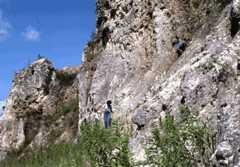 | Fossiliferous limestone containing rhodoliths (coralline red algae) | Panhandle along the western flank of the Gulf Trough
|
Caloosahatchee formation early Pleistocene | Image  | Quartz sand and shelly limestone | South Florida |
Cedar Keys Formation Paleocene to early Eocene | Image  | Recrystalized limestone and dolostone with gypsum, quartz and chert infill | Peninsular Florida |
Chattahoochee Formation early Miocene | Image  | Silty, sandy dolostone | Panhandle |
Chipola formation (Alum Bluff Group) early Miocene | Image  | Clayey, sandy fossiliferous carbonates and shelly sand | Panhandle
|
Citronelle Formation Pliocene to Pleistocene | Image  | Quartz sand, gravel and clay | Panhandle
|
Cypresshead Formation Pliocene to Pleistocene | Image  | Quartz sands | Northeast Florida
|
Hawthorn Group Oligocene to Pliocene | Image  | Limestone and siliciclastics; characterized by presence of phosphates | Peninsular Florida |
Jackson Bluff Formation late Pliocene | Image  | Fossiliferous clayey sands and sandy clays; molluscan fauna | Panhandle
|
Key Largo Limestone late Pleistocene | Image  | Coralline limestone | South Florida |
Marianna Limestone early Oligocene | Image  | Fossiliferous, argillaceous limestone | Panhandle
|
Miami Limestone late Pleistocene | Image  | Oolitic and brozoan limestone | South Florida
|
Miccosukee Formation Pliocene to Pleistocene | Image  | Interbedded and cross-bedded siliciclastics with a high clay content | Panhandle |
Ocala Limestone late Eocene | Image  | Highly permeable fossiliferous limestone | Peninsular Florida & Eastern Panhandle
|
Oldsmar Formation early Eocene | Image  | Recrystalized limestone and dolostone with gypsum infill | Peninsular Florida |
St. Marks Formation early Miocene | Image  | Fossiliferous limestone | Panhandle |
Suwannee Limestone early Oligocene | Image  | Micro-fossiliferous and crystalline limestone | North and Central Peninsular Florida
|
Tamiami Formation Pliocene | Image  | Slightly phosphatic sandy limestone | South Florida |
Torreya Formation (Hawthorn Group) early Miocene | Image  | Quartz sands and fine-grained limestone with phosphate | Panhandle |
Interested in subscribing to DEP newsletters or receiving DEP updates through email?
Sign UpAbout DEP
The Florida Department of Environmental Protection is the state’s lead agency for environmental management and stewardship – protecting our air, water and land. The vision of the Florida Department of Environmental Protection is to create strong community partnerships, safeguard Florida’s natural resources and enhance its ecosystems.
Learn More