| Site News |
|---|
| Warning: This wiki containsspoilers. Read at your own risk! Social media: If you would like, please joinour Discord server, and/or follow us onX (Twitter),Bluesky, orTumblr! |
God

| “ | It's true, we don't have much use for gods. But, well… You show us what we should aspire to. We need inspiration. You give us a reason to grow. To become more than we are. And if we don't have that, Yune, we're nothing more than statues. | ” | — Ike, toYune |
|---|
Agod ordeity (Japanese:神god), femininegoddess (Japanese:女神goddess) is an exceptionally powerful supernatural being. Gods are regarded byhumans and other races as divine and supreme entities, and are very often the subject of religious orders and worship from humans. The majority ofFire Emblem series games feature at least one god or character considered to be a god.
Characteristics
There are virtually no rules as to what a god must be like, with gods inFire Emblem ranging from the humanoid to the monstrous and grotesque. The abilities, appearance, and powers of each god vary greatly from individual to individual. Typically, as most religions presented in theFire Emblem series are pantheistic, each god has their own domain over which they have absolute control, rather than omnipotent rule over all domains of nature. They often bear extreme magical powers, including the ability of creation, or the ability to revive the dead.[1][2]
Relationships with other races
Usually, the relationship held between gods and mortals is that of religion, where the god is the object of worship from human societies. Many individual nations or societies have a religion or form of worship specific to them, but all have in common the reverence of gods as supreme beings responsible for the well-being of the world. Themagical disciplines oflight magic andstaff usage are both derived from faith in and worship of the gods,[3] and the vast majority of wielders of light magic in particular are ordained members of the clergy, to the point whereMicaiah using light magic while not being a priest is notably rare and unusual.[4]
For their part, however, gods very rarely intervene directly in mortal affairs, and even more rarely directly appear before them. Some gods, such asAshera, even express clear detachment from and disinterest in the lives of humans. At some point in the history ofValentia, however, bothMila andDuma physically manifested themselves among humans and directly shaped their chosen nations' viewpoints as a result.Ashunera is also said to have lived among the first sentient creatures ofTellius, theZunanma, in ancient history, and it wasn't until theGreat Flood that she, as her split selves Ashera andYune, retreated from interacting with other races.
List of gods
Major gods
These gods are explicitly named and play a significant role in the stories of their respective games.
- Ashunera, the god who created the world thatTellius resides in. Split into two after theGreat Flood.
- Sothis, the goddess whom theChurch of Seiros worships as "the Beginning" and the "progenitor god". She is capable of manipulating time to a limited degree, and can bestow this ability to others.
- Alfaðör, the Creator God. Created the Nine Realms ofHeroes, including Midgard.
Gods of Vanaheimr
Book VII ofHeroes takes place inVanaheimr, the realm of light.
- Njörðr, the God of the Sea and king of Vanaheimr; brother of Nerþuz and father of Freyr and Freyja.
- Nerþuz, God of the Land and Njörðr's sister.
- Seiðr, Goddess of Hope. Part of a triple goddess: through the cycle of time, she is destined to become the Golden Seer,Gullveig, and was once the lonely goddessKvasir.
- Heiðr, a goddess of Vanaheimr and Seiðr's adoptive sister. Cursed to become a golden serpent. Gullveig's child withKiran through light magic.
- Freyr, the Dream-King of Ljósálfheimr, the dream realm. Njörðr's son, Nerþuz's nephew, and Freyja's elder brother.
- Freyja, the Lady of Nightmare. Queen of Dökkálfheimr, realm of nightmares. Njörðr's daughter and Nerþuz's niece. Lives on asEitr in dreams after her death.
Gods of Ásgarðr
Book IX ofHeroes takes place inÁsgarðr, the Celestial Realm.
- Alfaðör, known as the Celestial King who inherited the title of Alfaðör. Father of Baldr, Höðr, and Váli.
- Loki, the Trickster God. Retainer to Alfaðör and an old friend of Thórr.
- Thórr, the War God. Retainer to Alfaðör and an old friend of Loki.
- Baldr, the Celestial Sun God. Daughter of Alfaðör and sister of Höðr and Váli.
- Höðr, the Dusk Shadow God. Daughter of Alfaðör and sister of Baldr and Váli.
- Váli, the God of Vengeance. Daughter of Alfaðör and sister of Baldr and Höðr.
- Heimdallr, the God of Foresight. Can foresee the actions of others.
Minor gods
These gods are mentioned in passing during the game, or mentioned in supplementary material. These gods typically have no particular relevance to the game's main plot in question, although they may be connected with an available item or be a major part of the backstory.
- A god known by the names "Grann" and "Yudu" is the pagan god ofJugdral and one of the "world builder" gods. He is worshiped by the humans there prior toLoptous andGair's worship spreading. Yudu is described as the sky god and the highest deity on Jugdral.[5]
- Ethniu, an earth goddess in Jugdrali culture mentioned byLeif (not to be confused withTailtiu's sister orMiranda's mother, all of whom have the same name in Japanese).
- Mother Earth and Father Sky, two loosely defined nature deities in the traditionalSacaen faith.
- Delphi, a sky god ofElibe who legend says protects all living creatures. He is associated with theDelphi Shield, which is said to bless fliers to allow them to fly withoutdanger.[6]
- Fale, a minor war god ofMagvel.[7]
- ThePagan Altar in Abyss portrays aDagdan God of Fate.
- Sommie, guardian deity of theSomniel.
Unnamed gods
In some cases, religions and cults exist while their gods are not identified by name throughout the course of the game.
- Ancient minor deities exist inArchanea.Gotoh used these deities to introduce magic humanity in the form of chants to summon the powers of the deities withtomes andstaves.[8]
- According toYoder, the faith of SaintElimine is pantheistic and cites multiple gods, with one notable parable told by its priests centering around Elimine helping an owl and an eagle find the "land of the gods". None of these gods are named, as the bulk of known information about the religion centers on Elimine herself, but are frequently mentioned in general by various Elimine bishops as "the gods".
- The "old gods" that were worshiped inValentia prior to the coming of Mila and Duma. They and the legendary warriors who followed them are represented by the altars for the overclasses.[9]
Beings worshipped as gods
Throughout the series several powerful beings, oftendragons, are revered as gods by humans, though they themselves are not gods.[10][clarification needed]
- Naga, a king of thedivine dragons. Worshipped as a guardian god in Archanea, a god of light in Jugrdal, and a divine dragon in Ylisse and Valm. Participated in theMiracle of Dahna
- Salamander, a dragon worshipped as a "guardian deity" by the small islandPyrathi in Archanea. Participated in the Miracle of Dahna
- Tiki is the daughter of Naga. She was commonly referred to as a "goddess" or a "fearsome guardian" whenGharnef placed her within theFane of Raman.[11]
- Duma, the Valentian "fell god" whose teachings emphasize power above all else, the brother of Mila. InGaiden, he was not stated to be a dragon.
- Mila, the Valentian "Earth Mother" whose teachings emphasize peace above all else, the sister of Duma. InGaiden, she was not stated to be a dragon.
- Loptous, an earth dragon who hates humanity, made a blood pact with Gair. The central object of worship of theLoptr Church founded by Gair.
- Forseti, a dragon who made a blood pact with the crusaderCed at the Miracle of Dahna. He is referred to as the "Wind God".
- Nine other unnamed dragons that participated in the Miracle of Dahna are worshiped as gods in Jugdral.
- TheTwelve Crusaders are occasionally regarded as gods by certain people in Jugdral,[12] although for the most part, the "god" term remains reserved for the twelve dragons.
- The heretic bishopKenneth considersNergal to be a god.[13]
- Grima, a draconic being created by the alchemistForneus. Worshiped by theGrimleal, apparently made a blood pact with a member of the cult in the past.
- TheFirst Dragons are revered as gods inHoshido andNohr.[citation needed]
- Anankos, aSilent Dragon, was worshiped by the people ofValla[citation needed] before he destroyed it in his madness.
- A sea god worshipped by the mysterious organization known as the "Berber" in Valentia, a being which did not actually exist.[14]
- Askr, a Divine Dragon with a cow-like form.The country named after him worships him as the God of Openness.
- Embla, a Divine Dragon with a bat-like form. Worshipped as the God of Closure bythe country named after her.
- Nifl, an Ice Dragon worshipped as the God of Ice and the founder ofthe country named after her.
- Múspell, a Flame Dragon, the founder ofthe country named after him, which worships him as the Flame God.
- Ymir, a dragon known as the "Life-Mother" tothe realm of life named after her.
- Læraðr was created from Yggdrasill, the World Tree, and can be seen as the World-Tree's other self.
Gallery
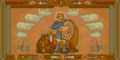 Naga, depicted as a male humanoid god inMystery of the Emblem.

 Ashunera, was split into two beings.
 Ashera, one of the aspects of Ashunera.
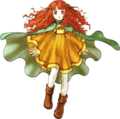 Yune, one of the aspects of Ashunera.


References
- ↑"She can even restore life to the dead. ...Surprised?" —Celica, onMila,Fire Emblem Awakening
- ↑"Yune: These soldiers… We've killed them already. They've been reborn in flesh but not spirit.
Sanaki: Brought back from the dead…
Elincia: A miracle of the goddess…
Caineghis: A blasphemy, you mean! How could the goddess of order violate the most fundamental natural law?" —Yune,Sanaki,Elincia andCaineghis,Fire Emblem: Radiant Dawn - ↑"Your magic stems from faith in the unknowable, the divine presence." —Knoll,Fire Emblem: The Sacred Stones
- ↑"Micaiah of the Dawn Brigade. The only wielder of light magic not bound to the clergy." — Class roll description for theLight Mage,Fire Emblem: Radiant Dawn
- ↑"By the way, the highest god is the sky deity called Yudu (or Gran), but these gods aren't mentioned ingame." — VincentASM, translation of comments byShouzou Kaga,Fire Emblem: Treasure (webpage), Serenesforest.net,Retrieved: May 15th, 2015
- ↑"Have you heard of the sky god, Delphi? He is said to race through the skies and protect all living things. They say that with his blessing, wyvern riders and pegasus knights can fly freely without danger..." — A villager inChapter 14,Fire Emblem: The Binding Blade
- ↑"But this is... The war god Fale's amulet!" —Vanessa in her andSyrene's C support,Fire Emblem: The Sacred Stones
- ↑"Gotoh convinced humans to borrow the deities' powers and warned them at the same time. So fire magic comes from the deity of fire, wind magic is borrowed from the deity of wind and etc. Magic is thus the technology where one harnesses energy that exists naturally. Spell books and staves can be thought of as vessels that store this energy. To release this energy requires a certain amount of skill, such as by chanting keywords or through mental control techniques. In order to acquire a sufficient skill level, one must undergo self-training. Prayers to the deities seems to reveal the keywords, while it also raises one's mental capacity." — VincentASM, translation of comments byShouzou Kaga,Mysteries of FE – Akaneia's Story (webpage), Serenesforest.net,Retrieved: February 24th, 2017
- ↑"Here lies a forgotten altar, left behind by one of the gods of yore...after the ancient folk chased them from this world in ages long past. Altars such as this grant the power to "overclass"—to transcend mortal limits." — Hermit, when entering the shrine in the Overclass DLC,Fire Emblem Echoes: Shadows of Valentia
- ↑"Naga: Yes. But know this: I am no god.
Lucina: But milady, you are the divine dragon!
Naga: So do sons of man name me. But I am no creator. I possess not the powers of making or unmaking. And neither does Grima. Neither of us bears the power to destroy the other utterly." —Naga andLucina,Fire Emblem Awakening - ↑"The fane is said to be guarded by a goddess, one with fearsome powers." —Malledus inChapter 18,Fire Emblem: Shadow Dragon
- ↑"House Velthomer wields the power of fire, as bestowed by the fire goddess, Fjalar. And House Friege wields thunder powers, as bestowed by the thunder god, Thrud." — A villager inChapter 4,Fire Emblem: Genealogy of the Holy War
- ↑"If a god truly exists, then it is my lord Nergal. Only him." —Kenneth inhis version of Chapter 25E/27H,Fire Emblem: The Blazing Blade
- ↑"Regarding the ancient pirate nation, there are records of a large organization known as the Berber. It is said that the Berber did not worship Mila or Duma. Instead, they revered their own sea god (although this god did not actually exist and was a fabrication)." (Valentia Accordion)
See also
| Races andanimals of theFire Emblem series | ||||
|---|---|---|---|---|
|