

Photo added byKent
Adding photos to this memorial is not allowed.
Photo requests are not allowed for this cemetery.
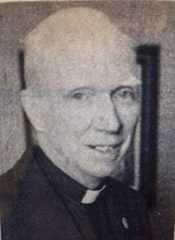
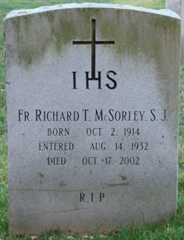
Rev Richard T. McSorley
- Birth
- Philadelphia, Philadelphia County, Pennsylvania, USA
- Death
- 17 Oct 2002 (aged 88)Washington, District of Columbia, USA
- Burial
- Washington,District of Columbia,USAShow MapGPS-Latitude: 38.9080849, Longitude: -77.0736431
- Plot
- H+2
- Memorial ID
- 84842091View Source
Adding photos to this memorial is not allowed.
Photo requests are not allowed for this cemetery.
The Rev. Richard T. McSorley, 88, a Jesuit priest, retired professor of peace studies at Georgetown University and writer of eight books on pacifism and social justice, died Oct. 17 at Georgetown University Hospital. He had coronary artery disease.
As an intellectual and an activist committed to pacifism, Father McSorley lived in the lofty world of ideas and debate as well as the dissident one of public protest against what he saw as rampant U.S. militarism. His opposition to war and war preparation included a long arrest record for street demonstrations, the founding of the Center for Peace Studies at Georgetown and the denouncing of the Just War theory as well as military solutions to conflict. Often at odds not only with his government but also his own religious order -- the Society of Jesus -- his fervor for nonviolence once led to his standing in the center of the Georgetown campus protesting the school's ROTC program with a large sign saying: "Should we teach life and love or death and hate?"
"Dick McSorley was resolute in his convictions for peace and for racial justice," the Rev. Robert Drinan, a fellow Jesuit and former Democratic congressman from Massachusetts, said yesterday. "Some saw him as a troublemaker, in the good sense, but he was deeply convinced of the necessity for nonviolent solutions to problems."
Father McSorley's early priestly training gave little hint of his eventual antiwar apostolate. One of 15 children in an Irish Catholic Philadelphia family -- seven siblings would join religious orders -- he entered a Jesuit seminary in Poughkeepsie, N.Y., at age 18 in 1932.
"We were created to praise, love and serve God and our neighbors, and in this way to save our souls," he wrote in his 1996 autobiography, "My Path to Peace and Justice." "The purpose of life was the same as the purpose of Jesuit life," he wrote.
In 1939, after studying philosophy, he was sent to the Philippines to teach. In December 1941, a week after the Japanese attack on Pearl Harbor, he and other Jesuits were captured by gun-wielding Japanese soldiers. He endured sickness and starvation in a concentration camp holding 2,500 prisoners, then was liberated in 1945 and returned home to be ordained a priest.
At his first parish, St. James, in the community of Ridge in Southern Maryland, he was stunned by the overt segregation in the parish, including whites and blacks being separated at the communion rail. "As I consulted brother Jesuits," he recalled, "this was the advice I received: If you speak out about segregation, you will never be appointed to any position of honor in the Jesuit order. I knew of no one else in the [order] who spoke out against segregation. I would be alone."
In 1952, and after four years of agitation, he was assigned to teach philosophy at Scranton University. "The respectable position of philosophy professor would silence any rumor that I was being punished for my views," he wrote. Nine years later, and after completing a doctorate at Ottawa University -- he wrote his thesis on "The Roots of Prejudice" -- he came to Georgetown University. From 1961 until 1985, his courses on peace and justice were routinely overflowing, with students often attending for no credit.
During these years, he marched with the Rev. Martin Luther King Jr. in the South, shared a jail cell with pediatrician Benjamin Spock after an antiwar demonstration, volunteered with Mitch Snyder at Washington's Community for Creative Nonviolence, helped found two Catholic Worker houses of hospitality in Washington, and strategized with pacifist priests Daniel and Philip Berrigan, designing such academic courses as "The Nonviolent Revolution of Peace." He pressed to have ROTC removed from campus, and he offered moral support to draft resisters.
It wasn't all fury and fire. An accomplished tennis player, he was asked by Ethel Kennedy in 1961 if he might have time to give lessons to some of her children. After the art of lobs, dinks and aces was duly mastered, Mrs. Kennedy asked if he'd help with their homework.
A lasting friendship with the Kennedy family began. In June of 1968, while Sen. Robert F. Kennedy lay dying in California after being shot at a Los Angeles hotel after his victory in the state's Democratic presidential primary, Father McSorley celebrated Mass in the family's home in McLean. After the funeral, the priest, who had been voted an alternative Kennedy delegate to the Democratic convention, returned to the Georgetown campus: "To know that Bobby was gone, with all the high hopes he inspired, left me desolate and weary."
In 1969, while in London, Father McSorley chanced upon a recent Georgetown graduate, Bill Clinton. With the Vietnam War raging, Clinton asked the priest to say a prayer for peace at an interdenominational service at St. Mark's Church. Afterward, antiwar marchers carried small white crosses to protest at the U.S. Embassy.
The incident surfaced during the Clinton presidential campaign in 1992. Republican strategists sought to portray Clinton the candidate as a dupe of a notoriously left-wing priest. Rep. Robert K. Dornan, co-chairman of the Bush campaign in California, took to the House floor to rail against Father McSorley as "a Marxist priest" who was "pro-fascist" and "still poisoning the minds" of Georgetown students with "garbage." President George H.W. Bush raised the Clinton-McSorley connection to question Clinton's "character and judgment."
During the campaign firestorm, Father McSorley, back in his office at the Center for Peace Studies, was besieged with requests for interviews from Larry King, Phil Donahue and other members of the media. He said no to all. Of the event in London, the priest later told The Washington Post, "If more people prayed for peace, as Bill Clinton did in 1969, the world would be a better place."
In addition to his autobiography, other books of his include "It's a Sin to Build a Nuclear Weapon," "New Testament Basis of Peacemaking," "Peace Prospects for Three Worlds," "Kill? For Peace?" "Peace Eyes" and "The More the Merrier."
In 1985, Georgetown alumni voted to give Father McSorley the Distinguished Teacher Award. Pax Christi, the Catholic pacifist group, awarded him the title "Ambassador of Peace." In the international peace community, Father McSorley earned respect for his efforts to bring Roman Catholicism closer to early Christian pacifism. In "New Testament Basis of Peacemaking," he wrote: "In the United States, Catholics have made a big point of proving their patriotism. One of the ways we do this is to put the names of the war dead on plaques in the back of the church. We should now begin also inscribing on those plaques the names of those who refused, for conscience sake, to be a part of war."
Survivors include two brothers and four sisters.
In the 1970s at Georgetown, the Rev. Richard T. McSorley protested the school's ROTC program.
Washington Post 10/17/2002
The Rev. Richard T. McSorley, 88, a Jesuit priest, retired professor of peace studies at Georgetown University and writer of eight books on pacifism and social justice, died Oct. 17 at Georgetown University Hospital. He had coronary artery disease.
As an intellectual and an activist committed to pacifism, Father McSorley lived in the lofty world of ideas and debate as well as the dissident one of public protest against what he saw as rampant U.S. militarism. His opposition to war and war preparation included a long arrest record for street demonstrations, the founding of the Center for Peace Studies at Georgetown and the denouncing of the Just War theory as well as military solutions to conflict. Often at odds not only with his government but also his own religious order -- the Society of Jesus -- his fervor for nonviolence once led to his standing in the center of the Georgetown campus protesting the school's ROTC program with a large sign saying: "Should we teach life and love or death and hate?"
"Dick McSorley was resolute in his convictions for peace and for racial justice," the Rev. Robert Drinan, a fellow Jesuit and former Democratic congressman from Massachusetts, said yesterday. "Some saw him as a troublemaker, in the good sense, but he was deeply convinced of the necessity for nonviolent solutions to problems."
Father McSorley's early priestly training gave little hint of his eventual antiwar apostolate. One of 15 children in an Irish Catholic Philadelphia family -- seven siblings would join religious orders -- he entered a Jesuit seminary in Poughkeepsie, N.Y., at age 18 in 1932.
"We were created to praise, love and serve God and our neighbors, and in this way to save our souls," he wrote in his 1996 autobiography, "My Path to Peace and Justice." "The purpose of life was the same as the purpose of Jesuit life," he wrote.
In 1939, after studying philosophy, he was sent to the Philippines to teach. In December 1941, a week after the Japanese attack on Pearl Harbor, he and other Jesuits were captured by gun-wielding Japanese soldiers. He endured sickness and starvation in a concentration camp holding 2,500 prisoners, then was liberated in 1945 and returned home to be ordained a priest.
At his first parish, St. James, in the community of Ridge in Southern Maryland, he was stunned by the overt segregation in the parish, including whites and blacks being separated at the communion rail. "As I consulted brother Jesuits," he recalled, "this was the advice I received: If you speak out about segregation, you will never be appointed to any position of honor in the Jesuit order. I knew of no one else in the [order] who spoke out against segregation. I would be alone."
In 1952, and after four years of agitation, he was assigned to teach philosophy at Scranton University. "The respectable position of philosophy professor would silence any rumor that I was being punished for my views," he wrote. Nine years later, and after completing a doctorate at Ottawa University -- he wrote his thesis on "The Roots of Prejudice" -- he came to Georgetown University. From 1961 until 1985, his courses on peace and justice were routinely overflowing, with students often attending for no credit.
During these years, he marched with the Rev. Martin Luther King Jr. in the South, shared a jail cell with pediatrician Benjamin Spock after an antiwar demonstration, volunteered with Mitch Snyder at Washington's Community for Creative Nonviolence, helped found two Catholic Worker houses of hospitality in Washington, and strategized with pacifist priests Daniel and Philip Berrigan, designing such academic courses as "The Nonviolent Revolution of Peace." He pressed to have ROTC removed from campus, and he offered moral support to draft resisters.
It wasn't all fury and fire. An accomplished tennis player, he was asked by Ethel Kennedy in 1961 if he might have time to give lessons to some of her children. After the art of lobs, dinks and aces was duly mastered, Mrs. Kennedy asked if he'd help with their homework.
A lasting friendship with the Kennedy family began. In June of 1968, while Sen. Robert F. Kennedy lay dying in California after being shot at a Los Angeles hotel after his victory in the state's Democratic presidential primary, Father McSorley celebrated Mass in the family's home in McLean. After the funeral, the priest, who had been voted an alternative Kennedy delegate to the Democratic convention, returned to the Georgetown campus: "To know that Bobby was gone, with all the high hopes he inspired, left me desolate and weary."
In 1969, while in London, Father McSorley chanced upon a recent Georgetown graduate, Bill Clinton. With the Vietnam War raging, Clinton asked the priest to say a prayer for peace at an interdenominational service at St. Mark's Church. Afterward, antiwar marchers carried small white crosses to protest at the U.S. Embassy.
The incident surfaced during the Clinton presidential campaign in 1992. Republican strategists sought to portray Clinton the candidate as a dupe of a notoriously left-wing priest. Rep. Robert K. Dornan, co-chairman of the Bush campaign in California, took to the House floor to rail against Father McSorley as "a Marxist priest" who was "pro-fascist" and "still poisoning the minds" of Georgetown students with "garbage." President George H.W. Bush raised the Clinton-McSorley connection to question Clinton's "character and judgment."
During the campaign firestorm, Father McSorley, back in his office at the Center for Peace Studies, was besieged with requests for interviews from Larry King, Phil Donahue and other members of the media. He said no to all. Of the event in London, the priest later told The Washington Post, "If more people prayed for peace, as Bill Clinton did in 1969, the world would be a better place."
In addition to his autobiography, other books of his include "It's a Sin to Build a Nuclear Weapon," "New Testament Basis of Peacemaking," "Peace Prospects for Three Worlds," "Kill? For Peace?" "Peace Eyes" and "The More the Merrier."
In 1985, Georgetown alumni voted to give Father McSorley the Distinguished Teacher Award. Pax Christi, the Catholic pacifist group, awarded him the title "Ambassador of Peace." In the international peace community, Father McSorley earned respect for his efforts to bring Roman Catholicism closer to early Christian pacifism. In "New Testament Basis of Peacemaking," he wrote: "In the United States, Catholics have made a big point of proving their patriotism. One of the ways we do this is to put the names of the war dead on plaques in the back of the church. We should now begin also inscribing on those plaques the names of those who refused, for conscience sake, to be a part of war."
Survivors include two brothers and four sisters.
In the 1970s at Georgetown, the Rev. Richard T. McSorley protested the school's ROTC program.
Washington Post 10/17/2002
Family Members


![]()
Most Rev Francis Joseph McSorley
1913–1970
Rev Fr Patrick Michael McSorley
1917–1980
![]()
Sr Eleanore Theresa "Richard Marie" McSorley
1918–2003
Rita Inez McSorley
1920–1920
![]()
Rev James Peter "Jim" McSorley
1921–2005
![]()
Joseph M. McSorley
1922–1986
John Paul McSorley
1923–1990
![]()
Sr Mary Rita McSorley
1924–2013
![]()
Sr Therese Bernadette McSorley
1925–1995
![]()
Marguerite VeronicaMcSorley Walsh
1927–2012
Anne NatalieMcSorley Lukens
1930–2000
Sr Rosemary "Roey" McSorley
1932–2016


Sponsored by Ancestry
- Created by:David McInturff
- Added: Feb 11, 2012
- Find a Grave Memorial ID:
- Find a Grave, database and images (https://www.findagrave.com/memorial/84842091/richard_t-mcsorley: accessed), memorial page forRev Richard T. McSorley (2 Oct 1914–17 Oct 2002), Find a Grave Memorial ID84842091, citing Georgetown University Jesuit Cemetery, Washington,District of Columbia,USA;Maintained by David McInturff (contributor47179039).
Add Photos forRev Richard T. McSorley
Fulfill Photo Request forRev Richard T....
Photo Request Fulfilled
Thank you for fulfilling this photo request. An email has been sent to the person who requested the photo informing them that you have fulfilled their request
There is an open photo request for this memorial
Are you adding a grave photo that will fulfill this request?
- Oops, something didn't work. Close this window, and upload the photo(s) again.
- Make sure that the file is a photo. Photos larger than 8 MB will be reduced. Photos larger than 20 MB will not be accepted.
- Photos larger than8.0 MB will be optimized and reduced.
- Photos larger than20 MB will not be accepted.
- Each contributor can upload a maximum of5 photos for a memorial.
- A memorial can have a maximum of20 photos from all contributors.
- The sponsor of a memorial may add an additional10 photos (for a total of30 on the memorial).
- Include gps location with grave photos where possible.
- No animated GIFs, photos with additional graphics (borders, embellishments.)
- No post-mortem photos.

File Name
Request Grave Photo
Photo request failed. Try again later.
The note field is required.
Leave a Flower
You are only allowed to leave one flower per day for any given memorial.
Memorial Photos
This is a carousel with slides. Use Next and Previous buttons to navigate, or jump to a slide with the slide dots. Use Escape keyboard button or the Close button to close the carousel.

Added by: Kent on 16 Feb 2025
Photo type: Person

Added by: David McInturff on 11 Feb 2012
Photo type: Grave
Save To
Your Virtual Cemeteries
Report Abuse
Are you sure that you want to report this flower to administrators as offensive or abusive?
This flower has been reported and will not be visible while under review.
Failed to report flower. Try again later.
Delete Flower
Failed to delete flower. Try again later.
Delete Memorial
Failed to delete memorial. Try again later.
This memorial cannot be deleted. You cancontact support with questions.
Reported Problems
- Problem #index#:
- Details:
- Reported By:
- Reported On:
There was an error deleting this problem. Try again later.
Report a problem
Recently Deceased
Report a Duplicate Memorial
Which memorial do you think is a duplicate ofRichard T. McSorley(84842091)?
We will review the memorials and decide if they should be merged.Learn more about merges.
Invalid memorial
Please enter a valid Memorial ID
You cannot merge a memorial into itself
Memorial has already been merged
Memorial has already been removed
Delete Photo
Are you sure that you want to delete this photo?
Failed to delete photo. Try again later.
Welcome to a Find a Grave Memorial Page
Learn about how to make the most of a memorial.
or don't show this again—I am good at figuring things out
Cover photo and vital information
Quickly see who the memorial is for and when they lived and died and where they are buried.
Show Map
If the memorial includes GPS coordinates, simply click 'Show Map' to view the gravesite location within the cemetery. If no GPS coordinates are available, you can contribute by adding them if you know the precise location.
Photos
For memorials with more than one photo, additional photos will appear here or on the photos tab.
Photos Tab
All photos appear on this tab and here you can update the sort order of photos on memorials you manage. To view a photo in more detail or edit captions for photos you added, click the photo to open the photo viewer.
Flowers
Flowers added to the memorial appear on the bottom of the memorial or here on the Flowers tab. To add a flower, click theLeave a Flower button.
Family Members
Family members linked to this person will appear here.
Related searches
Use the links underSee more… to quickly search for other people with the same last name in the same cemetery, city, county, etc.
Sponsor This Memorial
Remove advertising from a memorial by sponsoring it for <strong>just $10</strong>. Previously sponsored memorials or famous memorials will not have this option.
Share
Share this memorial using social media sites or email.
Save to
Save to an Ancestry Tree, a virtual cemetery, your clipboard for pasting or Print.
Edit or Suggest Edit
Edit a memorial you manage or suggest changes to the memorial manager.
Have Feedback
Thanks for using Find a Grave, if you have any feedback we would love to hear from you.