

Photo added byBobb Edwards
Adding photos to this memorial is not allowed.
Photo requests are not allowed for this cemetery.
John AdamsFamous memorial
- Birth
- Braintree, Norfolk County, Massachusetts, USA
- Death
- 4 Jul 1826 (aged 90)Quincy, Norfolk County, Massachusetts, USA
- Burial
- Quincy,Norfolk County,Massachusetts,USAShow MapGPS-Latitude: 42.2512164, Longitude: -71.0030917
- Plot
- Basement Crypt
- Memorial ID
- 6View Source
Adding photos to this memorial is not allowed.
Photo requests are not allowed for this cemetery.
Second United States President, First United States Vice President, Signer of the Declaration of Independence from Massachusetts, one of the Founding Fathers of the United States, and Revolutionary War Patriot. Born the first of three sons toJohn andSusanna Boylston Adams, he was born on the family farm which his father purchased in 1720 in the north precinct of Braintree, Suffolk, Massachusetts, now Quincy, and is now part of Adams National Historical Park, where his father was a Puritan farmer, a Lieutenant in the militia, a town Selectman (town Councilman), and a descendant of the first settlers who had arrived in 1636 to found the town. John attended Harvard College, and after graduating in 1755, taught school in Worcester, Massachusetts, for a few years. He decided he wanted to become a lawyer, and studied law underJames Putnam, a prominent lawyer in Worcester. In 1758, he was admitted to the Massachusetts Bar. A careful student, he would write detailed descriptions of events, court cases, and impressions of men, so that he could later study and reflect upon them. His 1761 notes of the court argument of attorneyJames Otis on the legality of the Writs of Assistance has served to be one of the best historical records of that argument, helping historians to understand both that law, the public perceptions of the effects of that law, and the patriotism that existed in James Otis. With the Stamp Act of 1765, Adams rose to prominence as an opponent ofKing George III, in which he argued to the Royal Governor that without representation in Parliament, Massachusetts hadn't assented to the Stamp Act. In 1770, following the Boston Massacre, the British soldiers involved were charged with murder. When no lawyer in Boston would agree to defend them, Adams, feeling they should have a proper defense, took the case and argued on their behalf. He got six of them acquitted, with the two soldiers who had fired directly into the crowd convicted only of manslaughter and dismissed from the Army. That same month, Adams was elected to the Massachusetts General Legislature, beginning his political career. Adams attended the First and Second Continental Congresses as a representative from Massachusetts. Believing in independence, he nominatedGeorge Washington of Virginia for Commander-in-Chief of the Continental Army. Tired of repeating his arguments for independence, Adams wrote a pamphletThoughts on Government (1776), which articulated his thoughts on independence and, more influentially, on the thought that monarchs, the aristocracy, and the common people all had to be mixed together and represented, in order to bring their support to the government. This thought was considered very radical at the time.Thoughts on Government was extremely influential on political thinkers, and was referenced as an authority in virtually every state when each wrote their state constitution. Adams helped write the Declaration of Independence and would sign as a Massachusetts delegate. In a letter to his wife,Abigail, dated July 3, 1776, he wrote that Independence Day "ought to be commemorated, as the Day of Deliverance, by solemn Acts of Devotion to God Almighty. It ought to be solemnized with Pomp and Parade, with Shews [shows], Games, Sports, Guns, Bells, Bonfires, and Illuminations from one end of this continent to the other from this time forward forever more." During the Revolution, he served as head of the Board of War and Ordnance, seeing that the Continental Army received the supplies it needed. In 1779, he wrote most of the Massachusetts Constitution, with help from his cousin,Samuel Adams, and patriotJames Bowdoin. During the Revolutionary War, Adams successfully negotiated treaties of recognition and friendship with France, Holland, and Prussia, giving the United States its first foreign recognition as a nation. In 1785, he was appointed as the first Ambassador from the United States to Great Britain. When the Constitution of the United States was adopted, Adams ran for President, coming in second behind General George Washington. In accordance with the United States Constitution, that made Washington President and Adams Vice President. As President of the Senate (the only duties that the Constitution gave the Vice President) he cast 29 tie-breaking votes. As the first Vice President, he set the standards for the sessions of the Congress, many of which are still in force today. In 1796, Adams ran for President on the Federalist Party platform against GovernorThomas Pinckney (Federalist Party),Thomas Jefferson (Democratic-Republican Party) and SenatorAaron Burr (also a Democratic-Republican). In a narrow victory, Adams won the Presidency over the next candidate, Thomas Jefferson, thus, Jefferson became Adams' Vice President. In the next four years, President Adams built up the Navy and fought an undeclared war with France. He signed into law the Alien and Sedition Acts as a legal instrument against French actions in America (but those were later used by some politicians to silence their political opponents) and gave the first ever State of the Union Address. In the election of 1800, each candidate ran for the first time with a Vice-Presidential running mate. In this election, Jefferson teamed with Aaron Burr to defeat John Adams and his running mate,Charles Pinckney. Just before leaving the Presidency, Adams became the first U.S. President to occupy the newly-constructed White House. In his final days as President, Adams appointed his Secretary of State,John Marshall, as Chief Justice of the Supreme Court. Marshall would go on to establish much of the legal decisions that influence the Supreme Court today; he is considered one of the best Chief Justices the United States ever had. Following his defeat, Adams retired into private life, returning to his farm in Massachusetts. He and Jefferson were bitter enemies because of the infighting of politics and wouldn't speak to each other again until 1812, when Adams finally reconciled with Jefferson. Becoming friends again, the two men corresponded on a number of political and philosophical discussions, giving future historians deep insight into political thought of the times and of the two men. Sixteen months before his death, Adams' son,John Quincy Adams, became the sixth President of the United States, the first son of a President to achieve this office. On July 4, 1826, the 50th Anniversary of the Declaration of Independence, Adams died at his home in Quincy. His last words were "Jefferson lives," considered a tribute of his deep affection for his friend and former rival. However, Thomas Jefferson had died a few hours earlier than John Adams on that same day.
Second United States President, First United States Vice President, Signer of the Declaration of Independence from Massachusetts, one of the Founding Fathers of the United States, and Revolutionary War Patriot. Born the first of three sons toJohn andSusanna Boylston Adams, he was born on the family farm which his father purchased in 1720 in the north precinct of Braintree, Suffolk, Massachusetts, now Quincy, and is now part of Adams National Historical Park, where his father was a Puritan farmer, a Lieutenant in the militia, a town Selectman (town Councilman), and a descendant of the first settlers who had arrived in 1636 to found the town. John attended Harvard College, and after graduating in 1755, taught school in Worcester, Massachusetts, for a few years. He decided he wanted to become a lawyer, and studied law underJames Putnam, a prominent lawyer in Worcester. In 1758, he was admitted to the Massachusetts Bar. A careful student, he would write detailed descriptions of events, court cases, and impressions of men, so that he could later study and reflect upon them. His 1761 notes of the court argument of attorneyJames Otis on the legality of the Writs of Assistance has served to be one of the best historical records of that argument, helping historians to understand both that law, the public perceptions of the effects of that law, and the patriotism that existed in James Otis. With the Stamp Act of 1765, Adams rose to prominence as an opponent ofKing George III, in which he argued to the Royal Governor that without representation in Parliament, Massachusetts hadn't assented to the Stamp Act. In 1770, following the Boston Massacre, the British soldiers involved were charged with murder. When no lawyer in Boston would agree to defend them, Adams, feeling they should have a proper defense, took the case and argued on their behalf. He got six of them acquitted, with the two soldiers who had fired directly into the crowd convicted only of manslaughter and dismissed from the Army. That same month, Adams was elected to the Massachusetts General Legislature, beginning his political career. Adams attended the First and Second Continental Congresses as a representative from Massachusetts. Believing in independence, he nominatedGeorge Washington of Virginia for Commander-in-Chief of the Continental Army. Tired of repeating his arguments for independence, Adams wrote a pamphletThoughts on Government (1776), which articulated his thoughts on independence and, more influentially, on the thought that monarchs, the aristocracy, and the common people all had to be mixed together and represented, in order to bring their support to the government. This thought was considered very radical at the time.Thoughts on Government was extremely influential on political thinkers, and was referenced as an authority in virtually every state when each wrote their state constitution. Adams helped write the Declaration of Independence and would sign as a Massachusetts delegate. In a letter to his wife,Abigail, dated July 3, 1776, he wrote that Independence Day "ought to be commemorated, as the Day of Deliverance, by solemn Acts of Devotion to God Almighty. It ought to be solemnized with Pomp and Parade, with Shews [shows], Games, Sports, Guns, Bells, Bonfires, and Illuminations from one end of this continent to the other from this time forward forever more." During the Revolution, he served as head of the Board of War and Ordnance, seeing that the Continental Army received the supplies it needed. In 1779, he wrote most of the Massachusetts Constitution, with help from his cousin,Samuel Adams, and patriotJames Bowdoin. During the Revolutionary War, Adams successfully negotiated treaties of recognition and friendship with France, Holland, and Prussia, giving the United States its first foreign recognition as a nation. In 1785, he was appointed as the first Ambassador from the United States to Great Britain. When the Constitution of the United States was adopted, Adams ran for President, coming in second behind General George Washington. In accordance with the United States Constitution, that made Washington President and Adams Vice President. As President of the Senate (the only duties that the Constitution gave the Vice President) he cast 29 tie-breaking votes. As the first Vice President, he set the standards for the sessions of the Congress, many of which are still in force today. In 1796, Adams ran for President on the Federalist Party platform against GovernorThomas Pinckney (Federalist Party),Thomas Jefferson (Democratic-Republican Party) and SenatorAaron Burr (also a Democratic-Republican). In a narrow victory, Adams won the Presidency over the next candidate, Thomas Jefferson, thus, Jefferson became Adams' Vice President. In the next four years, President Adams built up the Navy and fought an undeclared war with France. He signed into law the Alien and Sedition Acts as a legal instrument against French actions in America (but those were later used by some politicians to silence their political opponents) and gave the first ever State of the Union Address. In the election of 1800, each candidate ran for the first time with a Vice-Presidential running mate. In this election, Jefferson teamed with Aaron Burr to defeat John Adams and his running mate,Charles Pinckney. Just before leaving the Presidency, Adams became the first U.S. President to occupy the newly-constructed White House. In his final days as President, Adams appointed his Secretary of State,John Marshall, as Chief Justice of the Supreme Court. Marshall would go on to establish much of the legal decisions that influence the Supreme Court today; he is considered one of the best Chief Justices the United States ever had. Following his defeat, Adams retired into private life, returning to his farm in Massachusetts. He and Jefferson were bitter enemies because of the infighting of politics and wouldn't speak to each other again until 1812, when Adams finally reconciled with Jefferson. Becoming friends again, the two men corresponded on a number of political and philosophical discussions, giving future historians deep insight into political thought of the times and of the two men. Sixteen months before his death, Adams' son,John Quincy Adams, became the sixth President of the United States, the first son of a President to achieve this office. On July 4, 1826, the 50th Anniversary of the Declaration of Independence, Adams died at his home in Quincy. His last words were "Jefferson lives," considered a tribute of his deep affection for his friend and former rival. However, Thomas Jefferson had died a few hours earlier than John Adams on that same day.
Bio by:Kit and Morgan Benson
Inscription
LIBERTATEM AMICITIAM FIDEM RETINEBIS
D. O. M.
Beneath these Walls
Are deposited the Mortal Remains of
JOHN ADAMS,
Son of John and Susanna [Boylston] Adams,
Second President of the United States.
Born 30th October 1735.
On the fourth of July 1776
He pledged his Life, Fortune and Sacred Honour
To the INDEPENDENCE OF HIS COUNTRY.
On the third of September 1783
He affixed his Seal to the definitive Treaty with Great Britain
Which acknowledged that Independence,
And consummated the Redemption of his Pledge.
On the fourth of July 1826
He was summoned
To the Independence of Immortality,
And to the JUDGMENT OF HIS GOD.
This House will bear witness to his Piety;
This Town, his Birth-Place, to his Munificence;
History to his Patriotism;
Posterity to the Depth and Compass of his Mind.
At his Side
Sleeps till the Trump shall Sound
ABIGAIL,
His beloved and only Wife,
Daughter of William and Elizabeth [Quincy] Smith.
In every Relation of Life a Pattern
Of Filial, Conjugal, Maternal and Social Virtue.
Born November 22th 1744.
Deceased 28 October 1818.
Aged 74.
Married 25 October 1764.
During an Union of more than Half a Century
They survived, in Harmony of Sentiment, Principle and Affection
The Tempests of Civil Commotion;
Meeting undaunted, and surmounting
The Terrors and Trials of that Revolution
Which secured the Freedom of their Country;
Improved the Condition of their Times;
And brightened the Prospects of Futurity
To the Race of Man upon Earth.
PILGRIM,
From Lives thus spent thy earthly Duties learn;
From Fancy's Dreams to active Virtue turn;
Let Freedom, Friendship, Faith, thy Soul engage,
And serve like them thy Country and thy Age.
JOHN ADAMS
SIGNER OF THE DECLARATION OF INDEPENDENCE
FRAMER OF THE CONSTITUTION OF MASSACHUSETTS
SECOND PRESIDENT OF THE UNITED STATES
1735 - 1826
THE JOHN ADAMS CHAPTER DAUGHTERS
OF THE AMERICAN REVOLUTION CAUSED
THIS TABLET TO BE AFFIXED
1900
JOHN ADAMS
Family Members


See moreAdams memorials in:
How famous was John Adams?
What was John famous for?
- Current rating:4.82193 out of 5 stars
1,286 votes
Sign-in to cast your vote.
- Maintained by: Find a Grave
- Added: Apr 25, 1998
- Find a Grave Memorial ID:
- Find a Grave, database and images (https://www.findagrave.com/memorial/6/john-adams: accessed), memorial page for John Adams (30 Oct 1735–4 Jul 1826), Find a Grave Memorial ID6, citing United First Parish Church, Quincy,Norfolk County,Massachusetts,USA;Maintained by Find a Grave.
Add Photos for John Adams
Fulfill Photo Request for John Adams
Photo Request Fulfilled
Thank you for fulfilling this photo request. An email has been sent to the person who requested the photo informing them that you have fulfilled their request
There is an open photo request for this memorial
Are you adding a grave photo that will fulfill this request?
- Oops, something didn't work. Close this window, and upload the photo(s) again.
- Make sure that the file is a photo. Photos larger than 8 MB will be reduced. Photos larger than 20 MB will not be accepted.
- Photos larger than8.0 MB will be optimized and reduced.
- Photos larger than20 MB will not be accepted.
- Each contributor can upload a maximum of5 photos for a memorial.
- A memorial can have a maximum of20 photos from all contributors.
- The sponsor of a memorial may add an additional10 photos (for a total of30 on the memorial).
- Include gps location with grave photos where possible.
- No animated GIFs, photos with additional graphics (borders, embellishments.)
- No post-mortem photos.

File Name
Request Grave Photo
Photo request failed. Try again later.
The note field is required.
Leave a Flower
You are only allowed to leave one flower per day for any given memorial.
Memorial Photos
This is a carousel with slides. Use Next and Previous buttons to navigate, or jump to a slide with the slide dots. Use Escape keyboard button or the Close button to close the carousel.


Added by: Bobb Edwards on 19 Jun 2010
Photo type: Person


Added by: Ryan David Schweitzer on 19 Oct 2025
Photo type: Grave
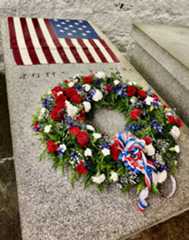

(Memorial Day Weekend 2024)
Added by: IslesSmiles on 07 Jul 2024
Photo type: Grave


Added by: Abeethegreat on 02 Aug 2017
Photo type: Grave


Added by: Abeethegreat on 02 Aug 2017
Photo type: Grave


Added by: John Martin on 13 Jul 2025
Photo type: Person


Added by: Derek Polo on 20 Jun 2022
Photo type: Person
Save To
Your Virtual Cemeteries
Report Abuse
Are you sure that you want to report this flower to administrators as offensive or abusive?
This flower has been reported and will not be visible while under review.
Failed to report flower. Try again later.
Delete Flower
Failed to delete flower. Try again later.
Delete Memorial
Failed to delete memorial. Try again later.
This memorial cannot be deleted. You cancontact support with questions.
Reported Problems
- Problem #index#:
- Details:
- Reported By:
- Reported On:
There was an error deleting this problem. Try again later.
Report a problem
Recently Deceased
Report a Duplicate Memorial
Which memorial do you think is a duplicate ofJohn Adams(6)?
We will review the memorials and decide if they should be merged.Learn more about merges.
Invalid memorial
Please enter a valid Memorial ID
You cannot merge a memorial into itself
Memorial has already been merged
Memorial has already been removed
Delete Photo
Are you sure that you want to delete this photo?
Failed to delete photo. Try again later.
Welcome to a Find a Grave Memorial Page
Learn about how to make the most of a memorial.
or don't show this again—I am good at figuring things out
Cover photo and vital information
Quickly see who the memorial is for and when they lived and died and where they are buried.
Show Map
If the memorial includes GPS coordinates, simply click 'Show Map' to view the gravesite location within the cemetery. If no GPS coordinates are available, you can contribute by adding them if you know the precise location.
Photos
For memorials with more than one photo, additional photos will appear here or on the photos tab.
Photos Tab
All photos appear on this tab and here you can update the sort order of photos on memorials you manage. To view a photo in more detail or edit captions for photos you added, click the photo to open the photo viewer.
Flowers
Flowers added to the memorial appear on the bottom of the memorial or here on the Flowers tab. To add a flower, click theLeave a Flower button.
Family Members
Family members linked to this person will appear here.
Related searches
Use the links underSee more… to quickly search for other people with the same last name in the same cemetery, city, county, etc.
Sponsor This Memorial
Remove advertising from a memorial by sponsoring it for <strong>just $10</strong>. Previously sponsored memorials or famous memorials will not have this option.
Share
Share this memorial using social media sites or email.
Save to
Save to an Ancestry Tree, a virtual cemetery, your clipboard for pasting or Print.
Edit or Suggest Edit
Edit a memorial you manage or suggest changes to the memorial manager.
Have Feedback
Thanks for using Find a Grave, if you have any feedback we would love to hear from you.