
Sumerian
Posted byRegan de Loggans |Last updated Mar 6, 2018 | Published on Sep 11, 2017 |ancient,culture overview

OVERVIEW
Womenswear
Sumerian civilization is divided into two periods: Early Sumerian (c. 3500-2500 BCE) and Later Sumerian (c. 2500-1000 BCE). Social classes were strictly hierarchical and patriarchal. Sumerian economy was based on the trade and export of barely, oil, and wool. Wool was the most important product; clothes, tapestries, and decorative items were made of wool. Women were the producers of the textiles. They spun the the wool and wove the cloth, while Sumerian men dyed the finished cloth. Both women and men wore skirts made of a fleece-like fabric known as kaunakes. The length of the skirts varied according to hierarchical status. Servants, slaves, and soldiers wore short skirts, while royalty and deities wore long skirts. They wrapped around the body and tied with a belt at the waist to hold the skirts up.
During the third millennium BCE, the Sumerian civilization of Mesopotamia was culturally defined by the development of the art of weaving. Weaving allows the production of rectangles of cloth large enough to clothe the body. Statuettes and bas-reliefs of Sumerian civilization show figures wearing both skirts composed of woven cloth and tufted fabrics, exemplifying this transition from non-woven to woven dress.
Figure 2 depicts the archeological finds from Tell Asmar. In the image, one can see the tufted non-woven skirt worn by the god Abu (left) and the woven cloth dress on the female deity (right). Rectangular cloth was used to wrap and drape the person. Most often it was wrapped around the waist, creating a wrap skirt. Later, another rectangular cloth was draped over the shoulder and kept in place by a fibula. This type of clothing inspired the dress of the Assyrians, Greeks, and Egyptians.

Fig. 1 - Artist unknown (Sumerian).Standard of Ur, Early Dynastic III (2500 BC). Inlaid shell, limestone (red), lapis lazuli, bitumen; height: 21.7 centimetres; length: 50.4 centimetres; width: 11.6 centimetres (end; base); width: 5.6 centimetres (end; top) cm. London: British Museum, 121201. Source:British Museum

Fig. 2 - Artist unknown (Sumerian).Statues from Tell Asmar, Iraq, 3rd millennium BCE. Alabaster. Iraq Museum. Source:Pinterest

Fig. 3 - Artist unknown (Sumerian).Standing female worshiper, Early Dynastic IIIa (ca. 2600–2500 BC). Limestone, inlaid with shell and lapis lazuli; 24.9 x 8.5 x 5.4 cm (9 13/16 x 3 3/8 x 2 1/8 in). New York: The Metropolitan Museum of Art, 62.70.2. Rogers Fund, 1962. Source:The Met
Menswear
[To come…]
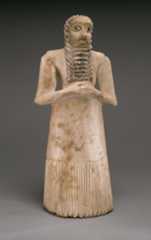
Fig. 1 - Artist unknown (Sumerian).Standing male worshiper, Early Dynastic I-II (ca. 2900–2600 BCE). Gypsum alabaster, shell, black limestone, bitumen; 29.5 x 12.9 x 10 cm (11 5/8 x 5 1/8 x 3 7/8 in). New York: The Metropolitan Museum of Art, 40.156. Fletcher Fund, 1940. Source:The Met
CHILDREN’S WEAR
References:
- Barber, E. J. W. Women’s Work: the first 20,000 Years. New York: W.W. Norton.1994.
- Evans, Jean. The Lives Of Sumerian Sculpture: An Archaeology of the Early Dynastic Temple. Chicago: University of Chicago, 2012.
- Laver, James. Costume and Fashion: A Concise History. New York: Thames & Hudson Inc., 2001.


Primary/Period Sources
Resources for Fashion History Research
To discover primary/period sources, explore the categories below.
Have a primary source to suggest? Or a newly digitized periodical/book to announce? Contact us!
Digitized Primary/Period Sources
Secondary Sources
Also see theancient overview page for more research sources… or browse ourZotero library.
Online
Books/Articles
- Jaana Seppälä’s Pocket Museum:
- Ancient Fashion – principally accessories
- Fashion • Ancient Accessories
Related Posts


Recent Essays
 fezIn 19th century, Asia, F, term definition
 1883 – Charles Frederick Worth, red silk satin and velvet dinner dressIn 1880-1889, 19th century, garment analysis
 15th century – Late Byzantine Silk Damask Dress and Taffeta TunicIn 15th century, Byzantine, garment analysis
 The Fez and the Ottoman Path to ModernityIn 19th century, 20th century, thematic essays
 1869 – Red Silk DressIn 1860-1869, 19th century, garment analysis