
Movatterモバイル変換


[0]ホーム

URL:


CNN values your feedback

1. How relevant is this ad to you?
2. Did you encounter any technical issues?
Thank You!
Your effort and contribution in providing this feedback is much appreciated.
Close
Ad Feedback

UK’s Beagle 2 lander spotted on Mars

ByMichael Pearson, CNN
3 min read
Updated 10:51 AM EST, Fri January 16, 2015
Link Copied!
NASA releases first ever ISS video shot at 8K
Video Ad Feedback
NASA shoots first 8K video of Earth
01:16
Now playing
• Source:CNN
NASA IOP SS Water Test 3
Video Ad Feedback
Why did NASA launch 450,000 gallons of water?
00:59
Now playing
• Source:CNN
In this photo released by NASA, the Northrop Grumman Antares rocket, with Cygnus resupply spacecraft onboard, launches from Pad-0A, Saturday, Nov. 17, 2018 at NASA's Wallops Flight Facility in Va. (Joel Kowsky/NASA via AP)
Video Ad Feedback
Watch NASA launch cargo ship into space
00:34
Now playing
• Source:HLN
SANTA BARBARA, CA - OCTOBER 07: The SpaceX Falcon 9 rocket (R) separates from the space craft (L) behind the rocket trail after launching from Vandenberg Air Force Base carrying the SAOCOM 1A and ITASAT 1 satellites, as seen on October 7, 2018 near Santa Barbara, California. After launching the satellites, the Falcon 9 rocket successfully returned to land on solid ground near the launch site rather than at sea. The satellites will become part of a six-satellite constellation that will work in tandem with an Italian constellation known as COSMO-SkyMed.    (Photo by David McNew/Getty Images)
Video Ad Feedback
SpaceX rocket launch lights up evening sky
01:09
Now playing
• Source: CNN Business
JAXA astroid ryugu images
Video Ad Feedback
Robot sends new images from asteroid's surface
00:33
Now playing
• Source:CNN
Massive structure on Saturn
Video Ad Feedback
'Bizarre' hexagon topping Saturn's north pole
01:05
Now playing
• Source:CNN
The SpaceX launch of a Falcon 9 rocket marks another milestone for Kennedy Space Center's Launch Complex 39-A.
Video Ad Feedback
60 years of NASA's history in 120 seconds
02:00
Now playing
• Source:CNN
nasa parker solar probe
Video Ad Feedback
Watch NASA launch probe that will explore sun
01:39
Now playing
• Source:CNN
nasa lagoon nebula new images lon orig_00000000.jpg
Video Ad Feedback
Stunning virtual tour of the Lagoon Nebula
01:19
Now playing
• Source:CNN
Artist's concept of the Solar Probe Plus spacecraft approaching the sun. In order to unlock the mysteries of the corona, but also to protect a society that is increasingly dependent on technology from the threats of space weather, we will send Solar Probe Plus to touch the sun.
Video Ad Feedback
Listen: The sun is not silent
00:59
Now playing
• Source:CNN
moon 2
Video Ad Feedback
Breathtaking virtual tour of the Moon in 4K
01:26
Now playing
• Source:CNN
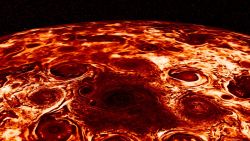
This composite image, derived from data collected by the Jovian Infrared Auroral Mapper (JIRAM) instrument aboard NASA's Juno mission to Jupiter, shows the central cyclone at the planet's north pole and the eight cyclones that encircle it.
Video Ad Feedback
NASA mission discovers Jupiter's inner secrets
01:02
Now playing
• Source:CNN
earliest light
Video Ad Feedback
Scientists detect 'fingerprint' of earliest light in the universe
00:46
Now playing
• Source:CNN
super blue blood moon
Video Ad Feedback
'Super blue blood moon' lights up the skies
00:46
Now playing
• Source:CNN
what is a black moon orig jpm_00000000.jpg
Video Ad Feedback
What's in a moon's name?
01:04
Now playing
• Source:CNN

Story highlights

A missing UK lander is spotted on the surface of Mars

The Beagle 2 never radioed Earth after descending to the Martian surface in 2003

CNN  — 

Turns out the Beagle had landed, after all.

The 11-year-old mystery of what happened to the UK-sponsored Beagle 2 Mars lander on its trip to the red planet’s surface appeared to be mostly solved Friday with the announcement the craft had been spotted in high-resolution NASA images taken from orbit.

The lander – crammed with devices to look for signs of life on Mars – never radioed home after hitching a ride aboard the European Space Agency’s Mars Express orbiter and dropping into the atmosphere on December 25, 2003.
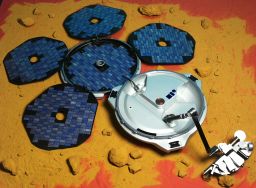
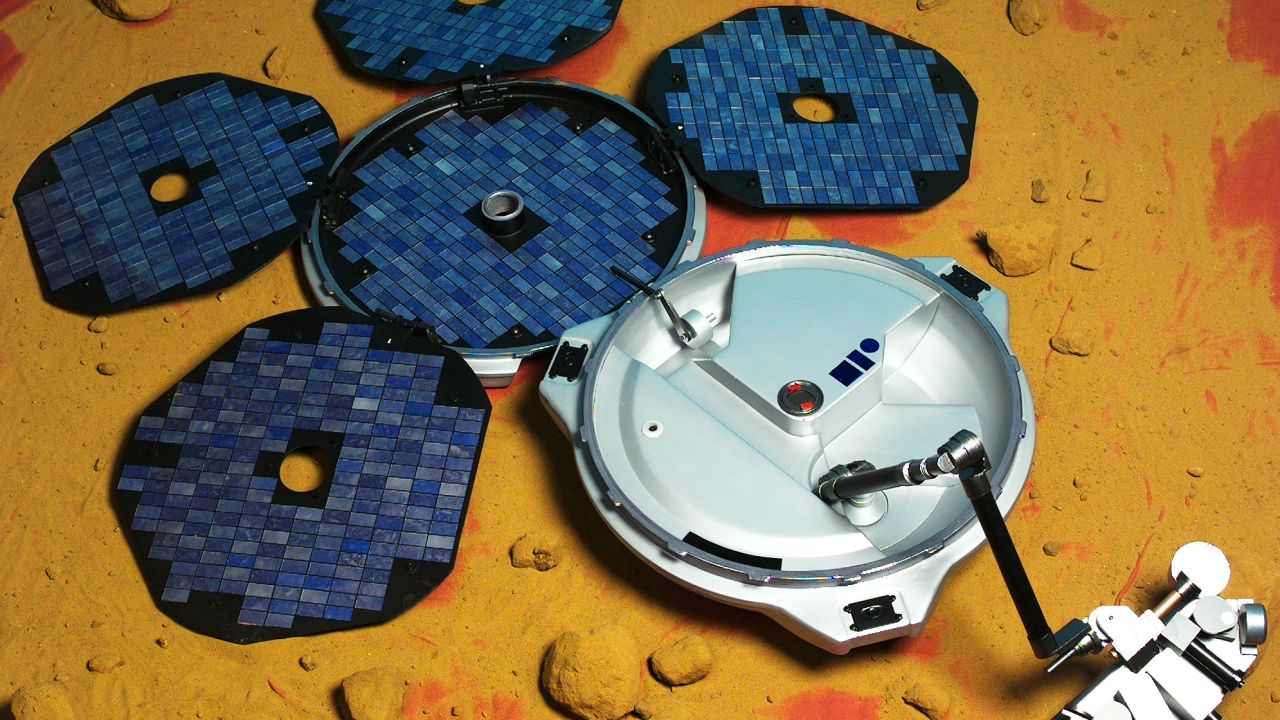
The Beagle 2 lander is shown in this European Space Agency image as it would have appeared on the surface of Mars, had it deployed properly.
ESA

The images appear to show that the lander’s solar panels didn’t fully open after landing, preventing the craft from getting power and exposing the antenna it would have used to communicate with controllers on Earth, according to the space agency.

While the reasons for that failure remain unknown, the discovery of the lander helps solve one of the most enduring mysteries in Martian exploration, said Mark Sims, a Beagle 2 team member from the University of Leicester.

“Every Christmas Day since 2003 I have wondered what happened to Beagle 2,” he said, adding that he’d almost given up hope of ever knowing what had come of the lander.

“The highly complex entry, descent and landing sequence seems to have worked perfectly and only during the final phases of deployment did Beagle 2 unfortunately run into problems,” he said.

The lander, which is less than 2 meters (6.56 feet) across when fully deployed, was first spotted in the NASA images by Michael Croon of Trier, Germany – a former member of the European Space Agency’s Mars Express operations team, the UK Space Agency said.

Croon is among a group of Beagle 2 team members who have spent years combing through images from NASA’s HiRISE camera, which is on the agency’s Mars Reconnaissance Orbiter, looking for signs of the missing craft, the agency said.

He found it in an area near the planned landing zone, an impact basin called Isidis Planitia close to the Martian equator.

The grainy images appear to show the lander resting on the surface, its solar panels only partially deployed. The craft’s rear cover and parachutes are nearby.

Had the lander deployed properly, a suite of onboard tools would have been used to analyze rocks, soil and atmosphere for signs of life.

The lander – the first European craft sent to the Martian surface – was named after the HMS Beagle, the ship that carried Charles Darwin on a groundbreaking 5-year scientific survey.

While its namesake resulted in no such breakthroughs, David Parker, chief executive of the UK Space Agency, said the discovery proves the Beagle 2 had its successes.

“The history of space exploration is marked by both success and failure,” he said. “This finding makes the case that Beagle 2 was more of a success than we previously knew and undoubtedly an important step in Europe’s continuing exploration of Mars.”

Ad Feedback
Ad Feedback
Ad Feedback
Ad Feedback
Ad Feedback
Ad Feedback
Ad Feedback
Ad Feedback

Download the CNN app

Scan the QR code to download the CNN app on Google Play.

Scan the QR code to download the CNN app from Google Play.

Download the CNN app

Scan the QR code to download the CNN app from the Apple Store.

Scan the QR code to download the CNN app from the Apple Store.

[8]ページ先頭

©2009-2026 Movatter.jp