
the Creative Commons Attribution 4.0 License.
the Creative Commons Attribution 4.0 License.
 | 28 Feb 2018
Calving relation for tidewater glaciers based on detailed stress field analysis
Ocean-terminating glaciers in Arctic regions have undergone rapiddynamic changes in recent years, which have been related to a dramaticincrease in calving rates. Iceberg calving is a dynamical processstrongly influenced by the geometry at the terminus of tidewaterglaciers. We investigate the effect of varying water level, calvingfront slope and basal sliding on the state of stress and flow regimefor an idealized grounded ocean-terminating glacier and scale theseresults with ice thickness and velocity. Results show that water depthand calving front slope strongly affect the stress state while theeffect from spatially uniform variations in basal sliding is muchsmaller. An increased relative water level or a reclining calvingfront slope strongly decrease the stresses and velocities in thevicinity of the terminus and hence have a stabilizing effect on thecalving front. We find that surface stress magnitude and distributionfor simple geometries are determined solely by the water depthrelative to ice thickness. Based on this scaled relationship for thestress peak at the surface, and assuming a critical stress for damageinitiation, we propose a simple and new parametrization for calvingrates for grounded tidewater glaciers that is calibrated withobservations.
- Article
(3150 KB) - Full-text XML
- BibTeX
- EndNote


Many ocean-terminating glaciers in the Arctic are currently undergoingrapid retreat, thinning and strong acceleration in flow. These dynamicmass losses contribute to about half of the Greenland ice sheet'scontribution to sea level rise(van den Broeke et al., 2009) and areexpected to further increase in the future(Nick et al., 2013). Themechanism of iceberg calving is thereby at the heart of these rapiddynamic changes of ocean-terminating glaciers. However, theunderstanding of the involved processes and the capability ofpredictive flow models to represent calving are limited(Straneo et al., 2013;Vieli and Nick, 2011).
Tidewater glacier evolution is the result of an interplay between massflux from upstream and the rate and size of calving events(Post et al., 2011). Both processes are strongly influenced by thegeometry of the glacier surface, the glacier bed and the bathymetry ofthe proglacial fjord(Nick et al., 2009) as well as externalforcings such as submarine melt due to heat advection by oceancurrents(Carr et al., 2013;Howat et al., 2010;Motyka et al., 2013;Straneo and Heimbach, 2013;Straneo et al., 2013)or changes in ice mélange(Amundson et al., 2010;Joughin et al., 2008).
Iceberg calving is a dynamical process of material failure whichoccurs when the local stress field in the vicinity of the calvingfront exceeds the fracture strength of ice, driving the formation andpropagation of cracks and eventually leading to the detachment ofa block of ice from the glacier front. The local geometry and waterlevel at the terminus determine the stress field and thereby thefracture processes and the geometry evolution. Further, buoyancyforces of submerged ice and erosion from subaqueous melt are expectedto enhance near-terminus stress intensity and hence calving rates,while a reclining terminus should reduce extensional stresses.
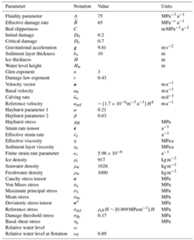
Table 1Model parameters, notations, units and values for constant parameters.
Several empirical and semi-empirical parametrizations of the calvingrate for different terminus geometries have been proposed. A simpleempirical relationship of linearly increasing calving rate with waterdepth, based on observations of tidewater glaciers in Alaska, has beenestablished, used and extended for different regions(Benn et al., 2007b;Brown et al., 1982). This approach only depends on the localwater depth at the terminus only and is not process-based, and it istherefore independent of glacier geometry and dynamics(Vieli et al., 2001). In contrast, the flotation calving criterion,proposed byVan der Veen (1996) and modified byVieli et al. (2001), determines the position of the terminus bycalving away all ice that is close to flotation. In this approach thecalving rate is an emergent quantity resulting from ice flow dynamics.Benn et al. (2007a,b) introduced a physics-based approachby setting the terminus position at the location where crevassespenetrate below the water level. The crevasse depth is computed usingtheNye (1957) theory, which relies on the equilibrium betweenlongitudinal stretching and overburden stress of the ice. Thisdynamic approach for calving allowed for successful reproduction ofcalving front variations of ocean-terminating glaciers in Greenlandand Antarctica(Cook et al., 2014;Nick et al., 2010,2013;Otero et al., 2010,2017). Although the crevasse depth model can becalibrated to observations(Lea et al., 2014), it lacks validationwith field observations and is based on a snapshot of the stressbalance, neglecting the pre-existence of cracks and their effect onthe stress state of the glacier(Krug et al., 2014). A recent, moresophisticated approach byBenn et al. (2017) predicts calvingpositions based on the maximum principal stress distribution andaccounts for the effect of water pressure in the submerged parts ofthe glacier front by combination of a continuum flow model witha discrete element model to simulate calving events.
For near-vertical calving fronts, the main driver for calving is thehorizontal deviatoric stress in the vicinity of thelaterally confined calving front. Its magnitude can be estimated fromthe difference of vertically integrated hydrostatic pressure withinthe ice and of ocean water at the calving front(Cuffey and Paterson, 2010). The resulting extensional stresswithin the ice depends on the ice thicknessH and the water depthHw at the calving front:
whereρi,ρw and are the ice density, water density and relativewater depth (Table 1). This equation illustratesthe square dependence of the horizontal extensional stress on relativewater level at the terminus. However, it should be noted that thisvertically integrated stress is not representative for the stressstate near the surface of the terminus, and such a “depth-averaged”longitudinal stress may be inaccurate as bending stresses areneglected.
Using the above longitudinal stress at the front, the maximum heightfor which a grounded glacier with a dry calving front can sustaina stable vertical front is approximately 110 m when crevassedepth is computed according to theNye (1957) theory and221 m when the ice is considered as undamaged and withoutcrevasses(Bassis and Walker, 2012). However, the presence of wateralong the calving front influences this maximum stable height, as anincrease of water depth for a constant ice thickness reduces thestresses and hence tends to increase the stability of the glacierfront. Thus, a thicker glacier must terminate in deeper water inorder for its calving front not to exceed a certain stress limit andto remain stable(Bassis and Walker, 2012).
Calving termini can also be over-steepened by melt undercutting, whichleads to higher stress intensities(Hanson and Hooke, 2000) and mayfacilitate calving(Benn et al., 2017). Ice flow model results(Hanson and Hooke, 2000) suggest that an increase of water depth leadsto a higher rate of over-steepening development at the calving frontand thus an increase of calving activity. However, model results seemto indicate that melt undercutting does not significantly affectcalving rates(Cook et al., 2014;Krug et al., 2015), while other studiessuggest that calving rates are strongly related to melt undercuttingfor some arctic glaciers(Cowton et al., 2016;Luckman et al., 2015;Petlicki et al., 2015). Conversely,a calving front inclined towards the inland is expected to be morestable than a vertical cliff.
The state of stress near the calving front is determined by icegeometry and water depth and controls the intensity and location ofmaterial degradation processes. Material creep and fracture processesin turn change the geometry of the glacier front. Observations andtheoretical considerations indicate a tendency of increasing relativewater level with increasing thickness(Bassis and Walker, 2012). Thisimplies that thick glaciers approach flotation at their front but forshallow water depth the bounds on stress, and hence cliff geometry,are less well constrained.
The relationship between water depth, stress state, front geometry andrelated calving type is well illustrated at the example of EqipSermia, a medium-sized ocean-terminating outlet glacier on the WestGreenland coast. Figure 1shows that this glacier is characterized by two distinct calving frontlobes with contrasting geometries: the grounded northern lobe exhibitsa 200 m high inclined calving face with slope angles exceeding45∘ while the southern lobe features a vertical ice cliffof∼50 m freeboard with a water depth of∼100 m(Lüthi et al., 2016). These substantially differentgeometries lead to distinct velocity and stress regimes in theproximity of the calving front which also determine the type ofcalving. The high, grounded, inclined northern cliff collapses attimescales of weeks, releasing large ice masses of up to106 m3 and generating 50 m tsunami waves(Lüthi and Vieli, 2016). In contrast, the southern part of the frontcalves smaller volumes of ice at intervals of several hours.

Figure 1Calving front of Eqip Sermia glacier in July 2016. Theboxes in the picture describe the geometrical properties of the twodistinct parts of the calving front.
Motivated partly by the case of contrasting calving front geometriesat Eqip Sermia, the aim of this study is to better understand thedetailed flow and stress regimes in the vicinity of the calving front oftidewater glaciers, including those that are far from flotation. Usinga numerical model that solves the full equations for ice flow, weinvestigate the sensitivity to variations in front thickness andslope, the water depth and the strength of the coupling to the bedwhich results from sliding processes. We perform these modelexperiments on idealized geometries of grounded glacier termini andsucceed to explicitly express the results as function of relativewater depth.
Based on these model results, we derive a novel parametrization ofcalving rate that is calibrated with observations from Arctictidewater glaciers. This parametrization only requires the relativewater level and is based on a fit to the modeled stress field at thesurface and an isotropic damage evolution relation.
2.1Ice flow model and rheology
We used the finite-element library libMesh(Kirk et al., 2006) toimplement the Stokes equations for continuum momentum and massconservation:
whereσ is the Cauchy stress tensor,ρithe ice density,g the gravitational force vector andu the velocity vector. As we assume ice to be incompressibleand isotropic, the Cauchy stress tensor can be decomposed into anisotropic and a deviatoric partσ′:
where is the isotropic mean stress andI theidentity matrix. The ice rheology is described as viscous power-lawfluid (Glen's flow law), linking the deviatoric stress tensorσ′ to the strain rate tensor:
The effective shear viscosityη is defined as
whereis the effective strain rate,A the fluidity parameter,n=3 thepower-law exponent andκε is a finite strain rateparameter included to avoid infinite viscosity at low stresses(Greve and Blatter, 2009).
The model domain was discretized with second-order nine-node quadrangleelements with Galerkin weighting. Model variables are approximatedwith a second-order approximation for the velocitiesu andw anda first-order approximation for the mean stressσm(forming a LBB-stable set). The accuracy of the solution was improvedwith adaptive mesh refinement near the calving front. The Stokesequations with the nonlinear rheology were solved with the PETScnonlinear solver SNES to a relative accuracy of10−4(Balay et al., 2008).
2.2Model geometry and scaling
We used a two-dimensional version of the model to conduct thegeometrical tests, as illustrated in Fig. 2. Thegeometry is defined in a Cartesian coordinate system with horizontalaxisx and vertical axisz with origin at sea level at the calvingfront (wherex=0). The ice moves from right to left. The idealizedglacier geometry used in all model experiments consists of a block ofice resting on a flat bed with a characteristic lengthL=2000 m and a characteristic ice thicknessH=200 m. The domain was discretized with 20 elements in thevertical and 200 elements in the horizontal which, after meshrefinement, led to a spatial resolution of2.5 m in theterminus area.
All numerical results are scalable with reference values for icethicknessHref and overburden stressσref andare therefore independent of the geometrical extent. This validity ofthe scaling was tested by running the model for different icethicknesses, which recovered identical flow and stress results. Thevelocity scaleuref was chosen as the vertical surfacevelocity caused by uniaxial confined compression in pure shear of anice block under its own weight (Cuffey and Paterson, 2010):
The coordinates and the water depth at the calving frontHw are scaled by the ice thicknessHref:
All stress and velocity components are scaled according to

Figure 2Geometry of the idealized grounded glacier.α is the slopeangle of the calving front above the vertical cliff.
2.3Boundary conditions
The upper surface of the glacier was described as a traction-freesurface boundary. Basal motion was parametrized with a slipperinesscoefficientC, which relates the basal velocityub withbasal shear stressτb(Gudmundsson and Raymond, 2008;Ryser et al., 2014):
This boundary condition was implemented as a two-element layer withconstant viscosity, which was added at thebottom of the model domain representing the glacier. At the lowerboundary of this “sediment layer”, a Dirichlet boundary conditionwith zero velocity () was imposed. A layer thickness ofhs=10 m was chosen, although tests with varyinghs showed nosignificant differences. This simple approach allowed us to capture thephysical processes that are relevant to this study. In the case ofvanishing basal motion the two-element layer was not used for the computation, andDirichlet boundary conditions () were imposed directly at thebottom of the model domain representing the glacier.
At the calving front a normal stress boundary condition was imposedbelow the water level, while the surface above water was keptstress-free. The stress boundary condition thus reads
whereσnn and are the normal andtangential tractions applied on the calving front (σnn isnegative, i.e., compressive sincez<0 below water) andρw is waterdensity (Table 1).
At the upstream boundary of the glacier domain velocities were fixedto zero. Additional modeling experiments showed that different valuesfor this upstream boundary condition do not affect the results of theanalysis.
2.4Sensitivity analysis strategy
The stress state and flow field near the calving front is analyzed inthree suites of numerical experiments that investigate the effect ofvariations in relative water levelω, the slope of the calvingfront and basal motion.
The water level sensitivity experiments were performed for relativewater levels and,where the last value is the relative water level at flotation. Thecalving front for this experiment was vertical and the bottomboundary without sliding (i.e., zero velocity Dirichlet boundarycondition). All these experiments were undertaken with both thedensity of ocean water (ρw=1028 kg m−3)and freshwater (ρw=1000 kg m−3).
The calving front slope sensitivity experiments were performed ona geometry with the upper part of the calving front reclining atvarious angles. The lower 25 % of the calving front heightwas set vertical, and the upper part inclined at angles from90, 75, 60 and45∘, until it reached the maximum surface height (seeFig. 2 for illustration). This particular geometricalsetup was chosen to represent a simplified geometry of Eqip Sermia,which has a 50 m high vertical cliff at the bottom witha 45∘ inclined slope up to the top at 200 m. Forthis experiment, the relative water level was set toω=0 andthe sliding velocity was set to zero.
The bed slipperiness sensitivity experiments were performed on a blockgeometry with a vertical calving front and a relative water levelω=0.5. The basal slipperiness coefficientC was varied from0 to 1000 with333 increments. A slipperiness of1000 corresponds to a sliding speed of300 m a−1 for a typical tidewater outlet glacier inGreenland with a driving stress of 0.3 MPa.
2.5Stress invariant combinations
Any criterion for fracture propagation or damage evolution should beindependent of the choice of coordinate system and can therefore beexpressed as a function of the invariants and eigenvalues of thestress tensor.Hayhurst (1972) proposed a linear combination ofthree stress invariants to describe the creep rupture of ductile andbrittle materials under multi-axial states of stress. The invariantschosen were maximum principal stressσ1, first stressinvariant and thevon Mises stressto form the stress combination
where the weightsα,β andγ fulfill the conditions
The Hayhurst stressχH has been used as a criterion for theinitiation and evolution of damage in several glaciological studies(Duddu and Waisman, 2012,2013;Duddu et al., 2013;Mobasher et al., 2016;Pralong and Funk, 2005;Pralong et al., 2003).

Figure 3Sensitivity experiment results for varying water depth.(a)Scaled Hayhurst stress distribution.(b) Scaled horizontal velocitydistributions.(c) Scaled Hayhurst stress along the surface.(d)Scaled horizontal velocity magnitude along the surface. In panels(a, b), the subplots show increasing water depth from thebottom to the top (water level at). Solid and dashedlines in panels(c, d) correspond to experiments with sea- and freshwater densities, respectively.

Figure 4Scaled velocities along the vertical face of the calvingfront (solid lines) for different relative water levels. Horizontalline markers show the relative water level for each curve.

Figure 5Sensitivity experiment results for varying calving frontslope. Panels(a–d) are the same as Fig. 3. In panels(a, b), the subplots show decreasingcalving front slopes from the bottom to the top. In panel(c), the localminimum of stress close to the calving front is located where thefront reaches its maximal height. In panel(d), vertical lines on thecurves for inclined fronts mark the distance at which the maximalsurface height is reached.
To investigate the full spectrum of possible stress states that leadto the initiation of damage, we investigated linear combinations offive stress invariants: andadditionally the third invariant of the stress tensorI3=det(σ) and third invariant of thedeviatoric stress tensor. Thisextended linear combination reads
with weights andμ that fulfill theconditions
We performed a sensitivity analysis based on the five stressinvariants of Eq. (14) by systematically varying the weightswith 0.1 increments (Eq. 15).

3.1Sensitivity analyses
All sensitivity experiment results shown in Figs. 3,5 and6 exhibitsimilar velocity and stress patterns. The effects of varying waterlevel, basal slipperiness and calving front slope on the stress fieldare displayed as Hayhurst stress with parameters chosen according toPralong and Funk (2005) (Table 1). In general, themodeled velocities and stresses increase towards the calving front,with a local stress maximum at the surface that is located less thanone ice thickness upstream of the calving front. This zone of highstress extends diagonally down towards the calving front where it hasa second local maximum closely above the water level. For experimentswith a relatively low water level, the absolute maxima in stress arefound at the bottom of the calving face.
3.1.1Water level height
The depth of the water at the calving front significantly impacts thestress regime and consequently the ice flow pattern and magnitude nearthe terminus. The effect of different water depths on the stressfield is displayed as Hayhurst stress in Fig. 3a and c.
For a reduction in the relative water level fromω=ωf toω=0 the maximum Hayhurst stressat the surface increases from0.08 to0.42 σrefand the location of the stress peak at the surface moves from 0.1 to0.5H upstream of the front, whereas the Hayhurst stress at thevertical calving front increases from0.15 to0.81 σref. Interestingly, the local maxima at thefront are always located near the water level. Further, the positionof the global stress maximum for low water levels (below 0.25) isfound at the bottom of the calving front instead of the surface(Table 2).
Figures 3b, d and4 illustrate how velocities close to the calvingfront increase by more than 1 order of magnitude when the waterlevel is decreased from near flotation (ω=0.85) to shallowwater (ω=0.25). Note that for all water depths the velocitiesare only affected up to approximately 2.5 ice thicknesses upstreamfrom the front.
Extrusion flow, a velocity pattern for which maximum horizontalvelocity occurs below the surface(Waddington, 2010), is clearlyvisible in Fig. 4 in the vicinity of the calving frontfor the low water level cases. This pattern of extrusion flow nearthe terminus was also observed byHanson and Hooke (2000) andLeysinger-Vieli and Gudmundsson (2004).
In summary, increasing relative water depth leads to decreased flowvelocities and lower stresses and moves the peak of the Hayhurststress at the surface closer to the front.
Table 2Maximum scaled Hayhurst stress and velocity forwater depth experiments. The s and f letters indicate whether thescaled Hayhurst stress maxima were found at the surface or at thebottom of the calving front, respectively.
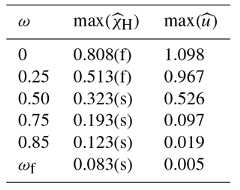
Table 3Maximum Hayhurst stress and velocity for calvingfront slope experiments.
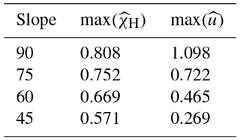
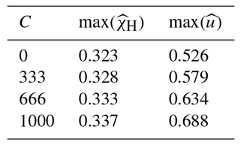
Table 4Maximum Hayhurst stress and velocity for bedslipperiness coefficient experiments.
3.1.2Calving front slope
Results from the sensitivity experiment on calving front slopedisplayed in Fig. 5 show large variations in stressesand flow speeds. Maximum Hayhurst stresses are found at the bottom ofthe calving front for all cases ranging from 0.57 to0.81 σref for slope angles between 45and 90∘ (Table 3). A second, localmaximum occurs at the surface behind the end of the slope, but themagnitude strongly decreases with decreasing slope. The maximumvelocity for a 45∘ slope is∼4 times smaller thanfor a vertical calving front (Fig. 5d). Thus, as thecalving front gets steeper, the stresses and the velocitiesincrease. Again, the peak in Hayhurst stress at the surface movesfurther upstream as the calving front is becoming more gentle anda further local stress maximum occurs along the sloped surface.Moreover, the velocities along the surface peak not towards thefront corner as in the vertical front case but rather towards thebottom of the sloped surface, which is another sign of extrusion flow.

Figure 7Sensitivity experiments result for an inclined surface(c, f), reverse bed(a, d) and the simple rectangular geometry(b, e). The left and right panels show the scaled Hayhurst stressand velocity distributions, respectively.
3.1.3Bed slipperiness
The flow and stress regimes of the idealized glacier are lesssensitive to an increase of bed slipperiness coefficient.Figure 6 shows that increased bed slipperiness leadsto a slight increase in flow velocity, and the affected zone at thesurface extends from three ice thicknesses in horizontal distance from thefront to five ice thicknesses. Increasing the bed slipperinesscoefficient produces very little effect near the front but causesa substantial increase of the stresses further upstream. Thedifferences in the magnitudes of the Hayhurst stress maximum at thesurface are, however, relatively small compared to the variations fromother sensitivity experiments. The locations of the stress maximaremain the same for all bed slipperiness sensitivity experiments.Moreover, the spatial distributions of Hayhurst stress and velocityremain qualitatively very similar throughout the domain for thedifferent bed slipperiness coefficients, and differences are mostlyapparent at the surface.
3.1.4Bed and surface slope
In the modeling presented so far we used a glacier geometry withhorizontal surface and bed. Consequently the driving stress and hencevelocities and stresses far upstream from the calving front are closeto zero. In reality glaciers have a sloping surface. Therefore, werepeated some of the above experiments on a simple glacier geometrywith a sloped bed and surface, a fixed cliff height and no sliding.Bed and surface slopes were chosen as−5 and5∘, respectively. Figure 7 illustratesthe results: a reclining slope at the surface (i.e., surface heightincreasing towards the inland) with a flat bed leads to higherstresses and velocities upstream of the calving front as compared tothe flat surface. However, the stress maximum and its location in thevicinity of the calving front remains almost identical(Fig. 7b, c). Similar results are obtained fora reverse bed slope with a flat surface (Fig. 7a, b).
To summarize, the stress and velocity fields in the vicinity of thecalving front are only slightly altered for sloping bed and surface.It is, however, noteworthy that the reclining surface slope induceshigher stresses near the surface, which could potentially inducecrevassing and thus advect pre-damaged ice to the calvingfront.

Figure 8Combinations of five stress tensor invariants at thesurface of an idealized glacier with a vertical calving frontwithout water pressure and zero basal motion. Each black linerepresents a linear combination of five stress invariants. Theblue envelope contains the maxima of all stress invariantcombinations. The green triangle, red square and purple circlerepresent the maximum of the scaled Hayhurst stress, von Mises stress and maximumprincipal stress, respectively.
3.2Stress invariant combinations
The Hayhurst stress, typically used as the driving force for damageevolution(Duddu and Waisman, 2012,2013;Duddu et al., 2013;Mobasher et al., 2016;Pralong and Funk, 2005;Pralong et al., 2003),is not the only possible combination of objective stress measures.Here we attempt a systematic analysis of the possible stress invariantcombinations (Eq. 14) and the corresponding locations of thestress maxima along the glacier surface. We illustrate this analysisat the example of the block geometry without any water pressure(ω=0) in Fig. 8, where all possible linearcombinations of five stress invariants along the surface aredisplayed. While the stress combinations show a wide variety ofcurves, the maximum achievable stress states are dominated by the vonMises stressσe and the maximum principal stressσ1, both of which contribute to the Hayhurst stress. Hence,these two stress invariants are likely the driving factors formaterial failure in the vicinity of the calving front. An importantaspect illustrated in Fig. 8 is the horizontalposition of the stress maximum, which is limited toxmax≃0.7 Href. This analysis thussuggests that a zone with maximum crevasse opening cannot be locatedin greater distance from the calving front thanxmax foran idealized glacier without pre-damaged ice.

Figure 9Envelopes of stress invariant combinations at the surface ofthe idealized glacier with zero basal motionfor varying relative water levelω. The green triangle, redsquare and purple circle represent the maximum of the scaledHayhurst stress, von Mises stress and maximum principal stress,respectively, for each water depth.
The magnitudes and positions of the maximum stress invariantcombinations for different relative water levelsω are shown inFig. 9 (blue area corresponds to Fig. 8).The maximum stress for dry conditions (ω=0) is located∼0.7 Href from the calving front with a maximum von Misesstress of∼ 0.45 σref, whereas a water levelclose to flotation (ω=0.85) leads to a stress maximum of∼0.15 σref at∼0.25Href from thecalving front. Figure 9 clearly illustrates that waterpressure at the calving front exerts a stabilizing effect on thecalving front by both lowering the stresses and decreasing thedistance from the calving front at which the stress maximum islocated, as argued earlier byBassis and Walker (2012).
The Hayhurst, maximum principal and von Mises stress distributions areshown in Figs. 3a,B1a andB1b, respectively.
The similarity of stress distribution curves along the glacier surfacefor varying relative water levels (Fig. 3c) allowsfor an explicit parametrization of the stresses. With some simpleassumptions on a damage evolution law, a calving rate parametrizationcan be derived that is expressed as a function of total ice thicknessand relative water level. Specifically, we assume that surfacecrevasses open under the extensional stressσ1. The Hayhurststress would be a similarly suited stress measure for the extensionalstress state under small compressive load at the glacier surface. Theabove stress state analysis showed that the three stress intensitymeasuresσ1,σe andχH along theglacier surface are very similar, as demonstrated inFig. 9.

Figure 10Modeled (dashed lines) and corresponding parametrized (solidlines) maximum extensive stresses at the surfacefor different water depths. The dotted lines show the horizontaldeviatoric stresses at the calving front for all water depthsbased on Eq. (1).
4.1Stress parametrization
The distribution along the glacier surface of scaled maximum principalstress is shown for different relative waterlevels in Fig. 10 (this is approximately thetensile stress along the surface, whereas Fig. 3cshows Hayhurst stress). The similarity in shape of these stresscurves allows for an approximate representation by a function thatdepends on the relative water levelω alone:
where is a stretched and shifted version ofthe scaled (by ice thickness) horizontal coordinate.This stretching function is somewhat cumbersome and is given inAppendix A. The extensional stress reaches the maximumat (setting the derivative ofEq. 16 to 0) with magnitude and can be approximatedby
It is interesting to note that the maximum extensional stress at thesurface has a similar form as the mean deviatoric stress inEq. (1) but is∼60 % higher.The scaled horizontal position of the stress maximum can beapproximated by
4.2Analytical calving relation
Using the parametrizations of magnitude and position of the maximumextensional stress at the surface (Eqs. 17aand18) the calving rate can be estimated undersimple assumptions on crevasse formation.
One major assumption is that a large crevasse forms at the location ofthe maximum tensile surface stress where the ice is weakened untilfailure. Such crevassing seems realistic as both observations andmodel results show the formation of huge crevasses. When failure ofthe surface ice is complete, we assume that all ice in front of thecrevasse is removed and a new calving front forms at the location ofthe crevasse. Here, we do not consider explicitly which processes areresponsible for downward propagation of the crevasse. Severalprocesses could be considered, such as bottom crevassing,hydro-fracturing by ponding water in surface crevasses, rapid elasticcrevasse propagation(Krug et al., 2014), ice break-off in multiplesteps (e.g., a surface slump, followed by subaqueous buoyant calving)or continued material fatigue due to tidal forcing. The proposedcalving relation relies on the major assumption that processesresponsible for ice break-off act on faster timescales than theformation of the surface crevasse and, therefore, that the calvingprocess is uniquely determined by the time to failure at the surfacestress maximum. Thus, the average calving ratecan be calculated as the distance of the stress maximum divided by thetime to failureTf. In dimensional coordinates this is
Assuming further that crevasse formation can be described by isotropicdamage formation with damage variableD, the stress in the damagedmaterial is(Pralong, 2006;Pralong et al., 2003). The isotropic damage evolutionrelationship employed here is
whereB is the rate factor for damage evolution,r andk areconstants,σ0 is the stress in the work zone andσth a stress threshold for damage creation.Integrating this relation over time, the time to failure, i.e., thetime required for damage to evolve from an initial valueD0 toa critical valueDc, reads
We further assume that the stress in the work zone is the maximumtensile stress. Inserting theparametrizations for maximum tensile stress and stress maximumposition (Eqs. 17c and18) in the above relation yields
The term in square brackets is constant, and after renaming it theeffective damage rate the expression reads
with parameter values andσth=0.17 MPa, which were determined froma calibration with data discussed below in Sect. 5.3. The parametervaluer=0.43 is chosen according toPralong and Funk (2005).
5.1Sensitivity analyses
The stress intensity and therefore ice deformation rates aredecreasing as the relative water level increases due to the pressureexerted by the water at the calving front. This feature is alreadycaptured by the depth-integrated extensional stress at the front(Eq. 1) and, in more detail, in the parametrizedmaximum extensional stress (Eq. 17a),illustrated in Fig. 10. In both cases thesquare dependence of the horizontal stress on relative water levelcontrols fracture or damaging processes, the magnitude and rate ofwhich depend linearly on the stress intensity.
In addition, the detailed modeling shows that the stress peak at theglacier surface moves upstream for lowering relative water level(Figs. 3 and10),implying that crevasses are likely to open in greater distance fromthe calving front and leading to detachment of larger masses duringcalving.
A higher relative water level results in a more stable calving front(Bassis and Walker, 2012), which seems to be incontrast with the often-used relations which predict that calvingrates increase with water depth(Brown et al., 1982;Hanson and Hooke, 2000;Meier and Post, 1987). In nature,however, glaciers terminating in deeper waters are also thicker andcalve at higher rates as they experience higher absolute (unscaled)stresses. Furthermore, submarine frontal melting is likely to lead tohigher calving rates by over-steepening of the front(O'Leary and Christoffersen, 2013), although the melt undercuttingeffect on calving rates seems to be limited(Cook et al., 2014;Krug et al., 2015).
Using freshwater instead of seawater at the calving front yieldsslightly higher stresses and velocities(Fig. 3c, d). This difference can be explained bythe reduced back pressure applied by freshwater on the calving front,which results from a lower water density.
The model results demonstrate that reclining calving fronts lead tolower velocities and stresses and thereby implicitly confirm thatinclined calving fronts should reach larger stable heights thanvertical cliffs, as observed for example at Eqip Sermia (200 mhigh at 45∘). This sensitivity analysis on front slopemay, together with observational data on non-vertical calving fronts,provide constraints on parameters of ice resistance to failure.Further, the presence of extrusion flow along the reclining calvingface of an idealized glacier was demonstrated. Such a velocitypattern has been observed and measured on an inclined slope at thenorthern front of Eqip Sermia(Lüthi et al., 2016) but is rarelydiscussed in modeling studies(Hanson and Hooke, 2000;Leysinger-Vieli and Gudmundsson, 2004).
Basal sliding leads to increased stresses at the surface throughoutthe computational domain. Thus, basal sliding may cause an onset ofice damaging and crevasse opening in a greater distance from thecalving front (Fig. 6c). The velocity patterns inFig. 6b show that the influence of bed slipperiness isonly apparent in the proximity of the calving front, even for highsliding coefficients. Moreover, stress distributions are almostidentical for all bed slipperiness experiments, which implies thatbasal sliding has a negligible effect on the stability of the calvingfront. Basal sliding adds a constant velocity at the bottom of thedomain rather than affecting the velocity gradients. This result doesnot include any spatial variation in bed slipperiness, which wouldlikely be caused by including a water-pressure-dependent slidingrelation. Effective pressure (the difference between ice normalstress at the bottom and water pressure) typically decreases towardsthe calving front for real glaciers with sloping surface and maycause additional sliding towards the front, an effect that is notconsidered in this modeling effort.
For a sloping glacier surface the location and magnitude of the stressmaximum in the vicinity of the calving front remain almost identical, asshown in Fig. 7. Similar results are obtained fora reverse bed slope with a flat surface, with a smaller influence onstresses and velocities than for the recliningsurface. However, the effect on stresses and velocities upstream of the calvingfront is not visible for the reverse bed slope with a flatsurface. This indicates that, for a glacier with a reclining surfaceslope, ice can potentially start damaging and forming crevasses at thesurface far upstream from the calving front.
5.2Calving relation
The proposed calving rate parametrization(Eq. 22) is simple and only requires twogeometrical quantities: frontal ice thicknessH and water depthHw. The assumptions about the failure process arelumped into three parameters –,σth andr –which can be determined by data calibration (Sect. 5.3). Theparametrization exhibits many similarities with established calvingrelations but is formulated in terms of two quantities that arecalculated by any ice flow model. It therefore is a drop-inreplacement for other calving relations used in glacier models ofdifferent complexity.
The calving rate parametrization (Eq. 22)has some interesting properties, which are illustrated inFigs. 11 and12.Holding constant the relative water depth, the absolute water depth orthe ice thickness results in different calving laws:
for constant relative water levelω the calving rategrows roughly like (black and gray linesin Fig. 11);
for constant absolute water depthHw=ωH a fit showsthat roughly (red and orange lines inFig. 11);
for constant ice thickness the calving rate decreases withincreasing relative water level (Fig. 12)roughly like
The predicted calving rate for a given water depth depends on thethickness of the glacier, which is the result of the mass fluxes in theterminus area. Thus, calving rates depend on the surface evolutionand hence the upstream dynamics of the glacier. The semi-empiricalcalving rate parametrization is therefore, in the sense of inclusionof upstream dynamics, similar to the position based calving models(Benn et al., 2007a,2017;Nick et al., 2010;Todd and Christoffersen, 2014). The formulation as a calving rate also makes thisparametrization relatively easy to use in larger-scale fixed gridmodels.

Figure 11Calving rates predicted by the parametrization in relation toice thickness. Calving rates increase with increasing total icethickness for a given water depthHw=ωH (red and orangelines), relative water levelω (black and gray lines) orfreeboardH−Hw (blue lines). Note that the gray line refers toa front at flotation.

Figure 12Calving rates predicted by the parametrization as a functionof relative water level. Calving rate decreases under increase ofthe relative water levelω for constant total ice thicknessH.

Figure 13Calving rates (m d−1) predicted by the parametrization are shown ascontours in dependence ofH andω. The hatched regionindicates the states excluded by the maximum calving front criterion(Bassis and Walker, 2012). The gray area indicates states where thestress thresholdσth precludes calving. Blue dotswith numbers indicate calving rates determined from measurements,shown in Table 5.


5.3Calibration of the parametrization
The calving rate parametrization (Eq. 22)contains three empirical parameters: andσth=0.17 MPa,which were obtained by calibration with data, andr=0.43, which istaken fromPralong and Funk (2005). Calving rates thus obtained arenot very sensitive to the exact choice of parameter values, which arewithin the range of previous studies(Duddu and Waisman, 2012;Lliboutry, 2002;Vaughan, 1993).
Sugiyama et al. (2015)Pfeffer (2007)Pfeffer (2007)Pfeffer (2007)Pfeffer (2007)Pfeffer (2007)Lüthi et al. (2016);Rignot et al. (2015)Murray et al. (2015);Voytenko et al. (2015)Carr et al. (2015)Carr et al. (2015)Lüthi et al. (2009)Carbonnell and Bauer (1968)Carbonnell and Bauer (1968)Pralong (2006)Carbonnell and Bauer (1968)Carbonnell and Bauer (1968)Rignot et al. (2015);Ryan et al. (2015)Trüssel et al. (2015)Table 5Values of calving front height, water depth andcalving rate for different glaciers.
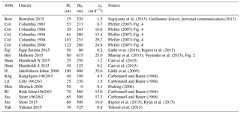
To calibrate these parameter choices, data on calving rate, icethickness and water depth for a wide variety of tidewater glaciers inthe Arctic were collected. The data set covers the full range of waterlevels (relative and absolute), velocities and ice thicknesses thatare found in Arctic tidewater glaciers. Unfortunately, many studiesreport only width-averaged data on calving front geometry and calvingrate, which are not suitable for our proposed relation which relies onlocal stresses on a flowline. Only a limited set of point data oncalving front geometries are available from the published literaturefrom which total ice cliff thickness, water depth and calving rate canbe obtained. For the calibration, we used the values shown inTable 5 from diverse data sources.
Contours of calving rates calculated withEq. (22) are shown inFig. 13 together with the maximumtheoretical calving front height predicted byBassis and Walker (2012). Figure 14plots the same calving rate data against results from theparametrization. While a sizable spread of the data is visible,especially for low calving rates, the general agreement shows that theparametrization is well suited to estimate calving rates for this setof tidewater glaciers in the Arctic.
Note that the derivation of the parametrization is independent of thespecific geometry or location of a tidewater glacier and thus thecalibration is expected to be “global” and valid for any tidewaterglacier.
This study improves our knowledge on the influence of geometry andwater depth on the stress and flow regimes in the vicinity of thecalving front and proposes a novel calving rate parametrization.
The magnitude of the stresses and flow speeds near a grounded verticalcalving front are dominantly dependent on water depth and increasewith decreasing water depth. Thus, the presence of water at thecalving front has a strong stabilizing effect. Importantly, theextensional stress at the surface can be parametrized as a function ofrelative water level only. Further, we find that grounded tidewaterglaciers with reclining calving faces have the potential to reachlarger maximum stable heights than those with vertical calvingfronts. Spatially uniform variations in basal sliding likely havea weaker effect than water depth and calving front slope on thestability, as the magnitude and location of the stress maximum showa small sensitivity to variations in bed slipperiness.
A simple calving rate parametrization was derived that was calibratedwith calving rate data of a set of tidewater glaciers in the Arctic.This approach can be used to compute calving rates for groundedtidewater glaciers with relatively simple geometries when frontthickness and water depth are known. The application of thisparametrization in flow models of different complexity should bestraightforward.
The present study lays the foundation for future, more detailed,studies of the calving process on more realistic geometries. Detailedanalyses including time evolution, further processes such as frontalmelt and water-filled crevasses, and data validation will be necessaryfor the implementation of improved calving parametrizations.
The libMesh library is a C++ framework for the numericalsimulation of partial differential equations on serial and parallel platformsavailable athttp://libmesh.github.io/ (Kirk et al., 2006). Data fromthis study can be made available from the authors upon request.
The distribution of longitudinal tensile stress at the surface can be fitted using stretched and scaledcoordinates depending on relative water levelω:
The stress fit includes a taper towards the calving front which waschosen as an exponential. The full approximation to the stress curveis given by

Figure B1Stress distributions for varying water depth.(a)Scaled maximum principal stress distribution.(b) Scaled von Mises stressdistribution.

The authors declare that they have no conflict ofinterest.
The authors wish to thank Jaime Otero and Jeremy Bassis for their reviewsand Douglas Benn, Joe Todd and Olivier Gagliardini for their comments thathelped considerably to improve this paper. This work was funded by theSwiss National Science Foundation Grant 200021_156098.
Edited by: Olivier Gagliardini
Reviewed by: Jeremy Bassis and Jaime Otero
Amundson, J., Fahnestock, M., Truffer, M., Brown, J., Lüthi, M., and Motyka, R.: Ice mélange dynamics and implications for terminus stability, Jakobshavn Isbræ, Greenland, J. Geophys. Res., 115, F01005,https://doi.org/10.1029/2009JF001405, 2010. a
Balay, S., Buschelman, K., Eijkhout, V., Gropp, W. D., Kaushik, D.,Knepley, M. G., McInnes, L. C., Smith, B. F., and Zhang, H.: PETSc UsersManual, Tech. Rep. ANL-95/11 – Revision 3.0.0, Argonne National Laboratory,available at:http://www.mcs.anl.gov/petsc (last access: 2 March 2017), 2008. a
Bassis, J. N. and Walker, C. C.: Upper and lower limits on the stability of calving glaciers from the yield strength envelope of ice, P. Roy. Soc. Lond. A Mat., 468, 913–931,https://doi.org/10.1098/rspa.2011.0422, 2012. a,b,c,d,e,f,g
Benn, D. I., Hulton, N. R., and Mottram, R. H.: `Calving laws', `sliding laws' and the stability of tidewater glaciers, Ann. Glaciol., 46, 123–130, 2007a. a,b
Benn, D. I., Warren, C. R., and Mottram, R. H.: Calving processes and the dynamics of calving glaciers, Earth-Sci. Rev., 82, 143–179,https://doi.org/10.1016/j.earscirev.2007.02.002, 2007b. a,b
Benn, D. I., Aström, J., Todd, J., Nick, F. M., Hulton, N. R., and Luckman, A.: Melt-undercutting and buoyancy-driven calving from tidewater glaciers: new insights from discrete element and continuum model simulations, J. Glaciol., 63, 691–702, 2017. a,b,c
Brown, C. S., Meier, M. F., and Post, A.: Calving speed of Alaskatidewater glaciers, with application to Columbia glacier, Tech. rep.,US Geological survey professional paper 1258-C,, available at:https://pubs.er.usgs.gov/publication/pp1258C (last access:22 January 2017),1982. a,b
Carbonnell, M. and Bauer, A.: Exploitation des couverturesphotographiques aériennes répétées du front desglaciers vêlants dans Disko Bugt et Umanak Fjord, Juin-Juillet1964, Tech. Rep. 3, Expédition glaciologique internationale auGroenland (EGIG), tirage à part des Meddelelser om Grønland,Bd. 173, Nr. 5, København, Lunos, 1968. a,b,c,d
Carr, J., Stokes, C., and Vieli, A.: Recent progress in understanding marine-terminating Arctic outlet glacier response to climatic and oceanic forcing: twenty years of rapid change, Prog. Phys. Geog., 37, 436–467,https://doi.org/10.1177/0309133313483163, 2013. a
Carr, J., Vieli, A., Stokes, C., Jamieson, S., Palmer, S., Christoffersen, P., Dowdeswell, J., Nick, F., Blankenship, D., and Young, D.: Basal topographic controls on rapid retreat of Humboldt Glacier, nothern Greenland, J. Glaciol., 61, 137–150,https://doi.org/10.3189/2015JoG14J128, 2015. a,b
Cook, S., Rutt, I. C., Murray, T., Luckman, A., Zwinger, T., Selmes,N., Goldsack, A., and James, T. D.: Modelling environmental influenceson calving at Helheim Glacier in eastern Greenland, The Cryosphere, 8,827–841,https://doi.org/10.5194/tc-8-827-2014, 2014. a,b,c
Cowton, T., Sole, A., Nienow, P., Slater, D., Wilton, D., and Hanna, E.: Controls on the transport of oceanic heat to Kangerdlugssuaq Glacier, East Greenland, J. Glaciol., 62, 1167–118,https://doi.org/10.1017/jog.2016.117, 2016. a
Cuffey, K. and Paterson, W.: The Physics of Glaciers, Elsevier, Burlington, MA, USA, iSBN 978-0-12-369461-4, 2010. a,b
Duddu, R. and Waisman, H.: A temperature dependent creep damage model for polycrystalline ice, Mech. Mater., 46, 23–41, 2012. a,b,c
Duddu, R. and Waisman, H.: A non local continuum damage mechanics approach to simulation of creep fracture in ice sheets, Comput. Mech., 51, 961–974, 2013. a,b
Duddu, R., Bassis, J. N., and Waisman, H.: A numerical investigation of surface crevasse propagation in glaciers using nonlocal continuum damage mechanics, Geophys. Res. Lett., 40, 3064–3068, 2013. a,b
Greve, R. and Blatter, H.: Dynamics of Ice Sheets and Glaciers, Springer-Verlag, Heidelberg, iSBN 978-3-642-03414-5, 2009. a
Gudmundsson, G. H. and Raymond, M.: On the limit to resolution andinformation on basal properties obtainable from surface data on icestreams, The Cryosphere, 2, 167–178,https://doi.org/10.5194/tc-2-167-2008,2008. a
Hanson, B. and Hooke, R. L.: Glacier calving: a numerical model of forces in the calving-speed/water-depth relation, J. Glaciol., 46, 188–196, 2000. a,b,c,d,e
Hayhurst, D. R.: Creep rupture under multi-axial states of stress, J. Mech. Phys. Solids, 20, 381–390, 1972. a
Howat, I. M., Box, J. E., Ahn, Y., Herrington, A., and McFadden, E. M.: Seasonal variability in the dynamics of marine terminating outlet glaciers in Greenland, J. Glaciol., 56, 601–613,https://doi.org/10.3189/002214310793146232, 2010. a
Joughin, I., Das, S. B., King, M. A., Smith, B. E., Howat, I. M., and Moon, T.: Seasonal speedup along the western flank of the Greenland Ice Sheet, Science, 320, 781–783,https://doi.org/10.1126/science.1153288, 2008. a
Kirk, B., Peterson, J. W., Stogner, R. H., and Carey, G. F.:libMesh:a C++ Library for ParallelAdaptive Mesh Refinement/Coarsening Simulations, Eng. Comput., 22, 237–254,https://doi.org/10.1007/s00366-006-0049-3, 2006. a
Krug, J., Weiss, J., Gagliardini, O., and Durand, G.: Combining damage and fracture mechanics to model calving, The Cryosphere, 8, 2101–2117,https://doi.org/10.5194/tc-8-2101-2014, 2014. a,b
Krug, J., Durand, G., Gagliardini, O., and Weiss, J.: Modelling the impact of submarine frontal melting and ice mélange on glacier dynamics, The Cryosphere, 9, 989–1003,https://doi.org/10.5194/tc-9-989-2015, 2015. a,b
Lea, J. M., Mair, D. W. F., Nick, F. M., Rea, B. R., van As, D., Morlighem, M., Nienow, P. W., and Weidick, A.: Fluctuations of a Greenlandic tidewater glacier driven by changes in atmospheric forcing: observations and modelling of Kangiata Nunaata Sermia, 1859–present, The Cryosphere, 8, 2031–2045,https://doi.org/10.5194/tc-8-2031-2014, 2014. a
Leysinger-Vieli, G. J.-M. C. and Gudmundsson, G. H.: On estimating length fluctuations of glaciers caused by changes in climatic forcing, J. Geophys. Res., 109, F01007,https://doi.org/10.1029/2003JF000027, 2004. a,b
Lliboutry, L.: Velocities, strain rates, stresses, crevassing and faulting on Glacier de Saint-Sorlin, French Alps, 1957–1976, J. Glaciol., 48, 125–141, 2002. a
Luckman, A., Benn, D. I., Cottier, F., Bevan, S., Nilsen, F., andInall, M.: Calving rates at tidewater glaciers vary strongly withocean temperature, Nat. Commun., 6, 8566,https://doi.org/10.1038/ncomms9566, 2015. a
Lüthi, M. P. and Vieli, A.: Multi-method observation and analysis of a tsunami caused by glacier calving, The Cryosphere, 10, 995–1002,https://doi.org/10.5194/tc-10-995-2016, 2016. a
Lüthi, M. P., Fahnestock, M., and Truffer, M.: Calving icebergs indicate a thick layer of temperate ice at the base of Jakobshavn Isbræ, Greenland, J. Glaciol., 55, 563–566,https://doi.org/10.3189/002214309788816650, 2009. a
Lüthi, M. P., Vieli, A., Moreau, L., Joughin, I., Reisser, M., Small, D., and Stober, M.: A century of geometry and velocity evolution at Eqip Sermia, West Greenland, J. Glaciol., 1–15,https://doi.org/10.1017/jog.2016.38, 2016. a,b,c
Meier, M. F. and Post, A.: Fast tidewater glaciers, J. Geophys. Res., 92, 9051–9058, 1987. a
Mobasher, M., Duddu, R., Bassis, J. N., and Waisman, H.: Modeling hydraulic fracture of glaciers using continuum damage mechanics, J. Glaciol., 62, 794–804,https://doi.org/10.1017/jog.2016.68, 2016. a,b
Motyka, R. J., Dryer, W. P., Amundson, J., Truffer, M., and Fahnestock, M.: Rapid submarine melting driven by subglacial discharge, LeConte Glacier, Alaska, Geophys. Res. Lett., 40, 1–6,https://doi.org/10.1002/grl.51011, 2013. a
Murray, T., Selmes, N., James, T., Edwards, S., Martin, I., O'Farwell, T., Aspey, R., Rutt, I., Nettles, M., and Baugé, T.: Dynamics of glacier calving at the ungrounded margin of Helheim Glacier, southeast Greenland, J. Geophys. Res., 120, 964–982,https://doi.org/10.1002/2015JF003531, 2015. a
Nick, F., Van der Veen, C., Vieli, A., and Benn, D.: A physically based calving model applied to marine outlet glaciers and implications for the glacier dynamics, J. Glaciol., 56, 781–794, 2010. a,b
Nick, F., Vieli, A., Vieli, A., Andersen, M. L., Joughin, I., Payne, A., Edwards, T., Pattyn, F., and van de Wal, R.: Future sea-level rise from Greenland's main outlet glaciers in a warming climate, Nature, 479, 235–238,https://doi.org/10.1038/nature12068, 2013. a,b
Nick, F. M., Vieli, A., Howat, I. M., and Joughin, I.: Large-scalechanges in Greenland outlet glacier dynamics triggered at theterminus, Nat. Geosci., 2, 110–114,https://doi.org/10.1038/ngeo394, 2009. a
Nye, J. F.: The distribution of stress and velocity in glaciers andice-sheets, P. Roy. Soc. Lond. A Mat., 239, 113–133, 1957. a,b
O'Leary, M. and Christoffersen, P.: Calving on tidewater glaciers amplified by submarine frontal melting, The Cryosphere, 7, 119–128,https://doi.org/10.5194/tc-7-119-2013, 2013. a
Otero, J., Navarro, F., Martin, C., Cuadrado, M., and Corcuera, M.: A three-dimentional calving model: numerical experiments on Johnsons Glacier, Livingston Island, Antarctica, J. Glaciol., 56, 200–214,https://doi.org/10.3189/002214310791968539, 2010. a
Otero, J., Navarro, F., Lapazaran, J. J., Welty, E., Puczko, D., and Finkelnbrug, R.: Modeling the controls on the front position of a tidewater glacier in Svalbard, Front. Earth Sci., 5, 200–214, 2017. a
Petlicki, M., Cieply, M., Jania, J. A., Prominska, A., and Kinnard, C.: Calving of a tidewater glacier driven by melting at the waterline, J. Glaciol., 61, 851–863,https://doi.org/10.3189/2015JoG15J062, 2015. a
Pfeffer, T.: A simple mechanism for irreversible tidewater glacier retreat, J. Geophys. Res., 112, F03S25,https://doi.org/10.1029/2006JF000590, 2007. a,b,c,d,e
Post, A., O'Neel, S., Motyka, R., and Streveler, G.: A complexrelationship between calving glaciers and climate, EOST. Am. Geophys. Un., 92, 305–306,https://doi.org/10.1029/2011EO370001, 2011. a
Pralong, A.: Ductile Crevassing, in: Glacier Science and Environmental Change, edited by: Knight, P. G., Blackwell Publishing, Oxford, 62 pp., 2006. a,b
Pralong, A. and Funk, M.: Dynamic damage model of crevasse opening and application to glacier calving, J. Geophys. Res., 110, B01309,https://doi.org/10.1029/2004JB003104, 2005. a,b,c,d,e
Pralong, A., Funk, M., and Lüthi, M. P.: A description of crevasse formation using continuum damage mechanics, Ann. Glaciol., 37, 77–82, 2003. a,b,c
Rignot, E., Fenty, I., Xu, Y., Cai, C., and Kemp, C.: Undercutting of marine-terminating glaciers in West Greenland, Geophys. Res. Lett., 42, 5909–5917,https://doi.org/10.1002/2015GL064236, 2015. a,b
Ryan, J. C., Hubbard, A. L., Box, J. E., Todd, J., Christoffersen, P., Carr, J. R., Holt, T. O., and Snooke, N.: UAV photogrammetry and structure from motion to assess calving dynamics at Store Glacier, a large outlet draining the Greenland ice sheet, The Cryosphere, 9, 1–11,https://doi.org/10.5194/tc-9-1-2015, 2015. a
Ryser, C., Lüthi, M., Andrews, L., Catania, G., Funk, M., Hawley, R., Hoffman, M., and Neumann, T.: Caterpillar-like ice motion in the ablation zone of the Greenland Ice Sheet, J. Geophys. Res.-Earth, 119, 2258–2271,https://doi.org/10.1002/2013JF003067, 2014. a
Straneo, F. and Heimbach, P.: North Atlantic warming and the retreat of Greenland's outlet glaciers, Nature, 504, 36–43,https://doi.org/10.1038/nature12854, 2013. a
Straneo, F., Heimbach, P., Sergienko, O., Hamilton, G., Catania, G., Griffies, S., Hallberg, R., Jenkins, A., Joughin, I., Motyka, R., Pfeffer, W. T., Price, S. F., Rignot, E., Scambos, T., Truffer, M., and Vieli, A.: Challenges to understand the dynamic response of Greenland's marine terminating glaciers to oceanic and atmospheric forcing, B. Am. Meteorol. Soc., 94, 1131–1144,https://doi.org/10.1175/BAMS-D-12-00100.1, 2013. a,b
Sugiyama, S., Sakakibara, D., Tsutaki, S., Maruyama, M., and Sawagaki, T.: Glacier dynamics near the calving front of Bowdoin Glacier, northwestern Greenland, J. Glaciol., 61, 223–223,https://doi.org/10.3189/2015JoG14J127, 2015. a
Todd, J. and Christoffersen, P.: Are seasonal calving dynamics forced by buttressing from ice mélange or undercutting by melting? Outcomes from full-Stokes simulations of Store Glacier, West Greenland, The Cryosphere, 8, 2353–2365,https://doi.org/10.5194/tc-8-2353-2014, 2014. a
Trüssel, B., Truffer, M., Hock, R., Motyka, R., Huss, M., and Zhang, J.: Runaway thinning of the low-elevation Yakutat Glacier, Alaska, and its sensitivity to climate change, J. Glaciol., 61, 65–75,https://doi.org/10.3189/2015JoG14J125, 2015. a
van den Broeke, M., Bamber, J., Ettema, J., Rignot, E., Schrama, E., van de Berg, W. J., van Meijgaard, E., Velicogna, I., and Wouters, B.: Partitioning recent Greenland mass loss, Science, 326, 984–986,https://doi.org/10.1126/science.1178176, 2009. a
Van der Veen, C. J.: Tidewater calving, J. Glaciol., 42, 375–385, 1996. a
Vaughan, D. G.: Relating the occurrence of crevasses to surface strain rates, J. Glaciol., 39, 255–266, 1993. a
Vieli, A. and Nick, F.: Understanding and modelling rapid dynamic changes of tidewater outlet glaciers: issues and implications, Surv. Geophys., 32, 437–458,https://doi.org/10.1007/s10712-011-9132-4, 2011. a
Vieli, A., Funk, M., and Blatter, H.: Flow dynamics of tidewater glaciers: a numerical modelling approach, J. Glaciol., 47, 595–606, 2001. a,b
Voytenko, D., Dixon, T. H., Howat, I. M., Gourmelen, N., Lembke, C., Werner, C. L., de la Peñ, S., and Oddsson, B.: Multi-year observations of Breidamerkurjökull, a marine-terminating glacier in southeastern Iceland, using terrestrial radar interferometry, J. Glaciol., 61, 42–54,https://doi.org/10.3189/2015JoG14J099, 2015. a
Waddington, E.: Life, death and afterlife of the extrusion flow theory, J. Glaciol., 200, 973–996, 2010. a