



1. Introduction
It is well known that the brightness of comets can undergo large, seemingly random fluctuation. Fluctuation involving short-term increases in activity (cometoutbursts) are distinctly noticeable and have attracted regular interests. It is suggested that comets can even resurrected from dormant4 or near-dormant state (Rickman et al.1990). In many known cases, the resurrection is short-lived; but it has been speculated that the resurrection can be long-lived—i.e., comets will show activity in their proceeding perihelion passages just like normal comets (Kresak1987; Kresak & Kresakova1990). However, the inventory of thesereactivated comets is virtually uncharted largely due to the difficulty to identify their inactive or weakly active progenitors.
The ever-increasing effort from various near-Earth object (NEO) surveys since the late 1990s has provided an excellent source of data to explore temporally variable phenomena such as reactivated short-period comets. As a starting point, it is useful to find short-period comets that have recently been in a dormant or near-dormant state. Here, we present a search of reactivated comets by examining pre-discovery data of known comets.
2. Methodology and Results
Since most NEO surveys started in the late 1990s, we focus on comets detected no earlier than 2000 + 5 = 2005 (where 5 is the typical orbital period for short-period comets in years) if we want to include at least one pre-discovery orbit of the comet. We also check for cometary activity in the proceeding orbit after the orbit of discovery. We specifically exclude active asteroids that are on the list compiled by Jewitt et al. (2015, pp. 221–241). At the time of the writing, there are 40 comets satisfying these criteria (Table1).
Table 1. Comets That Were First Detected In or After 2005 and Have Been Observed for at Least Two Orbits as of 2016 December 16
| 213P/Van Ness | 233P/La Sagra | 238P/Read |
| 249P/LINEAR | 255P/Levy | 257P/Catalina |
| 259P/Garradd | 260P/McNaught | 261P/Larson |
| 263P/Gibbs | 266P/Christensen | 267P/LONEOS |
| 277P/LINEAR | 278P/McNaught | 284P/McNaught |
| 286P/Christensen | 287P/Christensen | 293P/Spacewatch |
| 294P/LINEAR | 297P/Beshore | 298P/Christensen |
| 300P/Catalina | 302P/Lemmon-PANSTARRS | 309P/LINEAR |
| 310P/Hill | 316P/LONEOS-Christensen | 317P/WISE |
| 319P/Catalina-McNaught | 325P/Yang-Gao | 332P/Ikeya–Murakami |
| 333P/LINEAR | 335P/Gibbs | 336P/McNaught |
| 337P/WISE | 338P/McNaught | 339P/Gibbs |
| 340P/Boattini | 341P/Gibbs | 345P/LINEAR |
| P/2008 Y12 (SOHO) |
Note. Comets with pre-discovery images identified in this work and Hui et al. (2016) are highlighted in bold.
Download table as: ASCIITypeset image
We then searched the archival images provided by the SkyMorph service (http://skyview.gsfc.nasa.gov/skymorph/skymorph.html; Lawrence et al.1998), the Solar System Object Search service hosted at Canadian Astronomy Data Centre (http://www.cadc-ccda.hia-iha.nrc-cnrc.gc.ca/en/ssois/index.html; Gwyn et al.2012), as well as the Catalina Sky Survey (CSS; Christensen et al.2016), for pre-discovery images of each comet in Table1. Images are selected based on the predicted position and brightness of the comets ( for NEO survey images following Jedicke et al.2015, pp. 795–813, and
 for other images, wheremT is the total magnitude of the comet). The only comet excluded from this procedure is 332P/Ikeya–Murakami for which extensive archival data search had been conducted by Hui et al. (2016).
We found and retrieved pre-discovery images for a total of six comets. Images are reduced using the fourth U.S. Naval Observatory CCD Astrograph Catalog (UCAC4; Zacharias et al.2013). We identified previously unreported pre-discovery observation for three comets (297P/Beshore, 317P/WISE and 336P/McNaught), while for other images we estimated the limiting magnitude of the images to the nearest 0.5 mag using the faintest visible stars. Details of the pre-discovery (non-)detections are summarized in Table2. The involved facilities are summarized in Table3.
Table 2. Pre-discovery (non-)Detection of the Comets of Interest, Including Observational Date and Facility, Heliocentric Distance (rh), Predicted Visual Total Magnitude ( ) Using the Relation Derived by JPL Database, Observed Visual Total Magnitude (or Upper Limit;
 ), and Positional Error
| Comet | Date | Facility | rh (au) |  |  | Pos. Errora | Note |
|---|---|---|---|---|---|---|---|
| 213P/Van Nessb | 2002 Jan 6 | NEAT | 4.72 | 20.6 | >20.0 | 1 4 4 | |
| .. | 2002 Feb 5 | NEAT | 4.71 | 20.6 | >20.0 | 15 | |
| .. | 2002 Feb 15 | NEAT | 4.71 | 20.6 | >19.0 | 15 | Bright background |
| .. | 2003 Apr 16 | NEAT | 4.11 | 19.6 | >20.0 | 09 | |
| .. | 2003 Apr 25 | NEAT | 4.09 | 19.7 | >19.0 | 09 | Trailed image |
| .. | 2003 May 6 | NEAT | 4.06 | 19.7 | >20.0 | 08 | |
| .. | 2003 May 14 | NEAT | 4.04 | 19.7 | >20.0 | 08 | Star interference |
| 266P/Christensen | 2001 Apr 4 | NEAT | 2.98 | 19.7 | >18.5 | 79″ | |
| .. | 2001 Apr 26 | NEAT | 3.05 | 20.0 | >18.5 | 72″ | |
| 297P/Beshore | 2001 Mar 20 | INT | 2.65 | ∼22c | 16.6 | 11″ | Detected; trailed |
| .. | 2001 Mar 24 | NEAT | 2.64 | >18.5 | 16.5 | 11″ | Bright background |
| .. | 2001 Apr 22 | NEAT | 2.58 | >20.0 | 16.4 | 10″ | |
| .. | 2002 May 25 | NEAT | 2.82 | >20.0 | 17.9 | 3″ | |
| .. | 2002 May 26 | NEAT | 2.83 | >19.5 | 17.9 | 3″ | |
| .. | 2002 Jun 7 | NEAT | 2.85 | >18.0 | 17.9 | 3″ | Trailed image |
| .. | 2002 Jul 15 | NEAT | 2.96 | >20.0 | 18.0 | 4″ | |
| .. | 2002 Jul 16 | NEAT | 2.96 | >20.0 | 18.0 | 4″ | |
| .. | 2002 Aug 11 | NEAT | 3.04 | >20.0 | 18.3 | 4″ | |
| .. | 2002 Aug 30 | NEAT | 3.09 | >20.0 | 18.6 | 4″ | |
| .. | 2007 May16 | CSS | 2.99 | >19.5 | 19.0 | 5″ | |
| .. | 2008 Mar 5 | SSS | 2.41 | >19.5 | 16.1 | 1″ | |
| 302P/Lemmon-PANSTARRS | 1998 Aug 18 | NEAT | 3.60 | 19.2 | >18.5 | 28″ | |
| 317P/WISE | 2005 Apr 15 | CSS | 1.54 | 20.0 | >19.0 | 3″ | |
| .. | 2005 May 8 | CSS | 1.40 | 19.4 | >19.0 | 3″ | |
| .. | 2005 Jun 1 | SSS | 1.27 | 18.9 | >18.5 | 2″ | |
| .. | 2005 Jul 28 | SSS | 1.22 | 18.5 | ∼19 | 3″ | Detected |
| .. | 2005 Aug 16 | SSS | 1.29 | 19.1 | >18.5 | 3″ | |
| 332P/Ikeya–Murakamid | 2003 Sep. 25 | CFHT | 4.05 | 21.0 | >22.9e | 08 | |
| .. | 2003 Sep 27 | CFHT | 4.05 | 21.0 | >23.4e | 08 | Partial coverage |
| .. | 2005 Apr 19 | CSS | 1.60 | 10.6 | >19.5 | 2° | |
| .. | 2005 Apr 30 | CSS | 1.59 | 10.6 | >19.5 | 2° | |
| 336P/McNaught | 1996 Aug 9 | NEAT | 2.85 | 18.4 | >19.0 | 6″ | Star interference |
| .. | 1996 Aug 11 | NEAT | 2.85 | 18.4 | 19.5 | 6″ | Detected |
| .. | 2005 May 10 | WHT | 3.98 | 22.6 | >20.5 | 5″ | |
| .. | 2006 Feb 8 | SSS | 2.95 | 19.4 | >19.0 | 1″ | |
| .. | 2006 Mar 23 | SSS | 2.83 | 18.5 | >19.0 | 1″ | Star interference |
Notes. All magnitudes are in JohnsonV. Abbreviation of surveys/facilities: CFHT—Canada–France–Hawaii Telescope; CSS—Catalina Sky Survey; INT—Isaac Newton Telescope; NEAT—Near-Earth Asteroid Tracking; SSS—Siding Spring Survey; WHT—William Herschel Telescope.
aAngular width of the error ellipse semimajor axis provided by the JPL database. bThe predicted magnitude may be erroneous; orbital uncertainty is calculated by the author instead of retrieving from the JPL database. See main text. cThe comet is trailed; the reported brightness has been corrected for trailing loss. dData recalculated from Hui et al. (2016). eMagnitudes are converted to JohnsonV using the transformation equation derived by Jester et al. (2005).
Download table as: ASCIITypeset image
Table 3. Facilities Involved in the Archival Observations in Table2
| Facility | Location | Telescope | Field of view | Image resolution |
|---|---|---|---|---|
| CFHT | Maunakea, Hawai’i, USA | 3.6 m reflecting telescope + MegaCam | 1 deg2 | 0 2/pixel 2/pixel |
| CSS | Mt. Catalina, Arizona, USA | 0.68 m Schmidt telescope | 8 deg2 | 25/pixel |
| INT | La Palma, Canary Islands, Spain | 2.5 m Isaac Newton Telescope + WFC | 0.3 deg2 | 03/pixel |
| NEAT (1995–2000) | Haleakala, Hawai’i, USA | 1.0 m GEODSS telescope | 2 deg2 | 1″/pixel |
| NEAT (2000–2003) | Maui, Hawai’i, USA | 1.2 m AMOS telescope | 2 deg2 | 1″/pixel |
| NEAT (2001–2007) | Palomar Mountain, California, USA | 1.2 m Oschin Schmidt | 5 deg2 | 1″/pixel |
| SSS | Siding Spring Observatory, Australia | 0.5 m Uppsala Schmidt | 4 deg2 | 2″/pixel |
| WHT | La Palma, Canary Islands, Spain | 4.2 m William Herschel Telescope + Prime focus imager | 0.07 deg2 | 02/pixel |
Download table as: ASCIITypeset image
Individual comets are discussed below:
213P/Van Ness. (semimajor axis , eccentricitye = 0.38, inclination
 ) was discovered in 2005 September during an outburst of the comet (van Ness et al.2005). It was found to have split during the subsequent return in 2011, but the actual split might have taken place just a few days before the discovery in 2005 (Hanayama et al.2011). We found seven sets of pre-discovery images taken by the Near-Earth Asteroid Tracking (NEAT) survey in 2002–2003, where the comet was ∼4 au from the Sun. The comet was predicted to be
 around these times, though it is likely an exaggerated value since most observations are made after the outburst/fragmentation. The JPL orbit solution is not suitable for us due to the complication arising from the comet’s history of fragmentation; hence, we calculated the orbit and covariance matrix of the comet using the FindOrb package (http://www.projectpluto.com/find_orb.htm) based on the pre-fragmentation observations taken in 2005 August, available from the Minor Planet Center database (http://www.minorplanetcenter.net/db_search). The pre-outburst orbit is presented alongside the most recent JPL orbit in Table4.
Table 4. Original Orbit of 213P/Van Ness from JPL Orbit #67 vs. the Orbit Derived from Pre-outburst Data Only
| JPL #67 | Pre-outburst Orbit | |
|---|---|---|
| Epoch | 2012 Jun 2.0 (TT) | 2012 Jun 2.0 (TT) |
| Perihelion timeT | 2011 Jun 16.60716 (TT) | 2011 Jun 9.25791 (TT) |
| Perihelion distanceq (au) | 3.4268640 | 3.4196637 |
| Eccentricitye | 0.3806647 | 0.3800714 |
| Inclinationi (J2000.0) | 1023692 | 1023292 |
| Longitude of the ascending node Ω (J2000.0) | 31256369 | 31250968 |
| Argument of perihelionω (J2000.0) | 351416 | 341276 |
| Mean anomalyM | 5459485 | 5591280 |
| First observation | 2005 Aug 4 | 2005 Aug 4 |
| Last observation | 2012 Feb 3 | 2005 Aug 31 |
| Observations used | 3090 | 14 |
Download table as: ASCIITypeset image
According to the calculation, the NEAT images are wide enough to cover the entire uncertainty ellipse. The images were blinked to reveal moving objects. We searched the entire images and specifically look for objects that match the motion of 213P/Van Ness; none are found. Since the depth of the images only barely reaches the predictedmT, which is likely already inflated as mentioned above, we are only able to conclude that the comet was unlikely to be as bright as expected in 2003 April–May.
266P/Christensen. ( ,e = 0.34,
 ) was discovered in 2006 October (Christensen et al.2006). We found two sets of pre-discovery images taken in 2001, neither of which is deep enough to reach the predictedmT. Nevertheless, we blinked the images to search for the comet, but nothing was found.
297P/Beshore. ( ,e = 0.31,
 ) was discovered in 2008 May at a heliocentric distance of
 at an unusually bright 14th magnitude (Beshore et al.2008). At typical cometary brightening rate (
 ), 297P/Beshore would have been brighter than most NEO survey limits (
 ) since early 2007. The position of the comet was scanned no fewer than five times within three months before discovery, during which the comet would have been 15–16 mag. This strongly suggests that 297P/Beshore was discovered following a large outburst.
We found 12 sets of pre-discovery images in 2001–2008 in which nothing is found in all but one of them. The comet is readily visible (as a short streak) in the 900 s exposure taken by the Wide Field Camera on the Isaac Newton Telescope (INT) on 2001 March 20, when the comet was at (Figure1). The image retrieved from the INT archive has a moderate gradient and is first corrected by fitting and subtracting the background with a high-order polynomial function before photometric reduction. The trailing loss is then corrected for photometric measurement of the comet. For other sets of images, we blinked them to look for moving objects that match the motion of the comet and found nothing. The updated orbit, along with the pre-discovery INT observations included, is presented in Table5.
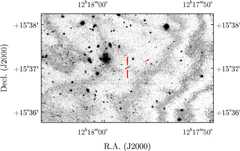
Figure 1. Pre-discovery image of 297P/Beshore (center), taken by the Isaac Newton Telescope on 2001 March 20. The comet (highlighted streak at the center of the image) was trailed due to the motion of the comet and the long exposure. The red arrow marks the predicted motion of the comet computed from JPL orbit #33.
Download figure:
Standard imageHigh-resolution imageTable 5. Original Orbit of 297P/Beshore from JPL Orbit #33 vs. the Updated Orbit with Pre-discovery Observations
| JPL #33 | Updated orbit | |
|---|---|---|
| Epoch | 2009 Mar 8.0 (TT) | 2009 Mar 8.0 (TT) |
| Perihelion timeT | 2008 Mar 21.01997 (TT) | 2008 Mar 21.01638 (TT) |
| Perihelion distanceq (au) | 2.4086462 | 2.4086958 |
| Eccentricitye | 0.3086498 | 0.3086364 |
| Inclinationi (J2000.0) | 1026285 | 1026298 |
| Longitude of the ascending node Ω (J2000.0) | 9828318 | 9828353 |
| Argument of perihelionω (J2000.0) | 13181419 | 13181361 |
| Mean anomalyM | 5334699 | 5334740 |
| First observation | 2008 May 6 | 2001 Mar 20 |
| Last observation | 2014 Jun 18 | 2014 Jun 18 |
| Observations used | 568 | 583 |
Download table as: ASCIITypeset image
297P/Beshore was measured to be in the INT data. This can be used to constrain the nucleus size by

whereas is the absolute cometary nuclear magnitude, where
 is the apparent nuclear magnitude,rH and
 are the heliocentric distance and the geocentric distance of the comet in astronomical units, respectively,α is the phase angle of the comet in degrees,
 andp = 0.04 are the phase coefficient and albedo, respectively (Lamy et al.2004, pp. 223–264), and
 is the apparent magnitude of the Sun. We can hereby derive
 km. This indicates that the comet was either inactive or very weakly active at the time of the observation, or has a sub-kilometer sized nucleus. We will revisit this issue in the discussion. The non-detection in the CSS and Siding Spring Survey (SSS) images in 2007 May and 2008 March provided further support to the conclusion that the comet was discovered following a large outburst in 2008.
The comet was recovered in early 2014 at 20th magnitude without any information about its appearance (Durig et al.2014). However, the comet was about 2 mag brighter than the brightness extrapolated from the 2001 data, indicating that the comet was more active than in 2001.
302P/Lemmon-PANSTARRS. ( ,e = 0.23,
 ) was discovered in 2007 July (Bolin et al.2014). It has only one set of pre-discovery images found and is not deep enough to allow any conclusions.
317P/WISE. ( ,e = 0.59,
 ) was discovered in 2010 May (Scotti et al.2010). We found five sets of pre-discovery images during its last undetected perihelion passage in 2005. The comet was visible in the SSS images taken on 2005 July 28, being about the same brightness as predicted. It is likely a low activity comet (Ye et al.2016) rather than a reactivated comet.
332P/Ikeya–Murakami. ( ,e = 0.49,
 ) was discovered in 2010 November at
 following an apparent outburst (Ishiguro et al.2014). Hui et al. (2016) searched a set of archival data in 2003–2005 and placed an upper limit of nucleus diameter
 km, which led them to conclude that the comet was largely inactive prior to its 2010 perihelion passage. Independent observation with theHubble Space Telescope has placed a tighter limit of
 km on the pre-outburst progenitor (Jewitt et al.2016).
The comet was recovered in late 2015 with the realization that it had split into a few dozen fragments (e.g., Kleyna et al.2016). Observations suggested that sublimation-driven mass loss is still ongoing on these fragments and some of the fragments continue to split.
336P/McNaught. ( ,e = 0.45,
 ) was discovered in 2006 April (McNaught2006) and has five sets of pre-discovery images found. The comet was visible on the NEAT images taken on 1996 August 11, being about 1 mag fainter than predicted but still 4 mag brighter than bare nucleus brightness. We therefore concluded that the comet was active in its 1996 perihelion.
3. Discussion
We identified comets 297P/Beshore and 332P/Ikeya–Murakami as plausible reactivated comets.
It is interesting that the reactivations of both comets are marked by large outbursts: 297P/Beshore had brightened by at least 5–6 mag; for 332P/Ikeya–Mukarami it is not known how much it had brightened, but the comet reportedly lost 4% of its mass (Jewitt et al.2016), comparable to the well-studied mega-outburst exhibited by 17P/Holmes in 2007 (Li et al.2011). The repeated activity of 297P/Beshore and 332P/Ikeya–Murakami into their next perihelion passages suggests that the mass-loss mechanism is re-triggered when the comet approaches the Sun, and that the activity would not be quickly shut down by aging and environmental effects, consistent with sublimation-driven activity. If so, a large nucleus disturbance (or even a disruption of the nucleus) is likely required to break the mantle that seals off the volatile and is consistent with the large outbursts observed at the reactivation of both comets. For 332P/Ikeya–Murakami, Jewitt et al. (2016) suggested rotational excitation as a likely driving force, while for 297P/Beshore no studies have been published as of 2016 December. Other mechanisms, such as asteroid impact, tidal and thermal stress, and amorphous ice crystallization, are also known to cause nucleus disturbance or disruption. However, the occurrence of asteroid impact for a typical kilometer-wide short-period comet is (Beech & Gauer2002), which is an unlikely event; tidal and thermal stress requires the comet to be sufficiently close to a giant planet or the Sun. Crystallization has been proposed to be the outburst trigger for the cases of 17P/Holmes (Li et al.2011) and 332P/Ikeya–Murakami (Ishiguro et al.2014), but it is unclear if amorphous ice does exist on cometary surfaces.
Hui et al. (2016) suggested a potential linkage between 332P/Ikeya–Murakami and P/2010 B2 (WISE). Such linkage, if real, would imply previous fragmentation of the progenitor of the two comets and provide an evolutionary sketch of a cascading fragmentation of a comet. We tested this idea on 297P/Beshore and searched for objects in similar orbits. The closest comet is P/2005 JN (Spacewatch) with the Southworth & Hawkins (1963)sD-criterion , while the closest asteroid is 2014 JO, with
 , but neither is as close as the 332P-B2 pair (
 ). This may be considered as further evidence, in addition to the fact that 332P/Ikeya–Murakami is observed to have fragmented while 297P/Beshore is not, that the evolutionary history of the two comets is different.
Is it possible that the two comets are just smaller (sub-kilometer), moderately active comets whose activity would not be noticeable without a large outburst? Though fully active (100% active surface) sub-kilometer comets are quickly eliminated by rotational instability, moderately active (∼1% active surface) sub-kilometer comets are less prone to such effects and can survive up to (Jewitt et al.2016), making them more likely to be detected, though probably without being recognized as a comet. To answer this question, we consider the cometrecognizability, defined by the sign of
 and the rotational instability of comets, defined by Jewitt (1997). HereMT is the absolute total magnitude of comets, derived using the relation determined by Jorda et al. (2008, p. 8046), assuming the comet activity is driven by water ice sublimation;MN is calculated using the aforementioned relation embedded in Equation (1) assuming a geometric albedo of 0.04,
 , and
, and . The main idea behind this definition is that comets will likely to be recognized when they produce enough dust that exceeds the nuclear brightness. The local sublimation rate is derived from the sublimation energy balance equation (Cowan & A’Hearn1979). For rotational instability equation, we followed the parameters discussed and adopted in Jewitt et al. (2016) except taking the moment-arm
 (Belton2014). Comets that can be detected need to have a disruption timescale,
 , that is longer than the characteristic timescale on which observers can find them,
 , which we take to be
 . The physical meaning of
 is that if a comet is disrupted before it has completed enough orbits to be detected in any of these orbits, we would not know it had existed.
As shown in Figure2, the two indicators—recognizability and rotational instability—divide the graph into four quadrants: (i) comets that can be recognized as such and will be found; (ii) comets that can be recognized as such but will be disrupted before being found; (iii) low-activity comets that cannot be recognized but will be found as asteroids; and (iv) low-activity comets that cannot be recognized as such, and will be disrupted before being found.
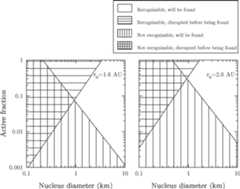
Figure 2. Recognizability and rotational stability of comets at different heliocentric distance, (appropriated to the pre-discovery detection of 332P/Ikeya–Murakami reported by Hui et al.2016), and
 (appropriated to the pre-discovery detection of 297P/Beshore reported in this work), as a function of the fraction of active surface and nucleus size. A comet is considered detectable when
 and vice versa, whereMT is derived assuming the comet activity is driven by water ice sublimation. The rotational stability is calculated using Jewitt (1997), taking the disruption timescale to be 20 year.
Download figure:
Standard imageHigh-resolution imageThe figure draws several interesting conclusions:
- 1.Most 1 km sized comets at a few astronomical units are difficult to recognize, unless they are very active (active fraction
 ) or are in outbursts.
 - 2.Rotational instability quickly depletes active sub-kilometer sized comets before the current NEO survey can find them. The predicted observable size population peaks around 1 km, which is in line with observation (Snodgrass et al.2011).


This provides further support to our previous conclusion that 297P/Beshore and 332P/Ikeya–Murakami had been weakly active before reactivation, since both comets have resided in the inner solar system for at least a few 102 year and are not completely disrupted.5
The result leads to a more generic question: how often do comets reactivate? By querying the JPL database, we found that there are about 100 comets that (a) have been observed at two orbits from 2005 to now; and (b) had been observed at their last orbit before 2005 (i.e., these comets have been observed for 20 years and have completed 3 orbits). The rate of reactivation is therefore . This rate is equivalent to the frequency of comets entering temporary dormancy, as comets must become dormant before they reactivate. Since short-period comets are only physically active for a few hundred orbits (Fernández et al.2002), this number seems to suggest that typical short-period comets likely only become temporarily dormant no more than a few times before their ultimate end, assuming no individual differences. On the other hand, if rotational excitation turns out to be the dominant mechanism in reactivating comets, temporarily dormant comets will be dominated by smaller comets, while larger comets do not or very rarely become temporary dormant.
4. Summary
We conducted a search to look for short-period comets that are reactivated from a dormant or near-dormant stage and are able to sustain their activity into their latter orbits. Comets 297P/Beshore and 332P/Ikeya–Murakami are identified as such comets. Both comets were discovered thanks to large outbursts. They are found to be inactive or weakly active before the orbit of discovery, and are still active in the proceeding orbit of the reactivation. The reactivation is likely triggered by large nucleus disturbance or disruption that breaks the regolith that used to seal off the volatile, allowing sublimation-driven activity to resume. We found the rate of reactivation for short-period comets to be , implying that typical short-period comets only become temporary dormant at most a few times.
The small sample size makes it difficult to interpret the findings. For example, it is unclear whether large outbursts are common in marking the reactivation of comets, and what mechanism causes such an outburst. The recent research on 332P/Ikeya–Murakami signals that rotational instability may play an important role in reactivating small comets. It would be advisable to pay more attention on the comets that were discovered due to large outbursts, the most prominent ones being P/2010 H2 (Vales) and P/2013 YG46 (Spacewatch), as well as the unsolved case of 297P/Beshore.
The recognizability–rotational instability analysis also suggests that active sub-kilometer sized comets are quickly eliminated due to rotational instability before current NEO surveys can find them. Next-generation high-cadence surveys, such as Asteroid Terrestrial-impact Last Alert System (Denneau2016), Zwicky Transient Facility (Ye2017), and Large Synoptic Survey Telescope (LSST Science Collaboration et al.2009), are likely to find these short-lived comets before they are gone.
I thank an anonymous referee and Man-To Hui for helpful comments, David Clark for discussion about archival data search, Davide Farnocchia and Gareth Williams for discussion about the validity of the pre-discovery observations, as well as Eric Christensen and Robert Seaman for their help with the Catalina Sky Survey (CSS) and Siding Spring Survey (SSS) data. I also thank the support of the GROWTH project, funded by the National Science Foundation under Grant No. 1545949. The SkyMorph service was developed under NASA’s Applied Information Systems Research (AISR) program. The Solar System Object Search service is hosted at the Canadian Astronomy Data Centre operated by the National Research Council of Canada with the support of the Canadian Space Agency. The pre-discovery image of 297P/Beshore was obtained from the Isaac Newton Group Archive which is maintained as part of the CASU Astronomical Data Centre at the Institute of Astronomy, Cambridge. The SSS survey was operated by the CSS in collaboration with the Australian National University. The CSS/SSS surveys are funded by the National Aeronautics and Space Administration under grant No. NNX15AF79G-NEOO, issued through the Science Mission Directorate’s Near Earth Object Observations Program. This research has made use of data and/or services provided by the International Astronomical Union’s Minor Planet Center.