
1. INTRODUCTION
Comets are small icy Solar System bodies that display a coma on close approach to the Sun. Thus far, only a few thousand comets have been detected from Earth, these having been flung inward by Jovian planets onto Sun-grazing orbits from vast reservoirs of icy bodies beyond the orbit of Neptune. Together, the Kuiper Belt and Oort Cloud may harbor trillions of such frozen bodies. Those that we see vaporizing represent only a tiny fraction of the actual population. Other stellar systems may likewise include reservoirs of comets (Zuckerman & Song2012). Indeed, true comets with gaseous comae and tails may be far more common in young or debris-rich systems with large planets that are only just in the process of forming. The gravitational field in such systems will be in a state of flux, potentially throwing large numbers of icy bodies toward the young central star. Thus, large numbers of infalling comet-like bodies (or ‘exocomets’) may be the signature of a young planetary system.
The association of infalling bodies with planetary formation was first suggested by Lagrange et al. (1987), and dynamical model simulations showed that large numbers of bodies will be flung on moderately eccentric orbits into the parent star from belts characterized by orbital resonances with a single massive planet (Beust et al.1990; Beust & Morbidelli1996). In our own system, the rapid migration of the Jovian planets is widely believed to have triggered the Late Heavy Bombardment (LHB) by destabilizing the orbits of distant bodies and propelling them inward (Gomes et al.2005). Because we see the cratered faces of only our own terrestrial neighbors, we do not currently know whether or not episodes analogous to the LHB occurred elsewhere. However, current thinking suggests that the evolution of all young systems is punctuated by brief but violent episodes of instability as terrestrial planetesimals reach diameters of ∼1,000 km and perturb the orbits of smaller planetesimals (Kenyon & Bromley2001; Rieke et al.2005; Wyatt et al.2007). This instability is expected to initiate a collisional cascade and potentially send comets on highly eccentric orbits toward the parent star. Thus by detecting systems with comet-like bodies, we not only gather indirect evidence of exoplanets, but are also presented with the opportunity of witnessing the onset and early stages of terrestrial planet formation.
To date, the search for exocomets has focused on young (< 50 Myr) A-type stars, which can provide a promising environment for studying young planetary system evolution and may be relatively rich in comet-like debris. An initial survey revealed that one-quarter of all rapidly rotating A-stars are surrounded by circumstellar gas, much of which is confined to disks (Abt et al.1997). Several subsequent studies have shown that roughly one-third of normal A-type main sequence stars exhibit IR excesses due to debris dust disks (Su et al.2006; Morales et al.2011). Although the actual placement of the debris disks is still debated, it seems most likely that dust-production occurs just interior to the snowline (T ∼ 170 –190 K) regardless of the star’s spectral type (B8–M0), which may suggest that at least some of the dust arises from the sublimation of icy bodies (Morales et al.2011; Su et al.2013). Moreover, A-type stars likely host planets since radial velocity studies show that they are five times more likely to harbor orbiting Jovian mass bodies than M-type stars (Johnson et al.2007). We also note that the first successful direct imaging of exoplanets was performed on A-type stars (Marois et al.2008; Kalas et al.2008).
A-type stars are so luminous that their radiation pressure is able to remove dust particles from their disks on timescales ≪ 1 Myr. Thus, the dust (and gas) in the debris disks that surround some main sequence A-type stars cannot be primordial, but instead must be constantly re-supplied by the collision and evaporation events amongst planetesimals (i.e., asteroid and comet-like bodies) (Kenyon & Bromley2004). Until recently it was supposed that even this second-generation dust must dissipate by 400 Myr (Habing et al.1999). However, newHerschel satellite observations have revealed a dusty debris disk around an M3-type star that is roughly ten times older than that (Lestrade et al.2012). To date, the debris disks around ∼20 A-type stars have been resolved by mapping their thermal emission (Churcher et al.2011; Booth et al.2013; Su et al.2013). Research in this field of study has mostly concentrated on the spatial distribution of the circumstellar disk dust as traced by its emission at IR and/or sub-mm wavelengths (van Zadelhoff et al.2001; Roberge & Weinberger2008). The associated tenuous gas, however, has proven much harder to detect, and relatively few observational diagnostics exist (Carmona2010). Most studies of circumstellar gas have focused on the CO emission, which is routinely detected in Herbig Ae/Be disks and originates in the cold, optically thick gas located at the outer surface of the disks at distances >50 AU from the central star (Dent et al.2005; Moor et al.2011). The warm disk gas located closer to the central star has recently been probed using the far IR emission lines of OI, CII, CH+ and H2O (Meeus et al.2012). This relatively warm (T = 100–2500 K) region within 20 AU of the star is where planets are expected to form and where exocomets will vaporize (Carmona2010).
Absorption due to the circumstellar gas (disk) component around A-type stars has been mostly probed by high resolution spectroscopy of the CaII K-line at 3,933 Å (Lagrange-Henri et al.1990; Welsh et al.1998; Redfield et al.2007; Montgomery & Welsh2012). The equivalent width (EW) of this line has recently been observed to change on a night-to-night basis in some debris disk stars (Montgomery & Welsh2012), which is perhaps not surprising given the constraints required to stabilize the gas disk. Any evaporation events occurring close to the star are likely to cause subtle changes in the plasma and destabilize the disk. In edge-on disks, direct evidence of infalling and evaporating material might be expected to take the form of transient gas absorption features seen at rapidly changing redshifts. This type of short-term (night-to-night and hour-to-hour) variability in absorption was first detected in β Pic through repeated observations of the Ca II K-line (Ferlet et al.1987; Lagrange-Henri et al.1990) and was subsequently confirmed through absorption observations in the ultraviolet regime (Vidal-Madjar et al.1994). Although transient, blue-shifted events were occasionally observed in the spectrum of β Pic (Crawford et al.1998), red-shifted absorption features outnumbered them by at least 9:1 (Lagrange-Henri et al.1992). Rapid variability was also observed in the Ca II IR triplet at 8,542 Å, suggesting that most of the ionized calcium was formed less than 1 AU from the star (Hobbs et al.1988). The existence of molecules with short residence times, in particular CO, established that at least some of the gas was produced through the evaporation of frozen bodies (Lecavelier des Etangs et al.2001). Furthermore, the CO gas was determined to be at a temperature of ∼25 K, which is very near its sublimation temperature. This short-term absorption variability in β Pic is now widely attributed to the release of gas from kilometer-sized “falling evaporating bodies” (FEBs or exocomets) that have been perturbed by an outer planet onto star-grazing orbits (Beust et al.1990). We recognize that comets (in our Solar System) possess lots of ice, whereas Karmann et al. (2001) have proposed that the FEBs which explain the β Pic data may be more like rocky asteroids with perhaps a small icy nucleus. Although the reader should be aware of these differences, in keeping with current parlance we have chosen to use exocomet and FEB as interchangeable terms throughout the rest of this article. In the absence of an alignment mechanism, the FEB model predicts equal numbers of red- and blue-shifted transient events. Thus, the greater frequency of red-shifted events implies a preferred direction and axis of the FEBs’ orbits. The FEB model received important confirmation when a giant planet (β Pictoris b) was imaged in the disk at roughly the predicted mass and separation distance by Lagrange et al. (2009). The favored mechanism (mean-motion resonances) required to trigger the influx of observed FEBs in the β Pic system is highly generic. It is effective as soon as just one planet is present on a moderately eccentric orbit (Beust & Morbidelli1996).
Absorption spectroscopy carried out at visible and ultraviolet wavelengths (Grady et al.1996,1997) has revealed short-term absorption variability at high velocities in several other stellar systems, all of which has been attributed to FEBs. Specifically, short-term absorption variability at velocities >50 km s-1 away from the main CaII K-line (and sometimes the NaI D lines) has thus far been reported toward five additional stars: HR 10 (Lagrange-Henri et al.1990), HD 85905 (Welsh et al.1998; Redfield et al.2007), 2 And (Cheng et al.1997; Montgomery & Welsh2012), 49 Ceti, and 5 Vul (Montgomery & Welsh2012). We note that the variability of the NaI D-lines towards β Car appears to be of a similar nature, but thus far it has been observed to take place only over timescales of months (Redfield et al.2007; Hempel & Schmitt2003) rather than hours or days. Thus, there are at present only six A-type stellar systems thought to include exocomets. These six exocomet systems share several physical characteristics. They are all A-type stars possessing high stellar rotation rates (V sin i > 120 km s-1), suggesting we are viewing these hot stars nearly edge-on, that most are main-sequence (the exception being the giant star HD 85905), and that they are all relatively young (< 60 Myr). Surprisingly, only half these comet-hosting stars show a mid-IR excess, a measurement that is normally indicative of the presence of circumstellar dust. However, unless the disk inclination angle is favorable, the detection of time-variable absorption may be unlikely. Alternatively, since the three stars that do not show mid-infrared excess also possess the largest rotational velocities, the FEB-like phenomenon might instead be due to a stellar phenomenon related to the rotation rate. We note that the absorption signals in the three stars with mid-infrared excesses (β Pic, 5 Vul, and 49 Ceti) have both a higher rate and stronger level of absorption activity (Montgomery & Welsh2012). These six systems likely represent the transitional objects that exist in the evolutionary chain between the pre-main sequence Herbig Ae stars with large IR excesses and the more evolved, dusty “Vega-like” A-type stars that possess more tenuous circumstellar disks (Montesinos et al.2009; Collins et al.2009).
Observed variability in the absorption profile of the CaII K-line does not necessarily indicate the presence of a protoplanetary disk or any associated planetesimals, particularly in systems that show only a change in the equivalent width (EW) of the circumstellar component without strong evidence of FEBs (HD 184006 and HD 223884). Both of these systems showed a temporary decrease in the equivalent width of the circumstellar component (Montgomery & Welsh2012), which is difficult to explain using the canonical FEB model. While it is possible that the evaporation of a planetesimal has temporarily upset the delicate balance required to confine the gas in these two systems such that the disk of corotating gas temporarily thins, it is equally likely that the phenomenon could be a stellar one. We note that neither of these systems shows a preponderance of circumstellar dust (Rieke et al.2005; Roberge & Weinberger2008). One of the stars showing night-to-night variability in the main circumstellar component of the CaII K-line (2 And) has been called a λ Boötis-type star. The anomalous abundances of such stars have been attributed to the selective accretion of volatiles as dust grains from either a circumstellar or interstellar environment migrate inwards (Kamp & Paunzen2002; Martinez-Galarza et al.2009). Other groups of young stars have shown short-term (i.e., night-to-night) absorption variability. For example, FU Orionis, the prototype of dusty pre-main sequence objects that brighten tremendously and remain bright, has shown similar rapid changes in its NaI D-lines (Errico et al.2003). The most likely mechanism in this case appears to be a magnetic field that is greatly inclined to the rotational axis and has led to a corotating disk and wind that are not azimuthally symmetric. Also, some main-sequence stars of spectral class A–F (including β Pic) undergo radial and nonradial pulsations as δ-Scuti-type variables. The exact role played by the oscillations in the β Pictoris phenomenon is unknown, but it is not hard to imagine scenarios in which a quickly varying circumstellar environment develops around a star that is both rotating rapidly and pulsating. For example, the stellar pulsations occurring in δ-Scuti-type variables may cause increased chromospheric activity, which may lead to mass-loss and the formation of a quasi-permanent circumstellar gas disk (Pasinetti Fracassini & Pastori1996). Finally, we note that observations of the stellar TiII lines in main sequence A-type stars with disks have shown quasi-periodic absorption variability over a 15–30 year timeframe that is consistent with material falling onto the star (Abt2008).
In summary, short-term variability at significant Doppler-shifted velocities is most probably correctly ascribed to the FEB phenomenon. However, variability at or near the main circumstellar absorption line is at present much less clear. Variability of this nature probably does not define a cohesive group in that a variety of physical mechanisms may be at play. Thus, in order to further understand the nature of the absorption variability in circumstellar gas surrounding young A-type stars, and to attempt to link this variability with the evaporation of infalling planetesimals originating in a surrounding debris disk, we present new observations of 21 nearby stars. These targets were observed at the CaII K-line (3,933 Å) with medium spectral resolution (R ∼ 60,000) on a nightly basis over two observing runs in 2011 and 2012 at the McDonald Observatory, Texas. These observations have revealed an additional four stars (HD 21620, HD 42111, HD 110411 and HD 145964) that exhibit circumstellar gas variability in the form of sporadic, weak, but short-lived absorption features thought to be associated with the evaporation of exocomets. This brings the total number of systems thought to harbor exocomets to ten, eight of which have been discovered by the present authors.
2. OBSERVATIONS AND DATA REDUCTION
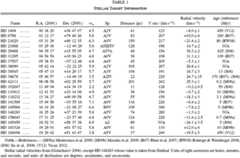
Medium spectral resolution observations ofR ∼ 60,000 (5 km s-1) were obtained at the CaII K-line (3,933 Å) towards the 21 A-type stars listed in Table 1. With the exception of the radial velocities (Gontcharov2006), the astrophysical data for each star have been drawn from the SIMBAD data retrieval system. Targets were selected based on the physical properties they shared with circumstellar gas systems that were already known to exhibit variable absorption at the CaII wavelengths. Thus, the program targets are similarly young, bright A-type main sequence stars that rotate rapidly and exhibit a strong mid-infrared excess (see point 5 of § 6 for a discussion of this latter point), with distances generally < 150 pc. The data were recorded with a 1,200 × 400 pixel Reticon CCD detector on the Sandiford Echelle Spectrograph which is mounted at the Cassegrain focus of the 2.1 m telescope at the McDonald Observatory, Texas. The spectral orders covered the 3,800–4,100 Å range, with the CaII K-line being at the center of the order blaze (the CaII H-line was unfortunately located at the very end of an order with significantly reduced signal-to-noise ratio [S/N]).
 |
Observations were performed over nights from 2011 May 14–18 and 2012 November 4–9, with the intent of observing each of the targets (weather permitting) on a nightly basis. Typically, one observation consisted of an integration time of ∼60 minutes, such that the spectra were well exposed with typical S/Ns of ∼200∶1 in the stellar continuum around the CaII K-line. The raw spectral orders on the CCD were bias-subtracted and the detector fixed pattern noise was removed using a very high S/N quartz lamp spectrum. Cosmic rays and bad pixels were removed, and the spectral orders were then extracted using the standard optimal spectrum extraction algorithm (Horne1986). The wavelength calibration of the stellar spectra was obtained by cross-reference to Th-Ar emission spectra recorded at the beginning and end of each night. This resulted in a wavelength accuracy of ∼0.015 Å (∼1 km s-1) for the stellar spectra. These wavelengths were then transformed into the heliocentric frame of reference for all future discussion in this article.
Many of our stellar spectra revealed a narrow circumstellar CaII K-line positioned at the bottom of the rotationally broadened stellar absorption line. This type of spectral signature is typical of those stars that possess circumstellar gas disks that corotate near to the radial velocity of the star (Montgomery & Welsh2012; Redfield et al.2007; Lagrange-Henri et al.1990). Each of the stellar continua was then fit with a 6th (or higher) order polynomial over the same velocity range of ± 110 km s-1 in order to determine a residual intensity absorption profile for the far weaker circumstellar CaII K-line. A typical 6th order polynomial fit to the continuum of the broad stellar CaII K-line has been shown previously (Montgomery & Welsh2012). The continuum placement software assigns an rms error to each of the spectral data points, which is adopted as the 1−σ error for these points (Vallerga et al.1993). The results of the fits to the stellar continua of the four stars showing significant changes in absorption activity can be seen in the residual intensity profiles of Figures 16.
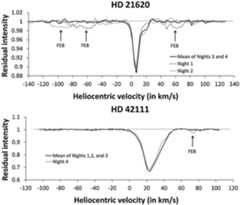
Fig. 1.— Upper plot: the CaII spectra of HD 21620 recorded on 11-04-2012 (night 1) and 11-05-2012 (night 2) compared with the average of the spectra recorded on the following 2 nights. FEB absorption events are clearly detected atV = -95, -60 and +60 km s-1.Lower plot: the CaII spectrum of HD 42111 recorded on 11-08-2012 (night 4) compared with the mean average of the spectra recorded on the previous 3 nights. A small change in the absorption strength of the main circumstellar CaII line is seen atV ∼ +40 km s-1, and an FEB absorption event is seen atV ∼ +80 km s-1 at a level well above the noise level of the continuum.

Fig. 2.— Nightly residual intensity absorption spectra of the CaII K-line recorded towards HD 21620.Arrows indicate the velocity interval over which the K-line absorption equivalent width (EW) was measured. Note the FEB absorption events on the nights of 2012 November 4 and 2012 November 5, which dissipate over a 24 hr period.

Fig. 3.— Nightly residual intensity absorption spectra of the CaII K-line recorded towards HD 42111.Arrows indicate the velocity interval over which the absorption equivalent width (EW) was measured. Note the FEB event atV ∼ +75 km s-1 on the night of 2012 November 8.

Fig. 4.— Nightly residual intensity absorption spectra of the CaII K-line recorded towards HD 110411.Arrows indicate the velocity interval over which the K-line absorption equivalent width (EW) was measured. Note both the significant change in total EW on the night of 2011 May 18 and also the FEB absorption event atV ∼ -80 km s-1 on the night of 2011 May 16.

Fig. 5.— Nightly residual intensity absorption spectra of the CaII K-line recorded towards HD 145964.Arrows indicate the velocity interval over which the absorption equivalent width (EW) was measured. Note both the significant change in total EW on the night of 2011 May 16 and also the FEB absorption event atV ∼ -70 km s-1 on the same night.
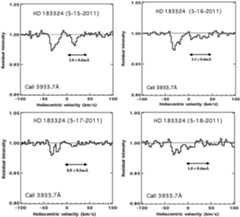
Fig. 6.— Nightly residual intensity absorption spectra of the CaII K-line recorded towards HD 183324.Arrows indicate the velocity interval over which the (presumed circumstellar) absorption equivalent width (EW) was measured. Note the significant change in the total EW on the night of 2011 May 17.
3. DETERMINATION OF ABSORPTION VARIABILITY
Our previous study suggested two types of temporal variability in the resultant residual intensity profiles (Montgomery & Welsh2012). Firstly, the strength or profile shape of the main circumstellar line may change and secondly, weak absorption features (FEBs) may intermittently appear at velocities that are red or blue shifted away from the main circumstellar line by tens of km s-1. To assess a change in the main circumstellar absorption line we measure its equivalent width (EW) from night-to-night, integrated over the same velocity interval. Errors associated with these measurements were calculated from the 1−σ errors derived for each data point as described above, and are typically around ± 10%. A change in absorption was taken to be statistically significant if the EW was measured to be more than 3−σ from the mean.
An FEB absorption feature is more difficult to identify and its significance more difficult to assess. Firstly, the FEB absorption line needs to possess a velocity well removed from the stronger central circumstellar CaII K-line in order to be identified with confidence. Secondly, the EW of the FEB absorption feature must be at least 3 - σ above the noise of the adjacent stellar continuum in order for it to be deemed significant and measurable. Thirdly, confirmation of the event requires the observation of an FEB absorption feature at a different velocity on the following night(s). The exact nature of the nightly transition is determined by the star grazer’s orbit, the direction in which it moves, and its survival after closest approach. Nightly progression either to lower or higher wavelengths is possible. Due to incomplete temporal coverage of an FEB event, the last requirement is, unfortunately, not always met. Thus we take the conservative approach of reporting the EWs of any significant (>3 - σ) FEB absorption events (well removed from the central Ca II absorption), and the velocity range over which this quantity was measured, without regard to its appearance on contiguous nights. Appearance on contiguous nights will, however, greatly strengthen the case for an FEB event.
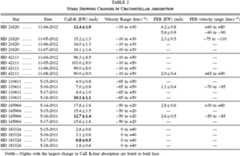
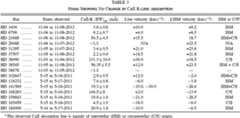
The five stars in our present study that showed significant changes in circumstellar absorption of either type appear in Table 2. This table lists the EW of the main CaII K-line measured on each night over the velocity range specified. In addition, we also list the EWs of FEB events that we deem significant, together with the velocity range over which this was measured. Sixteen of our targets showed no measurable change in the EW of the main circumstellar CaII K-line over the entire observing period, and the average EW values are listed in Table 3.
 |
 |
As shown in our previous paper (Montgomery & Welsh2012), changes in the shape and strength of the main CaII K-line profile can be assessed by plotting one night’s absorption profile alongside the mean profile of the other nightly observations that were deemed to show no change in EW. This type of plot is shown for the stars HD 21620 and HD 42111 in Figure 1.
4. CONTRIBUTION FROM THE LOCAL INTERSTELLAR MEDIUM
The sight-lines towards all of our targets likely pass through local interstellar gas clouds such that the observed CaII K-line profiles most probably include a nonnegligible and fixed contribution from absorption due to interstellar gas. Indeed, high spectral resolution observations of interstellar CaII K-line absorption carried out towards 1,267 nearby stars show that the EW of this interstellar absorption line can exceed 10 mÅ for stars less than 10 pc from the Sun (Welsh et al.2010). Hence, the EWs of the main CaII K-line listed in Tables 2 and3 may contain both an interstellar and circumstellar contribution. Fortunately, the heliocentric velocity vectors of 15 interstellar gas clouds located within ∼30 pc of the Sun have been derived (Redfield & Linsky2008). Thus, in many cases we can compare the observed velocity of the main CaII absorption with that of the projected velocity vector for each of the 15 clouds to ascertain if the central circumstellar absorption is being contaminated by an appreciable interstellar contribution. In addition, if our target stars lie close to a sight-line that has published interstellar data then we can also assess the interstellar contribution. These assessments are discussed for each of our targets in the following sections, together with the projected velocity vectors of any local cloud that traverses the stellar sight-line.
5. DISCUSSION OF SIGHT-LINE ABSORPTION CHARACTERISTICS
Our nightly observations of the CaII spectra towards the 21 targets reveal three different types of absorption behavior, based on the results listed in Table 2. Firstly, four stars show evidence of temporal FEB absorption activity, which is usually accompanied by changes in the EW of the main CaII circumstellar absorption profile. Secondly, one star (HD 183324) exhibits nightly absorption variability in the EW of its main CaII circumstellar line, but shows no evidence of any associated FEB activity. A third group of 16 stars shows no measurable absorption variability in their CaII spectra. Although there is often evidence for circumstellar gas, the limited temporal scope of our present CaII observations have failed to reveal any change in this gas.
For the eight systems with FEBs detected by us we have typically found absorption EWs of ∼5 mÅ for these variable components. Although such small EW values are not unknown in observations of the β Pic system, values that are ∼10 times higher are more frequently recorded (Lagrange-Henri et al.1992). This difference in FEB event EWs could be due to a variety of reasons such as the viewing angle of the gas disk or that the exocomets in orbit around β Pic could be abnormally larger than in other stellar systems. We also note that the β Pic system has been observed far more frequently than the typical 4 nights of our own observations of other systems, thus increasing the chances that larger evaporation events may be recorded.
5.1. Stars Exhibiting CaII Circumstellar Variability and the Presence of FEBs
We present the following data to support the detection of four new stellar systems (HD 21620, HD 42111, HD 110411, and HD 145964) that possess circumstellar gas and dust disks and sporadically reveal the presence of weak absorption features that we attribute to the evaporation of gas from exocomets. Further observations of these stars across a wider range of time-scales (hourly, daily and monthly) and over multiple wavelengths, will be necessary to firmly establish the existence of exocomets/planetesimals. In particular, simultaneous observations of transient absorption features within the CaII K-line and the metastable triplet at 8,542 Å will provide confirmation of the event and allow us to better characterize the gas (Mouillet & Lagrange1995). Changes in the profile of ultraviolet lines such as FeII, AlIII and MgII would strengthen our interpretation, as would the presence of CI, CIV and/or CO absorptions (Vidal-Madjar et al.1994).
5.1.1. HD 21620
This A0Ve shell star exhibits excess emission at both 24 μ m and 70 μ m, which is characteristic of circumstellar dusty debris disks viewed nearly edge-on (Roberge & Weinberger2008), and may be emitted by a zone comparable to the Kuiper Belt region (Morales et al.2009). Our four nights of observations appear in Figure 2 and show that the main CaII K-line absorption is centered atV ∼ +7 km s-1. Observations of the NaI D-line absorption in three stars neighboring HD 21620 (HD 21428, HD 21278, and HD 19279) reveal interstellar absorption centered atV ∼ +5 km s-1 (Genova & Beckman2003), implying that the main CaII absorption line detected towards HD 21620 (of distance 150 pc) is most likely of interstellar rather than circumstellar origin. Indeed, no significant absorption was detected for HD 21620 at its stellar radial velocity ofV ∼ -21.4 ± 2 km s-1. Evidently most of the circumstellar gas has dissipated in this 80 Myr old system (Roberge & Weinberger2008). Nevertheless, the CaII line profiles shown in Figure 2 reveal significant variability in EW over the four nights’ observations (12.4–16.1 mÅ; see Table 2), which cannot be explained by its space motion through the ISM of only 0.014 AU d-1. Given its mid-infrared excess and edge-on orientation it seems more likely that the observed changes in absorption are due to the evaporation of planetesimals/exocomets that are normally resident in a Kuiper Belt analog and on a grazing approach to the central star.
This view is supported by the sporadic appearance of weak absorption events occurring on either side of the interstellar CaII line. During the first night of observations (11-04-2012), we detected two (FEB) absorptions atV ∼ -70 km s-1 and +60 km s-1 (5 and 6 sigma events respectively). On the following night (11-05-2012) we detected FEB absorption atV ∼ -80 km s-1. In addition, there is a suggestion of broad but weak absorption centered atV ∼ -35 km s-1. Possibly, the two significant FEB events of the first night have both moved blueward a few tens of km s-1 by the second night. No FEB events are detected during the following two nights (2012 November 6 and 7). In addition, the main CaII absorption line profile reveals an asymmetry atV ∼ +20 km s-1 that is present with varying absorption strength on all four nights. Such stability in radial velocity but variability in strength usually signifies varying amounts of circumstellar gas corotating with the star (Montgomery & Welsh2012). Unfortunately, the radial velocity for HD 21620 isV ∼ -23 km s-1 (Gontcharov2006), which we have confirmed using a Balmer H-line that is present in our spectral data. At present, we have no explanation for this persisting feature. HD 21620 is a detached eclipsing binary with a photometric period of 5.36 days (Hoffleit1996), but this does not seem likely to be the direct cause of multiple red- and blue-shifted absorption events or the persistence of this feature. Clearly, more observations of this star are required to fully characterize its absorption variability and to establish if there is any relationship between binarity and the observed absorption variability.
HD 21620 has been identified as chemically peculiar by Zorec & Royer (2012). Abt & Morrell (1995) have noted abnormally weak MgII absorption in its stellar spectrum and suggested that such stars were accreting metal-poor material in the same way as the λ Bootis-type stars. Perhaps the selective accretion responsible for the λ Boötis phenomenon has ceased or operates at a much lower rate in the case of HD 21620. After all, the convection in A-type stellar envelopes is such that the overabundance will be detectable for only as long as the accretion continues.
5.1.2. HD 42111
This rapidly rotating A3V star has been classified as a shell star (Jaschek et al.1988) and is “Vega-like”, in that it has a small IR excess due to an optically thin dust disk with little or no associated gas (Montesinos et al.2009). The possibility that circumstellar gas existed around this star was first suggested by Lagrange-Henri (1991), based on the observed unusually high CaII/NaI column density ratio which was similar to that derived for β Pictoris. Ultraviolet spectral observations of HD 42111 subsequently revealed the presence of excited FeII ions that could only be associated with circumstellar gas (Grady et al.1996; Lecavelier des Etangs et al.1997). Based on the asymmetric shape of the FeII line profiles and the observed abnormal MgII doublet ratio, it was hypothesized that clumps of gas are continually falling onto HD 42111.
Our present observations (see Fig. 3) have revealed the main circumstellar CaII absorption line to be centered atV ∼ +24 km s-1, which is very close to the projected velocity of the Local Interstellar Cloud ofV = +22.5 km s-1, as well as being almost identical to the stellar radial velocity. The first 3 nights’ observation of the main CaII line reveal an average EW = 99 ± 8 mÅ which can be compared with the value of 95 ± 5 mÅ found by Lagrange-Henri (1991). On night 4 (2012 November 8) the EW of the main absorption line drops slightly to 90 ± 9 mÅ which is probably close to the minimum interstellar absorption value since there is an absorption deficit atV ∼ +35 km s-1 compared to the other three nights (see Fig. 1). This small (but detectable) decrease in absorption may well be linked to a change in the gas density of the circumstellar gas disk around HD 42111. On the same night, we also observed a small, but significant, absorption atV ∼ +75 km s-1 (see Fig. 3). It seems likely, given the previous detections of infalling gas on this star, that this is an example of an FEB event. Clearly further observations performed over a longer time frame will be necessary to determine if the absorption events evolve in red-shift over time.
5.1.3. HD 110411
This rapidly rotating A0V star has a known dusty debris disk with an associated mid-IR emission excess (Rhee et al.2007). The dust disk was recently resolved as part of theDEBRIS survey on theHerschel satellite (Booth et al.2013). The images show that much of the cold (T ∼ 80 K) dust is located at a distance of 92 AU from the star with an inclination of 70°. The SED blackbody fit to their data suggests an inner belt of dust at approximately 4 AU from the star with a temperature of ∼300 K. These two distinct belts suggest exosolar analogues of the asteroid belt and Kuiper Belt (Morales et al.2009). Our nightly observations, as shown in Figure 4, reveal a complex and changing central line profile that generally consists of two main absorption troughs spanning the ∼-65 to -30 km s-1 and -10 to +50 km s-1 velocity ranges. Interstellar absorption due to the local cloud complex covers the projected velocity range of 0 to +7 km s-1 (Redfield & Linsky2008), which also encompasses the absorption region spanned by circumstellar gas co-moving at the radial velocity of the star. This absorption component changes markedly from night-to-night in both depth and shape, with the most significant change being recorded with the observations of 2011 May 17 compared with those of 2011 May 18. However, even greater nightly absorption changes are associated with the absorption trough spanning the -65 to -30 km s-1 region. In three days, the EW of this feature increased from roughly 1.0 mÅ (May 15) to 4.0 mÅ (May 18).
We note that HD 110411 has been classified as a λ Boötis star (Gray & Corballi1993), such that the observed stellar mid-IR excess may be due to the heating of interstellar dust by the star passing through a diffuse interstellar cloud. However, at a distance of only 36 pc, HD 110411 is well within the confines of the rarefied Local Cavity such that an encounter with neutral interstellar gas is highly unlikely (Welsh et al.2010). The anomalous abundances in this λ Boötis star are more likely due to the selective accretion of volatiles present in a circumstellar environment.
This star has also been catalogued as a δ Scuti variable (Yushchenko et al.2005), and it has been shown that many of the (absorption) line cores of such stars exhibit time-variable splitting (Gonzalez et al.2008). However, it is difficult to imagine how such a process could explain the almost total disappearance of absorption in the -10 to +40 km s-1 region on the night of 2011 May 17. Instead, because the absorption variability appears over a velocity range that encompasses the radial velocity of the star, it seems more probable that this absorption change is associated with variability in the strength of a circumstellar gas disk.
On the night of 2011 May 16 we have detected a weak absorption feature in the -70 to -95 km s-1 velocity range with an EW of 1.1 ± 0.4 mÅ. This feature may have been marginally detected atV ∼ -60 km s-1 on the previous night, but it weakens and disappears by observations on the night of 2011 May 18. This type of variable absorption behavior is similar to that which we might expect from an FEB event due to the evaporation of comet-like objects on their grazing trajectories towards the parent star. Although less likely in our opinion, changes in the EW of the two main absorption troughs, one of which contains circumstellar disk gas, could also be due to the evaporation of gas from infalling planetesimals whose component profiles lie hidden within the velocity range of the main circumstellar and interstellar absorption troughs.
5.1.4. HD 145964
This B9V star has a small mid-IR excess that has been interpreted as arising from a warm (T ∼ 100 K) tenuous circumstellar dust disk, produced by the collisions between planetesimals in an asteroid belt-like system (Morales et al.2011,2009). Our nightly observations shown in Figure 5 reveal a well defined two-component absorption structure in the CaII spectra on three of the four nights. The absorption component centered onV ∼ -28 km s-1 can be identified with the projected velocity of the local G-cloud (Redfield & Linsky2008), while the component atV ∼ -10 km s-1 is close to that of the radial velocity of the star. We note that HD 144217, another member of the Upper Scorpius OB subgroup and only 16 pc from HD 145964, shows the same two-component velocity structure in both NaI and CaII absorption (Welty et al.1996), suggesting that the origin of theV ∼ -10 km s-1 component observed towards HD 145964 is interstellar rather than circumstellar.
The spectrum recorded for HD 145964 on 2011 May 14 is measurably different from those of the other three nights, in that significant additional absorption occurs atV ∼ -20 km s-1, which is reflected in the higher total EW of the main line profile measured for that night (see Table 2). This change in EW represents a 4 - σ variation from the (minimum) value measured over the velocity range of -50 to +20 km s-1 on the night of 2011 May 16. The excess absorption observed on 2011 May 14 could be due to the evaporation of gas from an FEB event whose projected velocity falls within the main CaII K-line absorption profile. This view is supported by the sporadic appearance of weak absorption features of EW = 2.8 mÅ on 2011 May 14 (+30 to +60 km s-1) and EW = 2.6 ± 0.5 m on 2011 May 16 (-50 to -85 km s-1), which we attribute to the evaporation of exocomets that presumably originated in the debris disk seen at infrared wavelengths.
We note that, like HD 21620, HD 145964 has been identified as chemically peculiar by Zorec & Royer (2012), and Abt & Morrell (1995) have likewise noted abnormally weak MgII absorption in its stellar spectrum. Thus, like HD 21620, HD 145964 may be accreting metal-poor material in the same way as the λ Boötis-type stars but at a lower rate.
5.2. Stars Exhibiting CaII Circumstellar Variability Only
We present the following data to support the detection of one star (HD 183324) that exhibits absorption variability within the main profile of the CaII K-line at the radial velocity of the star, but no sporadic appearances of weak absorption features caused by FEB events. As mentioned previously for the case of HD 110411, an evaporating exocomet event occurring close to the star could cause subtle changes in the plasma and destabilize the circumstellar gas disk. This would reveal itself as a change in the absorption strength of the main circumstellar line profile. Thus, the absence of observation of weak FEB absorption features at velocities well removed from the main circumstellar line, may not directly imply that exocomets are not present in systems that exhibit this type of absorption variability.
5.2.1. HD 183324
The four nights of observations of this A0V star shown in Figure 6 reveal absorption profiles consisting of three components at velocities ofV ∼ -30, -20 and +15 km s-1. Each of these components is observed to vary in strength between all of the nightly observations. The two negative velocity components can be identified with the projected velocities of the local Mic and Eri interstellar clouds (Redfield & Linsky2008), while the positive velocity component is near to the radial velocity of the star and hence is most probably of circumstellar origin. The star has a confirmed mid-IR excess thought to be caused by an associated debris disk around the star (Su et al.2006; Morales et al.2011), and it has been classified as a δ Scuti variable (Rodriguez et al.2000) and also as a λ Boötis star (Gerbaldi et al.2003), with the latter paper reporting a variable stellar radial velocity.
Close inspection of the nightly profiles of Figure 6 reveals several important points. The absorption strength of the region between -50 to -10 km s-1 varies from a maximum on 2011 May 15 to a well-defined two-component minimum on 2011 May 17. These two components are of a presumed interstellar origin, such that any observed variation in the absorption strength over this velocity range is probably due to the addition of (circumstellar) gas over time.
Secondly the (circumstellar) component centered near the radial velocity of the star atV ∼ +15 km s-1 (whose EW measured over the velocity range 0 to +40 km s-1 is reported in Table 2) is prominent during the first night of observation, but diminishes in absorption strength drastically on the third night only to increase in strength on the fourth night of observation. Such variable absorption behavior is typical of stellar systems in which gas is added to a circumstellar disk on a sporadic basis due to the evaporation of planetesimal-like objects. Thus, although our observations have not been able to isolate any actual FEB events, it seems very likely that HD 183324 not only has circumstellar gas and dust disks but it may also harbor a reservoir of planetesimal material. In support of this notion we note that very high spectral resolution (R ∼ 106) observations of the stable gas around β Pic indicate that its absorption component is comprised of many individual low velocity components, suggesting that the part of the stable gas component could be generated from very low velocity (time variable) FEB events (Beust et al.1998).
5.3. Stars Showing No Measurable Absorption Variability
In Table 3 we list the average EW of the CaII K-line profile recorded over several nights for 16 stars that exhibited no measurable absorption variability during our present observations. We also list the central velocity of the CaII line in addition to the projected velocity of the Local Interstellar cloud complex (Redfield & Linsky2008). Based on the radial velocity of the star shown in Table 1, we then list whether the majority of the absorption is due to the local ISM, its circumstellar envelope, or both. In cases where the observed velocity of the CaII absorption is centered at the radial velocity of the star, then the gas is probably associated with a circumstellar disk. These systems are either too old to possess a circumstellar exocomet harboring dust disk, or they do not show gas absorption variability on time-scales less than several nights of observation.
We note that one of the stars listed in Table 3, HD 141569, is known to possess a massive circumstellar debris disk, and is also thought to harbor at least one planet (Reche et al.2009). Emission from the12CO line has also been reported at the radial velocity of the star (V = -6.4 km s-1) and modeling suggests that the gas may reside in two circumstellar rings with radii of 90 and 250 AU (Dent et al.2005). Our CaII observations reveal a two-component absorption-line profile with components atV ∼ -30 and -10 km s-1, with the former component being identified with the projected velocity of the local interstellar G-cloud (Redfield & Linsky2008) and the latter component being a blend of circumstellar and interstellar gas. Unfortunately, we could only observe this star on two nights, which showed no significant change in the total EW of the absorption profile. We suggest that this star be observed in the future over a longer time period, since it would seem to have all of the attributes of a star that should harbor exocomets within its dust disk.
6. SUMMARY OF CIRCUMSTELLAR ACTIVITY AROUND A-TYPE STARS
In Table 4 of our previous paper (Montgomery & Welsh2012), we listed the physical attributes of nine stars that were previously known to exhibit measurable short-term circumstellar and/or FEB absorption activity. Since then several of the global properties listed have updated values and, taken together with our present results, we now present a new and extended Table 4 that attempts to reveal any common physical properties of A-type stars that possess circumstellar and/or exocomet activity as compared to the many stars that do not. We have also added the A-type stars HD 39182 and HD 109573 to those showing no FEB activity, based on several nights observations of the CaII K-line in 1997 (Welsh et al.1998).
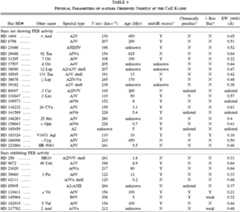 |
In this table, we consider parameters likely to characterize the two most coherent sets of stars. In the lower half of the table we list the 10 stars that show FEB-activity, as determined by the sporadic appearance of weak absorption features near the CaII K-line that vary in velocity over nightly time-frames. In the upper portion of the table we list stars that show no variability in the main circumstellar CaII K-line in addition to stars that show variability in the EW of the CaII K-line but show no direct evidence of associated FEB activity. We originally suspected that cometary activity would appear to increase with increasingV sin i, increasing amounts of dust as measured by mid-IR excess, and decreasing stellar age. Indeed, our targets were selected based largely on these three criteria. In addition to these parameters in Table 4, we have also included assessments of the stars chemical peculiarity. In column 7, we indicate the stars that Zorec & Royer (2012) listed as CP, and in column 8 we identify the stars that have been called λ Boötis stars. Stars that are identified as weak in Table 4 are those which Abt & Morrell (1995) flagged as exhibiting weak MgII absorption similar to the less-extreme examples of λ Boötis stars. In column 9, we list the equivalent widths of the λ 4481 MgII-absorption line as measured by Abt & Morrell (1995). References to the mid-IR excess measurements can be found in the descriptions of each star given either in this or our previous paper (Montgomery & Welsh2012).
Statistical analyses of the data in Table 4 have revealed five results concerning the two groups of stars (those showing FEB-activity and those not showing FEB-activity):
- 1.A one-tailed t-test corrected for unequal variance shows that stars exhibiting FEB-activity are significantly younger than the stars exhibiting no activity. There is only ∼3% chance that the two samples are, in fact, drawn from the same population and the difference occurred due to random chance.
- 2.A two-tailed t-test corrected for unequal variance shows no difference in stellar rotational velocity between the stars exhibiting FEB-activity and the stars exhibiting no activity. Given that all of the stars were selected as rapid rotators, this is perhaps not surprising. We will continue to use high values ofV sin i as a criterion for target selection because weak transient absorption events cannot be detected within narrow-lined stars. However, the angle of inclination may be less important than we originally thought.
- 3.In our total sample of 31 stars, only two have been called λ Bootis stars (HD 110411 and HD 183324) and both exhibited short-term circumstellar activity, which suggests a possible association between FEB activity and the λ Boo phenomena. We tested this hypothesis using the EW of the MgII-absorption line (λ 4481) and the one-tailed t-test corrected for unequal variance. The test revealed a slight difference in the EW of the two groups (p = 0.85). The FEB-active stars are weaker-lined, although there is a 15% chance that this difference is due to chance alone. This test is only meaningful, however, if the groups have on average the same spectral type. Other elemental abundances may prove more illuminating, but an insufficient number of our stars have measured metallicities.
- 4.A χ2 test reveals that the two groups of stars appear to reflect different frequencies of chemical peculiarity. When chemical peculiarity is defined to be the identification as ÒCPÓ by Zorec & Royer (2012), the stars exhibiting FEB-activity are more likely to show chemical anomalies (p = 0.84) than their non-active counterparts. If the definition of chemically peculiar is broadened to include designation as a λ Boötis star, the probability that the populations are different increases top = 0.96.
- 5.A χ2 test reveals no difference between the two groups of stars in terms of those have a reported strong mid-IR excess and those that do not. This was unexpected given that an IR excess is an excellent indicator of the presence of a circumstellar dust disk and associated circumstellar gas. Possession of an IR excess was an original criterion for our target selection, which we now believe isnot necessarily a good indicator of FEB activity. Values of a mid-IR excess for all of the targets in Table 4 have been taken from a variety of papers whose authors define it in different ways, dependent on the satellite that made the observations (e.g.,IRAS, Spitzer) and the mid-IR wavelengths observed (Su et al.2006; Rhee et al.2007; Roberge & Weinberger2008; Morales et al.2009). In general a major unknown in these observations is the inclination angle of the gas and dust disks surrounding these stars. Unless the disk inclination angle is favorable the detection of time-variable absorption may be unlikely. Also, FEBs are generally believed to cover a very small fraction of the stellar disk, while debris dust disks are typically extended well beyond the stellar disk even in cases in which systems are viewed edge-on, as is the case for HR 4796 (Schneider et al.2009). Another possibility, which may well apply for many older systems, is that the exocomet parent bodies in FEB systems are no longer colliding and grinding down because they are dynamically very evolved.
7. CONCLUSIONS
We have presented medium resolution (R ∼ 60,000) spectral observations of the CaII K-line at 3933 Å recorded in absorption towards 21 A-type stars suspected of possessing circumstellar gas debris disks. Observations were recorded over 11 nights from 2011 May 14–18 and 2012 November 4–9 at the McDonald Observatory in Texas, with the intent of repeatedly observing each of the targets (weather permitting) on successive nights. Measurable changes in the absorption strength of the CaII K-line near the stellar radial velocity were observed in 4 of the stars (HD 21620, HD 110411, HD 145964 and HD 183324). This type of absorption variability strongly indicates the presence of a circumstellar gas disk around these stars. However, to occur at the radial velocity of the star, an evaporating exocomet would have to be in front of the star and moving tangentially (i.e.,not falling into the star). This scenario is possible, but an unlikely explanation for all the occasions in which the main circumstellar line changes in EW. Instead, perhaps the corotating gas in these systems only exists due to a delicate balance achieved between radiation pressure and a braking mechanism, such that evaporation events occurring close to the star may cause subtle changes in the plasma and destabilize this gas (disk).
In addition, we have also detected weak absorption features that sporadically appear with velocities in the range ± 100 km s-1 of the main circumstellar K-line in the spectra of HD 21620, HD 42111, HD 110411 and HD 145964. Each of these four stars is known to possess circumstellar gas and dust disks, and thus these transient absorption features are most probably associated with the presence of falling evaporated bodies (FEBs, or exocomets) that are thought to liberate gas on their grazing trajectory towards and around the central star.
Statistical analyses of two groups of stars that have been repeatedly observed at the CaII K-line (i.e., A-stars showing FEB-activity compared to those that do not) reveal that stars exhibiting FEB-activity are significantly younger (p = 0.97) and more often exhibit chemical peculiarities (p = 0.96). The detection of FEB-activity does not appear to be directly associated with a strong mid-IR excess. This is probably linked to to the disk inclination angle, since unless this viewing angle is favorable the detection of time-variable absorption may be unlikely. Additionally, if the systems are more evolved then the evaporation of gas due to FEB activity could have ceased, whereas the circumstellar dust disks still remain.
An association between elemental abundance abnormalities and the transient absorption feature we have observed supports our hypothesis concerning infalling material. The elemental abundance pattern of FEB-active stars (typically an under-abundance of iron-peak elements and normal to over-abundant α-elements) also suggests on-going accretion and diffusion. Because of the narrow convection zones near their photospheres, A-type stars are uniquely prone to contamination by their environment. For example, Am stars have strong heavy element spectral lines that have been linked to accretion from the ambient interstellar medium (Bohm-Vitense2006). If planetesimals are present around these stars they may be providing a competitive source of external pollution. In rapidly rotating stars, meridional circulation or shear will cause more efficient mixing of the outermost layers, thereby reducing elemental abundance anomalies (Takeda et al.2008). Thus, rapidly rotating stars may represent the most normal of all A-type stars. The only way to preserve chemical anomalies in a rapidly rotating star is to have ongoing infall, which is precisely what we have presently observed.
We particularly acknowledge the assistance of the dedicated staff at the McDonald Observatory, Texas. We especially thank Maissa Salama for her work on this project as part of the University Research Apprentice Program (URAP) of UC Berkeley. We also thank Rachel Cooper of Clarion University for her assistance with the 2011 data reduction.