
- Article
- Published:
Ancient genomes indicate population replacement in Early Neolithic Britain
- Selina Brace1 na1,
- Yoan Diekmann2 na1,
- Thomas J. Booth1 na1,
- Lucy van Dorp ORCID:orcid.org/0000-0002-6211-23103,
- Zuzana Faltyskova2,
- Nadin Rohland4,
- Swapan Mallick3,5,6,
- Iñigo Olalde4,
- Matthew Ferry4,6,
- Megan Michel4,6,
- Jonas Oppenheimer4,6,
- Nasreen Broomandkhoshbacht4,6,
- Kristin Stewardson4,6,
- Rui Martiniano ORCID:orcid.org/0000-0003-0216-778X7,
- Susan Walsh8,
- Manfred Kayser ORCID:orcid.org/0000-0002-4958-847X9,
- Sophy Charlton ORCID:orcid.org/0000-0001-7487-26351,10,
- Garrett Hellenthal3,
- Ian Armit ORCID:orcid.org/0000-0001-8669-381011,
- Rick Schulting12,
- Oliver E. Craig ORCID:orcid.org/0000-0002-4296-840210,
- Alison Sheridan13,
- Mike Parker Pearson14,
- Chris Stringer ORCID:orcid.org/0000-0002-9183-73371,
- David Reich4,5,6 na2,
- Mark G. Thomas ORCID:orcid.org/0000-0002-2452-981X2,3 na2 &
- …
- Ian Barnes ORCID:orcid.org/0000-0001-8322-69181 na2
Nature Ecology & Evolutionvolume 3, pages765–771 (2019)Cite this article
15kAccesses
235Citations
753Altmetric
Subjects
AnAuthor Correction to this article was published on 08 May 2019
This article has beenupdated
Abstract
The roles of migration, admixture and acculturation in the European transition to farming have been debated for over 100 years. Genome-wide ancient DNA studies indicate predominantly Aegean ancestry for continental Neolithic farmers, but also variable admixture with local Mesolithic hunter-gatherers. Neolithic cultures first appear in Britain circa 4000 bc, a millennium after they appeared in adjacent areas of continental Europe. The pattern and process of this delayed British Neolithic transition remain unclear. We assembled genome-wide data from 6 Mesolithic and 67 Neolithic individuals found in Britain, dating 8500–2500 bc. Our analyses reveal persistent genetic affinities between Mesolithic British and Western European hunter-gatherers. We find overwhelming support for agriculture being introduced to Britain by incoming continental farmers, with small, geographically structured levels of hunter-gatherer ancestry. Unlike other European Neolithic populations, we detect no resurgence of hunter-gatherer ancestry at any time during the Neolithic in Britain. Genetic affinities with Iberian Neolithic individuals indicate that British Neolithic people were mostly descended from Aegean farmers who followed the Mediterranean route of dispersal. We also infer considerable variation in pigmentation levels in Europe by circa 6000 bc.
This is a preview of subscription content,access via your institution
Access options
Access Nature and 54 other Nature Portfolio journals
Get Nature+, our best-value online-access subscription
9,800 Yen / 30 days
cancel any time
Subscribe to this journal
Receive 12 digital issues and online access to articles
¥14,900 per year
only ¥1,242 per issue
Buy this article
- Purchase on SpringerLink
- Instant access to the full article PDF.
¥ 4,980
Prices may be subject to local taxes which are calculated during checkout
Data availability
BAM files (one file per library, before realigning around InDels; see Supplementary Table1) have been deposited at the European Nucleotide Archive under study accessionPRJEB31249.
Change history
08 May 2019
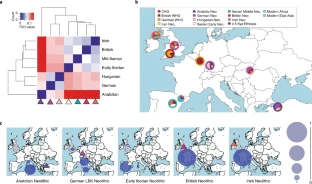
In the version of this Article originally published, there were errors in the colour ordering of the legend in Fig. 5b, and in the positions of the target and surrogate populations in Fig. 5c. This has now been corrected. The conclusions of the study are in no way affected. The errors have been corrected in the HTML and PDF versions of the article.
References
Collard, M., Edinborough, K., Shennan, S. & Thomas, M. G. Radiocarbon evidence indicates that migrants introduced farming to Britain.J. Arch. Sci.37, 866–870 (2010).
Sheridan, J. A. inLandscapes in Transition (eds Finlayson, B. & Warren, G.) 89–105 (Oxbow, 2010).
Thomas, J The Birth of Neolithic Britain: an Interpretive Account (Oxford University Press: 2013. .
Skoglund, P. et al. Genomic diversity and admixture differs for Stone Age Scandinavian foragers and farmers.Science344, 747–750 (2014).
Gamba, C. et al. Genome flux and stasis in a five millennium transect of European prehistory.Nat. Commun.5, 5257 (2014).
Cassidy, L. M. et al. Neolithic and Bronze Age migration to Ireland and establishment of the insular Atlantic genome.Proc. Natl Acad. Sci. USA113, 368–373 (2015).
Haak, W. et al. Massive migration from the steppe was a source for Indo-European languages in Europe.Nature522, 207–211 (2015).
Broushaki, F. et al. Early Neolithic genomes from the eastern Fertile Crescent.Science353, 499–503 (2016).
Hofmanová, Z. et al. Early farmers from across Europe directly descended from Neolithic Aegeans.Proc. Natl Acad. Sci. USA113, 6886–6891 (2016).
Lazaridis, I. et al. Genomic insights into the origin of farming in the ancient Near East.Nature536, 419–424 (2016).
Olalde, I. et al. A common genetic origin for early farmers from Mediterranean cardial and central European LBK cultures.Mol. Biol. Evol.32, 3132–3142 (2015).
Olalde, I. et al. The Beaker phenomenon and the genomic transformation of northwest Europe.Nature555, 190–196 (2018).
González-Fortes, G. et al. Paleogenomic evidence for multi-generational mixing between Neolithic farmers and mesolithic hunter-gatherers in the lower Danube basin.Curr. Biol.27, 1801–1810 (2017).
Lipson, M. et al. Parallel palaeogenomic transects reveal complex genetic history of early European farmers.Nature551, 368–372 (2017).
Mathieson, I. et al. The genomic history of southeastern Europe.Nature555, 197–203 (2018).
Günther, T. et al. Genomics of Mesolithic Scandinavia reveal colonization routes and high-latitude adaptation.PLoS Biol.16, e2003703 (2018).
Fu, Q. et al. The genetic history of Ice Age Europe.Nature534, 200–205 (2016).
Olalde, I. et al. Derived immune and ancestral pigmentation alleles in a 7,000-year-old Mesolithic European.Nature507, 225–228 (2014).
Mathieson, I. et al. Genome-wide patterns of selection in 230 ancient Eurasians.Nature528, 499–503 (2015).
Kılınç, G. M. et al. The demographic development of the first farmers in Anatolia.Curr. Biol.26, 2659–2666 (2016).
Jones, E. R. et al. The Neolithic transition in the Baltic was not driven by admixture with early European farmers.Curr. Biol.27, 576–582 (2017).
Lazaridis, I. et al. Ancient human genomes suggest three ancestral populations for present-day Europeans.Nature513, 409–413 (2014).
Mallick, S. et al. The Simons Genome Diversity Project: 300 genomes from 142 diverse populations.Nature538, 201–206 (2016).
Patterson, N. et al. Ancient admixture in human history.Genetics192, 1065–1093 (2012).
Lawson, D. J. et al. Inference of population structure using dense haplotype data.PLoS Genet.8, e1002453 (2012).
Chacon-Duque, J. C. et al. Latin Americans show wide-spread Converso ancestry and the imprint of local Native ancestry on physical appearance.Nat. Commun.9, 5388 (2018).
Loh, P.-R. et al. Inferring admixture histories of human populations using linkage disequilibrium.Genetics193, 1233–1254 (2013).
Bronk Ramsey, C. Bayesian analysis of radiocarbon dates.Radiocarbon51, 337–360 (2009).
Chaitanya, L. et al. The HIrisPlex-S system for eye, hair and skin colour prediction from DNA: introduction and forensic developmental validation.Forensic Sci. Int. Genet35, 123–135 (2018).
Whittle, A. W. R, Healy, F, Bayliss, A. & Allen, M. J. Gathering Time: Dating the Early Neolithic Enclosures of Southern Britain and Ireland. (Oxbow Books, 2011).
Scarre, C. The early Neolithic of western France and Megalithic origins in Atlantic Europe.Oxford J. Archaeol.11, 121–154 (1992).
Bollongino, R. et al. 2000 years of parallel societies in Stone Age Central Europe.Science342, 479–481 (2013).
Fraser, M. et al. New insights on cultural dualism and population structure in the Middle Neolithic Funnel Beaker culture on the island of Gotland.Sci. Rep.17, 325–334 (2018).
Charlton, S. et al. Finding Britain’s last hunter-gatherers: a new biomolecular approach to ‘unidentifiable’ bone fragments utilising bone collagen.J. Archaeol. Sci.73, 55–61 (2016).
Schulting, R. J. and Borić, D. inNeolithicEurope: Essays in Honour of Professor Alasdair Whittle (eds P. Bickle, V. Cummings, D. Hofmann & J. Pollard) 82–104 (Oxford, 2017).
Dabney, J. et al. Complete mitochondrial genome sequence of a Middle Pleistocene cave bear reconstructed from ultrashort DNA fragments.Proc. Natl Acad. Sci. USA110, 15758–15763 (2013).
Rohland, N., Harney, E., Mallick, S., Nordenfelt, S. & Reich, D. Partial uracil-DNA-glycosylase treatment for screening of ancient DNA.Phil. Trans. R. Soc. Lond. B370, 20130624–20130624 (2014).
Meyer, M. & Kircher, M. Illumina sequencing library preparation for highly multiplexed target capture and sequencing.Cold Spring Harb. Protoc.https://doi.org/10.1101/pdb.prot5448 (2010).
Kircher, M., Sawyer, S. & Meyer, M. Double indexing overcomes inaccuracies in multiplex sequencing on the Illumina platform.Nucleic Acids Res.40, e3 (2011).
Schubert, M., Lindgreen, S. & Orlando, L. Adapter Removal v2: rapid adapter trimming, identification, and read merging.BMC Res. Notes9, 88 (2016).
Li, H. & Durbin, R. Fast and accurate short read alignment with Burrows-Wheeler transform.Bioinformatics25, 1754–1760 (2009).
Mckenna, A. et al. The genome analysis toolkit: a MapReduce framework for analyzing next-generation DNA sequencing data.Genome Res.20, 1297–1303 (2010).
Link, V. et al. ATLAS: analysis tools for low-depth and ancient samples. Preprint atBiorxivhttps://doi.org/10.1101/105346 (2017).
Fu, Q. et al. A revised timescale for human evolution based on ancient mitochondrial genomes.Curr. Biol.23, 553–559 (2013).
Navarro-Gomez, D. et al. Phy-Mer: a novel alignment-free and reference-independent mitochondrial haplogroup classifier.Bioinformatics31, 1310–1312 (2014).
Ralf, A., Montiel González, D., Zhong, K. & Kayser, M. Yleaf: software for human Y-chromosomal haplogroup inference from next generation sequencing data.Mol. Biol. Evol.35, 1291–1294 (2018).
Wang, C., Zhan, X., Liang, L., Abecasis, G. R. & Lin, X. Improved ancestry estimation for both genotyping and sequencing data using projection procrustes analysis and genotype imputation.Am. J. Hum. Genet.96, 926–937 (2015).
Hellenthal, G. et al. A genetic atlas of human admixture history.Science343, 747–751 (2014).
Busby, G. B. et al. The role of recent admixture in forming the contemporary West Eurasian genomic landscape.Curr. Biol.25, 2518–2526 (2015).
Leslie, S. et al. The fine-scale genetic structure of the British population.Nature519, 309 (2015).
Delaneau, O. et al. A linear complexity phasing method for thousands of genomes.Nat. Methods9, 179–181 (2012).
Acknowledgements
The authors would like to thank the Longleat Estate, T. Lord at Lower Winskill Farm, B. Chandler at Torquay Museum, A. Chamberlain at the University of Manchester, L. Wilson and G. Mullan at the University of Bristol Spelaeological Society, E. Walker, A. Gwilt and J. Deacon at the National Museum of Wales, A. Maxted at Brighton Museum, M. Lahr at the Duckworth Laboratory, B. Lane at Wells Museum, M. Smith at Bournemouth University, D. Rice at the Museum of Gloucester and R. Kruszynski at the Natural History Museum for providing access to samples. In addition, Y.D. wishes to thank J. Blöcher, A. Scheu, C. Sell and J. Burger for discussions on the bioinformatic pipeline, and V. Link for help with ATLAS. M.G.T. and I.B. were supported by a Wellcome Trust Investigator Award (project No. 100713/Z/12/Z). S.C. was supported by the Natural Environment Research Council (NE/K500987/1). L.v.D acknowledges financial support from the Newton Trust (grant No. MR/P007597/1). R.M. was supported by an EMBO Long-Term Fellowship (No. ALTF 133-2017). D.R. was supported by a NIH grant (No. GM100233), by NSF HOMINID (No. BCS-1032255) and by an Allen Discovery Center of the Paul Allen Foundation, and is a Howard Hughes Medical Institute investigator. C.S. is supported by the Calleva Foundation and the Human Origins Research Fund. S.W. was supported by the US National Institute of Justice (grant No. 2014-DN-BX-K031).
Author information
These authors contributed equally: Selina Brace, Yoan Diekmann, Thomas J. Booth.
These authors jointly supervised this work: David Reich, Mark G. Thomas, Ian Barnes.
Authors and Affiliations
Department of Earth Sciences, Natural History Museum, London, UK
Selina Brace, Thomas J. Booth, Sophy Charlton, Chris Stringer & Ian Barnes
Research Department of Genetics, Evolution and Environment, University College London, London, UK
Yoan Diekmann, Zuzana Faltyskova & Mark G. Thomas
UCL Genetics Institute, University College London, London, UK
Lucy van Dorp, Swapan Mallick, Garrett Hellenthal & Mark G. Thomas
Department of Genetics, Harvard Medical School, Boston, MA, USA
Nadin Rohland, Iñigo Olalde, Matthew Ferry, Megan Michel, Jonas Oppenheimer, Nasreen Broomandkhoshbacht, Kristin Stewardson & David Reich
Broad Institute of MIT and Harvard, Cambridge, MA, USA
Swapan Mallick & David Reich
Howard Hughes Medical Institute, Harvard Medical School, Boston, MA, USA
Swapan Mallick, Matthew Ferry, Megan Michel, Jonas Oppenheimer, Nasreen Broomandkhoshbacht, Kristin Stewardson & David Reich
Department of Genetics, University of Cambridge, Cambridge, UK
Rui Martiniano
Department of Biology, Indiana University-Purdue University Indianapolis, Indianapolis, IN, USA
Susan Walsh
Department of Genetic Identification, Erasmus University Medical Centre Rotterdam, Rotterdam, the Netherlands
Manfred Kayser
Bioarch, University of York, York, UK
Sophy Charlton & Oliver E. Craig
School of Archaeological and Forensic Sciences, University of Bradford, Bradford, UK
Ian Armit
Institute of Archaeology, University of Oxford, Oxford, UK
Rick Schulting
National Museums Scotland, Edinburgh, UK
Alison Sheridan
Institute of Archaeology, University College London, London, UK
Mike Parker Pearson
- Selina Brace
Search author on:PubMed Google Scholar
- Yoan Diekmann
Search author on:PubMed Google Scholar
- Thomas J. Booth
Search author on:PubMed Google Scholar
- Lucy van Dorp
Search author on:PubMed Google Scholar
- Zuzana Faltyskova
Search author on:PubMed Google Scholar
- Nadin Rohland
Search author on:PubMed Google Scholar
- Swapan Mallick
Search author on:PubMed Google Scholar
- Iñigo Olalde
Search author on:PubMed Google Scholar
- Matthew Ferry
Search author on:PubMed Google Scholar
- Megan Michel
Search author on:PubMed Google Scholar
- Jonas Oppenheimer
Search author on:PubMed Google Scholar
- Nasreen Broomandkhoshbacht
Search author on:PubMed Google Scholar
- Kristin Stewardson
Search author on:PubMed Google Scholar
- Rui Martiniano
Search author on:PubMed Google Scholar
- Susan Walsh
Search author on:PubMed Google Scholar
- Manfred Kayser
Search author on:PubMed Google Scholar
- Sophy Charlton
Search author on:PubMed Google Scholar
- Garrett Hellenthal
Search author on:PubMed Google Scholar
- Ian Armit
Search author on:PubMed Google Scholar
- Rick Schulting
Search author on:PubMed Google Scholar
- Oliver E. Craig
Search author on:PubMed Google Scholar
- Alison Sheridan
Search author on:PubMed Google Scholar
- Mike Parker Pearson
Search author on:PubMed Google Scholar
- Chris Stringer
Search author on:PubMed Google Scholar
- David Reich
Search author on:PubMed Google Scholar
- Mark G. Thomas
Search author on:PubMed Google Scholar
- Ian Barnes
Search author on:PubMed Google Scholar
Contributions
I.B. and M.G.T. conceived the project. Y.D., S.B., Z.F., O.C. and T.B. contributed to the project design. S.B., Y.D., T.B., L.v.D, N.R., S.M., I.O., M.F., M.M., J.O., N.B., K.S., R.M., S.C. and S.W. generated and analysed data. I.B., M.G.T., Y.D., S.B., T.B., M.K., S.W., G.H., I.A., R.S., O.C., A.S., M.P.P., C.S. and D.R. contributed to the sampling strategy and the interpretation of results. I.B., M.G.T., Y.D., S.B. and T.B. wrote the paper, with contributions from all other authors.
Corresponding authors
Correspondence toMark G. Thomas orIan Barnes.
Ethics declarations
Competing interests
The authors declare no competing interests.
Additional information
Publisher’s note: Springer Nature remains neutral with regard to jurisdictional claims in published maps and institutional affiliations.
Supplementary information
Supplementary Information
Supplementary Notes 1–7 and Supplementary Figs. 1–23
Supplementary Data 1
Summary of sequencing data per individual with relevant metadata
Supplementary Data 2
Functional variation
Supplementary Data 3
Admixture dates
Supplementary Data 4
Pairwise comparison of WHG admixture proportions
Supplementary Data 5
Y-chromosomal lineages
Supplementary Data 6
New radiocarbon dates and stable isotopes
Supplementary Data 7
Chronological model outputs
Supplementary Data 8
SOURCEFIND inferred proportions of ancient ancestry
Supplementary Data 9
SOURCEFIND inferred proportions of modern ancestry
Supplementary Data 10
qpGraph outliers
Rights and permissions
About this article
Cite this article
Brace, S., Diekmann, Y., Booth, T.J.et al. Ancient genomes indicate population replacement in Early Neolithic Britain.Nat Ecol Evol3, 765–771 (2019). https://doi.org/10.1038/s41559-019-0871-9
Received:
Accepted:
Published:
Version of record:
Issue date:
Share this article
Anyone you share the following link with will be able to read this content:
Sorry, a shareable link is not currently available for this article.
Provided by the Springer Nature SharedIt content-sharing initiative
This article is cited by
Genetic affinities between the ancient Greek colony of Amvrakia and its metropolis
- Nikolaos Psonis
- Eugenia Tabakaki
- Pavlos Pavlidis
Genome Biology (2026)
Robust imputation-based method for eye, hair, and skin colour prediction from low-coverage ancient DNA
- Zoltán Maróti
- Emil Nyerki
- Tibor Kalmár
Scientific Reports (2026)
PANE: fast and reliable ancestral reconstruction on ancient genotype data with non-negative least square and principal component analysis
- Luciana de Gennaro
- Ludovica Molinaro
- Francesco Montinaro
Genome Biology (2025)
Continental influx and pervasive matrilocality in Iron Age Britain
- Lara M. Cassidy
- Miles Russell
- Daniel G. Bradley
Nature (2025)
The genetic history of Portugal over the past 5,000 years
- Xavier Roca-Rada
- Roberta Davidson
- João C. Teixeira
Genome Biology (2025)

