numpy.sin(x,/,out=None,*,where=True,casting='same_kind',order='K',dtype=None,subok=True[,signature,extobj]) = <ufunc 'sin'>¶Trigonometric sine, element-wise.
| Parameters: |
|
|---|---|
| Returns: |
|
Notes
The sine is one of the fundamental functions of trigonometry (themathematical study of triangles). Consider a circle of radius 1centered on the origin. A ray comes in from the+x axis, makesan angle at the origin (measured counter-clockwise from that axis), anddeparts from the origin. They coordinate of the outgoingray’s intersection with the unit circle is the sine of that angle. Itranges from -1 forx=3\pi / 2 to +1 for\pi / 2. Thefunction has zeroes where the angle is a multiple of\pi.Sines of angles between\pi and2\pi are negative.The numerous properties of the sine and related functions are includedin any standard trigonometry text.
Examples
Print sine of one angle:
>>>np.sin(np.pi/2.)1.0
Print sines of an array of angles given in degrees:
>>>np.sin(np.array((0.,30.,45.,60.,90.))*np.pi/180.)array([ 0. , 0.5 , 0.70710678, 0.8660254 , 1. ])
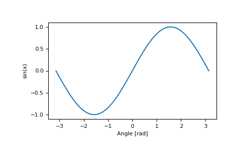
Plot the sine function:
>>>importmatplotlib.pylabasplt>>>x=np.linspace(-np.pi,np.pi,201)>>>plt.plot(x,np.sin(x))>>>plt.xlabel('Angle [rad]')>>>plt.ylabel('sin(x)')>>>plt.axis('tight')>>>plt.show()