numpy.random.laplace(loc=0.0,scale=1.0,size=None)¶Draw samples from the Laplace or double exponential distribution withspecified location (or mean) and scale (decay).
The Laplace distribution is similar to the Gaussian/normal distribution,but is sharper at the peak and has fatter tails. It represents thedifference between two independent, identically distributed exponentialrandom variables.
| Parameters: |
|
|---|---|
| Returns: |
|
Notes
It has the probability density function
f(x; \mu, \lambda) = \frac{1}{2\lambda}\exp\left(-\frac{|x - \mu|}{\lambda}\right).
The first law of Laplace, from 1774, states that the frequencyof an error can be expressed as an exponential function of theabsolute magnitude of the error, which leads to the Laplacedistribution. For many problems in economics and healthsciences, this distribution seems to model the data betterthan the standard Gaussian distribution.
References
| [1] | Abramowitz, M. and Stegun, I. A. (Eds.). “Handbook ofMathematical Functions with Formulas, Graphs, and MathematicalTables, 9th printing,” New York: Dover, 1972. |
| [2] | Kotz, Samuel, et. al. “The Laplace Distribution andGeneralizations, ” Birkhauser, 2001. |
| [3] | Weisstein, Eric W. “Laplace Distribution.”From MathWorld–A Wolfram Web Resource.http://mathworld.wolfram.com/LaplaceDistribution.html |
| [4] | Wikipedia, “Laplace distribution”,http://en.wikipedia.org/wiki/Laplace_distribution |
Examples
Draw samples from the distribution
>>>loc,scale=0.,1.>>>s=np.random.laplace(loc,scale,1000)
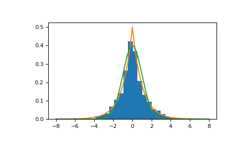
Display the histogram of the samples, along withthe probability density function:
>>>importmatplotlib.pyplotasplt>>>count,bins,ignored=plt.hist(s,30,density=True)>>>x=np.arange(-8.,8.,.01)>>>pdf=np.exp(-abs(x-loc)/scale)/(2.*scale)>>>plt.plot(x,pdf)
Plot Gaussian for comparison:
>>>g=(1/(scale*np.sqrt(2*np.pi))*...np.exp(-(x-loc)**2/(2*scale**2)))>>>plt.plot(x,g)