numpy.random.Generator.exponential#
method
- random.Generator.exponential(scale=1.0,size=None)#
Draw samples from an exponential distribution.
Its probability density function is
\[f(x; \frac{1}{\beta}) = \frac{1}{\beta} \exp(-\frac{x}{\beta}),\]for
x>0and 0 elsewhere.\(\beta\) is the scale parameter,which is the inverse of the rate parameter\(\lambda = 1/\beta\).The rate parameter is an alternative, widely used parameterizationof the exponential distribution[3].The exponential distribution is a continuous analogue of thegeometric distribution. It describes many common situations, such asthe size of raindrops measured over many rainstorms[1], or the timebetween page requests to Wikipedia[2].
- Parameters:
- scalefloat or array_like of floats
The scale parameter,\(\beta = 1/\lambda\). Must benon-negative.
- sizeint or tuple of ints, optional
Output shape. If the given shape is, e.g.,
(m,n,k), thenm*n*ksamples are drawn. If size isNone(default),a single value is returned ifscaleis a scalar. Otherwise,np.array(scale).sizesamples are drawn.
- Returns:
- outndarray or scalar
Drawn samples from the parameterized exponential distribution.
References
[1]Peyton Z. Peebles Jr., “Probability, Random Variables andRandom Signal Principles”, 4th ed, 2001, p. 57.
[2]Wikipedia, “Poisson process”,https://en.wikipedia.org/wiki/Poisson_process
[3]Wikipedia, “Exponential distribution”,https://en.wikipedia.org/wiki/Exponential_distribution
Examples
Assume a company has 10000 customer support agents and the time between customer calls is exponentially distributed and that the average time between customer calls is 4 minutes.
>>>scale,size=4,10000>>>rng=np.random.default_rng()>>>time_between_calls=rng.exponential(scale=scale,size=size)
What is the probability that a customer will call in the next 4 to 5 minutes?
>>>x=((time_between_calls<5).sum())/size>>>y=((time_between_calls<4).sum())/size>>>x-y0.08 # may vary
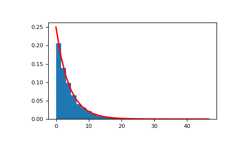
The corresponding distribution can be visualized as follows:
>>>importmatplotlib.pyplotasplt>>>scale,size=4,10000>>>rng=np.random.default_rng()>>>sample=rng.exponential(scale=scale,size=size)>>>count,bins,_=plt.hist(sample,30,density=True)>>>plt.plot(bins,scale**(-1)*np.exp(-scale**-1*bins),linewidth=2,color='r')>>>plt.show()