
18.5.3.Tasks and coroutines
Source code:Lib/asyncio/tasks.py
Source code:Lib/asyncio/coroutines.py
18.5.3.1.Coroutines
Coroutines used withasyncio may be implemented using theasyncdef statement, or by usinggenerators.Theasyncdef type of coroutine was added in Python 3.5, andis recommended if there is no need to support older Python versions.
Generator-based coroutines should be decorated with@asyncio.coroutine, although this is not strictly enforced.The decorator enables compatibility withasyncdef coroutines,and also serves as documentation. Generator-basedcoroutines use theyieldfrom syntax introduced inPEP 380,instead of the originalyield syntax.
The word “coroutine”, like the word “generator”, is used for twodifferent (though related) concepts:
The function that defines a coroutine(a function definition using
asyncdefordecorated with@asyncio.coroutine). If disambiguation is neededwe will call this acoroutine function (iscoroutinefunction()returnsTrue).The object obtained by calling a coroutine function. This objectrepresents a computation or an I/O operation (usually a combination)that will complete eventually. If disambiguation is needed we willcall it acoroutine object (
iscoroutine()returnsTrue).
Things a coroutine can do:
result=awaitfutureorresult=yieldfromfuture–suspends the coroutine until thefuture is done, then returns the future’s result, or raises anexception, which will be propagated. (If the future is cancelled,it will raise aCancelledErrorexception.) Note that tasks arefutures, and everything said about futures also applies to tasks.result=awaitcoroutineorresult=yieldfromcoroutine–wait for another coroutine toproduce a result (or raise an exception, which will be propagated).Thecoroutineexpression must be acall to another coroutine.returnexpression– produce a result to the coroutine that iswaiting for this one usingawaitoryieldfrom.raiseexception– raise an exception in the coroutine that iswaiting for this one usingawaitoryieldfrom.
Calling a coroutine does not start its code running –the coroutine object returned by the call doesn’t do anything until youschedule its execution. There are two basic ways to start it running:callawaitcoroutine oryieldfromcoroutine from another coroutine(assuming the other coroutine is already running!), or schedule its executionusing theensure_future() function or theAbstractEventLoop.create_task()method.
Coroutines (and tasks) can only run when the event loop is running.
@asyncio.coroutine¶Decorator to mark generator-based coroutines. This enablesthe generator use
yieldfromto callasyncdefcoroutines, and also enables the generator to be called byasyncdefcoroutines, for instance using anawaitexpression.There is no need to decorate
asyncdefcoroutines themselves.If the generator is not yielded from before it is destroyed, an errormessage is logged. SeeDetect coroutines never scheduled.
Note
In this documentation, some methods are documented as coroutines,even if they are plain Python functions returning aFuture.This is intentional to have a freedom of tweaking the implementationof these functions in the future. If such a function is needed to beused in a callback-style code, wrap its result withensure_future().
18.5.3.1.1.Example: Hello World coroutine
Example of coroutine displaying"HelloWorld":
importasyncioasyncdefhello_world():print("Hello World!")loop=asyncio.get_event_loop()# Blocking call which returns when the hello_world() coroutine is doneloop.run_until_complete(hello_world())loop.close()
See also
TheHello World with call_soon()example uses theAbstractEventLoop.call_soon() method to schedule acallback.
18.5.3.1.2.Example: Coroutine displaying the current date
Example of coroutine displaying the current date every second during 5 secondsusing thesleep() function:
importasyncioimportdatetimeasyncdefdisplay_date(loop):end_time=loop.time()+5.0whileTrue:print(datetime.datetime.now())if(loop.time()+1.0)>=end_time:breakawaitasyncio.sleep(1)loop=asyncio.get_event_loop()# Blocking call which returns when the display_date() coroutine is doneloop.run_until_complete(display_date(loop))loop.close()
See also
Thedisplay the current date with call_later() example uses a callback with theAbstractEventLoop.call_later() method.
18.5.3.1.3.Example: Chain coroutines
Example chaining coroutines:
importasyncioasyncdefcompute(x,y):print("Compute%s +%s ..."%(x,y))awaitasyncio.sleep(1.0)returnx+yasyncdefprint_sum(x,y):result=awaitcompute(x,y)print("%s +%s =%s"%(x,y,result))loop=asyncio.get_event_loop()loop.run_until_complete(print_sum(1,2))loop.close()
compute() is chained toprint_sum():print_sum() coroutine waitsuntilcompute() is completed before returning its result.
Sequence diagram of the example:
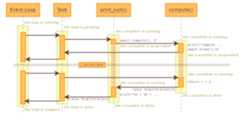
The “Task” is created by theAbstractEventLoop.run_until_complete() methodwhen it gets a coroutine object instead of a task.
The diagram shows the control flow, it does not describe exactly how thingswork internally. For example, the sleep coroutine creates an internal futurewhich usesAbstractEventLoop.call_later() to wake up the task in 1 second.
18.5.3.2.InvalidStateError
- exception
asyncio.InvalidStateError¶ The operation is not allowed in this state.
18.5.3.3.TimeoutError
- exception
asyncio.TimeoutError¶ The operation exceeded the given deadline.
Note
This exception is different from the builtinTimeoutError exception!
18.5.3.4.Future
- class
asyncio.Future(*,loop=None)¶ This class isalmost compatible with
concurrent.futures.Future.Differences:
result()andexception()do not take a timeout argument andraise an exception when the future isn’t done yet.Callbacks registered with
add_done_callback()are always calledvia the event loop’scall_soon().This class is not compatible with the
wait()andas_completed()functions in theconcurrent.futurespackage.
This class isnot thread safe.
cancel()¶Cancel the future and schedule callbacks.
If the future is already done or cancelled, return
False. Otherwise,change the future’s state to cancelled, schedule the callbacks and returnTrue.
cancelled()¶Return
Trueif the future was cancelled.
done()¶Return
Trueif the future is done.Done means either that a result / exception are available, or that thefuture was cancelled.
result()¶Return the result this future represents.
If the future has been cancelled, raises
CancelledError. If thefuture’s result isn’t yet available, raisesInvalidStateError. Ifthe future is done and has an exception set, this exception is raised.
exception()¶Return the exception that was set on this future.
The exception (or
Noneif no exception was set) is returned only ifthe future is done. If the future has been cancelled, raisesCancelledError. If the future isn’t done yet, raisesInvalidStateError.
add_done_callback(fn)¶Add a callback to be run when the future becomes done.
The callback is called with a single argument - the future object. If thefuture is already done when this is called, the callback is scheduledwith
call_soon().Use functools.partial to pass parameters to the callback. For example,
fut.add_done_callback(functools.partial(print,"Future:",flush=True))will callprint("Future:",fut,flush=True).
remove_done_callback(fn)¶Remove all instances of a callback from the “call when done” list.
Returns the number of callbacks removed.
set_result(result)¶Mark the future done and set its result.
If the future is already done when this method is called, raises
InvalidStateError.
set_exception(exception)¶Mark the future done and set an exception.
If the future is already done when this method is called, raises
InvalidStateError.
18.5.3.4.1.Example: Future with run_until_complete()
Example combining aFuture and acoroutine function:
importasyncioasyncdefslow_operation(future):awaitasyncio.sleep(1)future.set_result('Future is done!')loop=asyncio.get_event_loop()future=asyncio.Future()asyncio.ensure_future(slow_operation(future))loop.run_until_complete(future)print(future.result())loop.close()
The coroutine function is responsible for the computation (which takes 1 second)and it stores the result into the future. Therun_until_complete() method waits for the completion ofthe future.
Note
Therun_until_complete() method uses internally theadd_done_callback() method to be notified when the future isdone.
18.5.3.4.2.Example: Future with run_forever()
The previous example can be written differently using theFuture.add_done_callback() method to describe explicitly the controlflow:
importasyncioasyncdefslow_operation(future):awaitasyncio.sleep(1)future.set_result('Future is done!')defgot_result(future):print(future.result())loop.stop()loop=asyncio.get_event_loop()future=asyncio.Future()asyncio.ensure_future(slow_operation(future))future.add_done_callback(got_result)try:loop.run_forever()finally:loop.close()
In this example, the future is used to linkslow_operation() togot_result(): whenslow_operation() is done,got_result() is calledwith the result.
18.5.3.5.Task
- class
asyncio.Task(coro,*,loop=None)¶ Schedule the execution of acoroutine: wrap it in afuture. A task is a subclass of
Future.A task is responsible for executing a coroutine object in an event loop. Ifthe wrapped coroutine yields from a future, the task suspends the executionof the wrapped coroutine and waits for the completion of the future. Whenthe future is done, the execution of the wrapped coroutine restarts with theresult or the exception of the future.
Event loops use cooperative scheduling: an event loop only runs one task ata time. Other tasks may run in parallel if other event loops arerunning in different threads. While a task waits for the completion of afuture, the event loop executes a new task.
The cancellation of a task is different from the cancelation of afuture. Calling
cancel()will throw aCancelledErrorto the wrappedcoroutine.cancelled()only returnsTrueif thewrapped coroutine did not catch theCancelledErrorexception, or raised aCancelledErrorexception.If a pending task is destroyed, the execution of its wrappedcoroutine did not complete. It is probably a bug and a warning islogged: seePending task destroyed.
Don’t directly create
Taskinstances: use theensure_future()function or theAbstractEventLoop.create_task()method.This class isnot thread safe.
- classmethod
all_tasks(loop=None)¶ Return a set of all tasks for an event loop.
By default all tasks for the current event loop are returned.
- classmethod
current_task(loop=None)¶ Return the currently running task in an event loop or
None.By default the current task for the current event loop is returned.
Noneis returned when called not in the context of aTask.
cancel()¶Request that this task cancel itself.
This arranges for a
CancelledErrorto bethrown into the wrapped coroutine on the next cycle through the eventloop. The coroutine then has a chance to clean up or even deny therequest using try/except/finally.Unlike
Future.cancel(), this does not guarantee that the taskwill be cancelled: the exception might be caught and acted upon, delayingcancellation of the task or preventing cancellation completely. The taskmay also return a value or raise a different exception.Immediately after this method is called,
cancelled()willnot returnTrue(unless the task was already cancelled). A task willbe marked as cancelled when the wrapped coroutine terminates with aCancelledErrorexception (even ifcancel()was not called).
get_stack(*,limit=None)¶Return the list of stack frames for this task’s coroutine.
If the coroutine is not done, this returns the stack where it issuspended. If the coroutine has completed successfully or wascancelled, this returns an empty list. If the coroutine wasterminated by an exception, this returns the list of tracebackframes.
The frames are always ordered from oldest to newest.
The optional limit gives the maximum number of frames to return; bydefault all available frames are returned. Its meaning differs dependingon whether a stack or a traceback is returned: the newest frames of astack are returned, but the oldest frames of a traceback are returned.(This matches the behavior of the traceback module.)
For reasons beyond our control, only one stack frame is returned for asuspended coroutine.
print_stack(*,limit=None,file=None)¶Print the stack or traceback for this task’s coroutine.
This produces output similar to that of the traceback module, for theframes retrieved by get_stack(). The limit argument is passed toget_stack(). The file argument is an I/O stream to which the outputis written; by default output is written to sys.stderr.
- classmethod
18.5.3.5.1.Example: Parallel execution of tasks
Example executing 3 tasks (A, B, C) in parallel:
importasyncioasyncdeffactorial(name,number):f=1foriinrange(2,number+1):print("Task%s: Compute factorial(%s)..."%(name,i))awaitasyncio.sleep(1)f*=iprint("Task%s: factorial(%s) =%s"%(name,number,f))loop=asyncio.get_event_loop()loop.run_until_complete(asyncio.gather(factorial("A",2),factorial("B",3),factorial("C",4),))loop.close()
Output:
TaskA:Computefactorial(2)...TaskB:Computefactorial(2)...TaskC:Computefactorial(2)...TaskA:factorial(2)=2TaskB:Computefactorial(3)...TaskC:Computefactorial(3)...TaskB:factorial(3)=6TaskC:Computefactorial(4)...TaskC:factorial(4)=24
A task is automatically scheduled for execution when it is created. The eventloop stops when all tasks are done.
18.5.3.6.Task functions
Note
In the functions below, the optionalloop argument allows explicitly settingthe event loop object used by the underlying task or coroutine. If it’snot provided, the default event loop is used.
asyncio.as_completed(fs,*,loop=None,timeout=None)¶Return an iterator whose values, when waited for, are
Futureinstances.Raises
asyncio.TimeoutErrorif the timeout occurs before all Futuresare done.Example:
forfinas_completed(fs):result=yield fromf# The 'yield from' may raise# Use result
Note
The futures
fare not necessarily members of fs.
asyncio.ensure_future(coro_or_future,*,loop=None)¶Schedule the execution of acoroutine object: wrap it ina future. Return a
Taskobject.If the argument is a
Future, it is returned directly.New in version 3.4.4.
Changed in version 3.5.1:The function accepts anyawaitable object.
See also
The
AbstractEventLoop.create_task()method.
asyncio.async(coro_or_future,*,loop=None)¶A deprecated alias to
ensure_future().Deprecated since version 3.4.4.
asyncio.wrap_future(future,*,loop=None)¶Wrap a
concurrent.futures.Futureobject in aFutureobject.
asyncio.gather(*coros_or_futures,loop=None,return_exceptions=False)¶Return a future aggregating results from the given coroutine objects orfutures.
All futures must share the same event loop. If all the tasks are donesuccessfully, the returned future’s result is the list of results (in theorder of the original sequence, not necessarily the order of resultsarrival). Ifreturn_exceptions is true, exceptions in the tasks aretreated the same as successful results, and gathered in the result list;otherwise, the first raised exception will be immediately propagated to thereturned future.
Cancellation: if the outer Future is cancelled, all children (that have notcompleted yet) are also cancelled. If any child is cancelled, this istreated as if it raised
CancelledError– theouter Future isnot cancelled in this case. (This is to prevent thecancellation of one child to cause other children to be cancelled.)Changed in version 3.6.6:If thegather itself is cancelled, the cancellation is propagatedregardless ofreturn_exceptions.
asyncio.iscoroutine(obj)¶Return
Trueifobj is acoroutine object,which may be based on a generator or anasyncdefcoroutine.
asyncio.iscoroutinefunction(func)¶Return
Trueiffunc is determined to be acoroutine function, which may be a decorated generator function or anasyncdeffunction.
asyncio.run_coroutine_threadsafe(coro,loop)¶Submit acoroutine object to a given event loop.
Return a
concurrent.futures.Futureto access the result.This function is meant to be called from a different thread than the onewhere the event loop is running. Usage:
# Create a coroutinecoro=asyncio.sleep(1,result=3)# Submit the coroutine to a given loopfuture=asyncio.run_coroutine_threadsafe(coro,loop)# Wait for the result with an optional timeout argumentassertfuture.result(timeout)==3
If an exception is raised in the coroutine, the returned future will benotified. It can also be used to cancel the task in the event loop:
try:result=future.result(timeout)exceptasyncio.TimeoutError:print('The coroutine took too long, cancelling the task...')future.cancel()exceptExceptionasexc:print('The coroutine raised an exception:{!r}'.format(exc))else:print('The coroutine returned:{!r}'.format(result))
See theconcurrency and multithreadingsection of the documentation.
Note
Unlike other functions from the module,
run_coroutine_threadsafe()requires theloop argument tobe passed explicitly.New in version 3.5.1.
- coroutine
asyncio.sleep(delay,result=None,*,loop=None)¶ Create acoroutine that completes after a giventime (in seconds). Ifresult is provided, it is produced to the callerwhen the coroutine completes.
The resolution of the sleep depends on thegranularity of the eventloop.
This function is acoroutine.
- coroutine
asyncio.shield(arg,*,loop=None)¶ Wait for a future, shielding it from cancellation.
The statement:
res=yield fromshield(something())
is exactly equivalent to the statement:
res=yield fromsomething()
except that if the coroutine containing it is cancelled, the task runningin
something()is not cancelled. From the point of view ofsomething(), the cancellation did not happen. But its caller is stillcancelled, so the yield-from expression still raisesCancelledError. Note: Ifsomething()iscancelled by other means this will still cancelshield().If you want to completely ignore cancellation (not recommended) you cancombine
shield()with a try/except clause, as follows:try:res=yield fromshield(something())exceptCancelledError:res=None
- coroutine
asyncio.wait(futures,*,loop=None,timeout=None,return_when=ALL_COMPLETED)¶ Wait for the Futures and coroutine objects given by the sequencefuturesto complete. Coroutines will be wrapped in Tasks. Returns two sets of
Future: (done, pending).The sequencefutures must not be empty.
timeout can be used to control the maximum number of seconds to wait beforereturning.timeout can be an int or float. Iftimeout is not specifiedor
None, there is no limit to the wait time.return_when indicates when this function should return. It must be one ofthe following constants of the
concurrent.futuresmodule:Constant
Description
FIRST_COMPLETEDThe function will return when anyfuture finishes or is cancelled.
FIRST_EXCEPTIONThe function will return when anyfuture finishes by raising anexception. If no future raises anexception then it is equivalent to
ALL_COMPLETED.ALL_COMPLETEDThe function will return when allfutures finish or are cancelled.
This function is acoroutine.
Usage:
done,pending=yield fromasyncio.wait(fs)
Note
This does not raise
asyncio.TimeoutError! Futures that aren’t donewhen the timeout occurs are returned in the second set.
- coroutine
asyncio.wait_for(fut,timeout,*,loop=None)¶ Wait for the single
Futureorcoroutine objectto complete with timeout. Iftimeout isNone, block until the futurecompletes.Coroutine will be wrapped in
Task.Returns result of the Future or coroutine. When a timeout occurs, itcancels the task and raises
asyncio.TimeoutError. To avoid the taskcancellation, wrap it inshield().If the wait is cancelled, the futurefut is also cancelled.
This function is acoroutine, usage:
result=yield fromasyncio.wait_for(fut,60.0)
Changed in version 3.4.3:If the wait is cancelled, the futurefut is now also cancelled.