

Deploy IBM Spectrum Symphony workloads
This document describes Symphony Connectors for Google Cloud, which provideintegration between IBM Spectrum Symphony and Google Cloud. This integrationlets you use Google Cloud resources as flexible compute capacity for yourSymphony clusters. Symphony then manages the cluster by usinghost factory.Host factory is a component of IBM Spectrum Symphony that extends your clusterwith compute hosts from cloud providers like Google Cloud to meet resourcedemand in your Symphony clusters.
Use Symphony Connectors for Google Cloud to supplement your existing cloudinfrastructure with flexibleGoogle Cloud resources, particularly for high performance computing (HPC)workloads. Symphony Connectors for Google Cloud supports both Compute Engine andGoogle Kubernetes Engine services.
When to use Symphony Connectors for Google Cloud
Symphony Connectors for Google Cloud is designed to bridge the gap betweenSymphony's host factory service and Google Cloud. Use Symphony Connectors forGoogle Cloud in the following scenarios:
Cloud bursting: When your on-premises cluster resources areinsufficient, dynamically scale your Symphony workloads into Google Cloud toaccess additional compute capacity. Symphony Connectors for Google Cloudlets you automatically provision resources as needed, integrated withexisting Symphony job scheduling.
Hybrid cloud deployments: If you run Symphony workloads across bothon-premises and Google Cloud infrastructure, you can use this solution tounify resource management through the Symphony host factory framework.This approach creates a consistent experience for job submission andmonitoring, and flexible resource allocation.
Cost optimization: Use Google Cloud's flexible instance types andpricing models, such as Spot VMs (preemptible VMs), to runcost-sensitive workloads.
Development and testing: To provision temporary compute resources fordevelopment or testing workflows, use Symphony Connectors for Google Cloudrapidly set up and tear down environments. Costs are optimized throughautomatic resource cleanup.
Unified management: Use the host factory to create a consistent interfaceto manage both GKE pods and the Compute Engine instancesthat are used by Symphony.
Seamless enterprise integration: Use this solution to extend yourexisting Symphony deployments into Google Cloud without requiringsignificant architectural changes.
Learn how Symphony Connectors for Google Cloud works
Symphony Connectors for Google Cloud provide the necessary components to makeGoogle Cloud a provider for host factory.
The following diagram shows the architecture of Symphony Connectors forGoogle Cloud:
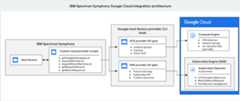
As shown in the preceding diagram, this architecture contains three main groups:an IBM Spectrum Symphony environment, a Google Cloud host factory providerlayer, and Google Cloud services. The Symphony environment contains the hostfactory and provider scripts. This architecture uses the Google Cloud hostfactory provider CLI tools layer to translate requests, allowing the Symphonyscripts to control Compute Engine resources and a Kubernetes operator runningin GKE.
The following sections explain the main components of Symphony Connectors for Google Cloud.
IBM Spectrum Symphony host factory
An IBM Spectrum Symphony service that manages the lifecycle of compute hostsfrom various providers based on workload demand. This Symphony component is thesoftware that Google Cloud integrates with.
Provider scripts
The Symphony host factory service uses a set of shell scripts to integrate with a cloud provider.These scripts perform actions like requesting and returning resources.
By default, Symphony doesn't include a Host factory provider for Google Cloud.
TheGoogle Cloud host factory provider enables theSymphony host factory framework to communicate with Google Cloud.
The following table shows the scripts that Symphony Connectors for Google Cloud uses:
| Name | Description | IBM documentation |
|---|---|---|
getAvailableTemplates.sh | Retrieves the available resource templates defined in the provider configuration. Host factory callsgetAvailableTemplates.sh to know what types of resources it can request. | getAvailableTemplates |
requestMachines.sh | Provisions new compute resources from Google Cloud. It receives a JSON payload specifying the template and quantity. | requestMachines |
requestReturnMachines.sh | Host factory deprovisions compute resources used by the Symphony cluster. It receives a JSON payload that identifies the machines to be returned. | requestReturnMachines |
getRequestStatus.sh | Host factory polls the status of ongoing provisioning requests initiated byrequestMachines.sh. It receives a JSON payload that contains request IDs. | getRequestStatus |
getReturnRequests.sh | Host factory polls the status of ongoing deprovisioning requests initiated byrequestReturnMachines.sh. It receives a JSON payload that contains request IDs. | getReturnRequests |
Google Cloud host factory provider
The host factory provider is the interface created by Google that integrateswith IBM Spectrum Symphony's host factory framework. This Google Cloud pluginincludes CLI tools that Symphony calls to request and manage resources inGoogle Cloud. CLI tools for both Compute Engine and GKEworkloads are available. Symphony Connectors for Google Cloud refers to theseCLI tools as providers:
- For Compute Engine workloads, you use theCompute Engine provider.
- For GKE workloads, you use the GKE provider.For GKE workloads, you need an additional operator. ThisKubernetesoperator runs within your GKE cluster to managethe lifecycle of the IBM Spectrum Symphony compute pods requested using theGKE provider.
After you install these CLI tools, you can also manually call the Compute Engine andGKE provider CLI tools using Python. The CLI tools are Pythonmodules, making them executable using the Python interpreter. For moreinformation, see theRunning fromPythondocumentation on GitHub.
Compute Engine provider
The Compute Engine provider (hf-gce) is a CLI tool designed tointegrate Symphony's host factory withCompute Engine. After you install the Compute Engine provider, youmust configure it inSymphony host factory. Once this configuration is complete, host factory canautomatically invokes scripts that use thehf-gce CLI.
The Compute Engine provider interactsdirectly with the Google Compute Engine API to manage the lifecycle of VM instancesbased on Symphony's demands and the configurations defined inthe provider instance and templates. It handles the creation, monitoring, andtermination ofCompute Engine VMs, allowing them to join the Symphony cluster as computenodes.
GKE provider
The GKE provider (hf-gke) is a CLI tool that connectsSymphony's host factory service with GKE. Host factory usesscripts that call thehf-gke CLI.
The GKE provider interacts with theGKE cluster's API to create, query, and delete Custom ResourceDefinitions (CRDs), specificallyGCPSymphonyResource andMachineReturnRequest.
TheKubernetes operator running within the GKE clusterhandles the actual Pod lifecycle management based on these custom resources.The GKE provider acts as the bridge between Symphony's resourcerequests and the Kubernetes custom resource-based orchestration.
Google Cloud services
You can connect to Compute Engine and Google Kubernetes Engine. There are no additionalcomponents for Compute Engine connections. For Google Kubernetes Engine connections, thereis a Kubernetes operator.
Kubernetes operator
You only need this additional operator for GKE workloads that yourun using theGKE provider. Thisoperator runs within your GKE cluster to manage the lifecycle of Symphonycompute Pods requested using the GKE provider. TheGKE provider has the following features:
- Asynchronous operations: supports high-performance asynchronousprocessing, suitable for large-scale deployments.
- Preemption handling: includes automatic detection andmanagement of Spot VM preemptions.
- Custom resource definitions: uses
GCPSymphonyResourceandMachineReturnRequestcustom resources to manage resources. - Resource cleanup: automates cleanup of completed resources,with configurable retention periods.
- Health monitoring: monitors the integration of the GKEprovider with built-in health checks and status reporting.
Limitations
Symphony Connectors for Google Cloud has the following limitations:
- Google Cloud does not create, manage, schedule, or execute yourIBM Spectrum Symphony workloads. You are responsible for all workloadmanagement within the Symphony software.
What's next
Visit the GitHub documentation to install and configure the Google Cloud host factory provider:
Except as otherwise noted, the content of this page is licensed under theCreative Commons Attribution 4.0 License, and code samples are licensed under theApache 2.0 License. For details, see theGoogle Developers Site Policies. Java is a registered trademark of Oracle and/or its affiliates.
Last updated 2025-12-15 UTC.