

Introduction to continuous queries
This document describes BigQuery continuous queries.
BigQuery continuous queries are SQL statements that runcontinuously. Continuous queries let you analyze incoming data inBigQuery in real time. You can insert the output rows producedby a continuous query into a BigQuery table or export them toPub/Sub, Bigtable, or Spanner. Continuousqueries can process data that has been written tostandard BigQuery tablesby using one of the following methods:
- TheBigQuery Storage Write API
- The
tabledata.insertAllmethod - Batch load
- The
INSERTDML statement - Writes from theresults of a batch query to a permanent table
- Writes from theresults of a BigQuery continuous query to a permanent table
- APub/Sub BigQuery subscription
- Writes fromDataflow to BigQuery
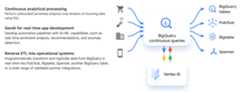
You can use continuous queries to perform time sensitive tasks, such ascreating and immediately acting on insights, applying real time machinelearning (ML) inference, and replicating data into other platforms. Thislets you use BigQuery as an event-driven data processingengine for your application's decision logic.
The following diagram shows common continuous query workflows:
Use cases
Common use cases where you might want to use continuous queries are as follows:
- Personalized customer interaction services: use generative AI to createtailored messages customized for each customer interaction.
- Anomaly detection: build solutions that let you perform anomaly and threatdetection on complex data in real time, so that you can react to issues morequickly.
- Customizable event-driven pipelines: use continuous query integration withPub/Sub to trigger downstream applications based on incomingdata.
- Data enrichment and entity extraction: use continuous queries to performreal time data enrichment and transformation by using SQL functions andML models.
- Reverse extract-transform-load (ETL): perform real time reverse ETL into otherstorage systems more suited for low latency application serving. For example,analyzing or enhancing event data that is written to BigQuery,and then streaming it to Bigtable or Spanner for applicationserving.
Supported operations
The following operations are supported in continuous queries:
- Running
INSERTstatementsto write data from a continuous query into a BigQuery table. Running
EXPORT DATAstatementstopublishcontinuous query output to Pub/Sub topics. Formore information, seeExport data to Pub/Sub.From a Pub/Sub topic, you can use the data with otherservices, such as performing streaming analytics by using Dataflow,or using the data in an application integration workflow.
Running
EXPORT DATAstatements to export data from BigQuerytoBigtable tables.For more information, seeExport data to Bigtable.Running
EXPORT DATAstatements to export data from BigQueryto Spanner tables. For more information, seeExport data to Spanner (reverse ETL).Calling the following generative AI function:
This function requires you to have aBigQuery ML remote modelover aVertex AI model.
Calling the following AI functions:
These functions require you to have aBigQuery ML remote modelover a Cloud AI API.
Normalizing numerical data by using the
ML.NORMALIZERfunction.Using stateless GoogleSQL functions—for example,conversion functions.In stateless functions, each row is processed independently from otherrows in the table.
Using the
APPENDSchange history function to start continuous query processing from aspecific point in time.
Authorization
TheGoogle Cloud access tokensthat are used when running continuous query jobs have a time to live (TTL) oftwo days when they are generated by a user account. Therefore, such jobs stoprunning after two days. The access tokens that are generated by serviceaccounts can run longer, but must still adhere to the maximum query runtime.For more information, seeRun a continuous query by using a service account.
Locations
Continuous queries are supported in the followinglocations:
| Region description | Region name | Details | |
|---|---|---|---|
| Americas | |||
| US multi-region | us | ||
| Columbus | us-east5 | ||
| Dallas | us-south1 |  Low CO2 Low CO2 | |
| Iowa | us-central1 | Low CO2 | |
| Las Vegas | us-west4 | ||
| Los Angeles | us-west2 | ||
| Mexico | northamerica-south1 | ||
| Montréal | northamerica-northeast1 | Low CO2 | |
| Northern Virginia | us-east4 | ||
| Oregon | us-west1 | Low CO2 | |
| Salt Lake City | us-west3 | ||
| Santiago | southamerica-west1 | Low CO2 | |
| São Paulo | southamerica-east1 | Low CO2 | |
| South Carolina | us-east1 | ||
| Toronto | northamerica-northeast2 | Low CO2 | |
| Asia Pacific | |||
| Delhi | asia-south2 | ||
| Hong Kong | asia-east2 | ||
| Jakarta | asia-southeast2 | ||
| Melbourne | australia-southeast2 | ||
| Mumbai | asia-south1 | ||
| Osaka | asia-northeast2 | ||
| Seoul | asia-northeast3 | ||
| Singapore | asia-southeast1 | ||
| Sydney | australia-southeast1 | ||
| Taiwan | asia-east1 | ||
| Tokyo | asia-northeast1 | ||
| Europe | |||
| EU multi-region | eu | ||
| Belgium | europe-west1 | Low CO2 | |
| Berlin | europe-west10 | ||
| Finland | europe-north1 | Low CO2 | |
| Frankfurt | europe-west3 | ||
| London | europe-west2 | Low CO2 | |
| Madrid | europe-southwest1 | Low CO2 | |
| Milan | europe-west8 | ||
| Netherlands | europe-west4 | Low CO2 | |
| Paris | europe-west9 | Low CO2 | |
| Stockholm | europe-north2 | Low CO2 | |
| Turin | europe-west12 | ||
| Warsaw | europe-central2 | ||
| Zurich | europe-west6 | Low CO2 | |
| Middle East | |||
| Doha | me-central1 | ||
| Dammam | me-central2 | ||
| Tel Aviv | me-west1 | ||
| Africa | |||
| Johannesburg | africa-south1 | ||
Limitations
Continuous queries are subject to the following limitations:
- BigQuery continuous queries don't maintain the state ofingested data. Common operations that rely on state, such as a
JOIN,aggregation function, or window function, aren'tsupported. You can't use the following SQL capabilities in a continuous query:
JOINoperations- Aggregate functions
- Approximate aggregate functions
The followingquery clauses:
The followingquery operators:
Queryset operators
BigQuery ML functions other than those listed inSupported operations
Data manipulation language (DML) statementsexcept for
INSERT.EXPORT DATAstatements that don't target Bigtable,Pub/Sub, or Spanner.
Continuous queries don't support the following data sources:
- External tables.
- Information schema views.
- BigLake tables for Apache Iceberg in BigQuery.
- Wildcard tables.
- Change Data Capture (CDC) upsertdata.
- Materialized views.
- Views that are defined by other continuous querylimitations, such as
JOINoperations, aggregate functions, change datacapture enabled tables.
Continuous queries don't support thecolumn-androw-level security features.
Whenexporting data to Bigtable,you can only targetBigtable instances that fall within the sameGoogle Cloud regional boundary as the BigQuerydataset that contains the table you are querying. For more information, seeLocation considerations.This restriction doesn't apply to exporting data to Pub/Subbecause Pub/Sub is a global resource.
When exporting data to Bigtable, Spanner, orPub/Sub locationalendpointsyou can only target Bigtable, Spanner, orPub/Sub resources that fall within the same Google Cloudregional boundary as the BigQuery dataset that contains thetable you are querying. This restriction doesn't apply when exporting datato Pub/Sub global endpoints.
You can't run a continuous query from adata canvas.
You can't modify the SQL used in a continuous query while the continuousquery job is running. For more information, seeModify the SQL of a continuous query.
If a continuous query job falls behind in processing incoming data and hasanoutput watermark lag ofmore than 48 hours, then it fails. You can run the query againand use the
APPENDSchange history function to resume processing from the point in time at whichyou stopped the previous continuous query job. For more information, seeStart a continuous query from a particular point in time.A continuous query configured with a user account can run for up to twodays. A continuous query configured with a service account can run forup to 150 days. When the maximum query runtime is reached, the query failsand stops processing incoming data.
Although continuous queries are built usingBigQueryreliability features, occasionaltemporary issues can occur. Issues might lead to some amount of automaticreprocessing of your continuous query, which could result in duplicatedata in the continuous query output. Design your downstream systems tohandle such scenarios.
Reservation limitations
- You must create Enterprise edition or Enterprise Pluseditionreservations in order to runcontinuous queries. Continuous queries don't support the on-demand computebilling model.
- When you create a
CONTINUOUSreservation assignment,the associated reservation is limited to at most500 slots. You can request an increase to this limit by contactingbq-continuous-queries-feedback@google.com. - You can't create a reservation assignment that uses a differentjob type in thesame reservation as a continuous query reservation assignment.
- You can't configure continuous query concurrency. BigQueryautomatically determines the number of continuous queries that can runconcurrently, based on available reservation assignments that use the
CONTINUOUSjob type. - When running multiple continuous queries using the same reservation,individual jobs might not split available resources fairly, asdefined byBigQuery fairness.
Slots autoscaling
Continuous queries can useslot autoscaling to dynamically scaleallocated capacity to accommodate your workload. As your continuous queriesworkload increases or decreases, BigQuery dynamically adjustsyour slots.
After a continuous query starts running, it activelylistens for incoming data,which consumes slot resources. While a reservation with a running continuousquery does not scale down to zero slots, an idle continuous query that isprimarily listening for incoming data is expected to consume a minimal amount ofslots, typically around 1 slot.
Idle slot sharing
Continuous queries can useidle slot sharingto share unused slot resources with other reservations andjob types.
- A
CONTINUOUSreservation assignment is stillrequired to run a continuous query and can't solely rely on idle slotsfrom other reservations. Thus aCONTINUOUSreservation assignment requireseither a non-zero slot baseline or a non-zero slot autoscaling configuration. - Only idle baseline slots or committed slots from a
CONTINUOUSreservationassignment are sharable.Autoscaled slots aren'tshareable as idle slots for other reservations.
Pricing
Continuous queries useBigQuery capacity compute pricing,which is measured inslots.To run continuous queries, you must have areservation that uses theEnterprise or Enterprise Plus edition,and areservation assignmentthat uses theCONTINUOUS job type.
Usage of other BigQuery resources, such as data ingestion andstorage, are charged at the rates shown inBigQuery pricing.
Usage of other services that receive continuous query results or that are calledduring continuous query processing are charged at the rates published for thoseservices. For the pricing of other Google Cloud services used by continuousqueries, see the following topics:
What's next
Trycreating a continuous query.
Except as otherwise noted, the content of this page is licensed under theCreative Commons Attribution 4.0 License, and code samples are licensed under theApache 2.0 License. For details, see theGoogle Developers Site Policies. Java is a registered trademark of Oracle and/or its affiliates.
Last updated 2025-12-15 UTC.