
Instant-loading AMP pages from your own domain
Wednesday, April 17, 2019
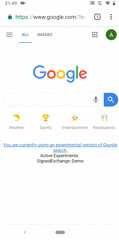
Today we are rolling out support in Google Search'sAMP web results (also known as "blue links") to link tosigned exchanges, an emerging new feature of the web enabled by theIETF web packaging specification. Signed exchanges enable displaying the publisher's domain when content is instantly loaded via Google Search. This is available in browsers that support the necessary web platform feature—as of the time of writing, Google Chrome—and availability will expand to include other browsers as they gain support (for example, the upcoming version of Microsoft Edge).
Background on AMP's instant loading
One of AMP's biggest user benefits has been the unique ability to instantly load AMP web pages that users click on in Google Search. Near-instant loading works by requesting content ahead of time, balancing the likelihood of a user clicking on a result with device and network constraints—anddoing it in a privacy-sensitive way.
We believe that privacy-preserving instant loading web content is a transformative user experience, but in order to accomplish this, we had to make trade-offs; namely, theURLs displayed in browser address bars begin with google.com/amp, as a consequence of being shown in the Google AMP Viewer, rather than display the domain of the publisher. We heard both user and publisher feedback over this, and last year weidentified a web platform innovation that provides a solution that shows the content's original URL while still retaining AMP's instant loading.
Introducing signed exchanges
A signed exchange is a file format, defined in theweb packaging specification, that allows the browser to trust a document as if it belongs to yourorigin. This allows you to use first-party cookies and storage to customize content and simplify analytics integration. Your page appears under your URL instead of the google.com/amp URL.

Google Search links to signed exchanges when the publisher, browser, and the Search experience context all support it. As a publisher, you will need to publish both the signed exchange version of the content in addition to the non-signed exchange version. Learn more about howGoogle Search supports signed exchange.
Getting started with signed exchanges
Many publishers have already begun to publish signed exchanges since thedeveloper preview opened up last fall. To implement signed exchanges in your own serving infrastructure, follow the guideServe AMP using Signed Exchanges available at amp.dev.
If you use a CDN provider, ask them if they can provide AMP signed exchanges.Cloudflare has recentlyannounced that it is offering signed exchanges to all of its customers without payment.
Check out our resources like thewebmaster community orget in touch with members of the AMP Project with any questions. You can alsoprovide feedback on the signed exchange specification.
Posted by Devin Mullins and Greg Rogers
Except as otherwise noted, the content of this page is licensed under theCreative Commons Attribution 4.0 License, and code samples are licensed under theApache 2.0 License. For details, see theGoogle Developers Site Policies. Java is a registered trademark of Oracle and/or its affiliates.