
Elevation API overview

Page Summary
The Elevation API provides elevation data for locations on Earth, enabling applications with elevation-sensitive features.
You can retrieve elevation for single points or calculate elevation differences along paths, useful for activities like hiking or biking.
The API accepts latitude/longitude coordinates and returns elevation data in meters relative to local mean sea level, with resolution information.
Developers can access the Elevation API through various client libraries (Java, Python, Go, Node.js) and integrate it into their applications.
To get started, set up a Google Cloud project, try sample requests, and explore the documentation for detailed usage instructions.
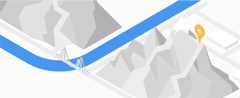
The Elevation API is a service that returns elevation data fora location on the earth, or sampled elevation data along paths.
Why use the Elevation API
With the Elevation API, you can develop applications to support your customers with elevation-sensitive activities, positioning applications, or low-surveying applications that include elevations and elevation changes along routes. For example, you can provide elevation gain and loss data to enhance a sports application for activities such as hiking, biking, or scuba diving.
What you can do with the Elevation API
With the Elevation API, you can include elevation data in your applications or on a map. For example:
- Get theelevation for a particular place.
- Calculate thedifferences in elevation along a route or between two points.
How the Elevation API works
The Elevation API accepts a request as an encoded URL with latitude/longitude coordinatesprovided as either discrete locations, or as a series of locations along a path. This request,for example, queries elevation for the center of Denver, Colorado, specifying a return in JSON format.https://maps.googleapis.com/maps/api/elevation/json ?locations=39.7391536%2C-104.9847034 &key=YOUR_API_KEY
The service derives the elevation for the provided coordinates. It also interpolateselevation for a location without elevation, providing an average returned from the fournearest locations that do provide elevation data. Finally, it determines the overallresolution for the location.
Resources
The following table summarizes the resources available through theElevation API along with the data it returns.
| Data resources | Data returned | Return format |
|---|---|---|
| Latitude/longitude coordinates You can provide data as a set of one or more locations, or as a series along a path. You can also provide encoded coordinates. Pass up to 512 coordinates. | The Elevation API provideselevation in meters relative to thelocal mean sea level (LMSL). Elevation can be returned as positive or negative values as indicated below:
|
|
How to use the Elevation API
| 1 | Get set up. | Start withSet up your Google Cloud project and complete the setup instructions that follow. |
| 2 | Try an elevation request | Once you have an API key, you can start testing out the Elevation API directly from your browser. SeeSample requests in theGetting started guide for details. |
| 3 | Compose a more complex request | Once you are set up with a project, try a request that supplies a location data along a path. SeeSpecifying paths for details. |
| 4 | Understand response basics | Explore the elevation data responses to prepare to use elevation data for your app. SeeElevation responses for details. |
| 5 | Incorporate elevation data into your own app! | You can use elevation data to enhance location-based apps, such as apps for sports activities or for survey data. |
Available client libraries
Call this API in the language ofyour choice through one of the following client libraries:
- Java Client for Google Maps Services
- Python Client for Google Maps Services
- Go Client for Google Maps Services
- Node.js Client for Google Maps Services
The Java Client, Python Client, Go Client and Node.js Client for Google MapsServices are community-supported client libraries, open sourced under theApache 2.0 License.Download them from GitHub, where you can also find installation instructions and sample code.
What's next
- Start using the Elevation API: Go toSet up your Google Cloud project.
- Try getting path-based elevation data: Go toSpecifying paths
- Follow best practices: Go toWeb Service Best Practices.
Except as otherwise noted, the content of this page is licensed under theCreative Commons Attribution 4.0 License, and code samples are licensed under theApache 2.0 License. For details, see theGoogle Developers Site Policies. Java is a registered trademark of Oracle and/or its affiliates.
Last updated 2025-12-11 UTC.