Automated Machine Learning (AutoML)

Page Summary
AutoML automates tasks in the machine learning workflow, like feature engineering, algorithm selection, and hyperparameter tuning, making model building faster and easier.
While manual training involves writing code and iteratively adjusting it, AutoML reduces repetitive work and the need for specialized skills.
AutoML empowers users to focus on the core machine learning problem and data instead of getting bogged down in manual tasks within the model development cycle.
This module explores the benefits and limitations of using AutoML, common patterns, and how to apply them to machine learning projects, assuming prior knowledge of basic machine learning concepts.
- Automate tasks in a machine learning workflow.
- Determine the benefits and limitations of using AutoML with your machine learning model.
- Enumerate the common AutoML patterns and apply them to your ML projects.
This module assumes you are familiar with the concepts covered in the following modules:
- Introduction to Machine Learning
- Linear regression
- Working with numerical data
- Working with categorical data
- Datasets, generalization, and overfitting
If you are starting a new machine learning (ML) project, you may be wonderingif manual training is your only option to build a machine learning model. Withmanual training, you write code using an ML framework to create a model. Duringthis process, you choose which algorithms to explore and iteratively tunehyperparameters to find the right model.
Of course, model training is not the only thing you need to think about. Inpractice, building a machine learning model from prototype to productioninvolves repetitive tasks and specialized skills. A simple exploratory MLworkflow looks something like this:
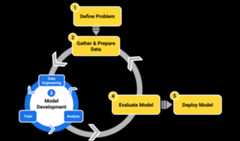
Repetitive tasks - The ML workflow can involve repetitive work andexperimentation. For example, during model development you typically need toexplore different combinations of algorithms and hyperparameters to identify themost appropriate model. With manual training, you write specialized code totrain the model and then adjust the code to run experiments with different MLalgorithms and hyperparameters to find the best model. For small or exploratoryprojects this manual process may not be a problem, but for larger projects theserepetitive tasks can be time consuming.
Specialized Skills - Manually developing an ML model involves specializedskills. In practice, not every team planning to develop a machine learning modelmay have these skills. If a team does not have a dedicated data scientist, doingthis work manually might not even be feasible.
Luckily, certain steps in model development can be automated to reduce theburden of repetitive work and the need for specialized skills. Automating thesetasks is the subject of this module on automated machine learning (AutoML).
What is AutoML?
AutoML is a process of automatingcertain tasks in a machine learning workflow.You can think of AutoML as a set of tools and technologies that make buildingmachine learning models faster and more accessible to a wider group of users.Though automation can help throughout the ML workflow, the tasks that are oftenassociated with AutoML are the ones included in the model development cycleshown in Figure 1. These repetitive tasks include:
- Data Engineering
- Feature engineering.
- Feature selection.
- Training
- Identifying an appropriate ML algorithm.
- Selecting the best hyperparameters.
- Analysis
- Evaluating metrics generated during training based on test andvalidation datasets.
With AutoML, you can focus on your ML problem and data rather than on featureselection, tuning hyperparameters, and choosing the right algorithm.
Key terms:Except as otherwise noted, the content of this page is licensed under theCreative Commons Attribution 4.0 License, and code samples are licensed under theApache 2.0 License. For details, see theGoogle Developers Site Policies. Java is a registered trademark of Oracle and/or its affiliates.
Last updated 2025-08-25 UTC.