ChannelSplitterNode
Baseline Widely available
This feature is well established and works across many devices and browser versions. It’s been available across browsers since July 2015.
TheChannelSplitterNode interface, often used in conjunction with its opposite,ChannelMergerNode, separates the different channels of an audio source into a set of mono outputs. This is useful for accessing each channel separately, e.g., for performing channel mixing where gain must be separately controlled on each channel.
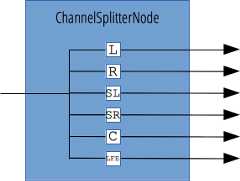
If yourChannelSplitterNode always has one single input, the amount of outputs is defined by a parameter on its constructor and the call toAudioContext.createChannelSplitter(). In the case that no value is given, it will default to6. If there are fewer channels in the input than there are outputs, supernumerary outputs are silent.
| Number of inputs | 1 |
|---|---|
| Number of outputs | variable; default to6. |
| Channel count mode | "explicit" Older implementations, as per earlier versions of the spec use"max". |
| Channel count | Fixed to the number of outputs. Older implementations, as per earlier versions of the spec use2 (not used in the default count mode). |
| Channel interpretation | "discrete" |
Constructor
ChannelSplitterNode()Creates a new
ChannelSplitterNodeobject instance.
Instance properties
No specific property; inherits properties from its parent,AudioNode.
Instance methods
No specific method; inherits methods from its parent,AudioNode.
Example
SeeBaseAudioContext.createChannelSplitter() for example code.
Specifications
| Specification |
|---|
| Web Audio API # ChannelSplitterNode |