
Theconformalbayes package provides functions toconstruct finite-sample calibrated predictive intervals for Bayesianmodels, following the approach inBarber et al. (2021). Thebasic idea is a natural one: use cross-validated residuals to estimatehow large predictive intervals need to be, on average.
Suppose we have a heavy-tailed dataset.
library(conformalbayes)library(rstanarm)library(ggplot2)sim_data=function(n=50){x=rnorm(n)y=3-2*x+rt(n, df=2)data.frame(x=x, y=y)}d_fit=sim_data()ggplot(d_fit,aes(x,y))+geom_point()+geom_smooth(method=lm, formula=y~x)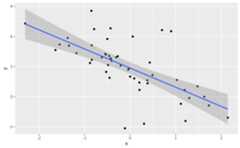
We can fit a linear regression to the data, but it won’t give usaccurate uncertainty quantification in our predictions.
# fit the modelm=stan_glm(y~x, data=d_fit, chains=1, refresh=0)d_test=sim_data(2000)interv_model=predictive_interval(m, newdata=d_test, prob=0.50)# are the points coveredcovered_model=with(d_test,interv_model[,1]<=y&y<=interv_model[,2])ggplot(d_test,aes(x,y, color=covered_model, group=1))+geom_point(size=0.4)+geom_linerange(aes(ymin=interv_model[,1], ymax=interv_model[,2]), alpha=0.4)+labs(color="Covered?")+geom_smooth(method=lm, formula=y~x, color="black")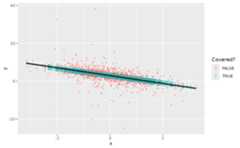
In fact, the 50% intervals over-cover, with a coverage rate of 69.8%,since the fat tails of the error terms pulls the estimate of theresidual standard deviation too high.
While a posterior predictive check could uncover this discrepancy,leading us to fit a more flexible model, we can take another approachinstead. The first step is to callloo_conformal(), whichcomputes leave-one-out cross-validation weights and residuals for use ingenerating more accurate predictive intervals.
m=loo_conformal(m)print(m)#> stan_glm#> family: gaussian [identity]#> formula: y ~ x#> observations: 50#> predictors: 2#> ------#> Median MAD_SD#> (Intercept) 2.9 0.3#> x -1.9 0.3#>#> Auxiliary parameter(s):#> Median MAD_SD#> sigma 2.1 0.2#>#> ------#> * For help interpreting the printed output see ?print.stanreg#> * For info on the priors used see ?prior_summary.stanreg#> (conformalbayes enabled, with estimated CI inflation factor 0.81 and#> transformation pair function (x) x and function (x) x)Theloo_conformal() returns the same fitted model, justwith a thin wrapping layer that contains the leave-one-outcross-validation information. You can see at the bottom of the outputthatconformalbayes estimates that correctly-sizedpredictive intervals are only 81% of the size of the model-basedpredictive intervals.
To actually generate predictive intervals, we usepredictive_interval(), just like normal:
interv_jack=predictive_interval(m, newdata=d_test, prob=0.50)# are the points coveredcovered_jack=with(d_test,interv_jack[,1]<=y&y<=interv_jack[,2])ggplot(d_test,aes(x,y, color=covered_jack, group=1))+geom_point(size=0.4)+geom_linerange(aes(ymin=interv_jack[,1], ymax=interv_jack[,2]), alpha=0.4)+labs(color="Covered?")+geom_smooth(method=lm, formula=y~x, color="black")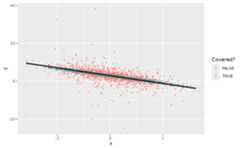
Indeed, the coverage rate for these jackknife conformal intervals is49.2%, as we would expect.
The conformal version ofpredictive_interval() doescontain two extra options:plus andlocal.Whenplus=TRUE, the function will generatejackknife+ intervals, which have a theoretical coverageguarantee. These can be computationally intensive, so by default theyare only generated when the number of fit and prediction data points isless than 500. In practice, non-plus jackknife intervalsgenerally perform just as well asjackknife+ intervals.Whenlocal=TRUE (the default), the function will generateintervals whose widths are proportional to the underlying model-basedpredictive intervals. So if your model accounts for heteroskedasticity,or produces narrow intervals in areas of covariate space with manyobservations (like a linear model),local=TRUE will producemore sensible intervals. The overall conformal performance guaranteesare unaffected.
Citations
Barber, R. F., Candes, E. J., Ramdas, A., & Tibshirani, R. J.(2021). Predictive inference with the jackknife+.The Annals ofStatistics, 49(1), 486-507.
Lei, J., G’Sell, M., Rinaldo, A., Tibshirani, R. J., & Wasserman,L. (2018). Distribution-free predictive inference for regression.Journal of the American Statistical Association, 113(523),1094-1111.