Display Language
Visual Studio Code ships by default with English as the display language and otherlanguages rely on Language Packextensions available from theMarketplace.
VS Code detects the operating system's UI language and prompts you to install the appropriate Language Pack, if available on the Marketplace. Below is an example recommending a Simplified Chinese Language Pack:
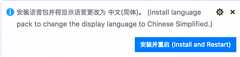
After installing the Language Pack extension and following the prompt to restart, VS Code uses the Language Pack matching your operating system's UI language.
Note: This article explains how to change the display language in the VS Code UI via Language Packs such as French or Chinese. If you want to add programming language support, for example for C++ or Java, refer to theProgramming Languages section of the documentation.
Changing the Display Language
You can also override the default UI language by explicitly setting the VS Code display language using theConfigure Display Language command.
Press⇧⌘P (Windows, LinuxCtrl+Shift+P) to bring up theCommand Palette then start typing "display" to filter and display theConfigure Display Language command.

PressEnter and a list of available languages bylocale is displayed, with the active (current) language highlighted.
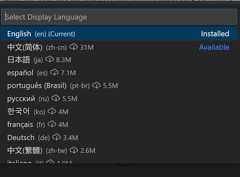
Select another language to change the display language. If the Language Pack is not yet installed, VS Code installs it. You are prompted to restart when you select a different display language.
TheConfigure Display Language command writes to the Runtime Configuration Arguments fileargv.json in your user VS Code folder (.vscode).
The display language can also be changed by editing theargv.json file directly (Preferences: Configure Runtime Arguments) and restarting VS Code.
Available locales
| Display Language | Locale |
|---|---|
| English (US) | en |
| Simplified Chinese | zh-cn |
| Traditional Chinese | zh-tw |
| French | fr |
| German | de |
| Italian | it |
| Spanish | es |
| Japanese | ja |
| Korean | ko |
| Russian | ru |
| Portuguese (Brazil) | pt-br |
| Turkish | tr |
| Polish | pl |
| Czech | cs |
| Hungarian | hu |
Marketplace Language Packs
As described above, VS Code ships with English as the default display language, but other languages are available throughMarketplace Language Packs.
You can also search for Language Packs in the Extensions view (⇧⌘X (Windows, LinuxCtrl+Shift+X)) by typing the language you are looking for along withcategory:"Language Packs".
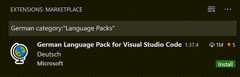
You can have multiple Language Packs installed and select the current display language with theConfigure Display Language command.
Setting the Language
If you want to use a specific language for a VS Code session, you can use the command-line switch--locale to specify a locale when you launch VS Code.
Below is an example of using the--locale command-line switch to set the VS Code display language to French:
code . --locale=frNote: You must have the appropriate Language Pack installed for the language you specify with the command-line switch. If the matching Language Pack is not installed, VS Code will display English.
Common questions
Unable to write to file because the file is dirty
This notification may mean that yourargv.json file wasn't saved after a previous change. Check if there are any errors in the file (Preferences: Configure Runtime Arguments), make sure the file is saved, and try to install the Language Pack again.
Can I contribute to a language pack's translations?
Yes, theVisual Studio Code Community Localization Project is open to anyone, where contributors can provide new translations, vote on existing translations, or suggest process improvements.
How can I enable a programming language like Python?
Refer to theProgramming Languages section to learn how to install support for programming languages, such as PHP, Python, and Java.