

About database observability
Database observability is a measure of how accurately you can infer the internalstate of a database system based on the data, or telemetry, that it generates inlogs, metrics, and traces.
Diagnosing and troubleshooting issues in an application can be particularlydifficult and time-consuming when a database is involved. Telemetry collectionis crucially important. Telemetry, when enriched with application context, canmake database instances more understandable, observable, and easier to maintain.You can identify issues and problematic trends easily and remedy them early,without having to incur costly downtime. Moreover, by using such data, you canconfigure newer database instances to collect the right kind of data from themoment they start.
You can use data effectively and proactively to prevent issues and focuson strategic innovation. Good telemetry collection is particularly usefulin theDevOps model, where databasegeneralists need to independently analyze telemetry to monitor, evaluate, andoptimize the performance and health of their rapidly evolving applications.
Google Cloud offers several powerful features spanning the four iterativeobservability stages to help you maintain the health of your Cloud SQLdatabase.
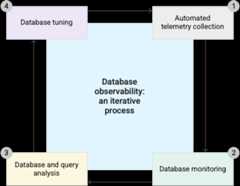
Automated telemetry collection
To achieve observability goals, we start by collecting telemetry,preferably through an automated process. When collected over a period,telemetry helps establish a baseline for metrics under different load conditions.
Google Cloud services automatically generate observability data, including metrics,logs, and traces, which can help provide a complete observability overview.
Cloud Monitoring collects measurementsof your service and of the Google Cloud resources that you use. Cloud SQL usesbuilt-in memory custom agents to collect query telemetry, resulting in a lowerimpact on performance and eliminating the need for agent maintenance or security overhead.
Cloud Logging collects logging data fromcommon application components. For Cloud SQL, see alsoView instance logs.
Cloud Trace collects latency data and executedquery plans from applications to help you track how requests propagate throughyour application. You can compare these latency distributions over time oracross versions. Cloud Trace alerts you when it detects asignificant shift in the latency profile of your application when it'sinstrumented to use Cloud Trace.
Sqlcommenter,anOpenTelemetry libraryfor databases helps you monitor your databases through the lens of anapplication. Sqlcommenter automatically instruments ORMs to augment SQLstatements with tags and allows OpenTelemetry trace context information to bepropagated to the database.
With tags and trace application context in databases, it's easy to correlateapplication code with database performance and troubleshoot microservices-basedarchitectures.
Database monitoring
Proper monitoring helps you determine whether your application is working optimally.Implement monitoring early, such as before you initiate a migration ordeploy a new application to a production environment. Disambiguate betweenapplication issues and underlying cloud issues.
The Cloud SQLOverview page shows graphs for some of the key metrics.
Cloud SQL also helps youcompare metrics for selected instances.
You can use Cloud Monitoring to createcustom dashboardsthat help you monitor metrics and toset up alert policiesso that you can receive timely notifications.
Database tuning
You can iterativelytroubleshoot and tuneyour database.
Cloud SQL recommenders help you analyze the current usage of your databaseand providerecommendationsandinsights based onheuristic methods and machine learning.
Cloud SQL recommenders are briefly described as follows:
| Name | Description |
|---|---|
| Out-of-disk recommender | Reduce the risk of downtime that might be caused by your Cloud SQL instances running out of disk space. |
| Idle instance recommender | Reduce costs by shutting down Cloud SQL instances that are inadvertently idle. |
| Overprovisioned instance recommender | Reduce costs by resizing Cloud SQL instances that are unnecessarily large for a given workload. |
| Underprovisioned instance recommender | Avoid bottlenecks from high CPU and memory usage and minimize the likelihood of out-of-memory events by resizing Cloud SQL instances that have high CPU and/or memory usage. |
What's next
- View the list ofCloud SQL metrics.
- Learn more aboutCloud Logging andCloud Monitoring. See alsoView instance logs.
- Troubleshoot and tune your database instance.
- Learn more aboutGoogle Cloud recommenders.
Except as otherwise noted, the content of this page is licensed under theCreative Commons Attribution 4.0 License, and code samples are licensed under theApache 2.0 License. For details, see theGoogle Developers Site Policies. Java is a registered trademark of Oracle and/or its affiliates.
Last updated 2026-02-19 UTC.