

Use Firestore Studio for Standard edition
You can manage Firestore Standard edition through the following actions in theGoogle Cloud console:
- View, query, add, edit, and delete data.
- Manage indexes.
View data
You can view all your Firestore Standard edition data in the Google Cloud console. Fromthe Firestore Standard edition data viewer, click on a document or collection toopen the data nested within that item.
In the Google Cloud console, go to theDatabases page.
Select the required database from the list of databases.
In the navigation menu, clickFirestore Studio.
Open a specific path
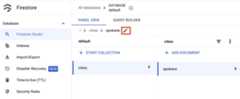
To open a document or collection at a specific path, use theEdit pathbutton:
Non-existent ancestor documents
A document can exist even if one or more its ancestors don'texist. For example, the document at path/mycoll/mydoc/mysubcoll/mysubdoc can exist even if the ancestor document/mycoll/mydoc does not. The Firestore Standard edition data viewer displaysnon-existent ancestor documents as follows:
- In a collection's list of documents, the document IDs of non-existent ancestordocuments areitalicized.
- In a non-existent ancestor document's information panel, the data viewerpoints out that the document does not exist.

Filter data
You can filter documents in a collection based on field value and the==,!-,>,>=,<,<=,in,not-in,array-contains,array-contains-any conditions. For example, you can display only documentswhere the value of fieldfirstname equalsSam. To apply a collection filter:
Click the filter button next to a collection ID:

From theAdd filters menu, select a document field, a filter condition,and a sort order.

ClickApply.
To remove a collection filter, open the same menu and clickClear filter.
Query data
You can query for documents in theQuery Builder tab of theFirestore Studio page.
In the Google Cloud console, go to theDatabases page.
Select the required database from the list of databases.
In the navigation menu, clickFirestore Studio.
Click theQuery Builder tab.
Select aquery scope.
SelectCollection to query a single collection. In the text field,enter a path to a collection.
SelectCollection group to query all collections with the sameID. In theCollection group field, enter a collection group ID.
The table will automatically display documents from the specified collectionor collection group.
ClickAdd to query to filter the returned set of documents. By default,the Query Builder adds a
WHEREclause. You canmodify this clause using the dropdowns and text fields or change to oneof the other available clauses. To continue building more complexqueries, clickAdd to query.To remove a query clause, click it's remove button. To remove all query clauses,clickClear.
Note: Queries must meet Firestore Standard edition requirements and limitationsfor queries. Otherwise, the query fails and the page returns an error thatdescribes why the query failed.ClickRun to retrieve results from your database.

Query requirements and limitations
As you use the Query Builder, keep in mind the following requirements andlimitations for queries.
All queries must be supported by one more indexes. If the database cannot findan index to support the query, it will return an error that contains a link tobuild the required index.
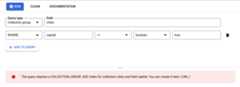
ORDER BYclauses must match the fields in theWHEREclauses and come inthe same order. By default, results are ordered by document ID. If you filterby any other field with anything other than an equality (==), add anORDER BYclause for that field.
Range (
<,<=,>,>=) and not equals (!=,not-in) query clausesmust all filter on the same field.
For additional limitations, seeQuery limitations.
Manage data
In Firestore Standard edition, you store data in documents and organize yourdocuments into collections. Before you start adding data, learn more about theFirestore Standard edition data model.
You can add, edit, and delete documents and collections from the Firebaseconsole. To manage your data from the GCP console,go to theFirestore Studio page:
In the Google Cloud console, go to theDatabases page.
Select the required database from the list of databases.
In the navigation menu, clickFirestore Studio.
Add data
- ClickStart Collection.
- Enter a collection ID. Enter a document ID. Firestore Standard edition will generate document ID, but you can overwrite for a specific document ID. Add fields for the data in your document.
- ClickSave. Your new collection and document appear in the data viewer.
- To add more documents to the collection, clickAdd Document.
Edit data
- Click on a collection to view its documents, then click on a document to view its fields and subcollections.
- Click on a field to edit its value. To add fields or subcollections to the selected document, clickAdd Field orStart Collection.
Delete data
You can delete documents or collections from the data viewer.
Note: In some cases, deleting a large number of documents might causethe data viewer to load slowly or to return a timeout error. This applies todelete operations performed through the data viewer and elsewhere.To delete a collection:
- Select the collection you want to delete.
- Click the menu icon at the top of the documents column, then clickDelete collection.

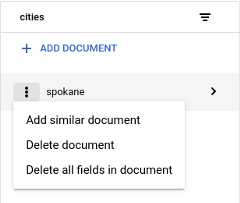
To delete a document:
- Select the document you want to delete.
- Click the menu icon at the top of the document details column. SelectDelete document orDelete document fields.
Deleting a document deletes all of the nested data in that document, includingany subcollections.
Deleting a document's fields does not delete its subcollections. Although empty,the document still exists and can appear in query results.
To delete a specific field in a document:
- Select the document to view its fields.
- Click the delete icon beside the field you want to delete.

Manage Firestore Security Rules
You can view yourFirestore Security Rulesfrom the Google Cloud console. To edit or delete your ruleset, enable Firebase, anduse the Firebase CLI or Firebase console.
Enabling Firebase
To edit your Firestore Security Rules, you mustenable Firebase for your Google Cloud project. If Firebase is not enabled,you can enable Firebase from theSecurity Rules page:

The Firestore Security Rules feature is closely integrated with Firebase Authand the Firebase SDKs (Web, Android, Apple platforms). For more on Firebase andFirestore, seegetting started with Firebase.
View Security Rules
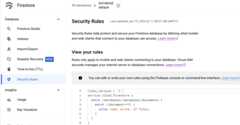
To view your Firestore Security Rules from the Google Cloud console, go to theSecurity Rules page:
In the Google Cloud console, go to theDatabases page.
Select the required database from the list of databases.
In the navigation menu, clickSecurity Rules.
Edit Security Rules
To edit or delete your Firestore Security Rules,use the Firebase CLI or Firebase console.In the Firebase console, go to theRules tabin theFirestore in Native Mode section. Learnmore aboutsetting up and customizing rules.
Manage indexes
To create new indexes for your queries and manage existing indexes from theFirebase console, go to theIndexes tabin theFirestore in Native Mode section. Learn more aboutmanaging indexes.
Except as otherwise noted, the content of this page is licensed under theCreative Commons Attribution 4.0 License, and code samples are licensed under theApache 2.0 License. For details, see theGoogle Developers Site Policies. Java is a registered trademark of Oracle and/or its affiliates.
Last updated 2026-02-18 UTC.