
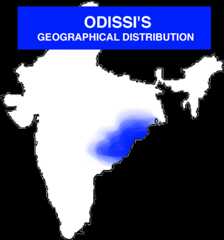
TheOdissi (Orissi) dance is the Indian classical dance from the Eastern state of Odissa. It has a long, yet broken tradition. Although dance in Odissa may be traced back more than 2000 years, it was brought to near extinction during the colonial period. Therefore, modern Odissi dance is a reconstruction.
History
Like other forms of Indian classical dance, theOdissi style traces its origins back to antiquity. Dancers are found depicted in bas-relief in the hills of Udaygiri (near Bhubaneshwar) dating back to the 1st century BC. TheNatya Shastra speaks of the dance from this region and refers to it asOdra-Magadhi.
Over the centuries three schools ofOdissi dance developed:Mahari, Nartaki, andGotipua. TheMahari tradition is thedevadasi tradition; this is the use of women who are attached to deities in the temple. TheNartaki tradition is the school ofOdissi dance which developed in the royal courts. Gotipua is a style characteristed by the use of young boys dressed up in female clothing to perform female roles.
Odissi dance was held in high esteem before the 17th century. Nobility were known for their patronage of the arts, and it was not unheard of for royalty of both sexes to be accomplished dancers. However, after the 17th century, the social position of dancers began to decline. Dancing girls were considered to be little more than prostitutes, and the “Anti-Nautch” movement of the British broughtOdissi dance to near extinction.
Before Independence, the position ofOrissi dance was very bad. The tradition of dancing girls at the temple at Puri was abolished. The royal patronage ofnartaki had been severely eroded by the absorption of India under the crown. The only viableOdissi tradition was theGotipua. This had weathered the British Anti-Nautch movement simply because it was danced by males. Yet even theGotipua tradition was in a very bad state.

Independence brought a major change in official attitudes toward Indian Dance. Like the other classical arts, dance was seen as a way to define India’s national identity. Governmental and non-governmental patronage increased. The few remainingOdissi dancers were given employment, and a massive job of reconstructing theOdissi dance began. This reconstruction involved combing through ancient texts, and more importantly, the close examination of dance posses represented in bas-relief in the various temples.
There were a number of people who were responsible for the reconstruction and popularisation ofOdissi dance. Most notable are Guru Deba Prasad Das, Guru Mayadhar Raut, Guru Pankaj Charan Das, Guru Mahadev Rout, Guru Raghu Dutta, and Guru Kelu Charan Mahapatra.
TodayOdissi dance is once again deemed a viable and “classical” dance.
Style
There are a number of characteristics of theOdissi dance. The style may be seen as a conglomeration of aesthetic and technical details.
One of the most characteristic features ofOdissi dance is theTribhangi. The concept ofTribhang divides the body into three parts, head, bust, and torso. Any posture which deals with these three elements is calledtribhangi. This concept has created the very characteristic poses which are more contorted than found in other classical Indian dances.
Themudras are also important. The termmudra means “stamp” and is a hand position which signifies things. The use ofmudras help tell a story in a manner similar to the hula of Hawaii.
Themes
The themes ofOdissi are almost exclusively religious in nature. They most commonly revolve around Krishna. Although the worship of Krishna is found throughout India, there are local themes which are emphasised. TheAshtapadi’s of Jayadev are a very common theme.
Music
The musical accompaniment ofOdissi dance is essentially the same as the music ofOdissa itself. There are various views on how the music of theOdissi relates to the music of greater North India. It is usually considered just another flavour ofHindustani sangeet, however there are some who feel thatOdissi should be considered a separate classical system.
There are a number of musical instruments used to accompany theOdissi dance. One of the most important is thepakhawaj, also known as themadal. This is the samepakhawaj that is used elsewhere in the north except for a few small changes. One difference is that the right head is a bit smaller than the usual north Indianpakhawaj. This necessitates a technique which in many ways is more like that of thetabla, ormridangam. Other instruments which are commonly used are thebansuri (bamboo flute), themanjira (metal cymbals), thesitar and thetanpura.
There was a move to classifyOdissi as a separate classical system. This movement is generally considered to have failed for a number of reasons. The general view is that traditionalOrissi singers and musicians have been so influenced byHindustani concepts that they are unable to present the music in its “original” form.
There is a peculiar irony to this movement. Had they succeeded in havingOdissi music declared to be a separate system, then it would be hard to justify calling it classical. It would fail to achieve any level, of ethnic transcendence and would essentially be reduced to the level of a “traditional” art form.