

Utah REINS-style state law
- The Administrative State
- Administrative State Index
- Ballotpedia's Five Pillars
- Educational opportunities related to the administrative state
- The Checks and Balances Newsletter
- January 2026
- December 2025
- November 2025
- October 2025
- September 2025
- August 2025
- July 2025
- June 2025
- May 2025
- April 2025
- March 2025
- February 2025
- January 2025
- December 2024
- November 2024
- October 2024
- September 2024
- August 2024
- July 2024
- June 2024
- May 2024
- April 2024
- March 2024
- February 2024
- January 2024
- December 2023
- November 2023
- October 2023
- September 2023
- August 2023
- July 2023
- June 2023
- May 2023
- April 2023
- March 2023
- February 2023
- January 2023
- December 2022
- November 2022
- October 2022
- September 2022
- August 2022
- July 2022
- June 2022
- May 2022
- April 2022
- March 2022
- February 2022
- January 2022
- December 2021
- November 2021
- October 2021
- September 2021
- August 2021
- July 2021
- June 2021
- May 2021
- April 2021
- March 2021
- February 2021
- January 2021
- December 2020
- November 2020
- October 2020
- September 2020
- August 2020
- July 2020
- June 2020
- May 2020
- April 2020
- March 2020
- February 2020
- January 2020
- December 2019
- November 2019
- October 2019
- September 2019
- August 2019
- July 2019
- June 2019
- May 2019
- April 2019
- March 2019
- February 2019
- January 2019
- December 2018
- November 2018
- October 2018
- September 2018
- August 2018
- July 2018
- June 2018
- May 2018
- April 2018
- Tracking
- Terms and definitions
- Glossary of administrative state terms
- Deference
- Rulemaking
- Formal rulemaking
- Informal rulemaking
- Hybrid rulemaking
- Proposed rule
- Final rule
- Comment period
- Ex parte communications
- Judicial review
- Nondelegation doctrine
- Adjudication
- Administrative law judge
- Due process
- Federalism
- Guidance
- Executive agency
- Independent federal agency
- More terms and definitions
- Laws and statutes
- Executive orders
- Jimmy Carter
- Ronald Reagan
- Bill Clinton
- George W. Bush
- Barack Obama
- Donald Trump (first term)
- Presidential Executive Order 13765 (Donald Trump, 2017)
- Presidential Executive Order 13771 (Donald Trump, 2017)
- Presidential Executive Order 13772 (Donald Trump, 2017)
- Presidential Executive Order 13777 (Donald Trump, 2017)
- Presidential Executive Order 13781 (Donald Trump, 2017)
- Presidential Executive Order 13783 (Donald Trump, 2017)
- Presidential Executive Order 13789 (Donald Trump, 2017)
- Presidential Executive Order 13836 (Donald Trump, 2018)
- Presidential Executive Order 13837 (Donald Trump, 2018)
- Presidential Executive Order 13839 (Donald Trump, 2018)
- Presidential Executive Order 13843 (Donald Trump, 2018)
- Joseph Biden
- Donald Trump (second term)
- Executive Order: Exclusions From Federal Labor-Management Relations Programs (Donald Trump, 2025)
- Executive Order: Stopping Waste, Fraud, and Abuse by Eliminating Information Silos (Donald Trump, 2025)
- Executive Order: Eliminating Waste and Saving Taxpayer Dollars by Consolidating Procurement (Donald Trump, 2025)
- Executive Order: Continuing the Reduction of the Federal Bureaucracy (Donald Trump, 2025)
- Executive Order: Implementing the President's "Department of Government Efficiency" Cost Efficiency Initiative (Donald Trump, 2025)
- Executive Order: Ensuring Lawful Governance and Implementing the President's "Department of Government Efficiency" Deregulatory Initiative (Donald Trump, 2025)
- Executive Order: Commencing the Reduction of the Federal Bureaucracy (Donald Trump, 2025)
- Executive Order: Ensuring Accountability for All Agencies (Donald Trump, 2025)
- Executive Order: Implementing The President’s “Department of Government Efficiency” Workforce Optimization Initiative (Donald Trump, 2025)
- Executive Order: Unleashing Prosperity Through Deregulation (Donald Trump, 2025)
- Executive Order: Eliminating the Federal Executive Institute (Donald Trump, 2025)
- Executive Order: Council To Assess The Federal Emergency Management Agency (Donald Trump, 2025)
- Executive Order: Ending Radical And Wasteful Government DEI Programs And Preferencing (Donald Trump, 2025)
- Executive Order: Reforming The Federal Hiring Process And Restoring Merit To Government Service (Donald Trump, 2025)
- Executive Order: Establishing And Implementing The President’s “Department Of Government Efficiency” (Donald Trump, 2025)
- Executive Order: Restoring Accountability to Policy-Influencing Positions Within the Federal Workforce (Donald Trump, 2025)
- More executive orders
- Agencies
- Executive departments
- Dept. of State
- Dept. of Defense
- Dept. of Justice
- Dept. of the Treasury
- Dept. of Homeland Security
- Dept. of Education
- Dept. of Health and Human Services
- Dept. of Labor
- Dept. of Veterans Affairs
- Dept. of Transportation
- Dept. of Energy
- Dept. of Housing and Urban Development
- Dept. of the Interior
- Dept. of Agriculture
- Dept. of Commerce
- Executive agencies
- Independent agencies
- Executive departments
- Court cases
- Administrative state legislation tracker
- Research
| What is a REINS-style state law? REINS-style state laws refer to state laws in the spirit of the federalRegulations from the Executive in Need of Scrutiny (REINS) Act that require legislative approval of proposed state agencyrules with associated costs in excess of a certain monetary threshold. REINS-style state laws aim to give state legislators the preemptive authority to halt the initial enactment of certain administrative regulations. |
| Administrative State |
|---|
 |
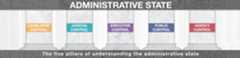
| Five Pillars of the Administrative State |
| •Agency control •Executive control •Judicial control •Legislative control • Public Control |
| Click here for more coverage of theadministrative state on Ballotpedia. |
| Click here to accessBallotpedia's administrative state legislation tracker. |
TheUtah REINS-style state law (House Bill 474) is aREINS-style state law that was signed into law by Kansas Gov.Spencer Cox (R) that requires
- statutory authorization of rules with implementation and compliance costs of $2 million or more over a five-year period, and
- legislative review for rules with implementation and compliance costs of $1 million or more over a five-year period.[1]
REINS-style state laws refer to state laws in the spirit of the federalRegulations from the Executive in Need of Scrutiny (REINS) Act. These laws require legislative approval of proposed state agency rules that carry associated costs in excess of a certain monetary threshold.
The Utah REINS Act includes the following provision:[1]
|
Background
- See also:Rulemaking,REINS Act
The federalREINS Act, which the Utah state version was modeled on, was initially designed byTea Party activist Lloyd Rogers in 2009. Rogers contacted former U.S. RepresentativeGeoff Davis (R-Ky.) to propose legislation requiring that "all rules, regulations, or mandates that require citizens, state or local government financial expenditures must first be approved by the U.S. Congress before they can become effective." The proposal was incorporated into theRepublican Party's Pledge to America legislative agenda leading up to the 2010 election cycle and was later introduced as legislation. It has since been introduced in the 112th Congress (2011-2013) through the 118th Congress (2023-2025).[3][4]
Legislative history
The Regulatory Oversight Amendments Act was introduced into theUtah House of Representatives on February 11, 2025, by the House Rules Committee as House Bill (HB) 474. The bill passed the House on February 27, 2025, and advanced through the Senate with amendments on March 5, 2025. The final version of the bill, after reconciliation, was approved by both theUtah State Senate andUtah House of Representatives on March 7, 2025. It was sent to Gov.Spencer Cox (R) on March 13, 2025, and signed into law on March 27, 2025.Cite error: Invalid<ref> tag; name cannot be a simple integer. Use a descriptive title
Below is an abbreviated timeline of the legislative history of the Utah REINS Act:[1]
- February 11, 2025: HB 474 was introduced in theUtah House of Representatives and referred to the House Rules Committee.
- February 27, 2025: The bill passed theUtah House of Representatives as amended with a vote of 66-0.
- March 5, 2025: The bill was referred to the Senate Rules Committee and passed theUtah State Senate with a vote of 27-0.
- March 7, 2025: The reconciled bill passed theUtah State Senate with a vote of 23-0 and theUtah House of Representatives with a vote of 72-0.
- March 27, 2025: Gov.Spencer Cox (R) signed the bill into law.
Provisions
The sections below contain a series of quotes explaining the major provisions of the law, based on the text of the bill. The quotes outline changes that affect the process for adopting administrative rules and regulations, including new legislative oversight requirements for rules with significant fiscal impact.
Legislative oversight
HB 474 requires agencies to submit proposed rules for legislative review if the rules are projected to have a statewide fiscal impact of more than $1 million over five years. These rules must be reviewed by the relevant appropriations subcommittee and interim committee before they can be enacted, unless exempted.[1]
| “ | (13) (a) (i) Before an agency enacts a rule, the agency shall submit to the appropriations subcommittee and interim committee with jurisdiction over the agency the agency's proposed rule for review, if the proposed rule, over a five-year period, has a fiscal impact of more than $1,000,000 statewide.[2] | ” |
Substantial fiscal impact
The bill defines "substantial fiscal impact" as a projected cost of at least $2 million over five years. Agencies may not adopt rules with this level of impact unless necessary to implement a statute or fulfill a duty delegated by the federal government.[1]
| “ | 63G-3-102 (22) "Substantial fiscal impact" means an anticipated fiscal impact of a proposed rule of at least $2,000,000 over a five-year period. 63G-3-301 (13) (d)The agency shall calculate the substantial fiscal impact in accordance with Subsection (5).(e) Unless an agency cannot implement a statute or execute a federally delegated authority without making a rule that is estimated to have substantial fiscal impact, the agency may not make the rule.[2] | ” |
See also
- REINS Act
- REINS Act (Wisconsin)
- Florida REINS-style state law
- Kansas REINS-style state law
- Indiana REINS-style state law
- Kentucky REINS-style state law
- Oklahoma REINS-style state law
- Louisiana REINS-style state law
- REINS-style state laws
- Rulemaking
External links
Footnotes
- ↑1.01.11.21.31.4Utah State Legislature, "H.B. 474 Regulatory Oversight Amendments", accessed May 19, 2025
- ↑2.02.12.2Note: This text is quoted verbatim from the original source. Any inconsistencies are attributable to the original source.
- ↑The Jackson Sun, "We were never closer to seeing REINS Act become law," January 4, 2017
- ↑Boston Herald, "Smith: Congress can regain power with REINS," January 6, 2017


