

United States Court of Appeals for the Sixth Circuit

TheUnited States Court of Appeals for the Sixth Circuit is afederal appellate court with appellatejurisdiction. It hears appeals from all of the circuit courts within its jurisdiction and its rulings may be appealed to theSupreme Court of the United States.
The Sixth Circuit has 16 authorized judicial posts. The chief judge of the court isJeffrey Sutton, who was appointed by PresidentGeorge W. Bush (R). Six of the judges on the court wereappointed by Donald Trump (R).
Appeals are heard in the Potter Stewart United States Courthouse inCincinnati, Ohio.
Four judges of the Sixth Circuit went on to serve on theSupreme Court of the United States. Howell Edmunds Jackson was appointed to the Supreme Court in 1893 byBenjamin Harrison (R), William R. Day was appointed in 1903 byTheodore Roosevelt (R), Horace Harmon Lurton was appointed in 1909 byWilliam Howard Taft (R), and Potter Stewart was appointed in 1958 byDwight Eisenhower (R).
This page contains the following information on the Sixth Circuit.
- An overview of the court'sjurisdiction
- A list of the court'sactive and senior judges
- A list of the court'scurrent vacancies
- Abrief history of the court
- Case reversal statistics by the Supreme Court of the United States
- Noteworthy cases heard by the court
- A list of the court'sformer judges
- Information aboutU.S. Courts of Appeals
- Where the court islocated
Vacancies
- See also:Current federal judicial vacancies
There are no vacancies on theSixth Circuit, out of the court's 16 judicial positions.
Pending nominations
There are no pending nominees for this court.
Active judges
Article III judges
| Judge | Appointed By | Assumed Office | Bachelors | Law |
|---|---|---|---|---|
| March 24, 1995 - | Radcliffe College, 1970 | Harvard Law School, 1973 | ||
| August 1, 1997 - | University of North Carolina, 1969 | Yale Law School, 1972 | ||
| May 5, 2003 - | Williams College, 1983 | The Ohio State University, Moritz School of Law, 1990 | ||
| June 10, 2005 - | Western Michigan University, 1973 | University of Michigan Law School, 1977 | ||
| July 7, 2008 - | University of Michigan, 1989 | University of Michigan Law, 1993 | ||
| May 25, 2017 - | Boston College, 1991 | University of California, Berkeley, Boalt Hall School of Law, 1994 | ||
| July 21, 2017 - | Vanderbilt University, 1986 | Harvard Law School, 1989 | ||
| November 2, 2017 - | University of Northern Iowa, 1990 | Northwestern University School of Law, 1993 | ||
| May 17, 2018 - | University of Pennsylvania, Wharton School, 1991 | University of Virginia School of Law, 1994 | ||
| March 7, 2019 - | University of Michigan, 1994 | University of Michigan, 1997 | ||
| March 11, 2019 - | Miami University, 2001 | University of Chicago Law School, 2005 | ||
| June 14, 2022 - | Wichita State University, 1989 | Washington University, St. Louis School of Law, 1992 | ||
| September 27, 2022 - | University of Memphis, 2003 | University of Memphis, Cecil C. Humphreys School of Law, 2007 | ||
| July 20, 2023 - | Harvard University, 2004 | UCLA School of Law, 2008 | ||
| September 19, 2024 - | University of Virginia, 1997 | University of Virginia School of Law, 2004 | ||
| July 17, 2025 - | Princeton University, 2009 | The George Washington University Law School, 2015 |
Active Article III judges by appointing political party
Below is a display of the number of active judges by the party of the appointing president. It does not reflect how a judge may rule on specific cases or their own political preferences.
- Democratic appointed: 6
- Republican appointed: 9
Senior judges
Senior status is a classification forfederal judges at all levels who are semi-retired. Senior judges are Article III judges who, having met eligibility through age and service requirements, continue to serve on federal courts while typically hearing a reduced number of cases. Some senior judges, however, elect to retain a full caseload after taking senior status. According to the Administrative Office of U.S. Courts, senior judges "typically handle about 15 percent of the federal courts' workload annually."[1] The date listed under assumed office in the table below reflects the date that the judge took senior status.
| Judge | Appointed By | Assumed Office | Bachelors | Law |
|---|---|---|---|---|
| September 1, 1994 - | University of Michigan, 1951 | University of Michigan Law School, 1953 | ||
| January 1, 2000 - | University of Detroit, 1992 | University of Detroit, Mercy School of Law, 1956 | ||
| July 1, 2001 - | Otterbein College, 1957 | New York University School of Law, 1960 | ||
| August 15, 2001 - | Wayne State University, 1960 | Detroit College of Law, 1963 | ||
| December 31, 2001 - | Vanderbilt University, 1958 | University of Virginia School of Law, 1963 | ||
| January 1, 2009 - | Vanderbilt University, 1964 | Vanderbilt University Law School, 1968 | ||
| November 21, 2010 - | Massachusetts Institute of Technology, 1964 | Harvard Law School, 1967 | ||
| February 28, 2017 - | Harvard College, 1965 | University of Chicago Law School, 1968 | ||
| November 1, 2017 - | University of Michigan, 1968 | University of Michigan Law School, 1971 | ||
| May 15, 2018 - | Stanford University, 1970 | University of Michigan Law School, 1974 | ||
| March 6, 2019 - | University of Akron, 1974 | University of Akron School of Law, 1978 | ||
| March 7, 2019 - | Ohio Wesleyan University, 1964 | University of Akron School of Law, 1971 | ||
| June 13, 2022 - | Barnard College, 1975 | University of Pennsylvania Law School, 1978 | ||
| January 9, 2023 - | Tufts University, 1972 | Yale Law School, 1975 | ||
| September 19, 2024 - | Vanderbilt University, 1972 | University of Virginia School of Law, 1975 |
Senior judges by appointing political party
Below is a display of the number of senior judges by the party of the appointing president. It does not reflect how a judge may rule on specific cases or their own political preferences.
- Democratic appointed: 4
- Republican appointed: 12
Former chief judges
In order to qualify for the office ofchief judge in an Article III circuit or district court, or on theUnited States Court of International Trade, a judge must be in active service and hold seniority over the court's commissioned judges who are 64 years of age or under, have served one year or more, and have not previously served as chief judge.[2]
In the event that no judge on the court meets those qualifications, the youngest judge in regular active service aged 65 years or more and who has served as a judge for one year or more shall become chief judge. If no judge meets those qualifications, the judge holding seniority in active service who has not served as chief before shall become the chief judge.[3][4][5]
The chief judge serves for a term of seven years until another judge becomes eligible to serve in the position. No judge is permitted to serve as chief judge after reaching the age of 70 years unless no other judge is qualified to serve.[3][4][5]
Unlike the chief justice of the United States, a chief judge returns to active service after the expiration of their term and does not create a vacancy on the court by the fact of their promotion.[2][3][4][5]
On theUnited States Court of Federal Claims, the chief judge is selected by thepresident of the United States. The judge must be less than 70 years of age. A chief may serve until they reach age 70 or until another judge is designated by the president as the new chief judge. If the president selects a new chief judge, the former chief judge may continue active service on the court for the remainder of their appointed term.[6]
|
|
Former judges
For more information on the judges of the Sixth Circuit, seeformer federal judges of the Sixth Circuit.
Jurisdiction
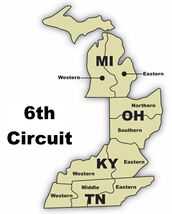
The Sixth Circuit hasappellate jurisdiction over cases heard in one of its subsidiary districts. These cases can include civil and criminal matters that fall under federal law. Appeals of rulings by theSixth Circuit Court of Appeals are petitioned to theSupreme Court of the United States. JusticeBrett Kavanaugh is thecircuit justice for the Sixth Circuit.
The United States Court of Appeals for the Sixth Circuit hasappellate jurisdiction over the United States district courts in the following federal judicial districts:
Caseloads
This section contains court management statistics dating back to 2010. It was last updated in September 2025.
Click[show] below for more information on caseload terms and definitions.
| Caseload statistics explanation | |||||||||
|---|---|---|---|---|---|---|---|---|---|
| Term | Explanation | ||||||||
| Cases filed and terminated | The number of civil and criminal lawsuits formally initiated or decided by the court in a calendar year. The chart below reflects the table columnsCases filed andCases terminated. | ||||||||
| Average time from filing to disposition | The average amount of time, in months, from a case's date of filing to date of disposition (acquittal, sentencing, dismissal, etc.). The chart below reflects the table columnsMedian time (Criminal) andMedian time (Civil). | ||||||||
| Starting case load | The number of cases pending from the previous calendar year. | ||||||||
| Cases filed | The number of civil and criminal lawsuits formally initiated in a calendar year. | ||||||||
| Cases terminated | The total number of civil and criminal lawsuits decided by the court in a calendar year. | ||||||||
| Remaining cases | The number of civil and criminal cases pending at the end of a given year. | ||||||||
| Median time (Criminal) | The average amount of time, in months, from a case's date of filing to the date of disposition. In criminal cases, the date of disposition occurs on the day of sentencing or acquittal/dismissal. | ||||||||
| Median time (Civil) | The average amount of time, in months, from a case's date of filing to the date of disposition. | ||||||||
| Three-year civil cases | The number and percent of civil cases that were filed more than three years before the end of the given calendar year. | ||||||||
| Vacant posts | The number of months during the year an authorized judgeship was vacant. | ||||||||
| Trial/Post | The number of trials completed divided by the number of authorized judgeships on the court. Trials include evidentiary trials, hearings on temporary restraining orders, and preliminary injunctions. | ||||||||
| United States Court of Appeals for the Sixth Circuit caseload stats, 2010-2024 | |||||||||||
|---|---|---|---|---|---|---|---|---|---|---|---|
| Year | Appeals Filed | Appeals Terminated | Pending Appeals | Terminations on the Merits (per Active Judge) | Procedural Terminations (per Active Judge) | Total Written Decisions (per Active Judge) | Number of Judgeships | Number of Sitting Senior Judges | Number of Vacant Judgeship Months | Median Time From Filing Notice of Appeal to Disposition | |
| 2010 | 4,983 | 4,324 | 5,309 | 293 | 75 | 97 | 16 | 10 | 10 | 16 | |
| 2011 | 4,734 | 5,281 | 4,769 | 401 | 89 | 127 | 16 | 9 | 8 | 16 | |
| 2012 | 4,965 | 5,544 | 4,195 | 456 | 71 | 151 | 16 | 9 | 0 | 13 | |
| 2013 | 4,981 | 5,404 | 3,774 | 424 | 68 | 156 | 16 | 8 | 5 | 10 | |
| 2014 | 4,605 | 5,141 | 3,249 | 448 | 55 | 161 | 16 | 8 | 12 | 9 | |
| 2015 | 4,594 | 4,497 | 3,346 | 380 | 51 | 137 | 16 | 8 | 12 | 9 | |
| 2016 | 5,191 | 5,088 | 3,419 | 472 | 55 | 165 | 16 | 8 | 12 | 8 | |
| 2017 | 4,495 | 5,018 | 2,854 | 432 | 53 | 161 | 16 | 10 | 24 | 8 | |
| 2018 | 4,165 | 4,334 | 2,659 | 322 | 50 | 116 | 16 | 9 | 18 | 7 | |
| 2019 | 4,366 | 4,060 | 2,965 | 281 | 38 | 99 | 16 | 13 | 24 | 8 | |
| 2020 | 4,163 | 4,487 | 2,641 | 374 | 43 | 132 | 16 | 12 | 0 | 8 | |
| 2021 | 3,832 | 3,820 | 2,652 | 329 | 34 | 110 | 16 | 12 | 0 | 8 | |
| 2022 | 3,225 | 3,445 | 2,433 | 284 | 31 | 98 | 16 | 13 | 0 | 9 | |
| 2023 | 3,355 | 3,451 | 2,537 | 272 | 30 | 91 | 16 | 13 | 9 | 9 | |
| 2024 | 3,476 | 3,290 | 2,751 | 270 | 33 | 93 | 16 | 12 | 0 | 9 | |
| Average | 4,342 | 4,479 | 3,304 | 363 | 52 | 126 | 16 | 10 | 9 | 10 | |
History
Court history
TheSixth Circuit was established by the United States Congress in 1891 by theEvarts Act of 1891, which established the first nine appeals circuits. Over the years, 14 additional seats were added to the court resulting in a total of 16 seats.[7]
Judicial posts
The following table highlights the development of judicial posts for the Sixth Circuit[7]:
| Year | Statute | Total Seats |
| March 3, 1891 | 26 Stat. 826 | 2 |
| January 25, 1899 | 30 Stat. 803 | 3 |
| May 8, 1928 | 45 Stat. 492 | 4 |
| May 31, 1938 | 52 Stat. 584 | 5 |
| May 24, 1940 | 54 Stat. 219 | 6 |
| March 18, 1966 | 80 Stat. 75 | 8 |
| June 18, 1968 | 82 Stat. 184 | 9 |
| October 20, 1978 | 92 Stat. 1629 | 11 |
| July 10, 1984 | 98 Stat. 333 | 15 |
| December 1, 1990 | 104 Stat. 5089 | 16 |
Reversal rate
Since 2007, SCOTUS has released opinions in1,313 cases. Of those, it reversed a lower court decision938 times (71.4 percent) while affirming a lower court decision363 times (27.6 percent).
In that time period, SCOTUS has decided88 cases originating from the Sixth Circuit, affirming in 17 cases and reversing in 71 cases, for a reversal rate of80.7 percent. As of the end of the2023 term, of the Article III circuits—the ordinal circuits, the D.C. Circuit, and the Federal Circuit—the court with the lowest rate of overturned decisions is theFourth Circuit at 62.1 percent.
Noteworthy cases
The following are noteworthy cases heard before this court. To suggest cases we should cover here,email us. To read opinions published by this court, clickhere.
| • Republican congressmen from Michigan can intervene in redistricting case (2018) | Click for summary→ |
|---|---|
| In December 2017, theLeague of Women Voters and 11 Democratic voters fromMichigan alleged that the state's 2011 electoral districts were unconstitutionally drawn to favor Republican candidates. The plaintiffs argued this was a violation of the First and Fourteenth Amendments. They asked a three-judge federal district court to rule the maps unconstitutional and establish new maps unless the legislature approved a constitutional redistricting plan.[8]
In August 2018, the Sixth Circuit reversed the district court's opinion, finding it "abused its discretion by denying permissive intervention." The court concluded the district court provided an inadequate explanation for denying the intervention.[9] Read the opinionhere. Articles: | |
| • Termination of woman following divorce permissible as spiritual leader at a religious organization (2015) | Click for summary→ |
|---|---|
| Alyce Conlon worked for InterVarsity Christian Fellowship/USA in 2011 when she and her husband began experiencing marital difficulties. She informed her superiors and was put on paid leave. The organization’s policies state that it reserves the right to consider an employee’s separation or divorce when making decisions about his or her continued employment with the company. When Conlon’s husband filed for divorce, InterVarsity fired her. She sued, claiming male employees who had gone through divorces were allowed to keep their jobs. The three-judge panel (Alice Batchelder,John M. Rogers andSandra Beckwith (sitting by designation)) of the 6th Circuit found that “[t]he government cannot dictate to a religious organization who its spiritual leaders” are.[10] Judge Batchelder, writing for the panel, relied upon the Supreme Court’s 2012 decision in ‘’Hosanna-Tabor Evangelical Lutheran Church and School v. Equal Employment Opportunity Commission’’, which found that federal discrimination laws do not apply to religious leaders at religious organizations. The panel used Conlon’s work title,spiritual director, as the basis for their determination that Conlon was a religious leader at InterVarsity. Articles: | |
| • Expulsion of medical student upheld for unprofessional behavior upheld by Sixth Circuit (2015) | Click for summary→ |
|---|---|
| Amir Al-Dabagh was a student at Case Western Reserve Medical School who allegedly groped female students, asked professors to lie on his behalf, and dodged paying taxi fare by jumping out of a moving cab.[11] During his internship, female office staff complained about conduct. A family also asked him to be removed from the exam room. The school demanded that Al-Dabagh take classes on professionalism and gender and repeat his internship prior to graduation. After the university learned of Al-Dabagh’s conviction for DUI in North Carolina, it decided it would not grant Al-Dabagh a degree. He was expelled from the school, although the university offered to allow him to withdraw on his own so he could apply to another medical school. Al-Dabagh refused. He filed suit, claiming that the university refusing to grant him a degree was tantamount to bad faith. Though Al-Dabagh won at the district court level, the university appealed to the6th Circuit and won. JudgeJeffrey Sutton wrote for the three-judge panel (includingAlice Batchelder andDeborah Cook). He highlighted the fact that professionalism was important to the medical field and listed first among the core competencies each degree candidate must meet at Case Western. Ultimately, Judge Sutton wrote that the university’s Committee on Students made an academic judgment when it refused to grant Al-Dabagh a degree and that such determinations are given deference unless they are outside “academic norms.”Cite error: Invalid Articles: | |
| • Sixth Circuit affirms injunction against early voting law in Ohio (2014) | Click for summary→ |
|---|---|
| In Ohio, during theGolden Week, residents could register and vote on the same day during the first week of the five-week early voting period in the state. The Ohio Legislature passed a law banning this voter registration period, leading to a lawsuit challenging the law. Opponents said minority groups who were more likely to vote during early voting periods when special voting programs were directed towards them. One such program, “Souls to the Polls,” took place on Sundays and worked with Black churches. Further, early voting often utilized special voting times, such as evening hours and weekends, making it easier for lower-income people and minorities to make it to the polls. The three-judge panel, consisting of judgesKaren Moore,Eric Clay andDamon Keith, found that the state did not prove that the Golden Week increased the likelihood of voter fraud or that the costs associated with early voting in general were too burdensome. Judge Moore wrote for the panel and stated that there was “extensive evidence in the record of the burdens African American, lower-income, and homeless voters will face in voting” without access to early voting. Articles: | |
| • Sixth Circuit reaffirms judicial immunity (2014) | Click for summary→ |
|---|---|
| JudgeD. Dean Evans was sued by an attorney, Robert Bright, after he refused to accept a plea deal from Bright's client. Bright filed a motion asking the court to accept the plea deal of his client, who initially refused the deal but almost immediately changed his mind. Bright accused the judge of abusing his discretion in the matter. In return, Judge Evans filed a complaint with theOhio Supreme Court, removed Bright from the case in question, and removed Bright from every other felony case to be heard in his courtroom. In total, Evans removed Bright from 70 cases. Defense Corp., the employer of Bright, fired him a month later because he could no longer represent clients before the judge, who was the only one hearing criminal cases in the county. Bright sued not only Evans for but also the county in which Judge Evans sits on the bench and his former employer, Defense Corp. The first judge to hear the case, JudgeJames Graham of theUnited States District Court for the Southern District of Ohio, refused to dismiss it, claiming that Judge Evans acted “outside his jurisdiction” and was thus not entitled to judicial immunity.[11] Judge Graham dismissed the claims against the county and Defense Corp., however. The case was taken to theSixth Circuit, and a three-judge panel consisting ofHelene White,Karen Moore andBernice Donald, reversed Judge Graham's ruling. Judge Moore wrote for the panel that, while Judge Evans acted “petty, unethical, and unworthy of his office,” judicial immunity still applied.[11] They also found that because Judge Evans’ court had subject matter jurisdiction over criminal proceedings in the county, he was not acting outside of his jurisdiction. Further, the panel indicated that it wished to protect judicial immunity for the sake of the entire judicial community. The panel affirmed the dismissal of Bright’s claims against the county and Defense, Corp. Articles: | |
Before the U.S. Supreme Court
This section focuses on cases the U.S. Supreme Court heard that originated in this court. To suggest cases we should cover here,email us.
2025-2026 term
The following cases are scheduled for argument before the U.S. Supreme Court during the 2025-2026 term.
| 2025-2026 U.S. Supreme Court cases from the 6th Circuit | |||
|---|---|---|---|
| Case | Opinion author | Decision | Vote |
| Coney Island Auto Parts Unlimited, Inc. v. Burton | Samuel Alito | affirmed | 9-0 |
| Enbridge Energy, LP v. Nessel | TBD | TBD | TBD |
| National Republican Senatorial Committee v. Federal Election Commission | TBD | TBD | TBD |
| Pung v. Isabella County, Michigan | TBD | TBD | TBD |
| Salazar v. Paramount Global | TBD | TBD | TBD |
2024-2025 term
The following case was heard by the U.S. Supreme Court during the 2024-2025 term.
| 2024-2025 U.S. Supreme Court cases from the 6th Circuit | |||
|---|---|---|---|
| Case | Opinion author | Decision | Vote |
| United States v. Skrmetti | John Roberts | affirmed | 6-3 |
| Ames v. Ohio Department of Youth Services | Ketanji Brown Jackson | vacated andremanded | 9-0 |
| Perttu v. Richards | John Roberts | affirmed | 5-4 |
| Esteras v. United States | Amy Coney Barrett | vacated andremanded | 7-2 |
2023-2024 term
The following case was heard by the U.S. Supreme Court during the 2023-2024 term.
| 2023-2024 U.S. Supreme Court cases from the 6th Circuit | |||
|---|---|---|---|
| Case | Opinion author | Decision | Vote |
| Lindke v. Freed | Amy Coney Barrett | vacated andremanded | 9-0 |
| Chiaverini v. City of Napoleon, Ohio | Elena Kagan | vacated andremanded | 6-3 |
| Starbucks Corp. v. McKinney | Clarence Thomas | vacated andremanded | 8-1 |
2022-2023 term
The following cases were heard by the U.S. Supreme Court during the 2022-2023 term.
| 2022-2023 U.S. Supreme Court cases from the 6th Circuit | |||
|---|---|---|---|
| Case | Opinion author | Decision | Vote |
| Perez v. Sturgis Public Schools | Neil Gorsuch | reversed andremanded | 9-0 |
| The Ohio Adjutant General’s Department v. Federal Labor Relations Authority | Clarence Thomas | affirmed | 7-2 |
| Polselli v. Internal Revenue Service | John Roberts | affirmed | 9-0 |
| Calcutt v. Federal Deposit Insurance Corp.(Decided without argument)[12] | Per curiam | reversed andremanded | N/A |
2021-2022 term
The following cases were heard before the U.S. Supreme Court during the 2021-2022 term.
| 2021-2022 U.S. Supreme Court cases from the 6th Circuit | |||
|---|---|---|---|
| Case | Opinion author | Decision | Vote |
| Wooden v. United States | Elena Kagan | reversed andremanded | 9-0 |
| Babcock v. Kijakazi | Amy Coney Barrett | affirmed | 8-1 |
| Cameron v. EMW Women’s Surgical Center, P.S.C. | Samuel Alito | reversed andremanded | 8-1 |
| Brown v. Davenport | Neil Gorsuch | reversed | 6-3 |
| Marietta Memorial Hospital Employee Health Benefit Plan v. DaVita, Inc. | Brett Kavanaugh | reversed andremanded | 7-2 |
| Shoop v. Twyford | John Roberts | reversed andremanded | 5-4 |
| National Federation of Independent Business v. Department of Labor | Per curiam | Application granted | 6-3 |
2020-2021 term
The following cases were decided by the U.S. Supreme Court during the 2020-2021 term.
| 2020-2021 U.S. Supreme Court cases from the 6th Circuit | |||
|---|---|---|---|
| Case | Opinion author | Decision | Vote |
| Mays v. Hines | Per curiam | reversed | 8-1 |
| Borden v. United States | Elena Kagan | reversed andremanded | 5-4 |
| Brownback v. King | Clarence Thomas | reversed | 9-0 |
| CIC Services v. Internal Revenue Service | Elena Kagan | reversed andremanded | 9-0 |
| Niz-Chavez v. Garland | Neil Gorsuch | reversed | 6-3 |
2019-2020 term
The following cases were decided by the U.S. Supreme Court during the 2019-2020 term.
| 2019-2020 U.S. Supreme Court cases from the 6th Circuit | |||
|---|---|---|---|
| Case | Opinion author | Decision | Vote |
| Ritzen Group Inc. v. Jackson Masonry | Ruth Bader Ginsburg | affirmed | 9-0 |
| Monasky v. Taglieri | Ruth Bader Ginsburg | affirmed | 9-0 |
Federal courthouse
The Court shares the Potter Stewart U.S. Courthouse inCincinnati, with theUnited States District Court for the Southern District of Ohio and the U.S. Marshall Service. The building is located in the business district of Cincinnati and has more than 440,000 square feet of usable space. Originally completed in 1938, the court's main features include a marble detailed two-story lobby and courtrooms with original wood paneling.[13]
About United States Court of Appeals
TheUnited States courts of appeals (orcircuit courts) are the intermediateappellate courts of theUnited States federal courts. The court of appeals was originally created in 1891 and has grown to include thirteen courts.
A court of appeals decides appeals from any of thedistrict courts that are in its federal judicial circuit. The appeals courts also can hear appeals from some administrative agencies. Decisions of the federal appeals courts can, in turn, be appealed to theSupreme Court of the United States.
There are thirteen United States courts of appeals. In addition, there are other federal courts (such as theCourt of Appeals for the Armed Forces, which hears appeals in court-martial cases) that have "Court of Appeals" in their titles.
The eleven numbered circuits and theD.C. Circuit are defined by geography. The thirteenth court of appeal is theCourt of Appeals for the Federal Circuit. This court has nationwide jurisdiction over certain types of appeals based on what the underlying legal case is about.
All of the courts of appeals also hear appeals from some administrative agency decisions and rulemaking. The largest share of this type of case is heard by the D.C. Circuit. The Federal Circuit hears appeals from specialized trial courts, primarily theCourt of International Trade and theCourt of Federal Claims, as well as appeals from the district courts inpatent cases and certain other specialized matters.
Federal circuit court judges are appointed for life. They are paid approximately $179,500 annually. At the age of 65, a federal judge may choose to retire with his or her full salary. Judges may also choose to go onsenior status at age 65, if they have served actively for 15 years.[14]
Appointments by president
The chart below shows the number of appeals court judges confirmed by the U.S. Senate through February 1 of the second year of each president's second term in office. At this point in the term, President Obama had the most appeals court appointments with 12.
Judges by circuit
- See also:Judicial vacancies in federal courts
The table below displays the number of judges in each circuit and indicates how many were appointed by presidents from each major political party. It also includes the number of vacancies on a circuit and how many pending nominations for that circuit are before theUnited States Senate. The table can be sorted by clicking the column headers above the line. It is updated every Monday.
See also
- Federal courts
- Federal judge
- United States Court of Appeals
- Eastern District of Kentucky
- Western District of Kentucky
- Eastern District of Michigan
- Western District of Michigan
- Northern District of Ohio
- Southern District of Ohio
- Eastern District of Tennessee
- Middle District of Tennessee
- Western District of Tennessee
External links
- Search Google News for this topic
- United States Court of Appeals for the 6th Circuit
- Judges of the Sixth Circuit
- Opinions and Oral Arguments
Footnotes
- ↑United States Courts, "FAQs: Federal Judges: What is a senior judge?" accessed December 19, 2016
- ↑2.02.1United States Courts, "Frequently Asked Questions," accessed January 25, 2022
- ↑3.03.13.2Cornell Law School Legal Information Institute, "28 U.S. Code § 136 - Chief judges; precedence of district judges," accessed January 25, 2022
- ↑4.04.14.2Cornell Law School Legal Information Institute, "28 U.S. Code § 258 - Chief judges; precedence of judges," accessed January 25, 2022
- ↑5.05.15.2Cornell Law School Legal Information Institute, "28 U.S. Code § 45 - Chief judges; precedence of judges," accessed January 25, 2022
- ↑Cornell Law School Legal Information Institute, "28 U.S. Code § 171 - Appointment and number of judges; character of court; designation of chief judge," accessed January 25, 2022
- ↑7.07.1Federal Judicial Center, "U.S. Court of Appeals for the Sixth Circuit: Legislative History," accessed May 4, 2021
- ↑Brennan Center for Justice, "League of Women Voters of Michigan v. Johnson," August 30, 2018
- ↑9.09.1United States Court of Appeals for the 6th Circuit, "League of Women Voters v. Johnson," August 30, 2018
- ↑Courthouse News, “Woman Fired for Broken Marriage Cannot Sue,” February 9, 2015
- ↑11.011.111.2Courthouse News, "Medical School Expulsion Justified, 6th Circ. Finds," January 29, 2015Cite error: Invalid
<ref>tag; name "chn" defined multiple times with different content - ↑SCOTUSblog, "Calcutt v. Federal Deposit Insurance Corp.," accessed June 13, 2023
- ↑United States General Services Administration, "Potter Stewart U.S. Courthouse"
- ↑United States Courts, "FAQs: Federal Judges," accessed May 5, 2021
| |||
|---|---|---|---|
| Active judges | Chief Judge: Jeffrey Sutton • Raymond Kethledge • Amul Thapar • Eric Clay • Richard Griffin • Karen Moore • Joan Larsen • Stephanie Dawkins Davis • John K. Bush • John Nalbandian • Eric Murphy • Chad Readler • Andre Mathis • Rachel Bloomekatz • Kevin Ritz | ||
| Senior judges | Helene White • Alice Batchelder • Ralph Guy • James L. Ryan • Alan Norris • Richard Suhrheinrich • Martha Daughtrey • David McKeague • Deborah Cook • Julia Gibbons • John M. Rogers (Sixth Circuit) • Ronald Gilman • Danny Boggs • R. Guy Cole • Eugene Siler • Jane Stranch • | ||
| Former judges | Damon Keith • Bernice Donald • Gilbert Merritt • Cornelia Kennedy • Boyce Martin • Julian William Mack • Harry Wellford • Robert Krupansky • Leroy Contie • Herbert Milburn • Albert Engel • Pierce Lively • Halmer Hull Emmons • John Baxter • William E. Miller • Howell Edmunds Jackson • William Howard Taft • Horace Harmon Lurton • Henry Franklin Severens • William Rufus Day • Loyal Edwin Knappen • John Kelvey Richards • Arthur Carter Denison • John Wesley Warrington • Maurice Donahue • John Weld Peck • Smith Hickenlooper • Xenophon Hicks • Charles Casper Simons • Charles Harwood Moorman • Florence Ellinwood Allen • Elwood Hamilton • John Donelson Martin (Federal appeals court judge) • Herschel Arant • Shackelford Miller • Wade Hampton McCree, Jr. • Henry Brooks • Clifford O'Sullivan • Paul Weick • Lester Cecil • John Peck II • Bailey Brown • Anthony Celebrezze • Bertram Combs • George Edwards (Sixth Circuit) • Thomas McAllister • Nathaniel Jones (federal judge) • Susan Neilson • Harry Phillips • David Aldrich Nelson • | ||
| Former Chief judges | Alice Batchelder • Gilbert Merritt • Boyce Martin • Danny Boggs • Albert Engel • Pierce Lively • R. Guy Cole • Xenophon Hicks • Charles Casper Simons • Florence Ellinwood Allen • John Donelson Martin (Federal appeals court judge) • Shackelford Miller • Paul Weick • Lester Cecil • George Edwards (Sixth Circuit) • Thomas McAllister • Harry Phillips • | ||


