

United States Court of Appeals for the First Circuit
| First Circuit |
|---|
| Court of Appeals |
| File:1st Circuit seal.png |
| Judgeships |
| Posts: 6 |
| Judges: 6 |
| Vacancies: 0 |
| Judges |
| Chief: |
| Active judges:Seth Aframe,David Barron,Joshua D. Dunlap,Gustavo Gelpí,Lara Montecalvo,Julie Rikelman Senior judges: |
TheUnited States Court of Appeals for the First Circuit is afederal appellate court with appellatejurisdiction. It hears appeals from all of the circuit courts within its jurisdiction and its rulings may be appealed to theSupreme Court of the United States.
Appeals are heard in the John Joseph Moakley Courthouse inBoston, Massachusetts. There is another circuit courthouse located in San Juan, Puerto Rico, where the court sits for two weeks a year.
Two judges of the First Circuit went on to serve on theSupreme Court of the United States.Stephen Breyer was appointed to the Supreme Court in 1994 byBill Clinton (D), andDavid Souter was appointed in 1990 byGeorge H. W. Bush (R).
This page contains the following information on the First Circuit.
- A list of the court'scurrent vacancies
- A list of the court'sactive and senior judges
- An overview of the court'sjurisdiction
- Selectedcase management statistics
- Abrief history of the court
- Case reversal statistics by the Supreme Court of the United States
- Noteworthy cases heard by the court
- Where the court islocated
- Information aboutU.S. Courts of Appeals
Vacancies
- See also:Current federal judicial vacancies
There are no current vacancies on theFirst Circuit, out of the court's six judicial positions.
Pending nominations
There are no pending nominees for this court.
Active judges
Article III judges
| Judge | Appointed By | Assumed Office | Bachelors | Law |
|---|---|---|---|---|
| May 23, 2014 - | Harvard College, 1989 | Harvard Law School, 1994 | ||
| October 19, 2021 - | Brandeis University, 1987 | Suffolk University Law School, 1991 | ||
| September 30, 2022 - | Swarthmore College, 1996 | Boston College Law School, 2000 | ||
| June 23, 2023 - | ||||
| May 23, 2024 - | Tufts University, 1996 | Georgetown University Law Center, 1999 | ||
| November 7, 2025 - | Pensacola Christian College | Notre Dame Law School |
Active Article III judges by appointing political party
Below is a display of the number of active judges by the party of the appointing president. It does not reflect how a judge may rule on specific cases or their own political preferences.
- Democratic appointed: 5
- Republican appointed: 1
Senior judges
Senior status is a classification forfederal judges at all levels who are semi-retired. Senior judges are Article III judges who, having met eligibility through age and service requirements, continue to serve on federal courts while typically hearing a reduced number of cases. Some senior judges, however, elect to retain a full caseload after taking senior status. According to the Administrative Office of U.S. Courts, senior judges "typically handle about 15 percent of the federal courts' workload annually."[1] The date listed under assumed office in the table below reflects the date that the judge took senior status.
| Judge | Appointed By | Assumed Office | Bachelors | Law |
|---|---|---|---|---|
| January 3, 1992 - | Harvard College, 1948 | Harvard Law School, 1951 | ||
| December 31, 2011 - | Haverford College, 1963 | Yale Law School, 1967 | ||
| March 31, 2022 - | Plymouth State College, 1978 | Georgetown University Law Center, 1981 | ||
| September 21, 2022 - | Brown University, 1973 | Boston University School of Law, 1976 | ||
| December 31, 2022 - | Wellesley College, 1968 | Boston University School of Law, 1971 | ||
| October 31, 2024 - | Amherst College, 1976 | Harvard Law School, 1979 |
Senior judges by appointing political party
Below is a display of the number of senior judges by the party of the appointing president. It does not reflect how a judge may rule on specific cases or their own political preferences.
- Democratic appointed: 4
- Republican appointed: 2
Former chief judges
In order to qualify for the office ofchief judge in an Article III circuit or district court, or on theUnited States Court of International Trade, a judge must be in active service and hold seniority over the court's commissioned judges who are 64 years of age or under, have served one year or more, and have not previously served as chief judge.[2]
In the event that no judge on the court meets those qualifications, the youngest judge in regular active service aged 65 years or more and who has served as a judge for one year or more shall become chief judge. If no judge meets those qualifications, the judge holding seniority in active service who has not served as chief before shall become the chief judge.[3][4][5]
The chief judge serves for a term of seven years until another judge becomes eligible to serve in the position. No judge is permitted to serve as chief judge after reaching the age of 70 years unless no other judge is qualified to serve.[3][4][5]
Unlike the chief justice of the United States, a chief judge returns to active service after the expiration of their term and does not create a vacancy on the court by the fact of their promotion.[2][3][4][5]
On theUnited States Court of Federal Claims, the chief judge is selected by thepresident of the United States. The judge must be less than 70 years of age. A chief may serve until they reach age 70 or until another judge is designated by the president as the new chief judge. If the president selects a new chief judge, the former chief judge may continue active service on the court for the remainder of their appointed term.[6]
|
|
Former judges
To see a list of judges who previously served the First Circuit,click here.
Jurisdiction
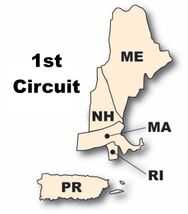
The First Circuit hasappellate jurisdiction over cases heard in one of its subsidiary districts. These cases fall under federal law, and may be either civil or criminal in nature. Appeals of rulings by theFirst Circuit Court of Appeals are petitioned to theSupreme Court of the United States. U.S. Supreme Court JusticeKetanji Brown Jackson is thecircuit justice for theFirst Circuit.
The United States Court of Appeals for the 1st Circuit has jurisdiction over the followingU.S. district courts:
- District of Maine
- District of Massachusetts
- District of New Hampshire
- District of Puerto Rico
- District of Rhode Island
Caseloads
This section contains court management statistics dating back to 2010. It was last updated in September 2025.Click[show] below for more information on caseload terms and definitions.
| Caseload statistics explanation | |||||||||
|---|---|---|---|---|---|---|---|---|---|
| Term | Explanation | ||||||||
| Cases filed and terminated | The number of civil and criminal lawsuits formally initiated or decided by the court in a calendar year. The chart below reflects the table columnsCases filed andCases terminated. | ||||||||
| Average time from filing to disposition | The average amount of time, in months, from a case's date of filing to date of disposition (acquittal, sentencing, dismissal, etc.). The chart below reflects the table columnsMedian time (Criminal) andMedian time (Civil). | ||||||||
| Starting case load | The number of cases pending from the previous calendar year. | ||||||||
| Cases filed | The number of civil and criminal lawsuits formally initiated in a calendar year. | ||||||||
| Cases terminated | The total number of civil and criminal lawsuits decided by the court in a calendar year. | ||||||||
| Remaining cases | The number of civil and criminal cases pending at the end of a given year. | ||||||||
| Median time (Criminal) | The average amount of time, in months, from a case's date of filing to the date of disposition. In criminal cases, the date of disposition occurs on the day of sentencing or acquittal/dismissal. | ||||||||
| Median time (Civil) | The average amount of time, in months, from a case's date of filing to the date of disposition. | ||||||||
| Three-year civil cases | The number and percent of civil cases that were filed more than three years before the end of the given calendar year. | ||||||||
| Vacant posts | The number of months during the year an authorized judgeship was vacant. | ||||||||
| Trial/Post | The number of trials completed divided by the number of authorized judgeships on the court. Trials include evidentiary trials, hearings on temporary restraining orders, and preliminary injunctions. | ||||||||
| United States Court of Appeals for the First Circuit caseload stats, 2010-2024 | |||||||||||
|---|---|---|---|---|---|---|---|---|---|---|---|
| Year | Appeals Filed | Appeals Terminated | Pending Appeals | Terminations on the Merits (per Active Judge) | Procedural Terminations (per Active Judge) | Total Written Decisions (per Active Judge) | Number of Judgeships | Number of Sitting Senior Judges | Number of Vacant Judgeship Months | Median Time From Filing Notice of Appeal to Disposition | |
| 2010 | 1,530 | 1,600 | 1,306 | 415 | 82 | 154 | 6 | 2 | 3 | 12 | |
| 2011 | 1,534 | 1,494 | 1,287 | 415 | 79 | 126 | 6 | 2 | 0 | 12 | |
| 2012 | 1,549 | 1,560 | 1,241 | 491 | 60 | 154 | 6 | 3 | 12 | 11 | |
| 2013 | 1,575 | 1,467 | 1,345 | 522 | 86 | 172 | 6 | 4 | 8 | 11 | |
| 2014 | 1,413 | 1,297 | 1,469 | 420 | 50 | 123 | 6 | 4 | 5 | 12 | |
| 2015 | 1,605 | 1,595 | 1,355 | 357 | 85 | 110 | 6 | 3 | 0 | 13 | |
| 2016 | 1,573 | 1,443 | 1,482 | 426 | 51 | 132 | 6 | 3 | 0 | 11 | |
| 2017 | 1,251 | 1,425 | 1,310 | 416 | 63 | 125 | 6 | 3 | 0 | 13 | |
| 2018 | 1,178 | 1,132 | 1,361 | 322 | 40 | 102 | 6 | 3 | 0 | 13 | |
| 2019 | 1,326 | 1,318 | 1,421 | 466 | 4 | 147 | 6 | 4 | 0 | 13 | |
| 2020 | 1,238 | 1,237 | 1,430 | 407 | 7 | 139 | 6 | 4 | 2 | 13 | |
| 2021 | 1,062 | 1,202 | 1,293 | 367 | 5 | 105 | 6 | 2 | 12 | 14 | |
| 2022 | 1,031 | 1,005 | 1,324 | 226 | 16 | 66 | 6 | 5 | 9 | 14 | |
| 2023 | 1,127 | 987 | 1,467 | 226 | 6 | 72 | 6 | 6 | 6 | 13 | |
| 2024 | 1,198 | 1,114 | 1,551 | 278 | 10 | 80 | 6 | 5 | 7 | 14 | |
| Average | 1,346 | 1,325 | 1,376 | 384 | 43 | 120 | 6 | 4 | 4 | 13 | |
History
First Circuit Court of Appeals (1891-present)
Congress established the U.S. circuit courts of appeals for nine judicial circuits in 1891. In 1905, an additional seat was added to the First Circuit and in 1915, theDistrict of Puerto Rico was added to the First Circuit. Additional judicial seats were added in 1978 and two more in 1984.[7]
Circuit Courts for the First Circuit (1802-1891)
TheEvarts Act in 1891 added a fourth tier to the federal judiciary by establishingcourts of appeals in each circuit. Circuit court judges were reassigned to the court of appeals.[8] TheJudicial Code of 1911 abolished the entire circuit court system and established the three-tiered judicial system that is in place today.[9][10]
Circuit Court for the First Circuit (1801-1802)
The United States Circuit Court for the First Circuit was created by theJudiciary Act of 1801. Prior to this act, appeals were reviewed by a three-judge panel composed of two judges from theSupreme Court and the district court judge who had issued the decision being appealed. It provided the first circuit with three new judges.[11][12] The act was repealed thirteen months later when a new Congressional majority took power. They returned to the previous system, with slight modifications to lighten the travel load of the Supreme Court Justices.[11][13]
The following table highlights the development of judicial posts for the First Circuit:[7]
| Year | Statute | Total Seats |
| March 3, 1891 | 26 Stat. 826 | 2 |
| January 21, 1905 | 33 Stat. 611 | 3 |
| October 20, 1978 | 92 Stat. 1629 | 4 |
| July 10, 1984 | 98 Stat. 333 | 6 |
Reversal rate
Since 2007, SCOTUS has released opinions in1,313 cases. Of those, it reversed a lower court decision938 times (71.4 percent) while affirming a lower court decision363 times (27.6 percent).
In that time period, SCOTUS has decided37 cases originating from the First Circuit, affirming in 14 cases and reversing in 23 cases, for a reversal rate of62.2 percent. As of the end of the2023 term, of the Article III circuits—the ordinal circuits, the D.C. Circuit, and the Federal Circuit—the court with the lowest rate of overturned decisions is theFourth Circuit at 62.1 percent.
Noteworthy cases
The following are noteworthy cases heard before this court. To suggest cases we should cover here,email us. To read opinions published by this court, clickhere.
| • Freedom of Information Act request for Planned Parenthood grant documents rightfully denied (2015) | Click for summary→ |
|---|---|
| The New Hampshire Right to Life organization filed a request to obtain documents from the Department of Health and Human Services (“HHS”) regarding its approval of a 2011 grant to Planned Parenthood for family planning services. HHS claimed that it could find no other provider in the state of New Hampshire to provide these services. In the three-judge panel (William Kayatta,Jeffrey R. Howard andJuan Torruella) opinion, Judge William Kayatta of the First Circuit reasoned that, just because Planned Parenthood had no competition in the state when the grant was made in 2011, it does not follow that the organization has no competition now or will have none in the future. Further, the documents New Hampshire Right to Life requested dealt with Planned Parenthood’s commercial dealings and thus contained commercial information. To make these documents public would give Planned Parenthood’s competitors an unfair advantage, according to Judge Kayatta. Articles: | |
| • Judge rules there is no constitutional right to gay marriage (2014) | Click for summary→ |
|---|---|
| Five same-sex couples filed a lawsuit in Puerto Rico, challenging laws in the Commonwealth of Puerto Rico that define marriage as between one man and one woman.U.S. District CourtJudge Juan Perez-Gimenez ruled in October 2014 that there is no constitutionally protected right to same-sex marriage. Perez-Gimenez said that theUnited States Supreme Court's decision inWindsor, the landmark case concerning the Defense of Marriage Act, reaffirmed that marriage is in the purview of the states, not the federal government, nor should the Commonwealth of Puerto Rico be forced to recognize same-sex marriages. Articles: | |
| • Stolen gun liability case (2012) Judge(s):Bruce Marshall Selya,Jeffrey R. Howard andO. Rogeriee Thompson (Jones v. Secord, 11-1576) | Click for summary→ |
|---|---|
On July 6, 2012, a three-judge panel for theUnited States Court of Appeals for the First Circuit upheld the ruling of JudgePaul Barbadoro of theUnited States District Court for the District of New Hampshire, who held that a New Hampshire man could not be held liable for the use of his handgun in a violent crime. Gail Jones, the mother of the shooting victim, filed a lawsuit alleging that Lawrence Secord was liable for the use of his handgun by his grandson in an armed robbery that resulted in three fatalities in 2007. Secord's gun was stolen by his grandson, who broke into a locked summer cabin to obtain the firearm. Barbadoro agreed with Secord that he had taken proper precautions to secure his firearm. JudgeBruce Marshall Selya agreed with Barbadoro's decision and wrote the opinion of the panel. He stated in the opinion that "[t]he record here, even when construed in the light most flattering to the plaintiff, does not show either a particularized risk of harm or a degree of foreseeability sufficient to animate this exception." Jones told the press she brought the lawsuit to raise awareness of gun storage and risks, telling the press, "[f]irearms are very dangerous when they're in the wrong hands."[14][15] | |
Before the U.S. Supreme Court
This section focuses on cases the U.S. Supreme Court heard that originated in this court. To suggest cases we should cover here,email us.
2025-2026 term
The following case was scheduled for argument before the U.S. Supreme Court during the 2025-2026 term.
| 2025-2026 United States Court of Appeals for the First Circuit | |||
|---|---|---|---|
| Case | Opinion author | Decision | Vote |
| Urias-Orellana v. Bondi | TBA | TBA | TBA |
2024-2025 term
The following case was heard by the U.S. Supreme Court during the 2024-2025 term.
| 2024-2025 U.S. Supreme Court cases from the 1st Circuit | |||
|---|---|---|---|
| Case | Opinion author | Decision | Vote |
| Smith & Wesson Brands v. Estados Unidos Mexicanos | Elena Kagan | reversed | 9-0 |
2023-2024 term
The following case was heard by the U.S. Supreme Court during the 2023-2024 term.
| 2023-2024 U.S. Supreme Court cases from the 1st Circuit | |||
|---|---|---|---|
| Case | Opinion author | Decision | Vote |
| Acheson Hotels, LLC v. Laufer | Amy Coney Barrett | vacated andremanded | 9-0 |
| Relentless, Inc. v. Department of Commerce | John Roberts | vacated andremanded | 6-3 |
2022-2023
The following cases were scheduled for argument before the U.S. Supreme Court during the 2022-2023 term.
| 2022-2023 U.S. Supreme Court cases from the 1st Circuit | |||
|---|---|---|---|
| Case | Opinion author | Decision | Vote |
| Students for Fair Admissions, Inc. v. President & Fellows of Harvard (Consolidated withStudents for Fair Admissions, Inc. v. University of North Carolina) | Chief Justice John Roberts | reversed | 6-3 |
| Financial Oversight and Management Board for Puerto Rico v. Centro de Periodismo Investigativo, Inc. | Elena Kagan | reversed andremanded | 8-1 |
| Flambeau Band of Lake Superior Chippewa Indians v. Coughlin | Ketanji Brown Jackson | affirmed | 8-1 |
2021-2022 term
The following cases were heard before the U.S. Supreme Court during the 2021-2022 term.
| 2021-2022 U.S. Supreme Court cases from the 1st Circuit | |||
|---|---|---|---|
| Case | Opinion author | Decision | Vote |
| United States v. Vaello-Madero | Brett Kavanaugh | reversed | 8-1 |
| United States v. Tsarnaev | Clarence Thomas | reversed | 6-3 |
| Carson v. Makin | John Roberts | reversed andremanded | 6-3 |
| Concepcion v. United States | TBD | TBD | TBD |
| Shurtleff v. City of Boston | Stephen Breyer | reversed andremanded | 9-0 |
2020-2021 term
The following cases were heard before the U.S. Supreme Court during the 2020-2021 term.
| 2020-2021 U.S. Supreme Court cases from the 1st Circuit | |||
|---|---|---|---|
| Case | Opinion author | Decision | Vote |
| Caniglia v. Strom | Clarence Thomas | vacated andremanded | 9-0 |
2019-2020 term
The following cases were heard before the U.S. Supreme Court during the 2019-2020 term.
| 2019-2020 U.S. Supreme Court cases from the 1st Circuit | |||
|---|---|---|---|
| Case | Opinion author | Decision | Vote |
| Financial Oversight and Management Board for Puerto Rico v. Aurelius Investment LLC (Consolidated withAurelius Investment v. Puerto Rico,Official Committee of Debtors v. Aurelius Investment, United States v. Aurelius Investment, andUTIER v. Financial Oversight and Management Board for Puerto Rico) | Stephen Breyer | reversed andremanded | 9-0 |
Federal courthouse
The court is based at the John Joseph Moakley Federal Courthouse inBoston, Massachusetts. The court normally meets in Boston, but for two weeks each year it assembles in Old San Juan, Puerto Rico, and occasionally at other locations within the circuit.
The John Joseph Moakley Federal Courthouse was designed by Henry Cobb, whose notable work includes Boston's John Hancock Tower and the headquarters for the International Monetary Fund in Washington D.C.Stephen Breyer led the architect selection process.[16] Construction on the Moakley Federal Courthouse was finished in 1998. The building overlooks Boston Harbor, houses 27 courtrooms and is home to both theFirst Circuit and theUnited States District Court for the District of Massachusetts. The dominant feature of the building is an 88-foot tall glass wall overlooking a park with views of downtown Boston and the Harbor.[17] You can find directions to the courthouse on the official website,MoakleyCourthouse.com under the contact tab.
About United States Courts of Appeal
TheUnited States courts of appeals (orcircuit courts) are the intermediateappellate courts of theUnited States federal courts. The court of appeals was originally created in 1891 and has grown to include thirteen courts.
A court of appeals decides appeals from any of thedistrict courts that are in its federal judicial circuit. The appeals courts also can hear appeals from some administrative agencies. Decisions of the federal appeals courts can, in turn, be appealed to theSupreme Court of the United States.
There are thirteen United States courts of appeals. In addition, there are other federal courts (such as theCourt of Appeals for the Armed Forces, which hears appeals in court-martial cases) that have "Court of Appeals" in their titles.
The eleven numbered circuits and theD.C. Circuit are defined by geography. The thirteenth court of appeal is theCourt of Appeals for the Federal Circuit. This court has nationwide jurisdiction over certain types of appeals based on what the underlying legal case is about.
All of the courts of appeals also hear appeals from some administrative agency decisions and rulemaking. The largest share of this type of case is heard by the D.C. Circuit. The Federal Circuit hears appeals from specialized trial courts, primarily theCourt of International Trade and theCourt of Federal Claims, as well as appeals from the district courts inpatent cases and certain other specialized matters.
Federal circuit court judges are appointed for life. They are paid approximately $179,500 annually. At the age of 65, a federal judge may choose to retire with his or her full salary. Judges may also choose to go onsenior status at age 65, if they have served actively for 15 years.[18]
Appointments by president
The chart below shows the number of appeals court judges confirmed by the U.S. Senate through February 1 of the second year of each president's second term in office. At this point in the term, President Obama had the most appeals court appointments with 12.
Judges by circuit
- See also:Judicial vacancies in federal courts
The table below displays the number of judges in each circuit and indicates how many were appointed by presidents from each major political party. It also includes the number of vacancies on a circuit and how many pending nominations for that circuit are before theUnited States Senate. The table can be sorted by clicking the column headers above the line. It is updated every Monday.
See also
- Federal courts
- Federal judge
- United States Court of Appeals
- United States District Court for the District of Maine
- United States District Court for the District of Massachusetts
- United States District Court for the District of New Hampshire
- United States District Court for the District of Puerto Rico
- United States District Court for the District of Rhode Island
External links
- United States Court of Appeals for the 1st Circuit
- Judges of the First Circuit
- List of opinions
- Federal Judicial Center - About the First Circuit
- John Joseph Moakley Courthouse Official Website
Footnotes
- ↑United States Courts, "FAQs: Federal Judges: What is a senior judge?" accessed December 19, 2016
- ↑2.02.1United States Courts, "Frequently Asked Questions," accessed January 25, 2022
- ↑3.03.13.2Cornell Law School Legal Information Institute, "28 U.S. Code § 136 - Chief judges; precedence of district judges," accessed January 25, 2022
- ↑4.04.14.2Cornell Law School Legal Information Institute, "28 U.S. Code § 258 - Chief judges; precedence of judges," accessed January 25, 2022
- ↑5.05.15.2Cornell Law School Legal Information Institute, "28 U.S. Code § 45 - Chief judges; precedence of judges," accessed January 25, 2022
- ↑Cornell Law School Legal Information Institute, "28 U.S. Code § 171 - Appointment and number of judges; character of court; designation of chief judge," accessed January 25, 2022
- ↑7.07.1Federal Judicial Center, "U.S. Court of Appeals for the First Circuit: Legislative History"
- ↑"Legislative history of the Court of Appeals for the First Circuit" from theFederal Judicial Center
- ↑Federal Judicial Center, "Summary" of the Judicial Code of 1911
- ↑United States Circuit Courts for the First Circuit
- ↑11.011.1Federal Judicial Center, "The U.S. Circuit Courts and the Federal Judiciary," accessed June 9, 2021
- ↑Federal Judicial Center, "Landmark Legislation: Judiciary Act of 1801," accessed June 9, 2021
- ↑Federal Judicial Center, "Summary of Judiciary Act of 1802"
- ↑Boston.com, "Court says gun owner not negligent in NH shooting," July 9, 2012
- ↑Justia.com, Opinion, Jones v. Secord
- ↑Metropolis, "Justice Stephen Breyer on Boston’s New Moakley Courthouse," November 20, 2012
- ↑MoakleyCourthouse.com, "History," accessed January 16, 2019
- ↑United States Courts, "FAQs: Federal Judges," accessed May 5, 2021

| |||||||||||||||||||||||||||||||||||


