

United States Court of Appeals for the Tenth Circuit
| Tenth Circuit |
|---|
| Court of Appeals |
 |
| Judgeships |
| Posts: 12 |
| Judges: 12 |
| Vacancies: 0 |
| Judges |
| Chief:Jerome Holmes |
| Active judges:Robert Bacharach,Joel Carson,Allison Eid,Richard Federico,Harris Hartz,Jerome Holmes,Scott Matheson,Carolyn McHugh,Nancy Moritz,Gregory Alan Phillips,Veronica Rossman,Timothy Tymkovich Senior judges: |
TheUnited States Court of Appeals for the Tenth Circuit is afederal appellate court with appellatejurisdiction. It hears appeals from all of the circuit courts within its jurisdiction and its rulings may be appealed to theSupreme Court of the United States. Appeals are heard in the Byron White U.S. Courthouse inDenver.
One judge from the Tenth Circuit has served on theSupreme Court of the United States.Neil Gorsuch was appointed to the Supreme Court in 2017 byDonald Trump (R).
This page contains the following information on the Tenth Circuit.
- An overview of the court'sjurisdiction
- A list of the court'sactive and senior judges
- A list of the court'scurrent vacancies
- Abrief history of the court
- Case reversal statistics by the Supreme Court of the United States
- Noteworthy cases heard by the court
- A list of the court'sformer judges
- Information aboutU.S. Courts of Appeals
- Where the court islocated
Vacancies
- See also:Current federal judicial vacancies
There are no current vacancies on theTenth Circuit, out of the court's 12 judicial positions.
Pending nominations
There are no pending nominees for this court.
Active judges
Article III judges
| Judge | Appointed By | Assumed Office | Bachelors | Law |
|---|---|---|---|---|
| December 10, 2001 - | Harvard College, 1967 | Harvard Law School, 1972 | ||
| April 1, 2003 - | Colorado College, 1979 | University of Colorado School of Law, 1982 | ||
| August 9, 2006 - | Wake Forest University, 1983 | Georgetown University Law Center, 1988 | ||
| December 27, 2010 - | Stanford University, 1975 | Yale Law School, 1980 | ||
| February 28, 2013 - | University of Oklahoma, 1981 | University of Washington School of Law, 1985 | ||
| July 9, 2013 - | University of Wyoming, 1983 | University of Wyoming College of Law, 1987 | ||
| March 14, 2014 - | University of Utah, 1978 | University of Utah College of Law, 1982 | ||
| July 29, 2014 - | Washburn University, 1982 | Washburn Law School, 1985 | ||
| November 3, 2017 - | Stanford University, 1987 | University of Chicago Law School, 1991 | ||
| May 17, 2018 - | Texas Tech University, 1994 | University of New Mexico School of Law, 1997 | ||
| September 28, 2021 - | Columbia University, 1993 | University of California, Hastings College of the Law, 1997 | ||
| December 13, 2023 - | Indiana University, 1999 | University of Kansas School of Law, 2002 |
Active Article III judges by appointing political party
Below is a display of the number of active judges by the party of the appointing president. It does not reflect how a judge may rule on specific cases or their own political preferences.
- Democratic appointed: 7
- Republican appointed: 5
Senior judges
Senior status is a classification forfederal judges at all levels who are semi-retired. Senior judges are Article III judges who, having met eligibility through age and service requirements, continue to serve on federal courts while typically hearing a reduced number of cases. Some senior judges, however, elect to retain a full caseload after taking senior status. According to the Administrative Office of U.S. Courts, senior judges "typically handle about 15 percent of the federal courts' workload annually."[1] The date listed under assumed office in the table below reflects the date that the judge took senior status.
| Judge | Appointed By | Assumed Office | Bachelors | Law |
|---|---|---|---|---|
| October 15, 1999 - | University of Denver, 1956 | University of Denver College of Law, 1959 | ||
| January 1, 2000 - | University of Utah School of Law, 1960 | |||
| January 26, 2001 - | New Mexico Military Institute, 1956 | University of Arizona College of Law, 1960 | ||
| May 25, 2001 - | University of Wyoming, 1956 | University of Wyoming College of Law, 1958 | ||
| October 16, 2005 - | Smith College, 1962 | Harvard Law School, 1965 | ||
| January 16, 2006 - | Northwestern University, 1962 | University of Michigan Law School, 1965 | ||
| December 31, 2012 - | Creighton University, 1969 | University of Wyoming College of Law, 1972 | ||
| April 30, 2013 - | University of Wyoming, 1965 | University of Wyoming College of Law, 1972 | ||
| December 31, 2017 - | University of Notre Dame, 1963 | Fordham University School of Law, 1967 | ||
| February 1, 2021 - | Adams State College, 1961 | George Washington University Law Center, 1964 | ||
| March 15, 2021 - | University of Kansas, 1969 | University of Kansas, School of Law, 1973 |
Senior judges by appointing political party
Below is a display of the number of senior judges by the party of the appointing president. It does not reflect how a judge may rule on specific cases or their own political preferences.
- Democratic appointed: 4
- Republican appointed: 7
Former chief judges
In order to qualify for the office ofchief judge in an Article III circuit or district court, or on theUnited States Court of International Trade, a judge must be in active service and hold seniority over the court's commissioned judges who are 64 years of age or under, have served one year or more, and have not previously served as chief judge.[2]
In the event that no judge on the court meets those qualifications, the youngest judge in regular active service aged 65 years or more and who has served as a judge for one year or more shall become chief judge. If no judge meets those qualifications, the judge holding seniority in active service who has not served as chief before shall become the chief judge.[3][4][5]
The chief judge serves for a term of seven years until another judge becomes eligible to serve in the position. No judge is permitted to serve as chief judge after reaching the age of 70 years unless no other judge is qualified to serve.[3][4][5]
Unlike the chief justice of the United States, a chief judge returns to active service after the expiration of their term and does not create a vacancy on the court by the fact of their promotion.[2][3][4][5]
On theUnited States Court of Federal Claims, the chief judge is selected by thepresident of the United States. The judge must be less than 70 years of age. A chief may serve until they reach age 70 or until another judge is designated by the president as the new chief judge. If the president selects a new chief judge, the former chief judge may continue active service on the court for the remainder of their appointed term.[6]
|
|
Former judges
To learn more about the judges of the Tenth Circuit, seeformer federal judges of the Tenth Circuit.
Jurisdiction
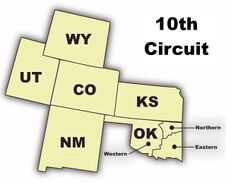
The Tenth Circuit hasappellate jurisdiction over cases heard in one of its subsidiary districts. These cases can include civil and criminal matters that fall under federal law. Appeals of rulings by the Tenth Circuit are petitioned to theSupreme Court of the United States. JusticeNeil Gorsuch is thecircuit justice for the Tenth Circuit.
The United States Court of Appeals for the 10th Circuit hasjurisdiction over the United States district courts in the following federal judicial districts:
- District of Colorado
- District of Kansas
- District of New Mexico
- Eastern District of Oklahoma
- Northern District of Oklahoma
- Western District of Oklahoma
- District of Utah
- District of Wyoming
Caseloads
This section contains court management statistics dating back to 2010. It was last updated in September 2025.
Click[show] below for more information on caseload terms and definitions.
| Caseload statistics explanation | |||||||||
|---|---|---|---|---|---|---|---|---|---|
| Term | Explanation | ||||||||
| Cases filed and terminated | The number of civil and criminal lawsuits formally initiated or decided by the court in a calendar year. The chart below reflects the table columnsCases filed andCases terminated. | ||||||||
| Average time from filing to disposition | The average amount of time, in months, from a case's date of filing to date of disposition (acquittal, sentencing, dismissal, etc.). The chart below reflects the table columnsMedian time (Criminal) andMedian time (Civil). | ||||||||
| Starting case load | The number of cases pending from the previous calendar year. | ||||||||
| Cases filed | The number of civil and criminal lawsuits formally initiated in a calendar year. | ||||||||
| Cases terminated | The total number of civil and criminal lawsuits decided by the court in a calendar year. | ||||||||
| Remaining cases | The number of civil and criminal cases pending at the end of a given year. | ||||||||
| Median time (Criminal) | The average amount of time, in months, from a case's date of filing to the date of disposition. In criminal cases, the date of disposition occurs on the day of sentencing or acquittal/dismissal. | ||||||||
| Median time (Civil) | The average amount of time, in months, from a case's date of filing to the date of disposition. | ||||||||
| Three-year civil cases | The number and percent of civil cases that were filed more than three years before the end of the given calendar year. | ||||||||
| Vacant posts | The number of months during the year an authorized judgeship was vacant. | ||||||||
| Trial/Post | The number of trials completed divided by the number of authorized judgeships on the court. Trials include evidentiary trials, hearings on temporary restraining orders, and preliminary injunctions. | ||||||||
| United States Court of Appeals for the Tenth Circuit caseload stats, 2010-2024 | |||||||||||
|---|---|---|---|---|---|---|---|---|---|---|---|
| Year | Appeals Filed | Appeals Terminated | Pending Appeals | Terminations on the Merits (per Active Judge) | Procedural Terminations (per Active Judge) | Total Written Decisions (per Active Judge) | Number of Judgeships | Number of Sitting Senior Judges | Number of Vacant Judgeship Months | Median Time From Filing Notice of Appeal to Disposition | |
| 2010 | 2,225 | 2,375 | 1,341 | 242 | 102 | 82 | 12 | 9 | 18 | 9 | |
| 2011 | 2,294 | 2,250 | 1,372 | 263 | 123 | 85 | 12 | 9 | 18 | 9 | |
| 2012 | 2,156 | 2,176 | 1,353 | 322 | 62 | 105 | 12 | 8 | 24 | 8 | |
| 2013 | 2,071 | 2,155 | 1,264 | 314 | 58 | 106 | 12 | 10 | 28 | 8 | |
| 2014 | 1,964 | 2,058 | 1,171 | 295 | 51 | 101 | 12 | 10 | 6 | 8 | |
| 2015 | 1,975 | 1,888 | 1,259 | 264 | 40 | 86 | 12 | 8 | 0 | 8 | |
| 2016 | 2,281 | 2,256 | 1,288 | 346 | 46 | 118 | 12 | 8 | 0 | 6 | |
| 2017 | 1,861 | 1,914 | 1,231 | 284 | 42 | 96 | 12 | 6 | 9 | 8 | |
| 2018 | 1,788 | 1,805 | 1,214 | 252 | 39 | 85 | 12 | 6 | 12 | 9 | |
| 2019 | 1,792 | 1,775 | 1,231 | 240 | 40 | 79 | 12 | 7 | 0 | 10 | |
| 2020 | 1,700 | 1,725 | 1,206 | 244 | 35 | 81 | 12 | 7 | 0 | 10 | |
| 2021 | 1,588 | 1,697 | 1,096 | 218 | 23 | 72 | 12 | 8 | 17 | 10 | |
| 2022 | 1,647 | 1,622 | 1,123 | 218 | 32 | 73 | 12 | 7 | 12 | 9 | |
| 2023 | 1,751 | 1,735 | 1,139 | 252 | 34 | 84 | 12 | 7 | 0 | 10 | |
| 2024 | 1,766 | 1,762 | 1,143 | 223 | 39 | 75 | 12 | 7 | 0 | 9 | |
| Average | 1,924 | 1,946 | 1,229 | 265 | 51 | 89 | 12 | 8 | 10 | 9 | |
History
Court history
The Tenth Circuit was established on February 28, 1929, underTenth Circuit Reorganization Act of 1929, which broke the then-Eighth Circuit into theEighth Circuit and theTenth Circuit. All of the judges who resided in the newly createdTenth Circuit were transferred to the new appellate court. Over time, eight additional seats were added to the circuit, resulting in a total of 12 seats.[7] The court's current jurisdiction contains 560,625 square miles or roughly 20% of the total U.S. landmass. For a full history of the Tenth Circuit, please see theTenth Judicial Circuit Historical Society's Official website.
Judicial posts
The following table highlights the development of judicial posts for the Tenth Circuit:[7]
| Year | Statute | Total Seats |
| February 28, 1929 | 45 Stat. 1346 | 4 |
| August 3, 1949 | 63 Stat. 493 | 5 |
| May 19, 1961 | 75 Stat. 80 | 6 |
| June 18, 1968 | 82 Stat. 184 | 7 |
| October 20, 1978 | 92 Stat. 1629 | 8 |
| July 10, 1984 | 98 Stat. 333 | 10 |
| December 1, 1990 | 104 Stat. 5089 | 12 |
Reversal rate
Since 2007, SCOTUS has released opinions in1,313 cases. Of those, it reversed a lower court decision938 times (71.4 percent) while affirming a lower court decision363 times (27.6 percent).
In that time period, SCOTUS has decided46 cases originating from the Tenth Circuit, affirming in 17 cases and reversing in 29 cases, for a reversal rate of63 percent. As of the end of the2023 term, of the Article III circuits—the ordinal circuits, the D.C. Circuit, and the Federal Circuit—the court with the lowest rate of overturned decisions is theFourth Circuit at 62.1 percent.
Noteworthy cases
The following were noteworthy cases heard before this court.
| • States cannot require citizenship documents to register to vote (2014) | Click for summary→ |
|---|---|
| On November 10, 2014, theTenth Circuit struck down Kansas and Arizona laws requiring individuals to show citizenship documents when registering to vote. The ruling was an affirmation of action taken by the U.S. Election Assistance Commission, which blocked the states from requiring those documents and led both states to sue in federal court. The federal court found that the agency exceeded its authority in blocking the states from requiring citizenship documents. Th ethree-judge panel of the Tenth Circuit, consisting of JudgesJerome Holmes,Carlos Lucero andGregory Alan Phillips, said that the states lacked the authority to require the federal government to include citizenship documents as a requirement on the voter registration form, which the states argued the agency had to do in compliance with the states’ own laws. Further, Judge Lucero, writing for the panel, said that the states failed to show that requiring proof of citizenship decreased fraudulent voting. Articles: | |
| • Utah same-sex marriage ruling upheld (2014) Judge(s):Paul Kelly,Carlos Lucero andJerome Holmes (Kitchen v. Herbert, 13-4178) | Click for summary→ | ||||||
|---|---|---|---|---|---|---|---|
JudgeCarlos Lucero wrote the opinion in the appeal ofKitchen v. Herbert, a case that involved a same-sex marriage inUtah. TheTenth Circuit ruled 2-1 in favor ofDistrict of Utah's ruling that ended the ban on same-sex marriage on the grounds that it violated theFourteenth Amendment's equal protection clause. Judge Lucero wrote andJerome Holmes concurred:
JudgePaul Kelly dissented on the point that marriage was a fundamental right. He wrote:
| |||||||
| • Tenth Circuit refuses stay on injunction against online streaming company Aero (2014) | Click for summary→ |
|---|---|
| Aereo, a company that retransmits television signals to subscribers, was enjoined by federal JudgeDale Kimball from operating in six states in February 2014. Judge Kimball found that Aereo was “indistinguishable” from a cable provider and should have the proper licenses necessary to stream broadcast network signals to subscribers. The injunction covered six states: Wyoming, Colorado, Utah, New Mexico, Kansas, and Oklahoma. The company sought to have the injunction lifted with a preliminary stay until after trial by appealing to theTenth Circuit. JudgesMary Briscoe andRobert Bacharach, the majority of a three-judge panel, refused to lift the injunction, stating that Aereo did not sufficiently show that it would likely succeed at trial, one of the requirements to order a stay. Further, the Tenth Circuit judges found no other factors that weighed in favor of staying the injunction.JudgeHarris Hartz dissented from the majority. Articles: | |
| • Horse slaughterhouses may reopen prior to resolution of appeal (2013) Judge(s):Gregory Alan Phillips andDavid Ebel (Front Range Equine Rescue, et al v. Vilsack, et al, 13-2187) | Click for summary→ |
|---|---|
On December 13, 2013, JudgesGregory Alan Phillips andDavid Ebel of theTenth Circuit denied an emergency motion filed by animal rights groups for an injunction seeking to halt horse slaughterhouses from resuming operations for the first time since 2007. Plaintiffs requested a stay on those activities pending the final resolution of their appeal but "failed to meet their burden," according to the judges' decision. In the underlying case, animal rights groups sought to prevent the slaughter of horses in New Mexico, Missouri, and Iowa, claiming that the U.S. Department of Agriculture issued inspection permits to three slaughterhouses but failed to prepare various documents essential to determining the environmental impact of their intended operations, in violation of the National Environmental Policy Act. Chief JudgeChristina Armijo of theUnited States District Court for the District of New Mexico temporarily enjoined the slaughter of horses while considering the case but later dismissed the proceedings with prejudice. The plaintiff animal rights groups appealed to the Tenth Circuit, and on November 5, 2013, the appeals court issued a temporary stay of Judge Armijo's decision pending further review. About one month later, Judges Phillips and Ebel lifted that stay, citing the plaintiffs' likelihood of success in the final resolution of their appeal, making way for horse slaughterhouses to begin operations.[10][11] | |
| • Court sides with Abercrombie in religious discrimination case (2013) Judge(s):Paul Kelly,David Ebel, andJerome Holmes (Equal Employment Opportunity Commission v. Abercrombie & Fitch Stores, Inc., 11-5110) | Click for summary→ |
|---|---|
On October 1, 2013, theTenth Circuit vacated a trial courtsummary judgment ruling in a suit filed by the Equal Employment Opportunity Commission (EEOC) on behalf of a Muslim job applicant after the clothing store Abercrombie & Fitch (A&F) declined to hire her because she wore a headscarf. JudgeJerome Holmes wrote for the majority, joined by JudgePaul Kelly. JudgeDavid Ebel wrote separately, concurring in part and dissenting in part. In the underlying case, the plaintiff Samantha Elauf interviewed for a job at A&F while wearing a religious headscarf but did not specifically inform her interviewer that she wore it for a religious purpose. The interviewer assumed that it was worn for a religious purpose. Elauf was not hired because her headscarf violated A&F's dress code. In the ruling, Holmes said that the trial court's decision was erroneous because there could be no religious discrimination without notification of the need for a religious accommodation. Here, because Elauf failed to tell her interviewer that she would need accommodation for her religious headscarf, the EEOC would not have been unable to conclusively establish that A&F had actual notice of her religious needs. In his separate opinion, Ebel agreed that the trial court's decision was incorrect but argued that the question of discrimination should have been sent to a jury.[12] The Supreme Court overturned the ruling in October 2015, finding that accommodation was not the issue but rather if Elauf's headscarf was a "motivating factor" in deciding against hiring her. JusticeAntonin Scalia wrote for the 8-1 majority, " “[A]n employer who acts with the motive of avoiding accommodation may violate [the law] even if he has no more than an unsubstantiated suspicion that accommodation would be needed.”[13] | |
Before the U.S. Supreme Court
This section focuses on cases the U.S. Supreme Court heard that originated in this court. To suggest cases we should cover here,email us.
2025-2026 term
The following cases were scheduled for argument before the U.S. Supreme Court during the 2025-2026 term.
| 2025-2026 U.S. Supreme Court cases from the 10th Circuit | |||
|---|---|---|---|
| Case | Opinion author | Decision | Vote |
| Chiles v. Salazar | TBD | TBD | TBD |
| The GEO Group, Inc. v. Menocal | TBD | TBD | TBD |
| Flower Foods, Inc. v. Brock | TBD | TBD | TBD |
2024-2025 term
The following cases were heard by the U.S. Supreme Court during the 2024-2025 term.
| 2024-2025 U.S. Supreme Court cases from the 10th Circuit | |||
|---|---|---|---|
| Case | Opinion author | Decision | Vote |
| United States v. Miller | Ketanji Brown Jackson | reversed | 8-1 |
| Velazquez v. Garland | Neil Gorsuch | reversed andvacated | 5-4 |
| Waetzig v. Halliburton Energy Services | Samuel Alito | reversed andremanded | 9-0 |
| Oklahoma v. Environmental Protection Agency (Consolidated withPacificorp v. Environmental Protection Agency) | Clarence Thomas | reversed andremanded | 8-0 |
| Andrew v. White (Decided without argument) | Per curiam | vacated andremanded | N/A |
2023-2024 term
The following cases were heard by the U.S. Supreme Court during the 2023-2024 term.
| 2023-2024 U.S. Supreme Court cases from the 10th Circuit | |||
|---|---|---|---|
| Case | Opinion author | Decision | Vote |
| Office of the United States Trustee v. John Q. Hammons Fall 2006, LLC | Ketanji Brown Jackson | reversed andremanded | 6-3 |
2022-2023 term
The following cases were scheduled for argument before the U.S. Supreme Court during the 2022-2023 term.
| 2022-2023 U.S. Supreme Court cases from the 10th Circuit | |||
|---|---|---|---|
| Case | Opinion author | Decision | Vote |
| 303 Creative LLC v. Elenis | Neil Gorsuch | reversed | 6-3 |
| Abitron Austria GmbH v. Hetronic International, Inc. | Samuel Alito | vacated andremanded | 9-0 |
2021-2022 term
The following cases were heard before the U.S. Supreme Court during the 2021-2022 term.
| 2021-2022 U.S. Supreme Court cases from the 10th Circuit | |||
|---|---|---|---|
| Case | Opinion author | Decision | Vote |
| Denezpi v. United States | Amy Coney Barrett | affirmed | 6-3 |
2020-2021 term
The following cases were scheduled for argument before the U.S. Supreme Court during the 2020-2021 term.
| 2020-2021 U.S. Supreme Court cases from the 10th Circuit | |||
|---|---|---|---|
| Case | Opinion author | Decision | Vote |
| Torres v. Madrid | John Roberts | vacated andremanded | 5-3 |
| Carr v. Saul (Consolidated withDavis v. Saul) | Sonia Sotomayor | reversed andremanded | 9-0 |
| HollyFrontier Cheyenne Refining, LLC v. Renewable Fuels Association | Neil Gorsuch | reversed | 6-3 |
2019-2020 term
The following cases were heard before the U.S. Supreme Court during the 2019-2020 term.
| 2019-2020 U.S. Supreme Court cases from the 10th Circuit | |||
|---|---|---|---|
| Case | Opinion author | Decision | Vote |
| Sharp v. Murphy | Per curiam | affirmed | NA |
| Rodriguez v. Federal Deposit Insurance Corporation | Neil Gorsuch | vacated andremanded | 9-0 |
| Lomax v. Ortiz-Marquez | Elena Kagan | affirmed | 9-0 |
| Colorado Department of State v. Baca | Per curiam | reversed | 8-0 |
Federal courthouse
TheTenth Circuit is located in the Byron White U.S. Courthouse inDenver. The courthouse was built between 1910 and 1916 replacing a previous building. The exterior of the building uses local Colorado Yule marble, the same material used on the Lincoln Memorial in Washington. Originally, the building held all of the federal agencies located in Denver. Over time, as the federal agencies grew, the building came to be occupied by only the Post Office. The building was expanded and renovated in 1994 to rehouse the federal courthouse, with the current value of the building estimated at $200 million.[14]
About United States Court of Appeals
TheUnited States courts of appeals (orcircuit courts) are the intermediateappellate courts of theUnited States federal courts. The court of appeals was originally created in 1891 and has grown to include thirteen courts.
A court of appeals decides appeals from any of thedistrict courts that are in its federal judicial circuit. The appeals courts also can hear appeals from some administrative agencies. Decisions of the federal appeals courts can, in turn, be appealed to theSupreme Court of the United States.
There are thirteen United States courts of appeals. In addition, there are other federal courts (such as theCourt of Appeals for the Armed Forces, which hears appeals in court-martial cases) that have "Court of Appeals" in their titles.
The eleven numbered circuits and theD.C. Circuit are defined by geography. The thirteenth court of appeal is theCourt of Appeals for the Federal Circuit. This court has nationwide jurisdiction over certain types of appeals based on what the underlying legal case is about.
All of the courts of appeals also hear appeals from some administrative agency decisions and rulemaking. The largest share of this type of case is heard by the D.C. Circuit. The Federal Circuit hears appeals from specialized trial courts, primarily theCourt of International Trade and theCourt of Federal Claims, as well as appeals from the district courts inpatent cases and certain other specialized matters.
Federal circuit court judges are appointed for life. They are paid approximately $179,500 annually. At the age of 65, a federal judge may choose to retire with his or her full salary. Judges may also choose to go onsenior status at age 65, if they have served actively for 15 years.[15]
Appointments by president
The chart below shows the number of appeals court judges confirmed by the U.S. Senate through February 1 of the second year of each president's second term in office. At this point in the term, President Obama had the most appeals court appointments with 12.
Judges by circuit
- See also:Judicial vacancies in federal courts
The table below displays the number of judges in each circuit and indicates how many were appointed by presidents from each major political party. It also includes the number of vacancies on a circuit and how many pending nominations for that circuit are before theUnited States Senate. The table can be sorted by clicking the column headers above the line. It is updated every Monday.
See also
- Tenth Circuit Reorganization Act of 1929
- Federal courts
- Federal judge
- United States Court of Appeals
- District of Colorado
- District of Kansas
- District of New Mexico
- Eastern District of Oklahoma
- Northern District of Oklahoma
- Western District of Oklahoma
- District of Utah
- District of Wyoming
External links
- Search Google News for this topic
- United States Court of Appeals for the Tenth Circuit
- Judges of the Tenth Circuit
- Published Opinions
Footnotes
- ↑United States Courts, "FAQs: Federal Judges: What is a senior judge?" accessed December 19, 2016
- ↑2.02.1United States Courts, "Frequently Asked Questions," accessed January 25, 2022
- ↑3.03.13.2Cornell Law School Legal Information Institute, "28 U.S. Code § 136 - Chief judges; precedence of district judges," accessed January 25, 2022
- ↑4.04.14.2Cornell Law School Legal Information Institute, "28 U.S. Code § 258 - Chief judges; precedence of judges," accessed January 25, 2022
- ↑5.05.15.2Cornell Law School Legal Information Institute, "28 U.S. Code § 45 - Chief judges; precedence of judges," accessed January 25, 2022
- ↑Cornell Law School Legal Information Institute, "28 U.S. Code § 171 - Appointment and number of judges; character of court; designation of chief judge," accessed January 25, 2022
- ↑7.07.1Federal Judicial Center, "U.S. Court of Appeals for the Tenth Circuit: Legislative History," accessed May 4, 2021
- ↑8.08.1United States Court of Appeals for the Tenth Circuit, "Kitchen v. Herbert," June 25, 2014
- ↑9.09.1Note: This text is quoted verbatim from the original source. Any inconsistencies are attributable to the original source.
- ↑Food Safety News, "10th Circuit Grants Temporary Injunction in Horse Case," November 5, 2013
- ↑Associated Press, "Appeals court allows horse slaughterhouses to open," December 14, 2013
- ↑National Law Journal, "Tenth Circuit Sides with Abercrombie in Hijab Case," October 3, 2013
- ↑HuffPost, "Supreme Court Rules Against Abercrombie & Fitch In Discrimination Case," June 1, 2015
- ↑U.S. Court of Appeals for the Tenth Circuit, "History of the Byron White Courthouse," accessed May 4, 2021
- ↑United States Courts, "FAQs: Federal Judges," accessed May 5, 2021
| |||||||||||||||||||||||||||||||||||


