

Ulysses S. Grant
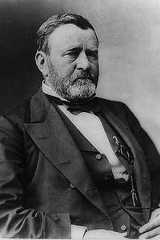
Ulysses S. Grant (b. Hiram Ulysses Grant, April 27, 1822, in Point Pleasant, Ohio) was the 18th president of the United States. He served from 1869 to 1877 and died at age 63 on July 23, 1885.
Grant was a member of theRepublican Party. His vice presidents were Schuyler Colfax (1869-1873) and Henry Wilson (1873-1877).
Grant was president during the Reconstruction period following the American Civil War.
Prior to his presidency, Grant served in the Civil War as colonel and brigadier general of the 21st Illinois Volunteer Infantry Regiment, major general of volunteers, lieutenant general of Union armies, and general-in-chief of the United States Army. He led the Union to ultimately defeat the Confederate States Army in 1865.[1]
Biography
Timeline of life events
Below is an abbreviated outline of Grant's professional and political career:[1][2][3]
- 1822: Born in Point Pleasant,Ohio
- 1843: Graduated from United States Military Academy, West Point; assigned to the Fourth Infantry of the U.S. Army
- 1846-1848: Served in the Mexican-American War
- 1861-1865: Served in the American Civil War
- 1865: Confederate General Robert E. Lee surrendered to Grant at Appomattox Court House
- 1866: Appointed general-in-chief of the United States Army
- 1868: Electedpresident of the United States, defeating Democrat Horatio Seymour
- 1869: Grant's brother-in-law Abel Corbin implicated in Black Friday financial panic
- 1870: Signed theFifteenth Amendment to the United States Constitution
- 1872: Signed legislation to establish Yellowstone as the country's first national park
- 1872: Re-elected aspresident of the United States
- 1875: Signed the Civil Rights Act of 1875
- 1875: Grant’s secretary Orville Babcock indicted in Whiskey Ring scandal
- 1880: LostRepublican presidential candidate nomination toJames Garfield
- 1885: Died of throat cancer in Mount McGregor,New York
Before the presidency
Hiram Ulysses Grant was born to Jesse Root Grant and Hannah Simpson Grant in Point Pleasant, Ohio, on April 27, 1822. He grew up in Georgetown, Ohio, where his father ran a tannery. In 1839, Grant entered the United States Military Academy in West Point, New York. An error was made during the admissions process in which Grant's name was incorrectly rendered as Ulysses S. Grant, a rendering which Grant accepted as his legal name. Following graduation in 1843, Grant was assigned to the Fourth Infantry of the United States Army, stationed in St. Louis, Missouri. He served in the Mexican-American War from 1846 to 1848, then returned to St. Louis to marry Julia Boggs Dent.[1][2][3]
Grant resigned from the army in 1854 but returned at the start of the American Civil War in 1861. He served in the 21st Illinois Volunteer Infantry Regiment and was appointed by PresidentAbraham Lincoln to serve as lieutenant general of the Union armies in 1864. He then served as the general-in-chief of the United States Army from 1864 to 1869.[1][2][3] Grant led the Union to defeat the Confederate States Army through an aggressive military strategy, resulting in the end of the Civil War and the surrender of General Robert E. Lee at Appomattox Court House on April 9, 1865.[4]
On May 24, 1868, theRepublican Party nominated Grant as the party's presidential candidate, and he ran with the slogan "Let Us Have Peace." He defeatedDemocratic candidate Horatio Seymour in the presidential election on November 3, 1868, receiving 214 electoral votes to Seymour's 80.[2][5]
Presidency
Grant served as president during the Reconstruction period following the Civil War. In his first term as president, theFifteenth Amendment to the United States Constitution was ratified, granting black males the right to vote. Grant also signed the Enforcement Acts of 1870 and 1871 and the Ku Klux Klan Act of 1871, which were designed to protect black citizens from the violation of their voting rights and associated violence.[6] Grant also signed legislation to establish the National Weather Service and Yellowstone National Park.[2]
On November 5, 1872, Grant won the popular vote in his second presidential election, defeatingDemocratic candidate Horace Greeley. Greeley died before the Electoral College cast its votes. Grant received 286 electoral votes, while the remaining votes went to four Democratic candidates.[7]
During his second term as president, Grant signed the Civil Rights Act of 1875, designed to provide all citizens with equal access to public accommodations. That year, he also signed the Resumption Act to return the country to the gold standard.[1]
The Grant presidency was also marked by a series of government scandals and negative public reactions. Grant's brother-in-law was involved in the Black Friday financial crisis of 1869, during which speculators Jay Gould and James Fisk manipulated the New York Gold Exchange market. It was revealed in 1872 that government officials, including Vice President Schuyler Colfax, were implicated in the Crédit Mobilier Scandal that took place during the construction of the Union Pacific Railroad. Grant’s secretary, Orville Babcock, was indicted and later acquitted for involvement in the Whiskey Ring scandal of 1876, in which whiskey distributors and distillers bribed government officials in order to evade liquor taxes. The public also responded negatively to government salary increase legislation in 1873. In addition to increasing the salaries of the president and Supreme Court justices, the legislation included retroactive pay increases for Congress members that were later rescinded.[1][2][3][8]
Post-presidency
After the presidency, Grant and his wife Julia spent two years traveling around the world before settling inNew York City in 1880. In 1884, Grant was bankrupted after investing in Ferdinand Ward's Ponzi scheme. He then focused on writing his memoirs while facing the diagnosis of throat cancer. Grant died in Mount McGregor, New York, in July 1885, just after finishing his memoirs.[1]
Personal
Note: Pleasecontact us if the personal information below requires an update.
In school, Grant was known as an average student and a skilled equestrian. He and his wife Julia had four children—Frederick,Ulysses Jr., Ellen, and Jesse. Grant's memoirs were published shortly after his death in 1885 by Mark Twain.[3]
The answer to the riddle "Who is buried in Grant's tomb?" is "No one"—Ulysses and Julia Grant were entombed in sarcophagi in the New York City tomb.[9]
Elections
Grant defeated Seymour in the presidential election of 1868, receiving 214 electoral votes to Seymour's 80.
| U.S. presidential election, 1868 | |||||
|---|---|---|---|---|---|
| Party | Candidate | Vote % | Votes | Electoral votes | |
| Republican |  Ulysses S. Grant/Schuyler Colfax Ulysses S. Grant/Schuyler Colfax | 52.7% | 3,013,790 | 214 | |
| Democratic | Horatio Seymour/Francis Blair Jr. | 47.3% | 2,708,980 | 80 | |
| Total Votes | 5,722,770 | 294 | |||
| Election results via:1868 official election results | |||||
Grant defeated Greeley in the presidential election of 1872, receiving 286 electoral votes. Greeley died before the electoral votes were cast, and his electoral votes were distributed among four other Democratic candidates.
| U.S. presidential election, 1872 | |||||
|---|---|---|---|---|---|
| Party | Candidate | Vote % | Votes | Electoral votes | |
| Republican | Ulysses S. Grant/Henry WilsonIncumbent | 55.9% | 3,597,132 | 286 | |
| Democratic | Horace Greeley/B. Gratz Brown | 44.1% | 2,834,125 | 0 | |
| Total Votes | 6,431,257 | 286 | |||
| Election results via:1868 official election results | |||||
State of the Union addresses
Every year in office, thepresident of the United States addressesCongress on the present state of affairs as well as the administration's goals for the coming year.[10] Following are transcripts from Grant's State of the Union addresses:
- December 6, 1869
- December 5, 1870
- December 4, 1871
- December 2, 1872
- December 1, 1873
- December 7, 1874
- December 7, 1875
- December 5, 1876
See also
Andrew Jackson
Rutherford B. Hayes
Federal judges nominated by Ulysses Grant
External links
Footnotes
- ↑1.01.11.21.31.41.51.6Library of Congress, "Ulysses S. Grant Papers, Timeline," accessed May 30, 2018
- ↑2.02.12.22.32.42.5National Park Service, "Ulysses S. Grant Timeline," accessed May 30, 2018
- ↑3.03.13.23.33.4History.com, "Ulysses S. Grant," accessed May 30, 2018
- ↑Library of Congress, "The Civil War in America," accessed June 18, 2018
- ↑270 To Win, "1868 Presidential Election," accessed May 31, 2018
- ↑Senate.gov, "Landmark Legislation: The Enforcement Acts of 1870 and 1871," accessed May 31, 2018
- ↑270 To Win, "1872 Presidential Election," accessed May 31, 2018
- ↑History.com, "Crédit Mobilier," accessed May 31, 2018
- ↑The Atlantic, "Goodbye to Grant," July 23, 2016
- ↑Congressional Research Service, "The President’s State of the Union Address: Tradition, Function, and Policy Implications," January 24, 2014
| Political offices | ||
|---|---|---|
| Preceded by Andrew Jackson (Democratic-Republican) | President of the United States 1869-1877 | Succeeded by Rutherford B. Hayes (R) |

| |||||||


