

Topics and participation in the MSNBC Democratic debate (February 2016)
 Ballotpedia'sscope changes periodically, and this article type is no longer actively created or maintained. If you would like to help our coverage grow, considerdonating to Ballotpedia.Ballotpedia'sscope changes periodically, and this article type is no longer actively created or maintained. If you would like to help our coverage grow, considerdonating to Ballotpedia.
- 2020 Candidates
- 2016 Pres. Election
- Candidates
- Presidential debates (2015-2016)
- Ballot access for presidential candidates
- Important campaign dates
- Delegate rules
- Polling
- Presidential campaign fundraising, 2008-2016
- Ratings and scorecards
- Straw polling
- Democratic National Convention, 2016
- Republican National Convention, 2016
- Analysis
- Media narratives
- Post-debate analysis
- Insiders Polls
- Full Insiders coverage
- September: Democratic control of the White House
- September: Democratic control of Congress
- January: Democratic
- January: Republican
- December: Democratic
- December: Republican
- Insiders Poll: First Democratic debate (October 13, 2015)
- September: Democratic
- September: Republican
- Insiders Poll: Winners and losers from the Fox News Republican Debate
- Post-debate commentary
- Issues
- Domestic affairs
- Current events
- Abortion
- Branches of government
- Civil liberties
- Climate change
- Constitution
- Crime and justice
- Education
- Energy and environmental policy
- Epidemic control
- Federal assistance programs
- Gun control
- Healthcare
- Immigration
- Infrastructure
- LGBTQ rights
- Marijuana
- Puerto Rico
- Rural policy
- Stop-and-frisk policing
- Urban policy
- Economic affairs and government regulations
- Foreign affairs and national security
- Political savvy
- Political and leadership attributes
- Campaign preparations
- Domestic affairs
- Power Players
- Polls
- Conventions & delegates
 Date:November 8, 2016 |
Winner:Donald Trump (R) Hillary Clinton (D) •Jill Stein (G) •Gary Johnson (L) •Vice presidential candidates |
Important dates •Nominating process •Ballotpedia's 2016 Battleground Poll •Polls •Debates •Presidential election by state •Ratings and scorecards |
2028 •2024 •2020 •2016 Have you subscribed yet? Join the hundreds of thousands of readers trusting Ballotpedia to keep them up to date with the latest political news. Sign up for the Daily Brew. |
This article analyzes the central themes of theDemocratic presidential debate held on February 4, 2016, in Durham, New Hampshire. The transcript prepared byThe Washington Post was used to measure candidate participation and audience engagement.[1]Footage from the debate was consulted where there were ambiguities in the text.
To compare the statistics of this debate to those of the previous Democratic debate, see the analysis of theNBC Democratic debate in January 2016.
Segments
The fifth Democratic presidential debate featured 25 unique discussion segments covering progressive policy, national security and domestic issues. These discussion segments were measured by any shift in the theme of a discussion prompted by one of the moderators:Chuck Todd orRachel Maddow.
- Opening statements
- Achievability of Bernie Sanders' policy proposals
- Progressivism
- Affiliation with theDemocratic Party
- Establishment politics and endorsements
- Public campaign financing
- Banking policy and Hillary Clinton's relationship with Wall Street
- Regulation of corporations
- Ground strategy in Iraq and Syria
- Ground strategy in Afghanistan
- Bernie Sanders' foreign policy
- U.S.-Iran relations
- National security and North Korea, Iran and Russia
- Department of Veterans Affairs
- Audit of the Iowa Democratic caucuses
- Bernie Sanders' electability
- Hillary Clinton's private email server
- Bernie Sanders' alleged endorsement misrepresentations
- Death penalty
- Water crisis in Flint, Mich.
- Trade agreements
- Prioritizing reforms
- Abolishing or creating new federal agencies
- Vice presidency
- Closing statements
"These candidates are both running for the Democratic nomination, but they are very different from each other when it comes to what matters most and how they would go about the job of being president. Our job tonight is to draw out those differences so you, the voters, can understand them and be fully informed," said Todd at the beginning of the debate.
To this end, the first four discussion segments following the opening statements related to each candidate's identity as a progressive. The moderators allowed several uninterrupted and lengthy exchanges between Clinton and Sanders on campaign finance reform, healthcare reform, student loan reform, and banking policy, in addition to the original topic of these discussion segments.
Overall participation
Participation in a discussion segment was defined as a substantive comment related to the discussion segment's topic. Jokes and attempts to gain permission from a moderator to speak were not considered participatory speech acts. In some instances, candidates who participated in a discussion segment diverted from the prompted topic.
Hillary Clinton andBernie Sanders participated in 22 discussion segments and 24 discussion segments, respectively. The only discussion segment Sanders did not participate in covered whether there were any federal agencies that should be abolished or created.
Clinton did not participate in the discussion segments on public campaign financing and the regulation of corporations. She was invited to comment on the Sanders campaign's alleged endorsement misrepresentations but declined to do so.
Candidate participation by behavior
Participation in the debate was also measured by the candidate's behavior at the start of each discussion segment. This study considered whether a candidate was initially prompted by a moderator to speak during a discussion segment or whether he or she independently engaged in the discussion segment by interrupting another candidate or calling on the moderator for permission to speak. A candidate's conduct after they joined a discussion segment was not considered.
Clinton preemptively joined a discussion segment once to criticize Sanders' foreign policy. Sanders, similarly, interjected himself only once into the discussion segment on U.S.-Iran relations.
Candidate participation by speaking order
This study also calculated the number of times a candidate spoke first or second during a discussion segment, whether prompted by a moderator with a question or invitation to rebut or by interjection.
Audience engagement
Audience engagement was measured by noting applause, cheering, or laughter inThe Washington Post's transcript. Footage from the debate was consulted when the text was ambiguous about to whom the audience was responding.
Clinton received the most instances of audience engagement during the discussion segments on whether she was part of the establishment or influenced by contributions from Wall Street. She was jeered once, however, when she accused Sanders of launching an "artful smear" campaign against her.
Sanders' instances of audience engagement were distributed equally throughout the debate.
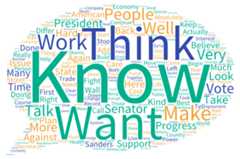
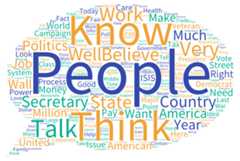
Candidate speech analysis
|

|

See also
- Presidential candidates, 2016
- Presidential election, 2016/Polls
- 2016 presidential candidate ratings and scorecards
- Presidential election, 2016/Straw polls


