

Theodore Roosevelt

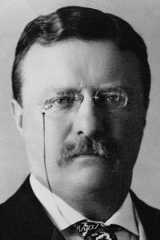
Theodore Roosevelt (b. on October 27, 1858, inNew York, New York) was the 26th president of the United States, succeeding PresidentWilliam McKinley (R) upon McKinley's assassination in 1901. He became the nation's youngest president. A member of theRepublican Party for most of his career, he later ran unsuccessfully for president in 1912 under the banner of theProgressive Party.[1] He and PresidentFranklin Delano Roosevelt (D) were distant cousins.
Biography
Theodore Roosevelt was born into a wealthy family in 1858 inNew York, New York. In 1884, his fortunes changed when his wife, Alice Lee Roosevelt, and mother died on the same day. For two years, Roosevelt left New York for solitude in the Dakota Territory. He eventually remarried to Edith Carow, while visiting England.
In 1886, he lost an election bid to become the mayor of New York. He was, however, appointed by PresidentBenjamin Harrison (R) to theU.S. Civil Service Commission, and reappointed by PresidentGrover Cleveland (D). He continued in civil service as the president of the New York City Board of Police Commissioners, and later as the assistant secretary of the U.S. Navy, appointed by PresidentWilliam McKinley (R).
After the Spanish-American War began in 1898, Roosevelt served as a Lieutenant Colonel in the Rough Rider Regiment and fought in the battle of San Juan Hill in Cuba. After the war, Roosevelt became the Republican Party nominee for governor of New York. He won the general election.
In 1900, uncertain about whether to begin strategizing for a 1904 presidential election run or to serve another term as governor, Roosevelt joined President William McKinley's campaign ticket as the Republican vice presidential nominee. McKinley's first vice president had passed away, leaving an opening. In 1901, however, after a successful reelection, McKinley was killed by an assassin's bullet, making Roosevelt president, the nation's youngest at age 42.
As president, he initiated what was called the Square Deal, encouraging his administration's use of theSherman Antitrust Act against industrial trusts including the Northern Securities Company, a railroad trust that controlled several major railways in the country, and promoting conservation by reserving 200 million acres as national forests. In foreign policy, he is known for his statement "speak softly and carry a big stick." His administration intervened in Panama's independence from Colombia, which initiated construction of the Panama Canal, and Roosevelt encouraged the build-up of the U.S. Navy. He received the Nobel Prize for Peace for helping to negotiate the end of the Russo-Japanese War.
Though he upheld a 1904 campaign promise to not run for reelection in 1908, he split with the Republican Party in 1912 to run as the candidate for the newly assembledProgressive Party, sometimes known as theBull Moose Party. The bid for reelection was unsuccessful, and he lost toWoodrow Wilson. He remained in the public eye, becoming an early proponent of American entry into the First World War. He died in his home in New York on January 6, 1919.[1][2]
Elections
1912 presidential election
| U.S. presidential election, 1912 | |||||
|---|---|---|---|---|---|
| Party | Candidate | Vote % | Votes | Electoral votes | |
| Republican | William Taft/Nicholas ButlerIncumbent | 23.2% | 3,487,939 | 8 | |
| Democratic |  Woodrow Wilson/Thomas Marshall Woodrow Wilson/Thomas Marshall | 41.8% | 6,294,384 | 435 | |
| Progressive | Theodore Roosevelt/Hiram Johnson | 27.4% | 4,121,609 | 88 | |
| Socialist | Eugene Debs/Emil Seidel | 6% | 900,743 | 0 | |
| N/A | Other | 1.6% | 241,865 | 0 | |
| Total Votes | 15,046,540 | 531 | |||
| Election results via:David Leip's Atlas of U.S. Presidential Elections | |||||
1904 presidential election
| U.S. presidential election, 1904 | |||||
|---|---|---|---|---|---|
| Party | Candidate | Vote % | Votes | Electoral votes | |
| Republican | Theodore Roosevelt/Charles W. FairbanksIncumbent | 56.4% | 7,623,486 | 336 | |
| Democratic | Alton B. Parker/Henry G. Davis | 37.6% | 5,077,911 | 140 | |
| Socialist | Eugene V. Debs/Benjamin Hanford | 3% | 402,489 | 0 | |
| Prohibition | Silas C. Swallow/George Washington Carroll | 1.9% | 258,596 | 0 | |
| People's (Populist) | Thomas E. Watson | 0.8% | 114,051 | 0 | |
| Socialist Labor | Charles H. Corregan | 0.2% | 33,156 | 0 | |
| Total Votes | 13,509,689 | 476 | |||
| Election results via:1904 official election results | |||||
State of the Union addresses
Every year in office, thepresident of the United States addressesCongress on the present state of affairs as well as the administration's goals for the coming year.[3] The following are transcripts from Hoover's State of the Union addresses.
- December 3, 1901
- December 2, 1902
- December 7, 1903
- December 6, 1904
- December 5, 1905
- December 3, 1906
- December 3, 1907
- December 8, 1908
See also
External links
Footnotes
| Political offices | ||
|---|---|---|
| Preceded by William McKinley (R) | President of the United States 1901-1909 | Succeeded by William Howard Taft (R) |

| |||||||


