

Texas Supreme Court
| Texas Supreme Court |
|---|
 |
| Court Information |
| Justices: 9 |
| Founded: 1876 |
| Location:Austin |
| Salary |
| Associates: $210,000[1] |
| Judicial Selection |
| Method:Partisan election |
| Term: 6 years |
| Active justices |
| Jimmy Blacklock,Jane Bland,Brett Busby,John Devine,Kyle Hawkins,Rebeca Huddle,Debra Lehrmann,James Sullivan,Evan Young |
Founded in 1836, the Texas Supreme Court is the state'scourt of last resort for civil matters and has nine judgeships. The current chief of the court isJimmy Blacklock.
As of January 2025, all nine judges on the court identified with theRepublican Party.
The Texas Supreme Court meets in Austin, Texas.[2]
In Texas, state supreme court justices are elected in partisan elections. There are eight states that use this selection method. To read more about the partisan election of judges,click here.

Jurisdiction
The Texas supreme court is the court of last resort for civil and juvenile cases. TheTexas Court of Criminal Appeals has final jurisdiction in criminal cases. The court has mandatory jurisdiction over writs ofmandamus andhabeas corpus.[3]
The Supreme Court also has jurisdiction to answer questions of state law certified from a federal appellate court; has original jurisdiction to issue writs and to conduct proceedings for the involuntary retirement or removal of judges; and reviews cases involving attorney discipline upon appeal from the Board of Disciplinary Appeals of the State Bar of Texas."[4]
The supreme court creates rules for civil trial procedures and appellate procedures. It creates rules for the administration of justice in the state. It monitors the caseload of the state's 14 courts of appeals and transfers cases as needed.[5]
The following text from Article V, Section 3 of the Texas Constitution covers the organization and jurisdiction of the court:
| “ | Jurisdiction of Supreme Court; Writs; Clerk (a) The Supreme Court shall exercise the judicial power of the state except as otherwise provided in this Constitution. Its jurisdiction shall be co-extensive with the limits of the State and its determinations shall be final except in criminal law matters. Its appellate jurisdiction shall be final and shall extend to all cases except in criminal law matters and as otherwise provided in this Constitution or by law. The Supreme Court and the Justices thereof shall have power to issue writs of habeas corpus, as may be prescribed by law, and under such regulations as may be prescribed by law, the said courts and the Justices thereof may issue the writs of mandamus, procedendo, certiorari and such other writs, as may be necessary to enforce its jurisdiction. The Legislature may confer original jurisdiction on the Supreme Court to issue writs of quo warranto and mandamus in such cases as may be specified, except as against the Governor of the State. (b) The Supreme Court shall also have power, upon affidavit or otherwise as by the court may be determined, to ascertain such matters of fact as may be necessary to the proper exercise of its jurisdiction.[6][7] | ” |
| —Texas Constitution, Article V, Section 3 | ||
Justices
The table below lists the current justices of the Texas Supreme Court, their political party, when they assumed office, and the appointing governor.
| Office | Name | Party | Date assumed office | Appointed by |
|---|---|---|---|---|
| Texas Supreme Court Place 1 Chief Justice | Jimmy Blacklock | Republican | January 6, 2025 | Greg Abbott (R) |
| Texas Supreme Court Place 2 | James Sullivan | Republican | January 6, 2025 | Greg Abbott (R) |
| Texas Supreme Court Place 3 | Debra Lehrmann | Republican | June 21, 2010 | Rick Perry (R) |
| Texas Supreme Court Place 4 | John Devine | Republican | January 1, 2013 | |
| Texas Supreme Court Place 5 | Rebeca Huddle | Republican | October 30, 2020 | Greg Abbott (R) |
| Texas Supreme Court Place 6 | Jane Bland | Republican | August 26, 2019 | Greg Abbott (R) |
| Texas Supreme Court Place 7 | Kyle Hawkins | Republican | October 27, 2025 | Greg Abbott (R) |
| Texas Supreme Court Place 8 | Brett Busby | Republican | March 20, 2019 | Greg Abbott (R) |
| Texas Supreme Court Place 9 | Evan Young | Republican | November 9, 2021 | Greg Abbott (R) |
Chief justice
TheChief Justice of the Supreme Court of Texas isJimmy Blacklock (R).
Vacancies
There are no current vacancy on theTexas Supreme Court, out of the court's nine judicial positions.
Salary
- See also:Texas court salaries and budgets
In 2025, the justices of the court received a base salary of $210,000, according to the Office of Court Administration.[8]
Judicial selection
- See also:Judicial selection in Texas
Thenine justices of theTexas Supreme Court are selected in statewidepartisan elections. The elected justices serve six-year terms, after which they must run for re-election if they wish to remain on the court.[9]
Qualifications
To serve on the Supreme Court, a justice must be:
- a U.S. citizen;
- a resident ofTexas;
- licensed to practice law in the state;
- between the ages of 35 and 75;[10][11] and
- a practicing lawyer and/or justice for at least 10 years.[9]
Chief justice
Thechief justice of the Texas Supreme Court is selected by voters at large. He or she serves in that capacity for a full six-year term.[9]
Vacancies
In the event of a midterm vacancy, thegovernor appoints a replacement who must be confirmed by theTexas Senate. The appointee serves until the next general election, in which he or she may compete to serve for the remainder of the unexpired term.[9]
The map below highlights how vacancies are filled in state supreme courts across the country.
Elections
- See also:Texas Supreme Court elections
See also: Texas Supreme Court elections, 2030
Texas Supreme Court Place 2
There are noofficial candidates yet for this election.
Texas Supreme Court Place 4
There are noofficial candidates yet for this election.
Texas Supreme Court Place 6
There are noofficial candidates yet for this election.
See also: Texas Supreme Court elections, 2028
Texas Supreme Court Place 3
There are noofficial candidates yet for this election.
Texas Supreme Court Place 5
There are noofficial candidates yet for this election.
Texas Supreme Court Place 9
There are noofficial candidates yet for this election.
See also: Texas Supreme Court elections, 2026
Texas Supreme Court Place 1 Chief Justice
General election
The primary will occur on March 3, 2026. The general election will occur on November 3, 2026. General election candidates will be added here following the primary.
Democratic primary
Democratic primary for Texas Supreme Court Place 1 Chief Justice
Cory Carlyle (D) andMaggie Ellis (D) are running in the Democratic primary for Texas Supreme Court Place 1 Chief Justice on March 3, 2026.
Candidate | ||
 | Cory Carlyle | |
 | Maggie Ellis | |
| There are noincumbents in this race. | |||
 = candidate completed theBallotpedia Candidate Connection survey. = candidate completed theBallotpedia Candidate Connection survey. | ||||
| If you are a candidate and would like to tell readers and voters more about why they should vote for you,complete the Ballotpedia Candidate Connection Survey. | ||||
Do you want a spreadsheet of this type of data?Contact our sales team. | ||||
Republican primary
Republican primary for Texas Supreme Court Place 1 Chief Justice
IncumbentJimmy Blacklock (R) is running in the Republican primary for Texas Supreme Court Place 1 Chief Justice on March 3, 2026.
Candidate | ||
 | Jimmy Blacklock | |
| Incumbents arebolded and underlined. | |||
| = candidate completed theBallotpedia Candidate Connection survey. | ||||
| If you are a candidate and would like to tell readers and voters more about why they should vote for you,complete the Ballotpedia Candidate Connection Survey. | ||||
Do you want a spreadsheet of this type of data?Contact our sales team. | ||||
Withdrawn or disqualified candidates
- Steve Smith (R)
Texas Supreme Court Place 2
General election
The primary will occur on March 3, 2026. The general election will occur on November 3, 2026. General election candidates will be added here following the primary.
Democratic primary
Democratic primary for Texas Supreme Court Place 2
Chari Kelly (D) is running in the Democratic primary for Texas Supreme Court Place 2 on March 3, 2026.
Candidate | ||
 | Chari Kelly | |
| There are noincumbents in this race. | |||
| = candidate completed theBallotpedia Candidate Connection survey. | ||||
| If you are a candidate and would like to tell readers and voters more about why they should vote for you,complete the Ballotpedia Candidate Connection Survey. | ||||
Do you want a spreadsheet of this type of data?Contact our sales team. | ||||
Republican primary
Republican primary for Texas Supreme Court Place 2
IncumbentJames Sullivan (R) is running in the Republican primary for Texas Supreme Court Place 2 on March 3, 2026.
Candidate | ||
 | James Sullivan | |
| Incumbents arebolded and underlined. | |||
| = candidate completed theBallotpedia Candidate Connection survey. | ||||
| If you are a candidate and would like to tell readers and voters more about why they should vote for you,complete the Ballotpedia Candidate Connection Survey. | ||||
Do you want a spreadsheet of this type of data?Contact our sales team. | ||||
Texas Supreme Court Place 7
General election
The primary will occur on March 3, 2026. The general election will occur on November 3, 2026. General election candidates will be added here following the primary.
Democratic primary
Democratic primary for Texas Supreme Court Place 7
Gordon Goodman (D) andKristen Hawkins (D) are running in the Democratic primary for Texas Supreme Court Place 7 on March 3, 2026.
Candidate | ||
 | Gordon Goodman | |
 | Kristen Hawkins | |
| There are noincumbents in this race. | |||
| = candidate completed theBallotpedia Candidate Connection survey. | ||||
| If you are a candidate and would like to tell readers and voters more about why they should vote for you,complete the Ballotpedia Candidate Connection Survey. | ||||
Do you want a spreadsheet of this type of data?Contact our sales team. | ||||
Republican primary
Republican primary for Texas Supreme Court Place 7
IncumbentKyle Hawkins (R) is running in the Republican primary for Texas Supreme Court Place 7 on March 3, 2026.
Candidate | ||
| Kyle Hawkins | ||

| Incumbents arebolded and underlined. | |||
| = candidate completed theBallotpedia Candidate Connection survey. | ||||
| If you are a candidate and would like to tell readers and voters more about why they should vote for you,complete the Ballotpedia Candidate Connection Survey. | ||||
Do you want a spreadsheet of this type of data?Contact our sales team. | ||||
Texas Supreme Court Place 8
General election
The primary will occur on March 3, 2026. The general election will occur on November 3, 2026. General election candidates will be added here following the primary.
Democratic primary
Democratic primary for Texas Supreme Court Place 8
Gisela Triana (D) is running in the Democratic primary for Texas Supreme Court Place 8 on March 3, 2026.
Candidate | ||
 | Gisela Triana | |
| There are noincumbents in this race. | |||
| = candidate completed theBallotpedia Candidate Connection survey. | ||||
| If you are a candidate and would like to tell readers and voters more about why they should vote for you,complete the Ballotpedia Candidate Connection Survey. | ||||
Do you want a spreadsheet of this type of data?Contact our sales team. | ||||
Republican primary
Republican primary for Texas Supreme Court Place 8
IncumbentBrett Busby (R) is running in the Republican primary for Texas Supreme Court Place 8 on March 3, 2026.
Candidate | ||
 | Brett Busby | |
| Incumbents arebolded and underlined. | |||
| = candidate completed theBallotpedia Candidate Connection survey. | ||||
| If you are a candidate and would like to tell readers and voters more about why they should vote for you,complete the Ballotpedia Candidate Connection Survey. | ||||
Do you want a spreadsheet of this type of data?Contact our sales team. | ||||
Withdrawn or disqualified candidates
- David Rogers (R)
See also: Texas Supreme Court elections, 2024
Texas Supreme Court Place 2
General election
General election for Texas Supreme Court Place 2
IncumbentJimmy Blacklock (R) defeatedDaSean Jones (D) in the general election for Texas Supreme Court Place 2 on November 5, 2024.
Candidate | % | Votes | ||
| ✔ | | Jimmy Blacklock (R) | 58.2 | 6,372,584 |
 | DaSean Jones (D) | 41.8 | 4,571,171 | |
| Incumbents arebolded and underlined. The results have been certified. Source | Total votes: 10,943,755 | ||
| = candidate completed theBallotpedia Candidate Connection survey. | ||||
| If you are a candidate and would like to tell readers and voters more about why they should vote for you,complete the Ballotpedia Candidate Connection Survey. | ||||
Do you want a spreadsheet of this type of data?Contact our sales team. | ||||
Democratic primary
Democratic primary for Texas Supreme Court Place 2
DaSean Jones (D) defeatedRandy Sarosdy (D) in the Democratic primary for Texas Supreme Court Place 2 on March 5, 2024.
Candidate | % | Votes | ||
| ✔ | | DaSean Jones | 59.6 | 529,623 |
 | Randy Sarosdy | 40.4 | 359,402 | |
| There were noincumbents in this race. The results have been certified. Source | Total votes: 889,025 | ||
| = candidate completed theBallotpedia Candidate Connection survey. | ||||
| If you are a candidate and would like to tell readers and voters more about why they should vote for you,complete the Ballotpedia Candidate Connection Survey. | ||||
Do you want a spreadsheet of this type of data?Contact our sales team. | ||||
Republican primary
Republican primary for Texas Supreme Court Place 2
IncumbentJimmy Blacklock (R) advanced from the Republican primary for Texas Supreme Court Place 2 on March 5, 2024.
Candidate | % | Votes | ||
| ✔ | | Jimmy Blacklock | 100.0 | 1,749,450 |
| Incumbents arebolded and underlined. The results have been certified. Source | Total votes: 1,749,450 | ||
| = candidate completed theBallotpedia Candidate Connection survey. | ||||
| If you are a candidate and would like to tell readers and voters more about why they should vote for you,complete the Ballotpedia Candidate Connection Survey. | ||||
Do you want a spreadsheet of this type of data?Contact our sales team. | ||||
Texas Supreme Court Place 4
General election
General election for Texas Supreme Court Place 4
IncumbentJohn Devine (R) defeatedChristine Weems (D) in the general election for Texas Supreme Court Place 4 on November 5, 2024.
Candidate | % | Votes | ||
| ✔ |  | John Devine (R) | 57.3 | 6,256,496 |
 | Christine Weems (D) | 42.7 | 4,656,560 | |
| Incumbents arebolded and underlined. The results have been certified. Source | Total votes: 10,913,056 | ||
| = candidate completed theBallotpedia Candidate Connection survey. | ||||
| If you are a candidate and would like to tell readers and voters more about why they should vote for you,complete the Ballotpedia Candidate Connection Survey. | ||||
Do you want a spreadsheet of this type of data?Contact our sales team. | ||||
Withdrawn or disqualified candidates
- Matthew Sercely (L)
Democratic primary
Democratic primary for Texas Supreme Court Place 4
Christine Weems (D) advanced from the Democratic primary for Texas Supreme Court Place 4 on March 5, 2024.
Candidate | % | Votes | ||
| ✔ | | Christine Weems | 100.0 | 825,485 |
| There were noincumbents in this race. The results have been certified. Source | Total votes: 825,485 | ||
| = candidate completed theBallotpedia Candidate Connection survey. | ||||
| If you are a candidate and would like to tell readers and voters more about why they should vote for you,complete the Ballotpedia Candidate Connection Survey. | ||||
Do you want a spreadsheet of this type of data?Contact our sales team. | ||||
Republican primary
Republican primary for Texas Supreme Court Place 4
IncumbentJohn Devine (R) defeatedBrian Walker (R) in the Republican primary for Texas Supreme Court Place 4 on March 5, 2024.
Candidate | % | Votes | ||
| ✔ | | John Devine | 50.4 | 921,556 |
 | Brian Walker | 49.6 | 905,418 | |
| Incumbents arebolded and underlined. The results have been certified. Source | Total votes: 1,826,974 | ||
| = candidate completed theBallotpedia Candidate Connection survey. | ||||
| If you are a candidate and would like to tell readers and voters more about why they should vote for you,complete the Ballotpedia Candidate Connection Survey. | ||||
Do you want a spreadsheet of this type of data?Contact our sales team. | ||||
Libertarian Party convention
Libertarian convention for Texas Supreme Court Place 4
Matthew Sercely (L) advanced from the Libertarian Party convention for Texas Supreme Court Place 4 on April 14, 2024.
Candidate | ||
| ✔ | Matthew Sercely | |
| There were noincumbents in this race. The results have been certified. Source | |||
| = candidate completed theBallotpedia Candidate Connection survey. | ||||
| If you are a candidate and would like to tell readers and voters more about why they should vote for you,complete the Ballotpedia Candidate Connection Survey. | ||||
Do you want a spreadsheet of this type of data?Contact our sales team. | ||||
Texas Supreme Court Place 6
General election
General election for Texas Supreme Court Place 6
IncumbentJane Bland (R) defeatedBonnie Lee Goldstein (D) andDavid Roberson (L) in the general election for Texas Supreme Court Place 6 on November 5, 2024.
Candidate | % | Votes | ||
| ✔ |  | Jane Bland (R) | 56.2 | 6,145,167 |
 | Bonnie Lee Goldstein (D) | 40.5 | 4,425,189 | |
 | David Roberson (L) | 3.3 | 355,485 | |
| Incumbents arebolded and underlined. The results have been certified. Source | Total votes: 10,925,841 | ||
| = candidate completed theBallotpedia Candidate Connection survey. | ||||
| If you are a candidate and would like to tell readers and voters more about why they should vote for you,complete the Ballotpedia Candidate Connection Survey. | ||||
Do you want a spreadsheet of this type of data?Contact our sales team. | ||||
Democratic primary
Democratic primary for Texas Supreme Court Place 6
Bonnie Lee Goldstein (D) defeatedJoe Pool Jr. (D) in the Democratic primary for Texas Supreme Court Place 6 on March 5, 2024.
Candidate | % | Votes | ||
| ✔ | | Bonnie Lee Goldstein | 73.1 | 646,690 |
 | Joe Pool Jr. | 26.9 | 237,465 | |
| There were noincumbents in this race. The results have been certified. Source | Total votes: 884,155 | ||
| = candidate completed theBallotpedia Candidate Connection survey. | ||||
| If you are a candidate and would like to tell readers and voters more about why they should vote for you,complete the Ballotpedia Candidate Connection Survey. | ||||
Do you want a spreadsheet of this type of data?Contact our sales team. | ||||
Republican primary
Republican primary for Texas Supreme Court Place 6
IncumbentJane Bland (R) advanced from the Republican primary for Texas Supreme Court Place 6 on March 5, 2024.
Candidate | % | Votes | ||
| ✔ | | Jane Bland | 100.0 | 1,690,507 |
| Incumbents arebolded and underlined. The results have been certified. Source | Total votes: 1,690,507 | ||
| = candidate completed theBallotpedia Candidate Connection survey. | ||||
| If you are a candidate and would like to tell readers and voters more about why they should vote for you,complete the Ballotpedia Candidate Connection Survey. | ||||
Do you want a spreadsheet of this type of data?Contact our sales team. | ||||
Libertarian Party convention
Libertarian convention for Texas Supreme Court Place 6
David Roberson (L) advanced from the Libertarian Party convention for Texas Supreme Court Place 6 on April 14, 2024.
Candidate | ||
| ✔ | | David Roberson |
| There were noincumbents in this race. The results have been certified. Source | |||
| = candidate completed theBallotpedia Candidate Connection survey. | ||||
| If you are a candidate and would like to tell readers and voters more about why they should vote for you,complete the Ballotpedia Candidate Connection Survey. | ||||
Do you want a spreadsheet of this type of data?Contact our sales team. | ||||
See also: Texas Supreme Court elections, 2022
Texas Supreme Court Place 3
General election
General election for Texas Supreme Court Place 3
IncumbentDebra Lehrmann (R) defeatedErin Nowell (D) andTom Oxford (L) in the general election for Texas Supreme Court Place 3 on November 8, 2022.
Candidate | % | Votes | ||
| ✔ |  | Debra Lehrmann (R) | 56.2 | 4,475,136 |
 | Erin Nowell (D) | 41.8 | 3,330,529 | |
 | Tom Oxford (L) | 2.0 | 162,036 | |
| Incumbents arebolded and underlined. The results have been certified. Source | Total votes: 7,967,701 | ||
| = candidate completed theBallotpedia Candidate Connection survey. | ||||
| If you are a candidate and would like to tell readers and voters more about why they should vote for you,complete the Ballotpedia Candidate Connection Survey. | ||||
Do you want a spreadsheet of this type of data?Contact our sales team. | ||||
Democratic primary
Democratic primary for Texas Supreme Court Place 3
Erin Nowell (D) advanced from the Democratic primary for Texas Supreme Court Place 3 on March 1, 2022.
Candidate | % | Votes | ||
| ✔ | | Erin Nowell | 100.0 | 914,184 |
| There were noincumbents in this race. The results have been certified. Source | Total votes: 914,184 | ||
| = candidate completed theBallotpedia Candidate Connection survey. | ||||
| If you are a candidate and would like to tell readers and voters more about why they should vote for you,complete the Ballotpedia Candidate Connection Survey. | ||||
Do you want a spreadsheet of this type of data?Contact our sales team. | ||||
Republican primary
Republican primary for Texas Supreme Court Place 3
IncumbentDebra Lehrmann (R) advanced from the Republican primary for Texas Supreme Court Place 3 on March 1, 2022.
Candidate | % | Votes | ||
| ✔ | | Debra Lehrmann | 100.0 | 1,535,581 |
| Incumbents arebolded and underlined. The results have been certified. Source | Total votes: 1,535,581 | ||
| = candidate completed theBallotpedia Candidate Connection survey. | ||||
| If you are a candidate and would like to tell readers and voters more about why they should vote for you,complete the Ballotpedia Candidate Connection Survey. | ||||
Do you want a spreadsheet of this type of data?Contact our sales team. | ||||
Libertarian Party convention
Libertarian convention for Texas Supreme Court Place 3
Tom Oxford (L) advanced from the Libertarian Party convention for Texas Supreme Court Place 3 on April 10, 2022.
Candidate | ||
| ✔ | | Tom Oxford |
| There were noincumbents in this race. The results have been certified. Source | |||
| = candidate completed theBallotpedia Candidate Connection survey. | ||||
| If you are a candidate and would like to tell readers and voters more about why they should vote for you,complete the Ballotpedia Candidate Connection Survey. | ||||
Do you want a spreadsheet of this type of data?Contact our sales team. | ||||
Texas Supreme Court Place 5
General election
General election for Texas Supreme Court Place 5
IncumbentRebeca Huddle (R) defeatedAmanda Reichek (D) in the general election for Texas Supreme Court Place 5 on November 8, 2022.
Candidate | % | Votes | ||
| ✔ |  | Rebeca Huddle (R) | 57.1 | 4,530,668 |
 | Amanda Reichek (D) | 42.9 | 3,406,054 | |
| Incumbents arebolded and underlined. The results have been certified. Source | Total votes: 7,936,722 | ||
| = candidate completed theBallotpedia Candidate Connection survey. | ||||
| If you are a candidate and would like to tell readers and voters more about why they should vote for you,complete the Ballotpedia Candidate Connection Survey. | ||||
Do you want a spreadsheet of this type of data?Contact our sales team. | ||||
Democratic primary
Democratic primary for Texas Supreme Court Place 5
Amanda Reichek (D) advanced from the Democratic primary for Texas Supreme Court Place 5 on March 1, 2022.
Candidate | % | Votes | ||
| ✔ | | Amanda Reichek | 100.0 | 913,836 |
| There were noincumbents in this race. The results have been certified. Source | Total votes: 913,836 | ||
| = candidate completed theBallotpedia Candidate Connection survey. | ||||
| If you are a candidate and would like to tell readers and voters more about why they should vote for you,complete the Ballotpedia Candidate Connection Survey. | ||||
Do you want a spreadsheet of this type of data?Contact our sales team. | ||||
Republican primary
Republican primary for Texas Supreme Court Place 5
IncumbentRebeca Huddle (R) advanced from the Republican primary for Texas Supreme Court Place 5 on March 1, 2022.
Candidate | % | Votes | ||
| ✔ | | Rebeca Huddle | 100.0 | 1,519,069 |
| Incumbents arebolded and underlined. The results have been certified. Source | Total votes: 1,519,069 | ||
| = candidate completed theBallotpedia Candidate Connection survey. | ||||
| If you are a candidate and would like to tell readers and voters more about why they should vote for you,complete the Ballotpedia Candidate Connection Survey. | ||||
Do you want a spreadsheet of this type of data?Contact our sales team. | ||||
Texas Supreme Court Place 9
General election
Special general election for Texas Supreme Court Place 9
IncumbentEvan Young (R) defeatedJulia Maldonado (D) in the special general election for Texas Supreme Court Place 9 on November 8, 2022.
Candidate | % | Votes | ||
| ✔ |  | Evan Young (R) | 56.4 | 4,474,900 |
 | Julia Maldonado (D) | 43.6 | 3,458,103 | |
| Incumbents arebolded and underlined. The results have been certified. Source | Total votes: 7,933,003 | ||
| = candidate completed theBallotpedia Candidate Connection survey. | ||||
| If you are a candidate and would like to tell readers and voters more about why they should vote for you,complete the Ballotpedia Candidate Connection Survey. | ||||
Do you want a spreadsheet of this type of data?Contact our sales team. | ||||
Democratic primary
Special Democratic primary for Texas Supreme Court Place 9
Julia Maldonado (D) advanced from the special Democratic primary for Texas Supreme Court Place 9 on March 1, 2022.
Candidate | % | Votes | ||
| ✔ | | Julia Maldonado | 100.0 | 922,595 |
| There were noincumbents in this race. The results have been certified. Source | Total votes: 922,595 | ||
| = candidate completed theBallotpedia Candidate Connection survey. | ||||
| If you are a candidate and would like to tell readers and voters more about why they should vote for you,complete the Ballotpedia Candidate Connection Survey. | ||||
Do you want a spreadsheet of this type of data?Contact our sales team. | ||||
Republican primary
Special Republican primary for Texas Supreme Court Place 9
IncumbentEvan Young (R) defeatedDavid Schenck (R) in the special Republican primary for Texas Supreme Court Place 9 on March 1, 2022.
Candidate | % | Votes | ||
| ✔ | | Evan Young | 54.9 | 860,852 |
 | David Schenck | 45.1 | 708,359 | |
| Incumbents arebolded and underlined. The results have been certified. Source | Total votes: 1,569,211 | ||
| = candidate completed theBallotpedia Candidate Connection survey. | ||||
| If you are a candidate and would like to tell readers and voters more about why they should vote for you,complete the Ballotpedia Candidate Connection Survey. | ||||
Do you want a spreadsheet of this type of data?Contact our sales team. | ||||
See also: Texas Supreme Court elections, 2020
Texas Supreme Court Place 1 Chief Justice
General election
General election for Texas Supreme Court Place 1 Chief Justice
IncumbentNathan Hecht (R) defeatedAmy Clark Meachum (D) andMark Ash (L) in the general election for Texas Supreme Court Place 1 Chief Justice on November 3, 2020.
Candidate | % | Votes | ||
| ✔ |  | Nathan Hecht (R) | 53.0 | 5,827,085 |
 | Amy Clark Meachum (D) | 44.5 | 4,893,402 | |
 | Mark Ash (L) | 2.5 | 277,491 | |
| Incumbents arebolded and underlined. The results have been certified. Source | Total votes: 10,997,978 | ||
| = candidate completed theBallotpedia Candidate Connection survey. | ||||
| If you are a candidate and would like to tell readers and voters more about why they should vote for you,complete the Ballotpedia Candidate Connection Survey. | ||||
Do you want a spreadsheet of this type of data?Contact our sales team. | ||||
Withdrawn or disqualified candidates
Democratic primary
Democratic primary for Texas Supreme Court Place 1 Chief Justice
Amy Clark Meachum (D) defeatedJerry Zimmerer (D) in the Democratic primary for Texas Supreme Court Place 1 Chief Justice on March 3, 2020.
Candidate | % | Votes | ||
| ✔ | | Amy Clark Meachum | 80.5 | 1,434,175 |
 | Jerry Zimmerer | 19.5 | 347,186 | |
| There were noincumbents in this race. The results have been certified. Source | Total votes: 1,781,361 | ||
| = candidate completed theBallotpedia Candidate Connection survey. | ||||
| If you are a candidate and would like to tell readers and voters more about why they should vote for you,complete the Ballotpedia Candidate Connection Survey. | ||||
Do you want a spreadsheet of this type of data?Contact our sales team. | ||||
Withdrawn or disqualified candidates
- William McLeod (D)
Republican primary
Republican primary for Texas Supreme Court Place 1 Chief Justice
IncumbentNathan Hecht (R) advanced from the Republican primary for Texas Supreme Court Place 1 Chief Justice on March 3, 2020.
Candidate | % | Votes | ||
| ✔ | | Nathan Hecht | 100.0 | 1,718,096 |
| Incumbents arebolded and underlined. The results have been certified. Source | Total votes: 1,718,096 | ||
| = candidate completed theBallotpedia Candidate Connection survey. | ||||
| If you are a candidate and would like to tell readers and voters more about why they should vote for you,complete the Ballotpedia Candidate Connection Survey. | ||||
Do you want a spreadsheet of this type of data?Contact our sales team. | ||||
Green Party convention
Green convention for Texas Supreme Court Place 1 Chief Justice
Charles E. Waterbury (G) advanced from the Green Party convention for Texas Supreme Court Place 1 Chief Justice on April 18, 2020.
Candidate | ||
| ✔ |  | Charles E. Waterbury |
| There were noincumbents in this race. The results have been certified. | |||
| = candidate completed theBallotpedia Candidate Connection survey. | ||||
| If you are a candidate and would like to tell readers and voters more about why they should vote for you,complete the Ballotpedia Candidate Connection Survey. | ||||
Do you want a spreadsheet of this type of data?Contact our sales team. | ||||
Libertarian Party convention
Libertarian convention for Texas Supreme Court Place 1 Chief Justice
Mark Ash (L) advanced from the Libertarian Party convention for Texas Supreme Court Place 1 Chief Justice on August 3, 2020.
Candidate | ||
| ✔ | | Mark Ash |
| There were noincumbents in this race. The results have been certified. Source | |||
| = candidate completed theBallotpedia Candidate Connection survey. | ||||
| If you are a candidate and would like to tell readers and voters more about why they should vote for you,complete the Ballotpedia Candidate Connection Survey. | ||||
Do you want a spreadsheet of this type of data?Contact our sales team. | ||||
Texas Supreme Court Place 6
General election
General election for Texas Supreme Court Place 6
IncumbentJane Bland (R) defeatedKathy Cheng (D) in the general election for Texas Supreme Court Place 6 on November 3, 2020.
Candidate | % | Votes | ||
| ✔ | | Jane Bland (R) | 55.2 | 6,050,534 |
 | Kathy Cheng (D) | 44.8 | 4,903,527 | |
| Incumbents arebolded and underlined. The results have been certified. Source | Total votes: 10,954,061 | ||
| = candidate completed theBallotpedia Candidate Connection survey. | ||||
| If you are a candidate and would like to tell readers and voters more about why they should vote for you,complete the Ballotpedia Candidate Connection Survey. | ||||
Do you want a spreadsheet of this type of data?Contact our sales team. | ||||
Democratic primary
Democratic primary for Texas Supreme Court Place 6
Kathy Cheng (D) defeatedLarry Praeger (D) in the Democratic primary for Texas Supreme Court Place 6 on March 3, 2020.
Candidate | % | Votes | ||
| ✔ | | Kathy Cheng | 74.5 | 1,310,598 |
| Larry Praeger | 25.5 | 448,114 | ||
| There were noincumbents in this race. The results have been certified. Source | Total votes: 1,758,712 | ||
| = candidate completed theBallotpedia Candidate Connection survey. | ||||
| If you are a candidate and would like to tell readers and voters more about why they should vote for you,complete the Ballotpedia Candidate Connection Survey. | ||||
Do you want a spreadsheet of this type of data?Contact our sales team. | ||||
Republican primary
Republican primary for Texas Supreme Court Place 6
IncumbentJane Bland (R) advanced from the Republican primary for Texas Supreme Court Place 6 on March 3, 2020.
Candidate | % | Votes | ||
| ✔ | | Jane Bland | 100.0 | 1,699,236 |
| Incumbents arebolded and underlined. The results have been certified. Source | Total votes: 1,699,236 | ||
| = candidate completed theBallotpedia Candidate Connection survey. | ||||
| If you are a candidate and would like to tell readers and voters more about why they should vote for you,complete the Ballotpedia Candidate Connection Survey. | ||||
Do you want a spreadsheet of this type of data?Contact our sales team. | ||||
Texas Supreme Court Place 7
General election
General election for Texas Supreme Court Place 7
IncumbentJeffrey S. Boyd (R) defeatedStaci Williams (D) andWilliam Bryan Strange (L) in the general election for Texas Supreme Court Place 7 on November 3, 2020.
Candidate | % | Votes | ||
| ✔ |  | Jeffrey S. Boyd (R) | 53.3 | 5,843,420 |
 | Staci Williams (D) | 44.4 | 4,861,649 | |
| William Bryan Strange (L) | 2.3 | 256,742 | ||
| Incumbents arebolded and underlined. The results have been certified. Source | Total votes: 10,961,811 | ||
| = candidate completed theBallotpedia Candidate Connection survey. | ||||
| If you are a candidate and would like to tell readers and voters more about why they should vote for you,complete the Ballotpedia Candidate Connection Survey. | ||||
Do you want a spreadsheet of this type of data?Contact our sales team. | ||||
Democratic primary
Democratic primary for Texas Supreme Court Place 7
Staci Williams (D) defeatedBrandy Voss (D) in the Democratic primary for Texas Supreme Court Place 7 on March 3, 2020.
Candidate | % | Votes | ||
| ✔ | | Staci Williams | 65.1 | 1,134,105 |
 | Brandy Voss | 34.9 | 608,288 | |
| There were noincumbents in this race. The results have been certified. Source | Total votes: 1,742,393 | ||
| = candidate completed theBallotpedia Candidate Connection survey. | ||||
| If you are a candidate and would like to tell readers and voters more about why they should vote for you,complete the Ballotpedia Candidate Connection Survey. | ||||
Do you want a spreadsheet of this type of data?Contact our sales team. | ||||
Republican primary
Republican primary for Texas Supreme Court Place 7
IncumbentJeffrey S. Boyd (R) advanced from the Republican primary for Texas Supreme Court Place 7 on March 3, 2020.
Candidate | % | Votes | ||
| ✔ | | Jeffrey S. Boyd | 100.0 | 1,702,071 |
| Incumbents arebolded and underlined. The results have been certified. Source | Total votes: 1,702,071 | ||
| = candidate completed theBallotpedia Candidate Connection survey. | ||||
| If you are a candidate and would like to tell readers and voters more about why they should vote for you,complete the Ballotpedia Candidate Connection Survey. | ||||
Do you want a spreadsheet of this type of data?Contact our sales team. | ||||
Libertarian Party convention
Libertarian convention for Texas Supreme Court Place 7
William Bryan Strange (L) advanced from the Libertarian Party convention for Texas Supreme Court Place 7 on August 3, 2020.
Candidate | ||
| ✔ | William Bryan Strange | |
| There were noincumbents in this race. The results have been certified. Source | |||
| = candidate completed theBallotpedia Candidate Connection survey. | ||||
| If you are a candidate and would like to tell readers and voters more about why they should vote for you,complete the Ballotpedia Candidate Connection Survey. | ||||
Do you want a spreadsheet of this type of data?Contact our sales team. | ||||
Texas Supreme Court Place 8
General election
General election for Texas Supreme Court Place 8
IncumbentBrett Busby (R) defeatedGisela Triana (D) andTom Oxford (L) in the general election for Texas Supreme Court Place 8 on November 3, 2020.
Candidate | % | Votes | ||
| ✔ | | Brett Busby (R) | 53.4 | 5,847,135 |
| Gisela Triana (D) | 44.1 | 4,826,674 | |
| Tom Oxford (L) | 2.5 | 274,959 | |
| Incumbents arebolded and underlined. The results have been certified. Source | Total votes: 10,948,768 | ||
| = candidate completed theBallotpedia Candidate Connection survey. | ||||
| If you are a candidate and would like to tell readers and voters more about why they should vote for you,complete the Ballotpedia Candidate Connection Survey. | ||||
Do you want a spreadsheet of this type of data?Contact our sales team. | ||||
Democratic primary
Democratic primary for Texas Supreme Court Place 8
Gisela Triana (D) defeatedPeter M. Kelly (D) in the Democratic primary for Texas Supreme Court Place 8 on March 3, 2020.
Candidate | % | Votes | ||
| ✔ | | Gisela Triana | 72.0 | 1,251,611 |
 | Peter M. Kelly | 28.0 | 485,697 | |
| There were noincumbents in this race. The results have been certified. Source | Total votes: 1,737,308 | ||
| = candidate completed theBallotpedia Candidate Connection survey. | ||||
| If you are a candidate and would like to tell readers and voters more about why they should vote for you,complete the Ballotpedia Candidate Connection Survey. | ||||
Do you want a spreadsheet of this type of data?Contact our sales team. | ||||
Republican primary
Republican primary for Texas Supreme Court Place 8
IncumbentBrett Busby (R) advanced from the Republican primary for Texas Supreme Court Place 8 on March 3, 2020.
Candidate | % | Votes | ||
| ✔ | | Brett Busby | 100.0 | 1,692,583 |
| Incumbents arebolded and underlined. The results have been certified. Source | Total votes: 1,692,583 | ||
| = candidate completed theBallotpedia Candidate Connection survey. | ||||
| If you are a candidate and would like to tell readers and voters more about why they should vote for you,complete the Ballotpedia Candidate Connection Survey. | ||||
Do you want a spreadsheet of this type of data?Contact our sales team. | ||||
Libertarian Party convention
Libertarian convention for Texas Supreme Court Place 8
Tom Oxford (L) advanced from the Libertarian Party convention for Texas Supreme Court Place 8 on August 3, 2020.
Candidate | ||
| ✔ | | Tom Oxford |
| There were noincumbents in this race. The results have been certified. Source | |||
| = candidate completed theBallotpedia Candidate Connection survey. | ||||
| If you are a candidate and would like to tell readers and voters more about why they should vote for you,complete the Ballotpedia Candidate Connection Survey. | ||||
Do you want a spreadsheet of this type of data?Contact our sales team. | ||||
Texas Supreme Court Place 2
General election
General election for Texas Supreme Court Place 2
IncumbentJimmy Blacklock (R) defeatedSteven Kirkland (D) in the general election for Texas Supreme Court Place 2 on November 6, 2018.
Candidate | % | Votes | ||
| ✔ | | Jimmy Blacklock (R) | 53.2 | 4,358,756 |
 | Steven Kirkland (D) | 46.8 | 3,838,411 | |
| Incumbents arebolded and underlined. The results have been certified. Source | Total votes: 8,197,1670 | ||
| = candidate completed theBallotpedia Candidate Connection survey. | ||||
| If you are a candidate and would like to tell readers and voters more about why they should vote for you,complete the Ballotpedia Candidate Connection Survey. | ||||
Do you want a spreadsheet of this type of data?Contact our sales team. | ||||
Democratic primary
Democratic primary for Texas Supreme Court Place 2
Steven Kirkland (D) advanced from the Democratic primary for Texas Supreme Court Place 2 on March 6, 2018.
Candidate | ||
| ✔ | | Steven Kirkland |
| There were noincumbents in this race. The results have been certified. | |||
| = candidate completed theBallotpedia Candidate Connection survey. | ||||
| If you are a candidate and would like to tell readers and voters more about why they should vote for you,complete the Ballotpedia Candidate Connection Survey. | ||||
Do you want a spreadsheet of this type of data?Contact our sales team. | ||||
Republican primary
Republican primary for Texas Supreme Court Place 2
IncumbentJimmy Blacklock (R) advanced from the Republican primary for Texas Supreme Court Place 2 on March 6, 2018.
Candidate | ||
| ✔ | | Jimmy Blacklock |
| Incumbents arebolded and underlined. The results have been certified. | |||
| = candidate completed theBallotpedia Candidate Connection survey. | ||||
| If you are a candidate and would like to tell readers and voters more about why they should vote for you,complete the Ballotpedia Candidate Connection Survey. | ||||
Do you want a spreadsheet of this type of data?Contact our sales team. | ||||
Texas Supreme Court Place 4
General election
General election for Texas Supreme Court Place 4
IncumbentJohn Devine (R) defeatedR.K. Sandill (D) in the general election for Texas Supreme Court Place 4 on November 6, 2018.
Candidate | % | Votes | ||
| ✔ | | John Devine (R) | 53.7 | 4,399,890 |
 | R.K. Sandill (D) | 46.3 | 3,792,144 | |
| Incumbents arebolded and underlined. The results have been certified. Source | Total votes: 8,192,0340 | ||
| = candidate completed theBallotpedia Candidate Connection survey. | ||||
| If you are a candidate and would like to tell readers and voters more about why they should vote for you,complete the Ballotpedia Candidate Connection Survey. | ||||
Do you want a spreadsheet of this type of data?Contact our sales team. | ||||
Democratic primary
Democratic primary for Texas Supreme Court Place 4
R.K. Sandill (D) advanced from the Democratic primary for Texas Supreme Court Place 4 on March 6, 2018.
Candidate | ||
| ✔ | | R.K. Sandill |
| There were noincumbents in this race. The results have been certified. | |||
| = candidate completed theBallotpedia Candidate Connection survey. | ||||
| If you are a candidate and would like to tell readers and voters more about why they should vote for you,complete the Ballotpedia Candidate Connection Survey. | ||||
Do you want a spreadsheet of this type of data?Contact our sales team. | ||||
Republican primary
Republican primary for Texas Supreme Court Place 4
IncumbentJohn Devine (R) advanced from the Republican primary for Texas Supreme Court Place 4 on March 6, 2018.
Candidate | ||
| ✔ | | John Devine |
| Incumbents arebolded and underlined. The results have been certified. | |||
| = candidate completed theBallotpedia Candidate Connection survey. | ||||
| If you are a candidate and would like to tell readers and voters more about why they should vote for you,complete the Ballotpedia Candidate Connection Survey. | ||||
Do you want a spreadsheet of this type of data?Contact our sales team. | ||||
Texas Supreme Court Place 6
See also: Texas Supreme Court elections, 2018
General election
General election for Texas Supreme Court Place 6
IncumbentJeff Brown (R) defeatedKathy Cheng (D) in the general election for Texas Supreme Court Place 6 on November 6, 2018.
Candidate | % | Votes | ||
| ✔ |  | Jeff Brown (R) | 53.7 | 4,404,602 |
| Kathy Cheng (D) | 46.3 | 3,796,001 | |
| Incumbents arebolded and underlined. The results have been certified. Source | Total votes: 8,200,6030 | ||
| = candidate completed theBallotpedia Candidate Connection survey. | ||||
| If you are a candidate and would like to tell readers and voters more about why they should vote for you,complete the Ballotpedia Candidate Connection Survey. | ||||
Do you want a spreadsheet of this type of data?Contact our sales team. | ||||
Democratic primary
Democratic primary for Texas Supreme Court Place 6
Kathy Cheng (D) advanced from the Democratic primary for Texas Supreme Court Place 6 on March 6, 2018.
Candidate | ||
| ✔ | | Kathy Cheng |
| There were noincumbents in this race. The results have been certified. | |||
| = candidate completed theBallotpedia Candidate Connection survey. | ||||
| If you are a candidate and would like to tell readers and voters more about why they should vote for you,complete the Ballotpedia Candidate Connection Survey. | ||||
Do you want a spreadsheet of this type of data?Contact our sales team. | ||||
Republican primary
Republican primary for Texas Supreme Court Place 6
IncumbentJeff Brown (R) advanced from the Republican primary for Texas Supreme Court Place 6 on March 6, 2018.
Candidate | ||
| ✔ | | Jeff Brown |
| Incumbents arebolded and underlined. The results have been certified. | |||
| = candidate completed theBallotpedia Candidate Connection survey. | ||||
| If you are a candidate and would like to tell readers and voters more about why they should vote for you,complete the Ballotpedia Candidate Connection Survey. | ||||
Do you want a spreadsheet of this type of data?Contact our sales team. | ||||


Appointments
2025
Justice Boyd vacancy
GovernorGreg Abbott (R) appointedKyle Hawkins to theTexas Supreme Court on October 24, 2025.[13] Hawkins replaces JusticeJeffrey S. Boyd, who retired on September 1, 2025. Hawkins is Gov.Abbott's (R) eighth nominee to the nine-member supreme court.
In Texas, state supreme court justices are elected in partisan elections. There are eight states that use this selection method. To read more about the partisan election of judges,click here.
In the event of a midterm vacancy, thegovernor appoints a replacement who must be confirmed by theTexas Senate. The appointee serves until the next general election, in which he or she may compete to serve for the remainder of the unexpired term.[9]
Justice Blacklock vacancy
GovernorGreg Abbott (R) appointedJames Sullivan to replace outgoingTexas Supreme Court JusticeJimmy Blacklock, who ascended to the Chief Justice position on January 6, 2025. Sulivan was GovernorAbbott's (R) seventh nominee to the nine-member supreme court.[14]
In Texas, state supreme court justices are elected in partisan elections. There are eight states that use this selection method. To read more about the partisan election of judges,click here.
In the event of a midterm vacancy, thegovernor appoints a replacement who must be confirmed by theTexas Senate. The appointee serves until the next general election, in which he or she may compete to serve for the remainder of the unexpired term.[9]
2024
GovernorGreg Abbott (R) appointedJimmy Blacklock on January 6, 2025.[14] Blacklock, an associate justice of theTexas Supreme Court since 2018, replaces outgoing Chief JusticeNathan Hecht, who retired on December 31, 2024, due to reaching themandatory retirement age of 75. Blacklock was GovernorAbbott's sixth appointee to the nine-member supreme court.
In Texas, state supreme court justices are elected in partisan elections. There are eight states that use this selection method. To read more about the partisan election of judges,click here.
In the event of a midterm vacancy, thegovernor appoints a replacement who must be confirmed by theTexas Senate. The appointee serves until the next general election, in which he or she may compete to serve for the remainder of the unexpired term.[9]
2021
Texas Governor Gov.Greg Abbott (R) appointedEvan Young to theTexas Supreme Court on November 1, 2021.[14] Young succeeded JusticeEva Guzman, who resigned on June 11, 2021.[15][16] Young was Gov. Abbott's fifth nominee to the nine-member supreme court.
At the time of the vacancy, Texas law directed thegovernor to appoint a replacement to theTexas Supreme Court in the event of a midterm vacancy. TheTexas State Senate must then confirm the nominee. Appointees serve until the next general election, in which he or she must participate in apartisan election to remain on the bench for the remainder of the unexpired term.[17]
2020
Justice Keasler vacancy
Texas GovernorGreg Abbott (R) appointedJesse McClure to theTexas Court of Criminal Appeals on December 21, 2020. McClure succeeded JudgeMichael Keasler, who retired on December 31, 2020. Keasler reached the mandatory retirement age of 78.[18]
McClure was Gov. Abbott's first nominee to the nine-member Court of Criminal Appeals and fourth nominee to a Texascourt of last resort.
At the time of the appointment, thegovernor would appoint a replacement in the event of a midterm vacancy. The nominee had to be confirmed by theTexas State Senate.
Texas was one of two states with two courts of last resort. TheTexas Supreme Court had jurisdiction over all civil cases, while the Court of Criminal Appeals exerciseddiscretionary review over criminal cases.
Justice Green vacancy
Texas Gov.Greg Abbott (R) appointedRebeca Huddle to theTexas Supreme Court on October 15, 2020. Huddle succeeded JusticePaul Green, who retired on August 31, 2020, to spend more time with his family.[19][20] Huddle was Abbott's fourth nominee to the nine-member supreme court.
At the time of the appointment, thegovernor would appoint a replacement in the event of a midterm vacancy. The nominee had to be confirmed by theTexas State Senate. Appointees would serve until the next general election, in which they had to participate in apartisan election to remain on the bench for the remainder of the unexpired term.[17]
2019
Texas Supreme Court JusticeJeff Brown vacated his seat on the state supreme court after he was elevated to be afederal judge on theUnited States District Court for the Southern District of Texas. TheU.S. Senate confirmed Brown to the federal district court on July 31, 2019.[21]
On August 26, 2019, Gov.Greg Abbott (R) nominatedJane Bland to fill the vacancy. Because the legislature was out of session at the time of the appointment, it did not require confirmation by theTexas State Senate. As a result, however, Bland needed to stand for election in 2020 to remain on the bench.
Under Texas law, the governor appointed a replacement in the event of a midterm vacancy on the supreme court. Bland wasGreg Abbott's (R) third nominee to the nine-member supreme court.
2018
Texas Supreme Court JusticePhil Johnson retired on December 31, 2018.
Under Texas law, the governor appoints and the state Senate must approve a replacement when a supreme court justice retires in the middle of his term.Brett Busby, Johnson's replacement, was Gov.Greg Abbott's (R) second nominee to the nine-member supreme court. TheTexas State Senate confirmed Busby on March 20, 2019.[22]
Caseloads
The table below details the number of cases filed with the court and the number of dispositions (decisions) the court reached in each year.[23]
| Texas Supreme Court caseload data | ||
|---|---|---|
| Year | Filings | Dispositions |
| 2022 | 1,347 | 1,320 |
| 2021 | 1,314 | 1,264 |
| 2020 | 1,328 | 1,379 |
| 2019 | 1,416 | 1,459 |
| 2018 | 1,420 | 1,451 |
| 2017 | 1,319 | 1,285 |
| 2016 | 1,199 | 1,190 |
| 2015 | 1,273 | 1,225 |
| 2014 | 1,211 | 1,217 |
| 2013 | 1,226 | 1,264 |
| 2012 | 1,224 | 1,209 |
| 2011 | 1,235 | 1,247 |
| 2010 | 1,337 | 1,339 |
| 2009 | 1,245 | 1,196 |
| 2008 | 1,229 | 1,321 |
| 2007 | 1,244 | 1,337 |
Analysis
Ballotpedia Courts: Determiners and Dissenters (2021)
 In 2020, Ballotpedia publishedBallotpedia Courts: Determiners and Dissenters, a study on how state supreme court justices decided the cases that came before them. Our goal was to determine which justices ruled together most often, which frequently dissented, and which courts featured the most unanimous or contentious decisions.
The study tracked the position taken by each state supreme court justice in every case they decided in 2020, then tallied the number of times the justices on the court ruled together. We identified the following types of justices:
- We considered two justicesopinion partners if they frequently concurred or dissented together throughout the year.
- We considered justices adissenting minority if they frequently opposed decisions together as a -1 minority.
- We considered a group of justices adetermining majority if they frequently determined cases by a +1 majority throughout the year.
- We considered a justice alone dissenter if he or she frequently dissented alone in cases throughout the year.
Summary of cases decided in 2020
- Number of justices: 9
- Number of cases: 90
- Percentage of cases with a unanimous ruling: 82.2% (74)
- Justice most often writing the majority opinion: Justices Bland and Busby (10 each)
- Per curiam decisions: 28
- Concurring opinions: 11
- Justice with most concurring opinions: Justices Guzman and Blacklock (3 each)
- Dissenting opinions: 17
- Justice with most dissenting opinions: Justice Boyd (6)
For the study's full set of findings in Texas, clickhere.
Ballotpedia Courts: State Partisanship (2020)
 Last updated: June 15, 2020
In 2020, Ballotpedia publishedBallotpedia Courts: State Partisanship, a study examining the partisan affiliation of all state supreme court justices in the country as of June 15, 2020.
The study presentedConfidence Scores that represented our confidence in each justice's degree of partisan affiliation, based on a variety of factors. This was not a measure of where a justice fell on the political or ideological spectrum, but rather a measure of how much confidence we had that a justice was or had been affiliated with a political party. To arrive at confidence scores we analyzed each justice's past partisan activity by collecting data on campaign finance, past political positions, party registration history, as well as other factors. The five categories ofConfidence Scores were:
- Strong Democrat
- Mild Democrat
- Indeterminate[24]
- Mild Republican
- Strong Republican
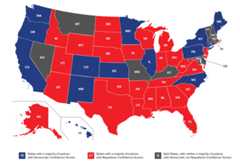
We used the Confidence Scores of each justice to develop a Court Balance Score, which attempted to show the balance among justices with Democratic, Republican, and Indeterminate Confidence Scores on a court. Courts with higher positive Court Balance Scores included justices with higher Republican Confidence Scores, while courts with lower negative Court Balance Scores included justices with higher Democratic Confidence Scores. Courts closest to zero either had justices with conflicting partisanship or justices with Indeterminate Confidence Scores.[25]
Texas had a Court Balance Score of10.4, indicatingRepublican control of the court. In total, the study found that there were 15 states with Democrat-controlled courts, 27 states with Republican-controlled courts, and eight states with Split courts. The map below shows the court balance score of each state.
Bonica and Woodruff campaign finance scores (2012)
In October 2012, political science professors Adam Bonica and Michael Woodruff of Stanford University attempted to determine the partisan outlook of state supreme court justices in their paper, "State Supreme Court Ideology and 'New Style' Judicial Campaigns." A score above 0 indicated a more conservative-leaning ideology while scores below 0 were more liberal. The state Supreme Court ofTexas was given a campaign finance score (CFscore), which was calculated for judges in October 2012. At that time,Texas received a score of0.91. Based on the justices selected,Texas was the 3rd most conservative court. The study was based on data from campaign contributions by judges themselves, the partisan leaning of contributors to the judges, or—in the absence of elections—the ideology of the appointing body (governor or legislature). This study was not a definitive label of a justice but rather an academic gauge of various factors.[26]
Noteworthy cases
The following are noteworthy cases heard before the Texas Supreme Court. For a full list of opinions published by the court, clickhere. Know of a case we should cover here? Let us know byemailing us.
| • Texas Supreme Court rules inBoeing v. Paxton (2015) Judge(s):John Devine (Boeing v. Paxton, No. 12-1007) | Click for summary→ |
|---|---|
In a 7-1 opinion in June 2015, theTexas Supreme Court ruled thatTexas Attorney GeneralKen Paxton must block the release of information from a lease between Boeing and the Port Authority of San Antonio. The reasoning was that the information, according to Boeing, could benefit the company's competitors. Previously, the state had blocked the release of information only when proprietary information and trade secrets were at stake.[27] The case concerned the lease between Boeing, an aerospace manufacturer, and the Port Authority for a manufacturing facility at Kelly Field Annex, formerly an air force base. In 2005, a former Boeing employee requested the release of the full lease; Paxton's office argued that Boeing's efforts to redact parts of the lease were not protected under the state's Public Information Act.[27] Boeing argued that information requested could allow a competitor to calculate the San Antonio operation's overhead costs, potentially putting Boeing at a disadvantage for future government projects.[27] Two lower courts sided with the Attorney General's office before the Supreme Court reversed their decisions and favored Boeing.[27] JudgeJohn Devine wrote for the majority that the test for whether information can be blocked "is whether knowing another bidder’s overhead costs would be an advantage, not whether it would be a decisive advantage."[27] He also cited a recent Attorney General ruling allowing GovernorGreg Abbott confidentiality in his meetings with out-of-state businesses he sought to attract to Texas, on the grounds that the governor's office is a "competitor" for the business' jobs.[27] In the only dissent, JusticeJeffrey S. Boyd argued that Boeing's defense was "too hypothetical and speculative" to qualify for state protection.[27] He wrote that Boeing failed to identify a specific federal contract for which it is competing or any specific competitor; he also wrote that Boeing failed to identify a specific advantage a competitor might garner through the release of the information.[27] The case drew attention for its reach. Within three months of the ruling, the Attorney General's office citedBoeing v. Paxton at least three times when siding with private companies under government contract.[27] | |
| • Texas Supreme Court rules on Open Beaches Act (2013) (Severance v. Patterson, No. 09-0387) | Click for summary→ |
|---|---|
Texans litigated beach ownership as theTexas Supreme Court heardSeverance v. Patterson in January 2013 regarding the Open Beaches Act. The court overturned an appellate ruling that gave the city of Surfside the right to refuse repairs and extend utilities to beachfront homes that were determined to be in the public right-of-way due to erosion. Thirteen beachfront homeowners argued that the Texas General Land Office's attempts to force them to remove their houses from the public right-of-way amounted to property theft. The Land Office, in a similar situation on Galveston Island, argued that state money cannot legally be spent on private property and that the erosion moving houses to the public beach made that beachfront private property. In 2012, the court determined that the 1959 Open Beaches Act, which was voted into the state Constitution in 2009 to allow public access to beaches, did not apply in the cases of an avulsive event. Such events could include a storm, which, by no fault of the homeowners, could cause erosion and move their house to the public beach.[28] | |
Ethics
TheTexas Code of Judicial Conduct sets forth ethical guidelines and principles for the conduct of judges and judicial candidates inTexas. It consists of eight overarching canons:
- Canon 1: Upholding the Integrity and Independence of the Judiciary
- Canon 2: Avoiding Impropriety and the Appearance of Impropriety in All of the Judge’s Activities
- Canon 3: Performing the Duties of Judicial Office Impartially and Diligently
- Canon 4: Conducting the Judge's Extra-Judicial Activities to Minimize the Risk of Conflict with Judicial Obligations
- Canon 5: Refraining from Inappropriate Political Activity
- Canon 6: Compliance with the Code of Judicial Conduct
- Canon 7: Effective Date of Compliance
- Canon 8: Construction and Terminology of the Code[29]
The full text of theTexas Code of Judicial Conduct can be foundhere.
Removal of judges
Court of Appeals judges inTexas may be removed in one of three ways:
- Removal or retirement by a review tribunal upon aTexas Commission on Judicial Conduct recommendation to the Supreme Court. The Commission investigates and, if warranted, prosecutes allegations of judicial misconduct. After a Commission recommendation, the Supreme Court selects a review tribunal made up of Court of Appeals judges to verify the Commission's findings and enter a judgment. Decisions are subject to appeal to the Supreme Court.
- By thegovernor on the address of two thirds of theTexas Senate and theTexas House of Representatives.
- By a two-thirds vote of the Senate, upon impeachment by a majority vote of the House.
History of the court
Texas entered the federal union after a decade as an independent nation. The supreme court of Texas was established in 1836 (nine years before statehood) in the Republic of Texasconstitution. The constitution made the supreme court the court of last resort, giving it unlimited appellate jurisdiction. It provided that judges would be elected by a joint ballot of the Texas House of Congress, for four-year terms. The constitution called for the Republic to be divided into three to eight judicial districts and required associate supreme court judges to be appointed from a district, where they would also ride a circuit as district court judges. The court would be presided over by a chief justice. The size of the court varied from five to eight justices.[30]
When Texas achieved statehood in 1845, the newconstitution modified the structure of the court by providing for a three-judge supreme court. The court was to meet yearly in three locations in the state and it eliminated the role of supreme court judges as district court judges. The judges were appointed by the governor and confirmed by the senate. The constitution also limited the court's appellate jurisdiction, providing that "the supreme court shall have appellate jurisdiction only, which shall be co-extensive with the limits of the state; but in criminal cases, and in appeals from interlocutory judgements, with such exceptions and under such regulations as the legislature shall make."[31] An 1850 amendment modified the judicial selection process, requiring the supreme court judges be elected in partisan elections, and they have remained so since, with the exception of the reconstruction period.[32]
TheTexas Constitution of 1876, the state's current constitution, provided for the court of appeals to relieve the supreme court of its growing backlog. The court was given jurisdiction for all criminal appeals in the state, making it the court of last resort in those cases. The supreme court is the court of last resort in civil cases. In 1891, the court of appeals was renamed theTexas Court of Criminal Appeals. Only Texas and Oklahoma have separate courts of last resort in civil and criminal matters.[33] Texans passedTexas Proposition 3, Appellate Court Reorganization Amendment (August 1891) in 1891 creating an intermediate level court of civil appeals to relieve the supreme court of its continuing appellate burden. Review by the supreme court of civil appeals from lower courts became discretionary. The supreme court has final appellate jurisdiction on civil and juvenile cases.[34]
In 1945, theTexas Proposition 2, Nine-Member Supreme Court Amendment (August 1945) constitutional amendment passed, providing for nine justices on the supreme court. This is the present number of justices. They remain elected by partisan elections.[35]
Former justices
Courts in Texas
- See also:Courts in Texas
InTexas, there are four federal district courts, a state supreme court, a state court of appeals, and trial courts with both general and limited jurisdiction. These courts serve different purposes, which are outlined in the sections below.
Click a link for information about that court type.
The image below depicts the flow of cases through Texas' state court system. Cases typically originate in the trial courts and can be appealed to courts higher up in the system.

Partisan control of Texas state government
Astate government trifecta is a term that describes single-party government, when one political party holds the governor's office and has majorities in both chambers of the legislature in a state government. A state supreme court plays a role in the checks and balances system of a state government.
Texas has a Republicantrifecta. The Republican Party controls the office of governor and both chambers of the state legislature.
See also



External links
Footnotes
- ↑This is the base salary, which may increase with years of service or if you hold the position of chief judge.
- ↑Texas Judicial Branch, "Supreme Court," accessed August 31, 2021
- ↑Texas Courts,"Texas Courts: A Descriptive Summary," accessed June 27, 2024
- ↑Texas Office of Court Administration, "FY 2010 Annual Report for the Texas Judiciary,"archived August 24, 2011
- ↑Texas Courts,"Texas Courts: A Descriptive Summary," accessed June 27, 2024
- ↑Texas Constitution and Statutes, "Texas Constitution," accessed March 30, 2014
- ↑Note: This text is quoted verbatim from the original source. Any inconsistencies are attributable to the original source.
- ↑Texas Courts, "Judicial salaries," accessed October 8, 2025
- ↑9.09.19.29.39.49.59.6American Judicature Society, "Methods of Judicial Selection: Texas," archived October 3, 2014
- ↑While no justice older than 74 may run for office, sitting justices who turn 75 are permitted to remain on the court until their terms expire.
- ↑Texas State Historical Association, "Judiciary," accessed September 12, 2014
- ↑Supreme Court of Texas Blog, "Other thoughts on Justice Brister’s departure," August 17, 2009
- ↑Office of the Texsa Governor, "Governor Abbott Appoints Hawkins As Justice Of The Supreme Court Of Texas," October 24, 2025
- ↑14.014.114.2The Texas Tribune, "Jimmy Blacklock named new chief justice of the Texas Supreme Court," January 6, 2025Cite error: Invalid
<ref>tag; name "appt" defined multiple times with different content - ↑Texas Tribune, "Texas Supreme Court Justice Eva Guzman resigns," June 7, 2021
- ↑Texas Tribune, "Eva Guzman, former Texas Supreme Court justice, officially starts campaign for attorney general," June 21, 2021
- ↑17.017.1National Center for State Courts, "Methods of Judicial Selection: Texas," accessed June 14, 2021Cite error: Invalid
<ref>tag; name "general" defined multiple times with different content - ↑Texas Tribune, "Houston judge Jesse McClure appointed to Texas Court of Criminal Appeals by Gov. Greg Abbott," December 21, 2020
- ↑Texas Tribune, "Texas Supreme Court Justice Paul Green says he will retire at the end of August after 15 years on the bench," July 21, 2020
- ↑Office of the Texas Governor, "Governor Abbott Appoints Rebeca Huddle To The Texas Supreme Court," October 15, 2020
- ↑Congress.gov, "PN510 — Jeffrey Vincent Brown — The Judiciary," accessed April 10, 2019
- ↑The Texas Tribune, "Texas Senate confirms Brett Busby for Supreme Court post," March 20, 2019
- ↑Texas Judicial Branch, “Statistics & Other Data,” accessed September 23, 2019
- ↑An Indeterminate score indicates that there is either not enough information about the justice’s partisan affiliations or that our research found conflicting partisan affiliations.
- ↑The Court Balance Score is calculated by finding the average partisan Confidence Score of all justices on a state supreme court. For example, if a state has justices on the state supreme court with Confidence Scores of 4, -2, 2, 14, -2, 3, and 4, the Court Balance is the average of those scores: 3.3. Therefore, the Confidence Score on the court is Mild Republican. The use of positive and negative numbers in presenting both Confidence Scores and Court Balance Scores should not be understood to that either a Republican or Democratic score ispositive ornegative. The numerical values represent their distance from zero, not whether one score is better or worse than another.
- ↑Stanford University, "State Supreme Court Ideology and 'New Style' Judicial Campaigns," October 31, 2012
- ↑27.027.127.227.327.427.527.627.727.8Governing, "Court makes it easier for companies to keep government contracts secret in Texas," September 25, 2015
- ↑The Houston Chronicle, "Texas Court hits open beaches law," January 25, 2013
- ↑Texas Judicial Branch, "Texas Code of Judicial Conduct," amended September 1, 2024
- ↑Texas Law: Tarlton Law Library,"Constitution of Texas, 1824-1876," accessed June 27, 2024
- ↑Texas Law Review,"Short History of the Supreme Court of the Republic of Texas," accessed June 27, 2024
- ↑Texas Judicial Branch,"Supreme Court Judicial Election History," accessed June 27, 2024
- ↑Texas State Historical Association,"Judiciary," accessed June 27, 2024
- ↑Texas State Historical Association,"Judiciary," accessed June 27, 2024
- ↑Texas Courts,"Texas Courts: A Descriptive Summary," accessed June 27, 2024
- ↑The Supreme Court of Texas, "Court History," accessed August 31, 2021
Federal courts:
Fifth Circuit Court of Appeals • U.S. District Court:Eastern District of Texas,Western District of Texas,Northern District of Texas,Southern District of Texas • U.S. Bankruptcy Court:Eastern District of Texas,Western District of Texas,Northern District of Texas,Southern District of Texas
State courts:
Texas Supreme Court•Texas Court of Appeals•Texas Court of Criminal Appeals•Texas District Courts•Texas County Courts•Texas County Courts at Law•Texas Statutory Probate Courts•Texas Justice of the Peace Courts
State resources:
Courts in Texas •Texas judicial elections •Judicial selection in Texas


