

Stephen Breyer

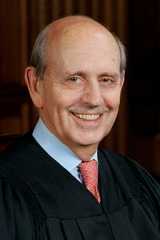
Stephen Breyer is a federal judge onsenior status with theSupreme Court of the United States. On January 27, 2022, PresidentJoe Biden (D) and Breyer officially announced Breyer would retire at the start of the court's summer recess.[1][2]NBC News had previously reported the retirement on January 26.[3] On June 29, 2022, Breyer announced that his retirement will be effective at noon on June 30, 2022.[4] Justice Breyer assumedsenior status on June 30, 2022.[5]Click here to read more.
Breyer was nominated by PresidentBill Clinton (D) to fill the seat left vacant byHarry Blackmun. He was confirmed by 87-9 vote and was sworn in on August 3, 1994.[6]
Breyer graduated from Stanford University in 1959 and then enrolled in Magdelen College at Oxford University as a Marshall Scholar, where he graduated with honors in 1961. He went on to study at Harvard Law School, where he worked as an editor at theHarvard Law Review before graduating in 1964. Breyer began his legal career clerking for Supreme Court JusticeArthur Goldberg. He held several government attorney roles, including assistant special prosecutor on the Watergate Special Prosecution Force and the chief counsel of the U.S. Senate Judiciary Committee.[7]
In 1980, PresidentJimmy Carter (D) nominated Breyer to sit on theUnited States Court of Appeals for the 1st Circuit. He served on the court from 1980 to 1994 and was chief judge in his final four years there.
Breyer’snotable opinions include the majority opinion in the recess appointment caseNLRB v. Noel Canning and his dissenting opinion in the copyright law caseEldred v. Ashcroft.
Professional career
- 1994-present:Supreme Court of the United States
- 2022-present: Senior judge
- 1994-2022: Associate justice
- 1980-1994: Judge,United States Court of Appeals for the 1st Circuit
- 1990-1994: Chief judge
- 1985-1989: Commissioner, United States Sentencing Commission
- 1979-1980: Chief counsel,Senate Judiciary Committee
- 1977-1980: Professor, Kennedy School of Government, Harvard University
- 1975: Visiting lecturer, College of Law, Sydney, Australia
- 1974-1975: Special counsel, Administrative Practices Subcommittee,Senate Judiciary Committee
- 1973: Assistant special prosecutor, Watergate Special Prosecution Force
- 1967-1994: Faculty, Harvard Law School
- 1981-1994: Lecturer
- 1967-1980: Professor
- 1965-1967: Special assistant to the assistant attorney general, Antitrust Division,United States Department of Justice
- 1964-1965: Law clerk, Hon.Arthur Goldberg,Supreme Court of the United States[8]
Biography
Early life and education
Breyer was born inSan Francisco, California. Breyer's father was legal counsel for the San Francisco Board of Education.
Breyer earned a B.A. in philosophy from Stanford University in 1959, a B.A. from Magdalen College at the University of Oxford as a Marshall Scholar in 1961, and anLL.B. from Harvard Law School in 1964. While at Harvard, Breyer was the article editor at theHarvard Law Review.[9]
Military service
Breyer served in the United States Army and attained the rank of corporal. He served actively for six months, from June to December of 1957. He was honorably discharged after eight years as an army reserve member.[10]
Approach to the law
In a review of his 2010 book,Making Our Democracy Work, a Judge's View, Breyer argued that:
| “ | The job of the Supreme Court is to apply the Constitution's values to modern circumstances, using the tools of judging: precedent, text and an assessment of the purpose of the constitutional provision at issue.[11][12] | ” |
Breyer also believes in theLiving Constitution. Nina Totenberg, NPR legal affairs correspondent, wrote of his views:
| “ | Breyer argued that the founders did want a living Constitution; they wrote a Constitution they wanted to last for the ages. The founders knew "perfectly well that conditions would change. The values don't change. The circumstances do."[11][12] | ” |
Martin-Quinn score
Breyer's Martin-Quinn score following the 2021-2022 term was -2.05, making him the second-most liberal justice on the court at that time. Martin-Quinn scores were developed by political scientists Andrew Martin and Kevin Quinn from the University of Michigan, and measure the justices of the Supreme Court along an ideological continuum. The further from zero on the scale, the more conservative (>0) or liberal (<0) the justice.
The chart below details every justice's Martin-Quinn score for the 2021-2022 term.
Video discussion (2015)
Breyer spoke at Harvard University in November 2015. He discussed the collegiality of the court, his view of the Constitution, and how he handles political disagreement. The video of that event is embedded below.
Breyer spoke onLegally Speaking, a show produced by University of California Television. He discussed the role of the court and its impact on the country. The video of that event is embedded below.
Judicial career
Supreme Court of the United States (1994 - 2022)
 |
| Nominee Information |
| Name: Stephen Breyer |
| Court:Supreme Court of the United States |
| Progress |
| Confirmed 83 days after nomination. |
 ANominated: May 7, 1994 ANominated: May 7, 1994 |
| AABA Rating:Unanimously Well Qualified |
| Questionnaire: |
| AHearing: July 12-15, 1994 |
| Hearing Transcript:Hearing Transcript |
| QFRs:(Hover over QFRs to read more) |
| AReported: July 25, 1994 |
| AConfirmed: July 29, 1994 |
| AVote: 87-9 |
In 1993, PresidentBill Clinton (D) considered Breyer for the seat vacated byByron White that ultimately went to JusticeRuth Bader Ginsburg. Breyer was instead appointed following the retirement ofHarry Blackmun in 1994. Clinton nominated Breyer to be an associate justice of the Supreme Court on May 17, 1994.[13]
TheAmerican Bar Association rated BreyerUnanimously Well Qualified to become an associate justice for the Supreme Court. Breyer found little resistance during his confirmation hearings. TwoRepublican senators expressed concerns,Richard Lugar (R-Ind.) and Robert C. Smith (R-N.H.) Lugar worried that investments with Lloyd's of London would cause possible conflicts of interest, while Smith found that Breyer stressed separation of church and state and could not "in good conscience, vote to confirm a nominee whose personal background, judicial record and testimony indicates he will move the Supreme Court away from ... conservative decisions."[14][15]
Breyer was confirmed by the U.S. Senate on July 29, 1994, by a vote 87-9. He took his seat on August 3, 1994.[16]
First Circuit Court of Appeals (1980-1994)
From 1980 to 1994, Breyer served as a judge on theUnited States Court of Appeals for the 1st Circuit. Breyer served as the court'schief judge from 1990 to 1994. He was nominated to the court of appeals by PresidentJimmy Carter (D) on November 13, 1980. In the last days of the Carter administration, on December 9, 1980, the U.S. Senate confirmed Breyer by an 80-10 vote. He served as a member of the Judicial Conference of the United States between 1990 and 1994 and the United States Sentencing Commission between 1985 and 1989.[17][18]
Supreme Court statistics
Opinions by year
Below is a table of the number of opinions, concurrences, and dissents that Breyer has issued since joining the Supreme Court, according to the data at Cornell University’s Legal Information Institute and from the annualStat Pack produced by the websiteSCOTUSBlog. This information is updated annually at the end of each term.[19][20][21]
| Opinions written by year, Stephen Breyer | ||||||||||||||||
|---|---|---|---|---|---|---|---|---|---|---|---|---|---|---|---|---|
| 2006 | 2007 | 2008 | 2009 | 2010 | 2011 | 2012 | 2013 | 2014 | 2015 | 2016 | 2017 | 2018 | 2019 | 2020 | 2021 | |
| Opinions | 6 | 8 | 7 | 8 | 8 | 5 | 8 | 7 | 8 | 8 | 8 | 7 | 8 | 5 | 6 | 6 |
| Concurrences | 3 | 2 | 2 | 7 | 6 | 5 | 5 | 2 | 4 | 3 | 3 | 5 | 2 | 2 | 1 | 1 |
| Dissents | 8 | 6 | 10 | 10 | 6 | 12 | 5 | 5 | 4 | 1 | 6 | 7 | 10 | 7 | 7 | 8 |
| Totals | 20 | 19 | 21 | 27 | 21 | 23 | 18 | 14 | 16 | 12 | 17 | 19 | 20 | 14 | 14 | 15 |
| Opinions written by year, Stephen Breyer | |||||||||||||
|---|---|---|---|---|---|---|---|---|---|---|---|---|---|
| 1995 | 1996 | 1997 | 1998 | 1999 | 2000 | 2001 | 2002 | 2003 | 2004 | 2005 | |||
| Opinions | 9 | 10 | 8 | 12 | 8 | 9 | 9 | 11 | 9 | 6 | 10 | ||
| Concurrences | 3 | 6 | 8 | 7 | 4 | 10 | 3 | 7 | 3 | 5 | 9 | ||
| Dissents | 7 | 3 | 11 | 7 | 4 | 10 | 11 | 6 | 4 | 10 | 5 | ||
| Concur in part, Dissent in part | 1 | 3 | 2 | 1 | 4 | 0 | 0 | 1 | 3 | 0 | 0 | ||
| Totals | 20 | 22 | 29 | 27 | 20 | 29 | 23 | 25 | 19 | 21 | 24 | ||
Justice agreement
In the 2021 term, Breyer had the highest agreement rate withElena Kagan. He had the highest disagreement rate withClarence Thomas.[22] In the 2020 term, Breyer had the highest agreement rate withSonia Sotomayor andElena Kagan. He had the highest disagreement rate withSamuel Alito.[23]
The table below highlights Breyer's agreement rate with each justice on the court during that term.[24][25]
| Stephen Breyer agreement rates by term, 2017 - 2021 | ||||||||||
|---|---|---|---|---|---|---|---|---|---|---|
| Justice | 2017 | 2018 | 2019 | 2020 | 2021 | |||||
| John Roberts | 70% | 69% | 74% | 73% | 62% | |||||
| Anthony Kennedy | 66% | N/A | N/A | N/A | N/A | |||||
| Clarence Thomas | 55% | 51% | 52% | 63% | 48% | |||||
| Ruth Bader Ginsburg | 89% | 82% | 93% | N/A | N/A | |||||
| Samuel Alito | 54% | 64% | 54% | 59% | 51% | |||||
| Sonia Sotomayor | 90% | 85% | 85% | 93% | 86% | |||||
| Elena Kagan | 93% | 86% | 90% | 93% | 89% | |||||
| Neil Gorsuch | 61% | 54% | 66% | 66% | 54% | |||||
| Brett Kavanaugh | N/A | 70% | 70% | 73% | 62% | |||||
| Amy Coney Barrett | N/A | N/A | N/A | 64% | 56% | |||||
Frequency in majority
In the 2021 term, Breyer was in the majority in 68 percent of decisions. He was in the majority more often than one other justice and less often than seven other justices.Cite error: Closing</ref> missing for<ref> tag
Since the 2011 term, Breyer has been in the majority more than 80 percent of the time five times. Across those 10 terms, he has been in the majority for 81 percent of all cases.
Noteworthy cases
The noteworthy cases listed in this section include any case where the justice authored a 5-4 majority opinion or an 8-1 dissent. Other cases may be included in this section if they set or overturn an established legal precedent, are a major point of discussion in an election campaign, receive substantial media attention related to the justice's ruling, or based on our editorial judgment that the case is noteworthy. For more on how we decide which cases are noteworthy, clickhere.
Since he joined the court through the 2021 term, Breyer authored the majority opinion in a 5-4 decision 35 times and authored a dissent in an 8-1 decision eight times. The table below details these cases by year.[26]
| Stephen Breyer noteworthy cases | ||||
|---|---|---|---|---|
| Year | 5-4 majority opinion | 8-1 dissenting opinion | ||
| Total | 35 | 8 | ||
| 2021 | 1 | 1 | ||
| 2020 | 0 | 0 | ||
| 2019 | 1 | 1 | ||
| 2018 | 1 | 0 | ||
| 2017 | 1 | 0 | ||
| 2016 | 1 | 0 | ||
| 2015 | 0 | 0 | ||
| 2014 | 3 | 0 | ||
| 2013 | 0 | 0 | ||
| 2012 | 1 | 0 | ||
| 2011 | 3 | 1 | ||
| 2010 | 1 | 1 | ||
| 2009 | 1 | 0 | ||
| 2008 | 0 | 0 | ||
| 2007 | 2 | 1 | ||
| 2006 | 2 | 0 | ||
| 2005 | 0 | 0 | ||
| 2004 | 1 | 0 | ||
| 2003 | 1 | 1 | ||
| 2002 | 1 | 1 | ||
| 2001 | 2 | 0 | ||
| 2000 | 2 | 1 | ||
| 1999 | 3 | 0 | ||
| 1998 | 2 | 0 | ||
| 1997 | 3 | 0 | ||
| 1996 | 1 | 0 | ||
| 1995 | 1 | 0 | ||
| 1994 | 0 | 0 | ||
Supreme Court opinions and orders
States may not invoke sovereign immunity to block USERRA lawsuits (2022)
Breyer authored a 5-4 majority opinion inTorres v. Texas Department of Public Safety, holding that "by ratifying the Constitution, the States agreed their sovereignty would yield to the national power to raise and support the Armed Forces. Congress may exercise this power to authorize private damages suits against nonconsenting States, as in USERRA."[27] Breyer was joined in the majority by Chief JusticeJohn Roberts and JusticesSonia Sotomayor,Elena Kagan, andBrett Kavanaugh.
In the majority opinion, Breyer wrote:[27]
| “ | The Constitution vests in Congress the power “[t]o raise and support Armies” and “[t]o provide and maintain a Navy.” Art. I, §8, cls. 1, 12–13. Pursuant to that authority, Congress enacted a federal law that gives returning veterans the right to reclaim their prior jobs with state employers and authorizes suit if those employers refuse to accommodate them. See Uniformed Services Employment and Reemployment Rights Act of 1994 (USERRA), 38 U. S. C. §4301 et seq. This case asks whether States may invoke sovereign immunity as a legal defense to block such suits.
| ” |
| —JusticeStephen Breyer | ||
No right to abortion under the U.S. Constitution (2022)
Breyer was part of the three-justice dissent inDobbs v. Jackson Women’s Health Organization. Breyer and Associate JusticesSonia Sotomayor andElena Kagan jointly authored the dissenting opinion. The majority opinion, authored by Associate JusticeSamuel Alito, held that the U.S. Constitution did not provide a right to abortion. Alito was joined in the majority by Associate JusticesClarence Thomas,Neil Gorsuch,Brett Kavanaugh, andAmy Coney Barrett. Chief JusticeJohn Roberts joined with the majority to uphold Mississippi's abortion law but not to overturnRoe and Casey. Alito wrote:
| “ | We hold thatRoe andCasey must be overruled. The Constitution makes no reference to abortion, and no such right is implicitly protected by any constitutional provision, including the one on which the defenders ofRoe andCasey now chiefly rely—the Due Process Clause of the Fourteenth Amendment. That provision has been held to guarantee some rights that are not mentioned in the Constitution, but any such right must be “deeply rooted in this Nation’s history and tradition” and “implicit in the concept of ordered liberty.”Washington v. Glucksberg, 521 U. S. 702, 721 (1997) (internal quotation marks omitted). | ” |
| —Justice Alito | ||
In their dissent, the justices wrote:
| “ | Whatever the exact scope of the coming laws, one result of today’s decision is certain: the curtailment of women’s rights, and of their status as free and equal citizens. ... The Constitution will, today’s majority holds, provide no shield, despite its guarantees of liberty and equality for all. ... | ” |
| —Justices Breyer, Sotomayor, and Kagan | ||
Does v. Mills (2021)
Does v. Mills: On October 19, 2021, U.S. Supreme Court JusticeStephen Breyer declined to suspend Maine’s COVID-19 vaccine mandate for healthcare workers. The plaintiffs argued that the mandate violated their right, under the First Amendment, to the free exercise of religion because it did not provide for a religious exemption. Chief JudgeJon Levy, of the U.S. District Court for the District of Maine, denied the plaintiffs' earlier request for a temporary restraining order and later refused to grant a preliminary injunction against the mandate. Levy, a Barack Obama (D) appointee, concluded that the plaintiffs had not been “prevented from staying true to their professed religious beliefs,” because they were still able to refuse vaccination, albeit at the risk of being terminated from their jobs. The U.S. Court of Appeals for the First Circuit declined to intervene, prompting the plaintiffs to petition Breyer, the justice assigned to field emergency requests from Maine, to suspend the mandate pending appeal. Later on October 19, the First Circuit affirmed Levy’s decision, finding that "Maine's interest in safeguarding its residents is paramount." The plaintiffs then filed another emergency application with Breyer, seeking an injunction pending a decision by the full Court as to whether to take up the appeal.[28][29][30][31][32]
Louisiana abortion law struck down (2019)
- See also:June Medical Services LLC v. Russo
Breyer authored a 5-4 majority opinion inJune Medical Services LLC v. Russo, holding Louisiana Act 620 was unconstitutional. Breyer was joined in the majority by JusticesRuth Bader Ginsburg,Sonia Sotomayor, andElena Kagan.[33]
| |||||||
Previous noteworthy opinions
- 2018-2019 term (Click to expand)
Native American state fuel taxes (2018)
Breyer authored a 5-4 majority opinion in this case ruling that a fuel wholesaler owned by a member of the Yakama Indian Nation was exempt from paying state fuel taxes for using public highways because the Yakama Treaty of 1855 granted members of the Nation the right "to travel upon all public highways" and preempted its obligation to pay the tax. Breyer was joined in the majority by Justices Ginsburg, Sotomayor, Kagan, and Gorsuch. Breyer wrote:[34]
“ The State of Washington imposes a tax upon fuel importers who travel by public highway. The question before us is whether an 1855 treaty between the United States and the Yakama Nation forbids the State of Washington to impose that tax upon fuel importers who are members of the Yakama Nation. We conclude that it does, and we affirm the Washington Supreme Court’s similar decision.[12] ”
- 2000-2014 (Click to expand)
Recess appointment power of president limited (2014)
On June 26, 2014, theU.S. Supreme Court issued its opinion in the case ofNational Labor Relations Board (NLRB) v. Noel Canning, a case on appeal from theUnited States Court of Appeals for the District of Columbia Circuit.
A NLRB order held that a soda distributor, Noel Canning, had unlawfully refused to execute a collective bargaining agreement with a labor union. The NLRB ordered the distributor to execute the agreement and to compensate the union members for any financial losses. Appealing the NLRB's decision to theD.C. Circuit, Noel Canning argued that three of the five NLRB members' appointments were made invalidly under the Recess Appointments Clause of the U.S. Constitution and, therefore, the NLRB did not have the necessary quorum of three members to issue its order. Noel Canning argued that the Senate was in betweenpro forma sessions and, therefore, was not in recess when the president made the three appointments. TheD.C. Circuit agreed, holding that the three-day adjournment betweenpro forma sessions of the Senate did not constitute a sufficient recess to make recess appointments under the Recess Appointments Clause.
Writing for a unanimous court, JusticeStephen Breyer upheld the D.C. Circuit's judgment, holding that the Senate's authority to conduct business by unanimous consent inpro forma sessions indicated that the Senate was not in a formal recess sufficient to trigger the clause for the three NLRB appointments at issue in this case.[35]
Illinois checkpoint case (2004)
Justice Stephen Breyer wrote the majority opinion in the case ofIllinois v. Lidster. The question in the case concerned whether or not a highway checkpoint established to gather information on a hit-and-run death could be used to arrest others not related to the original intent of the checkpoint. The Court found that the use of the checkpoint did not violate theFourth Amendment when police arrested Robert Lidster for drunk driving after he was stopped at the checkpoint. While it was argued thatEdmond, a prior case involving checkpoints, protected Lidster from random checkpoint searches, Breyer wrote the two cases differed:
“ The checkpoint stop here differs significantly from that inEdmond. The stop's primary law enforcement purposewas not to determine whether a vehicle's occupants were committing a crime, but to ask vehicle occupants, as members of the public, for their help in providing information about a crime in all likelihood committed by others. The police expected the information elicited to help them apprehend, not that vehicle's occupants, but other individuals.[36][12] ” Copyright law named for Sonny Bono upheld (2003)
Justice Breyer was the dissenting writer in the case ofEldred v. Ashcroft. The case involved the 1998 Sonny Bono Copyright Term Extension Act, which extended copyright coverage by 20 years. Breyer's dissent focused on the ways that the ruling will benefit the interests of corporations and heirs to copyright holders but showed no benefit to the public as a whole. He concluded by writing:
“ This analysis leads inexorably to the conclusion that the statute cannot be understood rationally to advance a constitutionally legitimate interest. The statute falls outside the scope of legislative power that the Copyright Clause, read in light of the First Amendment, grants to Congress. I would hold the statute unconstitutional.[37][12] ” Nebraska's partial-birth-abortion law struck down (2000)
On June 28, 2000, theU.S. Supreme Court issued its opinion in the case ofStenberg v. Carhart, a case on appeal from theUnited States Court of Appeals for the 8th Circuit.
In 1999,Nebraska passed a law that prohibited a medical procedure known as dilation and evacuation (D&E), which was more commonly known as partial birth abortion. The statute provided that "No partial birth abortion shall be performed in this state, unless such procedure is necessary to save the life of the mother whose life is endangered by a physical disorder, physical illness, or physical injury, including a life-endangering physical condition caused by or arising from the pregnancy itself." The statute defined partial birth abortion as "an abortion procedure in which the person performing the abortion partially delivers vaginally a living unborn child before killing the unborn child and completing the delivery." A violation of the statute was a Class III felony, which carried a prison term of up to 20 years and a fine of up to $25,000 per violation. Further, any violation of the statute provided for an immediate revocation of a physician's license to practice medicine in Nebraska. Carhart, a Nebraska physician, filed a lawsuit alleging the law violated the U.S. Constitution. Afederal district court and theEighth Circuit Court of Appeals ruled the law was unconstitutional.
Writing for a five-justice majority, JusticeStephen Breyer delivered the opinion of the court. The court upheld the Eighth Circuit's judgment that the law was unconstitutional because the law placed an undue burden on a woman's right to obtain an abortion. Breyer wrote, "because all those who perform abortion procedures using the D&E method must fear prosecution, conviction, and imprisonment, the Nebraska law imposes an undue burden upon a woman's right to make an abortion decision."[38]
See also
- Resignation of Stephen Breyer from the U.S. Supreme Court
- Supreme Court of the United States
- Supreme Court cases, October term 2021-2022
External links

Footnotes
- ↑United States Supreme Court, "Letter to President," January 27, 2022
- ↑YouTube, "President Biden Delivers Remarks on the Retirement of Supreme Court Justice Stephen Breyer," January 27, 2022
- ↑NBC News, "Justice Stephen Breyer to retire from Supreme Court, paving way for Biden appointment," January 26, 2022
- ↑The Hill, "Justice Breyer set to retire from Supreme Court on Thursday," accessed June 29, 2022
- ↑Federal Judicial Center, "Breyer, Stephen Gerald," accessed June 30, 2022
- ↑Ken I. Kersch, "Justice Breyer's Mandarin Liberty," accessed April 14, 2021
- ↑Oyez, "Stephen G. Breyer," accessed April 14, 2021
- ↑Supreme Court of the United States, "Current justice biographies," accessed April 14, 2021
- ↑Oyez.org, "Chicago-Kent College of Law, Stephen G. Breyer biography," accessed April 14, 2021
- ↑U.S. Government Publishing Office, "Senate Judiciary Committee Initial Questionnaire (Supreme Court)," accessed April 14, 2021
- ↑11.011.1NPR.org, "History through a Supreme Court justice's lens," September 13, 2010
- ↑12.012.112.212.312.412.512.612.712.8Note: This text is quoted verbatim from the original source. Any inconsistencies are attributable to the original source.
- ↑New York Times, "Clinton names Ruth Ginsburg, advocate for women, to court," June 15, 1993
- ↑American Bar Association, "Supreme Court Nominations," accessed July 8, 2014
- ↑Los Angeles Times, "Senate backs Breyer confirmation, 87-9 : Judiciary: Vote ensures that he can join the Supreme Court for start of its fall term in October. He is expected to take the oath of office next week.," July 30, 1994
- ↑Ken I. Kersch, "Justice Breyer's Mandarin Liberty," accessed April 14, 2021
- ↑Oyez, "Stephen G. Breyer," accessed April 14, 2021
- ↑GovTrack, "Senate Vote #1021 in 1980 (96th Congress)," accessed April 14, 2021
- ↑Cornell University, "Writings by Justice Breyer," accessed April 14, 2021
- ↑SCOTUSBlog, "Final Stat Pack for October Term 2016 and key takeaways," accessed April 16, 2018
- ↑SCOTUSBlog, "Final Stat Pack for October Term 2017 and key takeaways," accessed October 4, 2018
- ↑SCOTUSblog, "STAT PACK for the Supreme Court's 2021-22 term," July 1, 2022
- ↑SCOTUSblog, "2020-21 Stat pack: Justice Agreement," July 2, 2021
- ↑Due to a change in the 2020 stat packformat, the agreement rate uses the rate of agreement in judgment.
- ↑Due to a change in the 2021 stat packformat, the agreement rate uses the rate of agreement in judgment.
- ↑The Supreme Court Database, "Analysis," accessed June 11, 2019
- ↑27.027.1U.S. Supreme Court,Torres v. Texas Department of Public Safety, decided June 29, 2022
- ↑United States District Court for the District of Maine, "Does v. Mills: Verified Complaint for Temporary Restraining Order, Preliminary and Permanent Injunctive Relief, Declaratory Relief, and Damages," August 25, 2021
- ↑United States District Court for the District of Maine, "Does v. Mills: Opinion," August 26, 2021
- ↑United States District Court for the District of Maine, "Does v. Mills: Order on Plaintiffs' Motion for Preliminary Injunction," October 13, 2021
- ↑United States Court of Appeals for the First Circuit, "Does v. Mills: Opinion," October 19, 2021
- ↑Supreme Court of the United States, "Does v. Mills: Emergency Application for Writ of Injunction Pending Disposition of Petition for Writ of Certiorari," accessed October 28, 2021
- ↑33.033.1Supreme Court of the United States,June Medical Services v. Russo, decided June 29, 2020
- ↑SCOTUSblog, "Washington State Department of Licensing v. Cougar Den Inc.," accessed March 19, 2019
- ↑Supreme Court of the United States,National Labor Relations Board v. Noel Canning et al., June 26, 2014
- ↑Supreme Court of the United States, "Illinois v. Lidster," January 13, 2004
- ↑Supreme Court of the United States, "Eldred v. Ashcroft," January 15, 2003
- ↑Supreme Court of the United States,Stenberg v. Carhart, June 28, 2000
| Political offices | ||
|---|---|---|
| Preceded by Harry Blackmun | Supreme Court of the United States 1994-2022 | Succeeded by Ketanji Brown Jackson |
| Preceded by - | United States Court of Appeals for the 1st Circuit 1980-1994 | Succeeded by Sandra Lea Lynch |

| |||
|---|---|---|---|
| Active judges | • Gustavo Gelpí • David Barron • Lara Montecalvo • Julie Rikelman • Seth Aframe • Joshua D. Dunlap | ||
| Senior judges | Levin Hicks Campbell • Jeffrey R. Howard • Kermit Lipez • Sandra Lea Lynch • O. Rogeriee Thompson • William Kayatta • | ||
| Former judges | Stephen Breyer • David Souter • Norman Stahl • Bruce Marshall Selya • Michael Boudin • Juan Torruella • Hugh Bownes • Benjamin Bourne • John A. Lowell • Jeremiah Smith • John Lowell (federal judge, 1865-1884) • George Foster Shepley • LeBaron Bradford Colt • William LeBaron Putnam • Francis Cabot Lowell • Frederic Dodge • James Madison Morton • William Schofield • George Weston Anderson • George Hutchins Bingham • Charles Fletcher Johnson • Scott Wilson (Maine) • John Christopher Mahoney • Calvert Magruder • Bailey Aldrich • John Patrick Hartigan • Frank Coffin • Edward McEntee • Peter Woodbury • | ||
| Former Chief judges | Stephen Breyer • Levin Hicks Campbell • Jeffrey R. Howard • Michael Boudin • Juan Torruella • Sandra Lea Lynch • Calvert Magruder • Bailey Aldrich • Frank Coffin • Peter Woodbury • | ||

| |||
|---|---|---|---|
| 1993 | Adams •Ambrose •Barnes •Brinkema •Bucklew •Chasanow •Coffman •Daughtrey •Ferguson •Ginsburg •Hagen •Jackson •Lancaster •Leval •Lindsay •Messitte •Michael •Piersol •Saris •Schwartz •Seybert •Shanahan •Shaw •Stearns •Trager •Vazquez •Wilken •Wilson | ||
| 1994 | Baer •Barkett •Batts •Beaty •Benavides •Bennett •Berrigan •Biery •Block •Borman •Breyer •Briones •Bryson •Bucklo •Burgess •Burrage •Cabranes •Calabresi •Carr •Casellas •Castillo •Chatigny •Chin •Cindrich •Coar •Collins •Cooper •Cote •Currie •Davis •Dominguez •Downes •Duval •Friedman •Furgeson •Garcia •Gertner •Gettleman •Gillmor •Gilmore •Gleeson •Haggerty •Hamilton •Hannah •Hawkins •Henry •Holmes •Hood •Hull •Hurley •Jack •Jones •Jones •Kaplan •Katz •Kern •Kessler •Koeltl •Lisi •Manning •McKee •McLaughlin •Melancon •Miles-LaGrange •Moore •Motz •Murphy •O'Malley •O'Meara •Oliver •Paez •B. Parker •F. Parker •R. Parker •Perry •Ponsor •Pooler •Porteous •Rendell • Riley •Robertson •Rogers •Ross •Russell •Sands •Sarokin •Scheindlin •Silver •Squatrito •Stewart •Sullivan •Tatel •Thompson •Timlin •Urbina •Vanaskie •Vance •Walls •Wells •Williams | ||
| 1995 | Arterton •Atlas •Black •Blake •Briscoe •Tena Campbell •Todd Campbell •Chesney •Cole •Collier •Daniel •Davis •Dennis •Dlott •Donald •Duffy •Economus •Evans •Fallon •Folsom •Gaughan •Goodwin •Heartfield •Hunt •Illston •Jones •King •Kornmann •Lawson •Lenard •Lucero •Lynch •McKinley •Moody •Moore •Moskowitz •Murphy •Murtha •Nugent •O'Toole •Orlofsky •Pogue •Sessions •C. Smith •O. Smith •Stein •Thornburg •Tunheim •Wallach •Wardlaw •Webber •Whaley •Winmill • Wood | ||
| 1996 | Broadwater •Clevert •Fenner •Gershon •Gottschall •Greenaway •Hinkle •Jones •Kahn •Laughrey •Lemmon •Marten •Miller •Molloy •Montgomery •Pregerson •Rakoff •Sargus •Tashima •Thomas •Zapata | ||
| 1997 | Adelman •Bataillon •Breyer •Caputo •Casey •Chambers •Clay •Damrell •Droney •Friedman •Gajarsa •Garland •Gilman •Gold •Gwin •Hall •Hayden •Hull •Ishii •Jenkins •Kauffman •Kennedy •Kimball •Kollar-Kotelly •Lazzara •Marbley •Marcus •Middlebrooks •Miller •Moon •Pratt •Rendell •Sippel •Siragusa •Snyder •Thrash | ||
| 1998 | Aiken •Barbier •Barzilay •Berman •Buttram •Carter •Collins •Dawson •Dimitrouleas •Fletcher •Fogel •Frank •Graber •Hellerstein •Herndon •James •Johnson •Kane •Kelly •G. King •R. King •Lasnik •Lee •Lemelle •Lindsay •Lipez •Manella •Matz •McCuskey •McKeown •McMahon •Mickle •Mollway •Mordue •Moreno •Morrow •Munley •Murphy •Pallmeyer •Pauley •Polster •Pooler •Rawlinson •Ridgway •R. Roberts •V. Roberts •Sack •Scott •Seitz •Seymour •Shea •Silverman •Sleet •Sotomayor •Steeh •Story •Straub •Tagle •Tarnow •Trauger •Traxler •Tyson •Wardlaw •Whelan •Young | ||
| 1999 | Alsup •Barry •Brown •Buchwald •Cooper •Eaton •Ellison •Feess •Fisher •Gould •Guzman •Haynes •Hibbler •Hochberg •Hurd •Huvelle •Jordan •Katzmann •Kennelly •Linn •Lorenz •Lynn •Marrero •Murguia •Pannell •Pechman •Pepper •Phillips •Schreier •Stewart •Underhill •Ward •Williams •Wilson | ||
| 2000 | Ambro •Antoon •Battani •Berzon •Bolton •Brady •Bye •Cavanaugh •Daniels •Darrah •Dawson •Dyk •Fuentes •Garaufis •Garcia-Gregory •Hamilton •Huck •Hunt •Lawson •Lefkow •Lynch •Martin •McLaughlin •Moody •Murguia •Paez •Pisano •Presnell •Rawlinson •Reagan •Schiller •Singal •Steele •Surrick •Swain •Tallman •Teilborg •Tucker •Whittemore | ||

| |||
|---|---|---|---|
| 1977 | Ballantine •Bownes •Boyle •Bua •Carr •Clark •Cowan •Daly •Filippine •Higginbotham •Hoeveler •Hug •Johnstone •Kane •Keith •Leval •Logan •MacLaughlin •McKay •Melton •Merritt •Murphy •Nickerson •Oberdorfer •Roszkowski •Roy •Rubin •Sifton •Tang •Vance •Veron | ||
| 1978 | Arnold •Baker •Boyle •Burns •Campos •Claiborne •Collins •Cook •Devine •Diamond •Duplantier •Edenfield •Friedman •Gonzalez •Greene •Jenkins •Lowe •Mazzone •McMillian •O'Brien •Pfaelzer •Phillips •Pollak •Sand •Shapiro •Simmons •Smith •Sweet •Tanner •Wiseman •Ziegler | ||
| 1979 | Ackerman •Alarcon •Anderson •Arceneaux •Arnold •Aspen •Beatty •Beer •Belew •Bertelsman •Bilby •N. Black •S. Black •Bloch •Bowen •Brett •Brooks •Brown •Buchmeyer •Bunton •Burciaga •Cabranes •Carr •Carrigan •Castagna •Cire •Clark •Cohn •Conaboy •Cordova •Crabb •Cudahy •Davis •DeAnda •Debevoise •Edwards •Eginton •Ellison •Enslen •O. Evans •T. Evans •Farris •Ferguson •Fletcher •Frye •Garcia •Garza •B. Gibson •H. Gibson •Gierbolini-Ortiz •Giles •Gilliam •Green •Hall •Hastings •Hatchett •Hatfield •Hatter •Hawkins •Henderson •Higby •Hillman •Houck •Howard •Hudspeth •Hungate •F. Johnson •S. Johnson •N. Jones •S. Jones •Karlton •Kazen •Kearse •Keeton •Kehoe •Kennedy •Kidd •King •Kravitch •Loughlin •Martin •McCurn •McDonald •McNaught •McNichols •Mikva •Mitchell •Moran •Murnaghan •Murphy •D. Nelson •D.W. Nelson •Newblatt •Newman •Overton •Paine •Panner •J. Parker •R. Parker •Penn •Perez-Gimenez •Perry •Politz •Poole •Porter •Pregerson •Price •Rambo •Ramirez •Reavley •Redden •E. Reed •S. Reed •Reinhardt •Renner •Robinson •Rothstein •Sachs •Saffels •Sanders •Sarokin •Schroeder •Schwartz •Seay •Senter •Seymour •Shannon •Shaw •Shoob •Skopil •Sloviter •Sofaer •Spellman •Sprouse •Staker •Tate •Taylor •Thompson •Tidwell •Unthank •Vietor •Vining •Wald •Ward •Weinshienk •West •Wicker •Williams •Winder •Woods •Wright • Zobel | ||
| 1980 | Aguilar •Aldrich •Anderson •Boochever •Breyer •Britt •Cahill •Canby •Carroll •Cerezo •Clemon •S. Ervin •R. Erwin •Getzendanner •Gilmore •Ginsburg •Haltom •Hardy •Henderson •Hobbs •Holschuh •Horton •Howard •Johnson •Keep •Kelly •Kenyon •Kocoras •Marquez •Marshall •Michael •Nixon •Norris •Patel •Polozola •Propst •Quackenbush •Ramsey •Rice •Shadur •Spiegel •Tashima •Thompson •Vela •White •Williams | ||
| 1981 | |||

- Pages using DynamicPageList3 parser function
- Appointed by Jimmy Carter
- Appointed by William J. Clinton
- Confirmed 1980
- Confirmed 1994
- Federal Article III judges
- Federal judiciary nominee, May 1994
- Federal judiciary nominee, November 1980
- Former federal judge
- Former federal judge, United States Court of Appeals for the 1st Circuit
- Judge on senior status, United States Supreme Court
- Senior federal judge
- United States of America
- Former federal judge, First Circuit
- Appointed by Bill Clinton
- Former chief judge, First Circuit
- Army veteran
- Justice of the Rehnquist Court
- Justice of the Roberts Court
- Former Article III judges


