

Oregon Supreme Court
| Oregon Supreme Court |
|---|
 |
| Court Information |
| Justices: 7 |
| Founded: 1859 |
| Location:Salem, Oregon |
| Salary |
| Associates: $220,596[1] |
| Judicial Selection |
| Method:Nonpartisan election |
| Term: 6 years |
| Active justices |
| Stephen K. Bushong,Roger J. DeHoog,Rebecca Duncan,Meagan A. Flynn,Chris Garrett,Bronson James,Aruna Masih |
Founded in 1859, theOregon Supreme Court is the state'scourt of last resort and has seven judgeships. The current chief of the court isMeagan A. Flynn.
As of September 2023, all seven judges on the court were appointed by a Democratic governor.
The Oregon Supreme Court meets in the Supreme Court Building in Salem, Oregon.[2]
In Oregon, state supreme court justices are elected in nonpartisan elections. There are 13 states that use this selection method. To read more about the nonpartisan election of judges,click here.
Jurisdiction
The Oregon supreme court is the highest court in the state. The Oregon Supreme Court has discretionary jurisdiction to review decisions from theOregon Court of Appeals. The court also "hears direct appeals in death penalty, lawyer and judicial discipline, and Oregon Tax Court cases," "may accept original jurisdiction inmandamus,quo warranto, andhabeas corpus proceedings," and "reviews ballot measure titles, prison siting disputes, reapportionment of legislative districts and legal questions on Oregon law referred by federal courts."[3]
The chief justice is the administrative head of the judicial department and also exercises administrative authority over the appellate, circuit, and tax courts. The chief justice creates rules and procedures for judges, officers, and employees of the courts. The chief justice appoints the chief judge of the court of appeals and presiding judges of state trial courts. The chief justice oversees statewide budgeting, accounting, and fiscal management of the judicial branch.[4]
The supreme court admits lawyers to practice law through theOregon Board of Bar Examiners and it has the power to reprimand or disbar lawyers. The supreme court also has the power to censure, suspend, or remove judges.[5]
The following text from Article VII, Sections 1, 2, and 3 of theOregon Constitution covers the jurisdiction of the court:
| “ | Section 1: Courts; Election of Judges; Term of Office; Compensation The judicial power of the state shall be vested in one supreme court and in such other courts as may from time to time be created by law. The judges of the supreme and other courts shall be elected by the legal voters of the state or of their respective districts for a term of six years, and shall receive such compensation as may be provided by law, which compensation shall not be diminished during the term for which they are elected. Section 2: Amendment's Effect on Courts, Jurisdiction and Judicial System; Supreme Court's Original Jurisdiction The courts, jurisdiction, and judicial system of Oregon, except so far as expressly changed by this amendment, shall remain as at present constituted until otherwise provided by law. But the supreme court may, in its own discretion, take original jurisdiction in mandamus, quo warranto and habeas corpus proceedings. Section 3: Jury Trial; Re-Examination of Issues by Appellate Court; Record on Appeal to Supreme Court; Affirmance Notwithstanding Error; Determination of Case by Supreme Court In actions at law, where the value in controversy shall exceed $750, the right of trial by jury shall be preserved, and no fact tried by a jury shall be otherwise re-examined in any court of this state, unless the court can affirmatively say there is no evidence to support the verdict. Until otherwise provided by law, upon appeal of any case to the supreme court, either party may have attached to the bill of exceptions the whole testimony, the instructions of the court to the jury, and any other matter material to the decision of the appeal. If the supreme court shall be of opinion, after consideration of all the matters thus submitted, that the judgment of the court appealed from was such as should have been rendered in the case, such judgment shall be affirmed, notwithstanding any error committed during the trial; or if, in any respect, the judgment appealed from should be changed, and the supreme court shall be of opinion that it can determine what judgment should have been entered in the court below, it shall direct such judgment to be entered in the same manner and with like effect as decrees are now entered in equity cases on appeal to the supreme court. Provided, that nothing in this section shall be construed to authorize the supreme court to find the defendant in a criminal case guilty of an offense for which a greater penalty is provided than that of which the accused was convicted in the lower court.[6] | ” |
| —Oregon Constitution, Article VII, Sections 1, 2, and 3 | ||
Justices
The table below lists the current justices of the Oregon Supreme Court, their political party, when they assumed office, and the appointing governor.
| Office | Name | Party | Date assumed office | Appointed by |
|---|---|---|---|---|
| Oregon Supreme Court Position 1 | Stephen K. Bushong | Nonpartisan | January 1, 2023 | Kate Brown (D) |
| Oregon Supreme Court Position 2 | Rebecca Duncan | Nonpartisan | 2017 | Kate Brown (D) |
| Oregon Supreme Court Position 3 | Meagan A. Flynn | Nonpartisan | April 1, 2017 | Kate Brown (D) |
| Oregon Supreme Court Position 4 | Chris Garrett | Nonpartisan | January 1, 2019 | Kate Brown (D) |
| Oregon Supreme Court Position 5 | Aruna Masih | Nonpartisan | September 1, 2023 | Tina Kotek (D) |
| Oregon Supreme Court Position 6 | Roger J. DeHoog | Nonpartisan | January 19, 2022 | Kate Brown (D) |
| Oregon Supreme Court Position 7 | Bronson James | Nonpartisan | January 1, 2023 | Kate Brown (D) |
Salary
- See also:Oregon court salaries and budgets
In 2025, the justices of the court received a salary of $220,596, according to the National Center for State Courts.[7]
Judicial selection
- See also:Judicial selection in Oregon
Theseven justices on theOregon Supreme Court are selected throughnonpartisan elections.[8] Judges' terms begin on the first Monday in January following their election.[9]
Judges serve six-year terms. Judges seeking to serve more than one term must stand for re-election.[8]
Qualifications
To serve on this court, a judge must be:
- a U.S. citizen;
- a state resident for at least three years;
- a state bar member; and
- under the age of 75.[8]
Chief justice
Thechief justice is selected by peer vote and serves in that capacity for a six-year term.
Vacancies
If a midterm vacancy occurs on the court, thegovernor appoints a replacement. The appointee serves until the next general election occurring 61 or more days after the vacancy, at which point he or she may run for election.[8]The map below highlights how vacancies are filled in state supreme courts across the country.
Elections
- See also:Oregon Supreme Court elections
See also: Oregon Supreme Court elections, 2030
Oregon Supreme Court Position 1
There are noofficial candidates yet for this election.
Oregon Supreme Court Position 2
There are noofficial candidates yet for this election.
Oregon Supreme Court Position 3
There are noofficial candidates yet for this election.
Oregon Supreme Court Position 5
There are noofficial candidates yet for this election.
Oregon Supreme Court Position 7
There are noofficial candidates yet for this election.
Oregon Supreme Court Position 6
See also: Oregon Supreme Court elections, 2028
There are noofficial candidates yet for this election.
Oregon Supreme Court Position 4
See also: Oregon Supreme Court elections, 2026
There are noofficial candidates yet for this election.
See also: Oregon Supreme Court elections, 2024
Oregon Supreme Court Position 1
General election
General election for Oregon Supreme Court Position 1
IncumbentStephen K. Bushong (Nonpartisan) won election in the general election for Oregon Supreme Court Position 1 on November 5, 2024.
Candidate | % | Votes | ||
| ✔ |  | Stephen K. Bushong (Nonpartisan) | 97.9 | 1,221,817 |
| Other/Write-in votes | 2.1% | 26,077 | ||
| Incumbents arebolded and underlined. The results have been certified. Source | Total votes: 1,247,894 | ||
 = candidate completed theBallotpedia Candidate Connection survey. = candidate completed theBallotpedia Candidate Connection survey. | ||||
| If you are a candidate and would like to tell readers and voters more about why they should vote for you,complete the Ballotpedia Candidate Connection Survey. | ||||
Do you want a spreadsheet of this type of data?Contact our sales team. | ||||
Nonpartisan primary
The primary scheduled for May 21, 2024, was canceled. IncumbentStephen K. Bushong (Nonpartisan) advanced from the primary for Oregon Supreme Court Position 1 without appearing on the ballot.
Oregon Supreme Court Position 2
General election
The general election scheduled for November 5, 2024, was canceled.
Nonpartisan primary
Nonpartisan primary election for Oregon Supreme Court Position 2
IncumbentRebecca Duncan (Nonpartisan) won election outright in the primary for Oregon Supreme Court Position 2 on May 21, 2024.
Candidate | % | Votes | ||
| ✔ |  | Rebecca Duncan (Nonpartisan) | 97.8 | 584,752 |
| Other/Write-in votes | 2.2% | 12,979 | ||
| Incumbents arebolded and underlined. The results have been certified. Source | Total votes: 597,731 | ||
| = candidate completed theBallotpedia Candidate Connection survey. | ||||
| If you are a candidate and would like to tell readers and voters more about why they should vote for you,complete the Ballotpedia Candidate Connection Survey. | ||||
Do you want a spreadsheet of this type of data?Contact our sales team. | ||||
Oregon Supreme Court Position 3
General election
The general election scheduled for November 5, 2024, was canceled.
Nonpartisan primary
Nonpartisan primary election for Oregon Supreme Court Position 3
IncumbentMeagan A. Flynn (Nonpartisan) won election outright in the primary for Oregon Supreme Court Position 3 on May 21, 2024.
Candidate | % | Votes | ||
| ✔ |  | Meagan A. Flynn (Nonpartisan) | 97.9 | 580,295 |
| Other/Write-in votes | 2.1% | 12,567 | ||
| Incumbents arebolded and underlined. The results have been certified. Source | Total votes: 592,862 | ||
| = candidate completed theBallotpedia Candidate Connection survey. | ||||
| If you are a candidate and would like to tell readers and voters more about why they should vote for you,complete the Ballotpedia Candidate Connection Survey. | ||||
Do you want a spreadsheet of this type of data?Contact our sales team. | ||||
Oregon Supreme Court Position 5
General election
The general election scheduled for November 5, 2024, was canceled.
Nonpartisan primary
Nonpartisan primary election for Oregon Supreme Court Position 5
IncumbentAruna Masih (Nonpartisan) won election outright in the primary for Oregon Supreme Court Position 5 on May 21, 2024.
Candidate | % | Votes | ||
| ✔ | Aruna Masih (Nonpartisan) | 97.8 | 571,880 | |
| Other/Write-in votes | 2.2% | 12,895 | ||

| Incumbents arebolded and underlined. The results have been certified. Source | Total votes: 584,775 | ||
| = candidate completed theBallotpedia Candidate Connection survey. | ||||
| If you are a candidate and would like to tell readers and voters more about why they should vote for you,complete the Ballotpedia Candidate Connection Survey. | ||||
Do you want a spreadsheet of this type of data?Contact our sales team. | ||||
Oregon Supreme Court Position 7
General election
General election for Oregon Supreme Court Position 7
IncumbentBronson James (Nonpartisan) won election in the general election for Oregon Supreme Court Position 7 on November 5, 2024.
Candidate | % | Votes | ||
| ✔ |  | Bronson James (Nonpartisan) | 98.1 | 1,212,011 |
| Other/Write-in votes | 1.9% | 23,702 | ||
| Incumbents arebolded and underlined. The results have been certified. Source | Total votes: 1,235,713 | ||
| = candidate completed theBallotpedia Candidate Connection survey. | ||||
| If you are a candidate and would like to tell readers and voters more about why they should vote for you,complete the Ballotpedia Candidate Connection Survey. | ||||
Do you want a spreadsheet of this type of data?Contact our sales team. | ||||
Nonpartisan primary
The primary scheduled for May 21, 2024, was canceled. IncumbentBronson James (Nonpartisan) advanced from the primary for Oregon Supreme Court Position 7 without appearing on the ballot.
Oregon Supreme Court Position 6
See also: Oregon Supreme Court elections, 2022
General election
The general election scheduled for November 8, 2022, was canceled.
Nonpartisan primary
Nonpartisan primary election for Oregon Supreme Court Position 6
IncumbentRoger J. DeHoog (Nonpartisan) won election outright in the primary for Oregon Supreme Court Position 6 on May 17, 2022.
Candidate | % | Votes | ||
| ✔ |  | Roger J. DeHoog (Nonpartisan) | 98.2 | 613,950 |
| Other/Write-in votes | 1.8% | 11,515 | ||
| Incumbents arebolded and underlined. The results have been certified. Source | Total votes: 625,465 | ||
| = candidate completed theBallotpedia Candidate Connection survey. | ||||
| If you are a candidate and would like to tell readers and voters more about why they should vote for you,complete the Ballotpedia Candidate Connection Survey. | ||||
Do you want a spreadsheet of this type of data?Contact our sales team. | ||||
See also: Oregon Supreme Court elections, 2020
Oregon Supreme Court Position 1
General election
The general election scheduled for November 3, 2020, was canceled.
Nonpartisan primary
Nonpartisan primary election for Oregon Supreme Court Position 1
IncumbentThomas Balmer (Nonpartisan) won election outright againstVan Pounds (Nonpartisan) in the primary for Oregon Supreme Court Position 1 on May 19, 2020.
Candidate | % | Votes | ||
| ✔ |  | Thomas Balmer (Nonpartisan) | 70.8 | 727,421 |
 | Van Pounds (Nonpartisan) | 28.8 | 295,887 | |
| Other/Write-in votes | 0.4% | 3,638 | ||
| Incumbents arebolded and underlined. The results have been certified. Source | Total votes: 1,026,946 | ||
| = candidate completed theBallotpedia Candidate Connection survey. | ||||
| If you are a candidate and would like to tell readers and voters more about why they should vote for you,complete the Ballotpedia Candidate Connection Survey. | ||||
Do you want a spreadsheet of this type of data?Contact our sales team. | ||||
Oregon Supreme Court Position 4
General election
Special general election for Oregon Supreme Court Position 4
IncumbentChris Garrett (Nonpartisan) won election in the special general election for Oregon Supreme Court Position 4 on November 3, 2020.
Candidate | % | Votes | ||
| ✔ |  | Chris Garrett (Nonpartisan) | 97.3 | 1,366,654 |
| Other/Write-in votes | 2.7% | 38,206 | ||
| Incumbents arebolded and underlined. The results have been certified. Source | Total votes: 1,404,860 | ||
| = candidate completed theBallotpedia Candidate Connection survey. | ||||
| If you are a candidate and would like to tell readers and voters more about why they should vote for you,complete the Ballotpedia Candidate Connection Survey. | ||||
Do you want a spreadsheet of this type of data?Contact our sales team. | ||||
Nonpartisan primary
The primary scheduled for May 19, 2020, was canceled. IncumbentChris Garrett (Nonpartisan) advanced from the special primary for Oregon Supreme Court Position 4 without appearing on the ballot.
Oregon Supreme Court Position 7
General election
The general election scheduled for November 3, 2020, was canceled.
Nonpartisan primary
Nonpartisan primary election for Oregon Supreme Court Position 7
IncumbentMartha L. Walters (Nonpartisan) won election outright in the primary for Oregon Supreme Court Position 7 on May 19, 2020.
Candidate | % | Votes | ||
| ✔ |  | Martha L. Walters (Nonpartisan) | 98.7 | 828,329 |
| Other/Write-in votes | 1.3% | 10,625 | ||
| Incumbents arebolded and underlined. The results have been certified. Source | Total votes: 838,954 | ||
| = candidate completed theBallotpedia Candidate Connection survey. | ||||
| If you are a candidate and would like to tell readers and voters more about why they should vote for you,complete the Ballotpedia Candidate Connection Survey. | ||||
Do you want a spreadsheet of this type of data?Contact our sales team. | ||||
Oregon Supreme Court Position 2
General election
The general election scheduled for November 6, 2018, was canceled.
Nonpartisan primary
Nonpartisan primary election for Oregon Supreme Court Position 2
IncumbentRebecca Duncan (Nonpartisan) won election outright in the primary for Oregon Supreme Court Position 2 on May 15, 2018.
Candidate | % | Votes | ||
| ✔ | | Rebecca Duncan (Nonpartisan) | 100.0 | 521,465 |
| Incumbents arebolded and underlined. The results have been certified. | Total votes: 521,465 | ||
| = candidate completed theBallotpedia Candidate Connection survey. | ||||
| If you are a candidate and would like to tell readers and voters more about why they should vote for you,complete the Ballotpedia Candidate Connection Survey. | ||||
Do you want a spreadsheet of this type of data?Contact our sales team. | ||||
Oregon Supreme Court Position 3
General election
The general election scheduled for November 6, 2018, was canceled.
Nonpartisan primary
Nonpartisan primary election for Oregon Supreme Court Position 3
IncumbentMeagan A. Flynn (Nonpartisan) won election outright againstVan Pounds (Nonpartisan) in the primary for Oregon Supreme Court Position 3 on May 15, 2018.
Candidate | % | Votes | ||
| ✔ | | Meagan A. Flynn (Nonpartisan) | 73.5 | 498,925 |
| Van Pounds (Nonpartisan) | 26.5 | 179,629 | |
| Incumbents arebolded and underlined. The results have been certified. | Total votes: 678,554 | ||
| = candidate completed theBallotpedia Candidate Connection survey. | ||||
| If you are a candidate and would like to tell readers and voters more about why they should vote for you,complete the Ballotpedia Candidate Connection Survey. | ||||
Do you want a spreadsheet of this type of data?Contact our sales team. | ||||
Oregon Supreme Court Position 5
General election
General election for Oregon Supreme Court Position 5
IncumbentAdrienne Nelson (Nonpartisan) won election in the general election for Oregon Supreme Court Position 5 on November 6, 2018.
Candidate | % | Votes | ||
| ✔ |  | Adrienne Nelson (Nonpartisan) | 98.2 | 1,059,178 |
| Other/Write-in votes | 1.8% | 19,514 | ||
| Incumbents arebolded and underlined. The results have been certified. Source | Total votes: 1,078,692 | ||
| = candidate completed theBallotpedia Candidate Connection survey. | ||||
| If you are a candidate and would like to tell readers and voters more about why they should vote for you,complete the Ballotpedia Candidate Connection Survey. | ||||
Do you want a spreadsheet of this type of data?Contact our sales team. | ||||


Appointments
2023
GovernorTina Kotek (D) appointedAruna Masih to theOregon Supreme Court. JusticeAdrienne Nelson resigned after she was elevated to theU.S. District Court of Oregon on February 23, 2023. Masih wasGovernorKotek's (D) first nominee to the seven-member supreme court.
In Oregon, state supreme court justices are elected in nonpartisan elections. There are 13 states that use this selection method. To read more about the nonpartisan election of judges,click here. If an interim vacancy occurs, the governor appoints a candidate to serve until the following general election. The next primary election was scheduled onMay 21, 2024, with a general election scheduled onNovember 5, 2024. Masih will have the opportunity to run for a full term.
2022
Justice Walters vacancy
Oregon GovernorKate Brown (D) appointedBronson James to theOregon Supreme Court effective January 1, 2023. James succeeded JusticeMartha Walters, who retired on December 31, 2022.[10] Walters' replacement will be Governor Kate Brown's (D) seventh nominee to the seven-member supreme court.
At the time of the vacancy under Oregon law, thegovernor appointed a replacement. The appointee served until the next general election occurring 60 or more days after the appointment, at which point they could run for election.
Justice Balmer vacancy
Oregon GovernorKate Brown (D) appointedStephen K. Bushong to theOregon Supreme Court effective January 1, 2023. Bushong succeeded JusticeThomas Balmer, who retired on December 31, 2022.[11] Balmer's replacement wasGovernorKate Brown's (D) sixth nominee to the seven-member supreme court.
At the time of the vacancy under Oregon law, thegovernor appointed a replacement. The appointee served until the next general election occurring 60 or more days after the appointment, at which point they could run for election.
2021
GovernorKate Brown (D) appointedRoger J. DeHoog to theOregon Supreme Court on January 19, 2022.[12] DeHoog succeeded JusticeLynn Nakamoto, who retired from the court on December 31, 2021.[13] DeHoog was Gov. Brown's sixth nominee to the seven-member supreme court.
At the time of the appointment, midterm vacancies on the court were filled by gubernatorial appointment.
2018
Oregon Supreme Court JusticeRives Kistler retired December 31, 2018.[14] On December 24, 2018, Gov.Kate Brown (D) appointed JudgeChris Garrett to succeed Kistler.[15] Garrett was Brown's fifth nominee to the seven-member supreme court.
Under Oregon law, the governor appoints a replacement in the event of a mid-term vacancy on the state supreme court. Justice Kistler's term was set to expire January 1, 2023. Garrett's appointment was effective January 1, 2019.[15]
Caseloads
The table below details the number of cases filed with the court and the number of opinions issued by the court between 2008 and 2016.[16] As of September 2024, data more recent than 2014 was not available online.
| Oregon Supreme Court caseload data | ||
|---|---|---|
| Year | Filings | Opinions issued[17] |
| 2016[18] | 813 | 81 |
| 2015[18] | 890 | 58 |
| 2014[18] | 977 | 75 |
| 2013[18] | 953 | 66 |
| 2012[18] | 923 | 64 |
| 2011[19] | 922 | 74 |
| 2010[20] | * | * |
| 2009[20] | * | * |
| 2008[21] | 1,352 | 75 |
| 2007[22] | 1,314 | 73 |
Analysis
Ballotpedia Courts: Determiners and Dissenters (2021)
 In 2020, Ballotpedia publishedBallotpedia Courts: Determiners and Dissenters, a study on how state supreme court justices decided the cases that came before them. Our goal was to determine which justices ruled together most often, which frequently dissented, and which courts featured the most unanimous or contentious decisions.
The study tracked the position taken by each state supreme court justice in every case they decided in 2020, then tallied the number of times the justices on the court ruled together. We identified the following types of justices:
- We considered two justicesopinion partners if they frequently concurred or dissented together throughout the year.
- We considered justices adissenting minority if they frequently opposed decisions together as a -1 minority.
- We considered a group of justices adetermining majority if they frequently determined cases by a +1 majority throughout the year.
- We considered a justice alone dissenter if he or she frequently dissented alone in cases throughout the year.
Summary of cases decided in 2020
- Number of justices: 7
- Number of cases: 53
- Percentage of cases with a unanimous ruling: 88.7% (47)
- Justice most often writing the majority opinion: Justice Balmer (10)
- Per curiam decisions: 8
- Concurring opinions: 2
- Justice with most concurring opinions: Justice Duncan (1)
- Dissenting opinions: 6
- Justice with most dissenting opinions: Justice Balmer (2)
For the study's full set of findings in Oregon, clickhere.
Ballotpedia Courts: State Partisanship (2020)
 Last updated: June 15, 2020
In 2020, Ballotpedia publishedBallotpedia Courts: State Partisanship, a study examining the partisan affiliation of all state supreme court justices in the country as of June 15, 2020.
The study presentedConfidence Scores that represented our confidence in each justice's degree of partisan affiliation, based on a variety of factors. This was not a measure of where a justice fell on the political or ideological spectrum, but rather a measure of how much confidence we had that a justice was or had been affiliated with a political party. To arrive at confidence scores we analyzed each justice's past partisan activity by collecting data on campaign finance, past political positions, party registration history, as well as other factors. The five categories ofConfidence Scores were:
- Strong Democrat
- Mild Democrat
- Indeterminate[23]
- Mild Republican
- Strong Republican
We used the Confidence Scores of each justice to develop a Court Balance Score, which attempted to show the balance among justices with Democratic, Republican, and Indeterminate Confidence Scores on a court. Courts with higher positive Court Balance Scores included justices with higher Republican Confidence Scores, while courts with lower negative Court Balance Scores included justices with higher Democratic Confidence Scores. Courts closest to zero either had justices with conflicting partisanship or justices with Indeterminate Confidence Scores.[24]
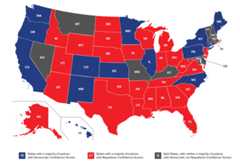
Oregon had a Court Balance Score of-8.86, indicatingDemocrat control of the court. In total, the study found that there were 15 states with Democrat-controlled courts, 27 states with Republican-controlled courts, and eight states with Split courts. The map below shows the court balance score of each state.
Bonica and Woodruff campaign finance scores (2012)
In October 2012, political science professors Adam Bonica and Michael Woodruff of Stanford University attempted to determine the partisan outlook of state supreme court justices in their paper, "State Supreme Court Ideology and 'New Style' Judicial Campaigns." A score above 0 indicated a more conservative-leaning ideology while scores below 0 were more liberal. The state Supreme Court ofOregon was given a campaign finance score (CFscore), which was calculated for judges in October 2012. At that time,Oregon received a score of-1.00. Based on the justices selected,Oregon was the 3rd most liberal court. The study was based on data from campaign contributions by judges themselves, the partisan leaning of contributors to the judges, or—in the absence of elections—the ideology of the appointing body (governor or legislature). This study was not a definitive label of a justice but rather an academic gauge of various factors.[25]
Ethics

TheOregon Code of Judicial Conduct sets forth ethical guidelines and principles for the conduct of judges and judicial candidates inOregon. It is composed of six rules:
- Rule 1: Sets forth the "Scope and Application of this Code; Definitions; Fundamental Principles"
- Rule 2: Titled: "Maintaining the Integrity of the Judicial System," describes the role of judges in "Promoting Confidence in the Judiciary," "Avoiding Misuse of the Prestige of Office," and how they may go about "Testifying as a Character Witness."
- Rule 3: Titled: "Impartial and Diligent Performance of Judicial Duties," outlines the responsibilities of judges, including their duty to exhibit "Impartiality and Fairness" to preside with "Decorum, Demeanor and Communication with Jurors," and when judges must disqualify themselves from presiding over a case.
- Rule 4: Describes how a judge may "Minimiz[e] the Risk of Conflict Between a Judge's Activities and the Obligations of Judicial Office"
- Rule 5: Provides instruction on how judges and judicial candidates should "Engag[e] in Political Activity and Judicial Campaign Activity"
- Rule 6: Describes the "Procedure for Advisory Opinions and Consideration of Good Faith Compliance"[26]
The full text of theOregon Code of Judicial Conduct can be foundhere.
Removal of judges
Judges inOregon may be removed in one of two ways:
- By a recommendation of theOregon Commission on Judicial Fitness and Disability to theOregon Supreme Court, which may then discipline, retire or remove a judge.
- By a recall election.[27]
Oregon Commission on Judicial Fitness and Disability
The Oregon Commission on Judicial Fitness and Disability reviews charges or complaints against judges whose actions are in alleged violation ofArticle VIII of the Oregon Constitution or theOregon Code of Judicial Conduct. If the commission files formal charges against the judge, a public hearing is held, after which, the commission submits its findings and recommendation of disciplinary action to theOregon Supreme Court. TheOregon Supreme Court is the only court in the state which may discipline judges via suspension censure, or removal of the offending judge.[28]
History of the court
The Oregon territory became a part of the United States in 1848. The territory encompassed much of present-day Oregon, Washington, and Idaho. A new territorial government was put into operation in 1849. A supreme court, district courts, probate courts, and justices of the peace were provided in the Territorial Act. The supreme court consisted of three justices who were appointed by the U.S. president with consent of the U.S. senate, for four-year terms. The territory was divided into three circuits and the justices were required to ride circuit as district court judges throughout the year, thus hearing cases on appeal where they made the original judgment. Appeals of district court decisions were heard by the territorial supreme court. Appeals from the territorial supreme court were taken to the U.S. Supreme Court.[29][30]
Oregon's first and only constitution was passed in 1857 and statehood was achieved in 1859; the constitution is still in use today. It vested judicial power in a supreme court, circuit courts, and county courts, and it allowed for justices of the peace and municipal courts. The constitution provided for four justices, elected through partisan elections in districts where they were required to live. Supreme court justice terms were six years. Justices were required to continue to ride circuit in the four districts until the population of the state reached 200,000 (this happened in 1878). The supreme court had appellate jurisdiction over the circuit courts. The constitution authorized the legislature to expand the court to up to seven justices. The court was expanded to five justices and five circuit districts in 1862.[31]
When the circuit court was split off in 1878 and had its own elected justices, the legislature reduced the number of justices on the supreme court from five to three. The legislature also ended the practice of electing supreme court justices by district, instead electing them at-large.[32]In 1909 the legislature increased the number of justices on the supreme court back to five because of the increased workload of the court.[33] In 1910, Oregonians passed theOregon Measure Nos. 362-363, Three-Fourths Verdicts in Civil Cases Initiative (1910) constitutional amendment. Among other items, the amendment gave the supreme court original jurisdiction inmandamus,habeas corpus, andquo warranto cases, and it modified supreme court judicial review, providing that the supreme court could not review a judgment if there were errors at the trial, if the correct, lawful judgment was nevertheless reached. The amendment also established six-year terms for judges.[34]
In 1913 the legislature expanded the supreme court to seven justices, where it has remained. The legislature authorized justices to hear and decided cases in groups of three, although some cases required the entire court to be present.[35]
In 1913, the supreme court created a board of bar examiners to examine bar applicants. Up to then the justices had administered examinations themselves.[36]
In 1929, the legislature ended at-large elections for the supreme court, numbering each seat, so that candidates would run for a single statewide seat. In 1931, the legislature made all judicial elections nonpartisan. Both of these changes remain in effect today.[37]
In 1981, the legislature centralized administration of the judicial department under the supervision of the chief justice of the state supreme court. It also gave the chief justice authority to appoint presiding judges of trial courts, and the chief judge of the court of appeals.[38]
Courts in Oregon
- See also:Courts in Oregon
InOregon, there is one federal district court, a state supreme court, a court of criminal appeals, and trial courts with both general and limited jurisdiction. These courts serve different purposes, which are outlined in the sections below.
Click a link for information about that court type.
The image below depicts the flow of cases through Oregon's state court system. Cases typically originate in the trial courts and can be appealed to courts higher up in the system.

Party control of Oregon state government
Astate government trifecta is a term that describes single-party government, when one political party holds the governor's office and has majorities in both chambers of the legislature in a state government. A state supreme court plays a role in the checks and balances system of a state government.
Oregon has a Democratictrifecta. The Democratic Party controls the office of governor and both chambers of the state legislature.
See also


External links
Footnotes
- ↑The salary of the chief justice may be higher than an associate justice.
- ↑Oregon Judicial Branch, "Oregon Supreme Court," accessed September 1, 2021
- ↑Oregon Secretary of State, Oregon Blue Book,"Oregon Supreme Court," accessed June 25, 2024
- ↑Oregon Secretary of State, Oregon Blue Book,"Oregon Supreme Court," accessed June 25, 2024
- ↑Oregon Secretary of State, Oregon Blue Book,"Oregon Supreme Court," accessed June 25, 2024
- ↑Note: This text is quoted verbatim from the original source. Any inconsistencies are attributable to the original source.
- ↑National Center for State Courts, "2025 Salaries and Rankings," accessed October 8, 2025
- ↑8.08.18.28.3American Judicature Society, "Methods of Judicial Selection: Oregon," archived October 3, 2014
- ↑Oregon State Legislature, "Oregon Constitution," accessed August 29, 2014
- ↑State of Oregon Judicial Department, "Oregon’s Supreme Court Chief Justice announces retirement," October 18, 2022
- ↑State of Oregon Judicial Department, "Oregon Supreme Court Justice Thomas Balmer Announces Retirement," October 3, 2022
- ↑State of Oregon Newsroom, "Governor Kate Brown Announces Appointments to the Oregon Supreme Court and Oregon Court of Appeals," January 19, 2022
- ↑State of Oregon Newsroom, "Governor Kate Brown Announces Oregon Supreme Court Vacancy," August 9, 2021
- ↑Portland Tribune, "First openly gay state Supreme Court justice to retire," September 13, 2018
- ↑15.015.1Oregon.gov, "Governor Brown Appoints Chris Garrett to the Oregon Supreme Court," December 24, 2018
- ↑Oregon Judicial Department, "Reports, Statistics, & Performance Measures," accessed September 24, 2019
- ↑Oregon does not report the number of cases disposed by the court.
- ↑18.018.118.218.318.4Oregon Judicial Department, "2016 Annual Report," accessed September 24, 2019(page 73)
- ↑Oregon Judicial Department, "2011-2014 Oregon Judicial Branch: A Four Year Report," accessed September 24, 2019(page 45)
- ↑20.020.1Cite error: Invalid
<ref>tag; no text was provided for refs namedNOTAVAIL - ↑Oregon Judicial Department, "2008 State of the Oregon Courts," accessed September 24, 2019(page 4)
- ↑Oregon Judicial Department, "Oregon Courts Today and Tomorrow," accessed September 24, 2019(page 1)
- ↑An Indeterminate score indicates that there is either not enough information about the justice’s partisan affiliations or that our research found conflicting partisan affiliations.
- ↑The Court Balance Score is calculated by finding the average partisan Confidence Score of all justices on a state supreme court. For example, if a state has justices on the state supreme court with Confidence Scores of 4, -2, 2, 14, -2, 3, and 4, the Court Balance is the average of those scores: 3.3. Therefore, the Confidence Score on the court is Mild Republican. The use of positive and negative numbers in presenting both Confidence Scores and Court Balance Scores should not be understood to that either a Republican or Democratic score ispositive ornegative. The numerical values represent their distance from zero, not whether one score is better or worse than another.
- ↑Stanford University, "State Supreme Court Ideology and 'New Style' Judicial Campaigns," October 31, 2012
- ↑Oregon Judicial Department, "Oregon Code of Judicial Conduct," accessed September 8, 2021
- ↑American Judicature Society, "Methods of Judicial Selection: Oregon, Removal of Judges," accessed April 2, 2014
- ↑Oregon Commission on Judicial Fitness and Disability, "About the Oregon Commission on Judicial Fitness and Disability," accessed April 21, 2015
- ↑State of Oregon Law Library,"Oregon Courts Under the Territorial Government," accessed June 25, 2024
- ↑State of Oregon Law Library,"Oregon Courts Under the Territorial Government," accessed June 25, 2024
- ↑State of Oregon Law Library,"Oregon Courts Under the Territorial Government," accessed June 25, 2024
- ↑State of Oregon Law Library,"How the Supreme Court Expanded," accessed June 25, 2024
- ↑State of Oregon Law Library,"Documents of Supreme Court Commissioners," accessed June 25, 2024
- ↑State of Oregon Law Library,"Article VII Amended," accessed June 25, 2024
- ↑State of Oregon Law Library,"District Courts; Supreme Courts," accessed June 25, 2024
- ↑State of Oregon Law Library,"Bar Examinations," accessed June 25, 2024
- ↑State of Oregon Law Library,"End of Partisan Elections," accessed June 25, 2024
- ↑State of Oregon Law Library,"The Unification of the Department," accessed June 25, 2024


