

Minnesota Supreme Court elections, 2022


| 2022 State Judicial Elections | |
|---|---|
2023» «2021 | |
 | |
| Overview | |
| Supreme Courts Overview | |
| Appellate Courts Overview | |
| View judicial elections by state: | |
The terms of twoMinnesota Supreme Court justices expired on January 2, 2023. The two seats were up fornonpartisan election on November 8, 2022. A primary was scheduled for August 9, 2022.
Minnesota was one of 30 states that held elections for state supreme court in 2022. That year, 84 of the 344 seats on state supreme courts were up for election. Of those, 64 were held by nonpartisan justices, 13 were held by Republican justices, and eight were held by Democratic justices. For more on the partisan affiliation of state supreme court justices, clickhere. For an overview of state supreme court elections in 2022, clickhere.
Candidates and results
Seat 3: Moore's seat
General election
General election for Minnesota Supreme Court Seat 3
IncumbentGordon Moore won election in the general election for Minnesota Supreme Court Seat 3 on November 8, 2022.
Candidate | % | Votes | ||
| ✔ |  | Gordon Moore (Nonpartisan) | 99.0 | 1,382,896 |
| Other/Write-in votes | 1.0 | 13,872 | ||
| Incumbents arebolded and underlined. The results have been certified. Source | Total votes: 1,396,768 | ||
 = candidate completed theBallotpedia Candidate Connection survey. = candidate completed theBallotpedia Candidate Connection survey. | ||||
| If you are a candidate and would like to tell readers and voters more about why they should vote for you,complete the Ballotpedia Candidate Connection Survey. | ||||
Do you want a spreadsheet of this type of data?Contact our sales team. | ||||
Nonpartisan primary election
The primary election was canceled. IncumbentGordon Moore advanced from the primary for Minnesota Supreme Court Seat 3.
Seat 6: Hudson's seat
General election
General election for Minnesota Supreme Court Seat 6
IncumbentNatalie E. Hudson won election in the general election for Minnesota Supreme Court Seat 6 on November 8, 2022.
Candidate | % | Votes | ||
| ✔ |  | Natalie E. Hudson (Nonpartisan) | 99.1 | 1,372,369 |
| Other/Write-in votes | 0.9 | 12,723 | ||
| Incumbents arebolded and underlined. The results have been certified. Source | Total votes: 1,385,092 | ||
| = candidate completed theBallotpedia Candidate Connection survey. | ||||
| If you are a candidate and would like to tell readers and voters more about why they should vote for you,complete the Ballotpedia Candidate Connection Survey. | ||||
Do you want a spreadsheet of this type of data?Contact our sales team. | ||||
Nonpartisan primary election
The primary election was canceled. IncumbentNatalie E. Hudson advanced from the primary for Minnesota Supreme Court Seat 6.
Voting information
- See also:Voting in Minnesota
Election information inMinnesota: Nov. 8, 2022, election.
What was the voter registration deadline?
- In-person: Nov. 8, 2022
- By mail: Received by Oct. 18, 2022
- Online: Oct. 18, 2022
Was absentee/mail-in voting available to all voters?
What was the absentee/mail-in ballot request deadline?
- In-person: Nov. 7, 2022
- By mail: Received by Nov. 7, 2022
- Online: Nov. 7, 2022
What was the absentee/mail-in ballot return deadline?
- In-person: Nov. 8, 2022
- By mail: Received by Nov. 8, 2022
Was early voting available to all voters?
What were the early voting start and end dates?
Were all voters required to present ID at the polls? If so, was a photo or non-photo ID required?
When were polls open on Election Day?
Campaign finance
Seat 3
Seat 6
About the Minnesota Supreme Court
- See also:Minnesota Supreme Court
The Minnesota Supreme Court is thecourt of last resort in the state ofMinnesota. It consists of seven justices who are elected to the court innonpartisan elections for six-year terms. The court sits in the supreme court's chamber located in the Minnesota State Capitol or in theMinnesota Judicial Center.[1]
Political composition
This was the political composition of the supreme court heading into the 2022 election.
| ■Barry Anderson | Appointed by Gov.Tim Pawlenty (R) in 2004 | |
| ■Margaret Chutich | Appointed by Gov.Mark Dayton (D) in 2016 | |
| ■Lorie Gildea | Appointed by Gov.Tim Pawlenty (R) in 2006 | |
| ■Natalie Hudson | Appointed by Gov.Mark Dayton (D) in 2015 | |
| ■Gordon Moore | Appointed by Gov.Tim Walz (D) in 2020 | |
| ■Anne K. McKeig | Appointed by Gov.Mark Dayton (D) in 2016 | |
| ■Paul Thissen | Appointed by Gov.Mark Dayton (D) in 2018 |
Selection
- See also:Nonpartisan election of judges
Justices of theMinnesota Supreme Court are chosen innonpartisan elections and elected to six-year terms. Candidates compete in primaries, from which the top two contestants advance to the general election.[2] Sitting justices must run for re-election if they wish to serve additional terms. While party affiliation is not designated on the ballot, incumbency is.[2] Interim vacancies are filled viagubernatorial appointment. Appointed justices serve until the next general election occurring more than one year after their appointment.[2] They may then stand for election to a full term, and other candidates may file to run against them.[3]
Qualifications
Justices are required to be "learned in the law" and under 70 years old. Sitting justices who reach the age of 70 while in office are allowed to serve until the last day of that month.[2][4]
Selection of the chief justice
The chief justice is directly chosen by voters in anonpartisan election. He or she serves in that capacity for a full six-year term.
Analysis
Ballotpedia Courts: Determiners and Dissenters (2021)
 In 2020, Ballotpedia publishedBallotpedia Courts: Determiners and Dissenters, a study on how state supreme court justices decided the cases that came before them. Our goal was to determine which justices ruled together most often, which frequently dissented, and which courts featured the most unanimous or contentious decisions.
The study tracked the position taken by each state supreme court justice in every case they decided in 2020, then tallied the number of times the justices on the court ruled together. We identified the following types of justices:
- We considered two justicesopinion partners if they frequently concurred or dissented together throughout the year.
- We considered justices adissenting minority if they frequently opposed decisions together as a -1 minority.
- We considered a group of justices adetermining majority if they frequently determined cases by a +1 majority throughout the year.
- We considered a justice alone dissenter if he or she frequently dissented alone in cases throughout the year.
Summary of cases decided in 2020
- Number of justices: 7
- Number of cases: 106
- Percentage of cases with a unanimous ruling: 74.5%% (79)
- Justice most often writing the majority opinion: Justice McKeig (78)
- Per curiam decisions: 13
- Concurring opinions: 8
- Justice with most concurring opinions: Justice Thissen (4)
- Dissenting opinions: 16
- Justice with most dissenting opinions: Justice Gildea and Anderson (5)
For the study's full set of findings in Minnesota, clickhere.
Ballotpedia Courts: State Partisanship (2020)
 Last updated: June 15, 2020
In 2020, Ballotpedia publishedBallotpedia Courts: State Partisanship, a study examining the partisan affiliation of all state supreme court justices in the country as of June 15, 2020.
The study presentedConfidence Scores that represented our confidence in each justice's degree of partisan affiliation, based on a variety of factors. This was not a measure of where a justice fell on the political or ideological spectrum, but rather a measure of how much confidence we had that a justice was or had been affiliated with a political party. To arrive at confidence scores we analyzed each justice's past partisan activity by collecting data on campaign finance, past political positions, party registration history, as well as other factors. The five categories ofConfidence Scores were:
- Strong Democrat
- Mild Democrat
- Indeterminate[5]
- Mild Republican
- Strong Republican
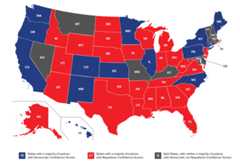
We used the Confidence Scores of each justice to develop a Court Balance Score, which attempted to show the balance among justices with Democratic, Republican, and Indeterminate Confidence Scores on a court. Courts with higher positive Court Balance Scores included justices with higher Republican Confidence Scores, while courts with lower negative Court Balance Scores included justices with higher Democratic Confidence Scores. Courts closest to zero either had justices with conflicting partisanship or justices with Indeterminate Confidence Scores.[6]
Minnesota had a Court Balance Score of-3.57, indicatingDemocratic control of the court. In total, the study found that there were 15 states with Democrat-controlled courts, 27 states with Republican-controlled courts, and eight states with Split courts. The map below shows the court balance score of each state.
See also


External links
Footnotes
- ↑Minnesota Judicial Branch, ""Minnesota Supreme Court,"" accessed December 18, 2014
- ↑2.02.12.22.3American Judicature Society, "Methods of Judicial Selection: Minnesota," archived October 2, 2014
- ↑The Office of the Revisor of Statutes, "Constitution of the State of Minnesota," accessed August 8, 2016
- ↑Office of the Revisor of Statutes, "2006 Minnesota Statutes," accessed July 30, 2014
- ↑An Indeterminate score indicates that there is either not enough information about the justice’s partisan affiliations or that our research found conflicting partisan affiliations.
- ↑The Court Balance Score is calculated by finding the average partisan Confidence Score of all justices on a state supreme court. For example, if a state has justices on the state supreme court with Confidence Scores of 4, -2, 2, 14, -2, 3, and 4, the Court Balance is the average of those scores: 3.3. Therefore, the Confidence Score on the court is Mild Republican. The use of positive and negative numbers in presenting both Confidence Scores and Court Balance Scores should not be understood to that either a Republican or Democratic score ispositive ornegative. The numerical values represent their distance from zero, not whether one score is better or worse than another.
Federal courts:
Eighth Circuit Court of Appeals • U.S. District Court:District of Minnesota • U.S. Bankruptcy Court:District of Minnesota
State courts:
Minnesota Supreme Court•Minnesota Court of Appeals•Minnesota District Courts•Minnesota Problem-Solving Courts•Minnesota Tax Court•Minnesota Workers' Compensation Court of Appeals
State resources:
Courts in Minnesota •Minnesota judicial elections •Judicial selection in Minnesota


